Spot to Perpetual Position Switching Guide 2026: 4 Market Signals, Funding Drag, and Smooth Rebalancing Execution
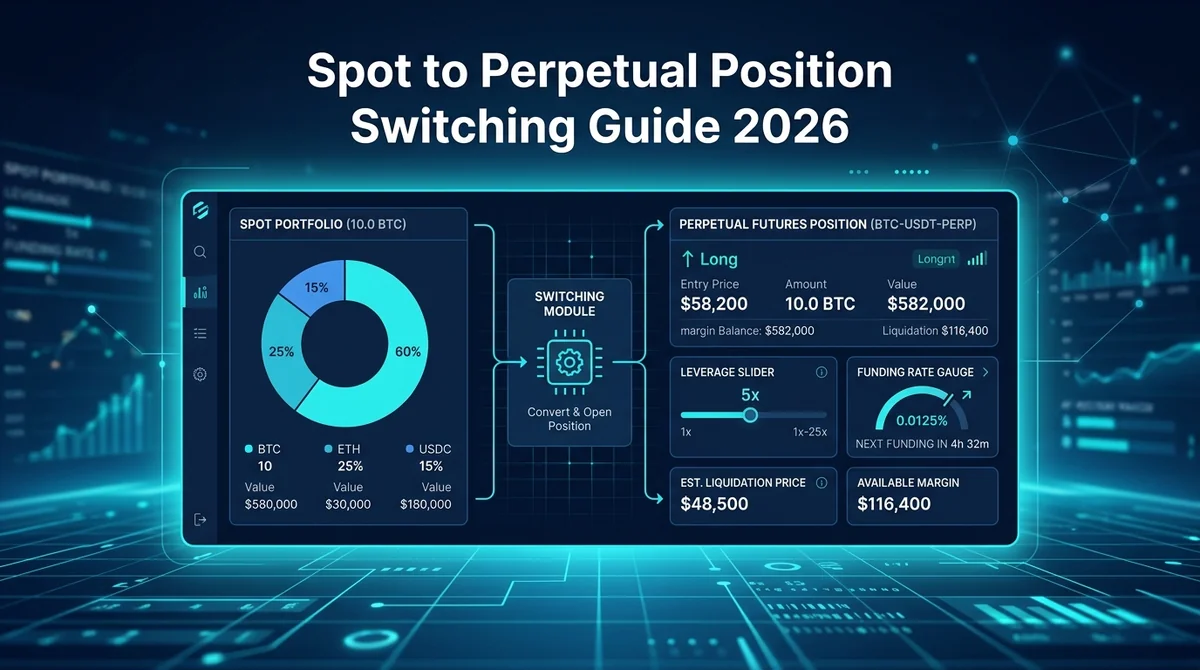
Learn how to switch from spot to perpetual futures, evaluate funding rate drag, execute laddered rebalancing, and control liquidation risks effectively.
The core criteria for transitioning from spot to perpetual futures lie in capital turnover requirements and downside hedging objectives. The next step is evaluating funding rate direction, basis premiums, and execution slippage to determine whether to transition in batches or maintain a spot allocation.
#Target Audience and Scope Definition
- Target Audience: Traders needing to free up dormant capital for multi-asset allocation, hedgers anticipating a clear short-term directional or downward trend, and professional users with disciplined margin monitoring and stop-loss execution capabilities.
- Non-Target Audience: Long-term holders with horizons exceeding 3 to 6 months who cannot monitor the market continuously, beginners unfamiliar with liquidation mechanisms, and risk-averse spot holders seeking zero liquidation risk.
#When Is It Appropriate to Switch from Spot to Perpetual Futures?
#Freeing Up Idle Capital vs. Pursuing Higher Capital Efficiency
Spot trading requires 100% capital allocation, locking up liquidity during strong uptrends or prolonged consolidation phases. When investors identify higher-conviction opportunities in other assets, converting part of their spot holdings into low-leverage (e.g., 1x to 2x) perpetual contracts preserves nominal market exposure while releasing idle capital. However, low-leverage perpetual long positions still require maintenance margin and are subject to ongoing funding fee drag—they are not entirely risk-free. For a systematic comparison between spot and derivatives, refer to Spot vs Perpetual: 2026 Strategy & Platform Decision Guide.
#How to Hedge Spot Risk with Perpetuals During Clear Downtrends
When technical or macroeconomic indicators signal clear market weakness, but investors prefer not to liquidate spot holdings due to tax or cost considerations, opening an equivalent perpetual short position locks in fiat value. If an extended downtrend is expected, selling spot holdings to open a light perpetual long with downside hedging avoids sustained unrealized spot losses, though the rebalancing process incurs bilateral trading friction.
#What Funding Rates and Trading Friction Are Incurred When Switching?
#How Significant Is the Ongoing Cost of Funding Rates Across Market Sentiments?
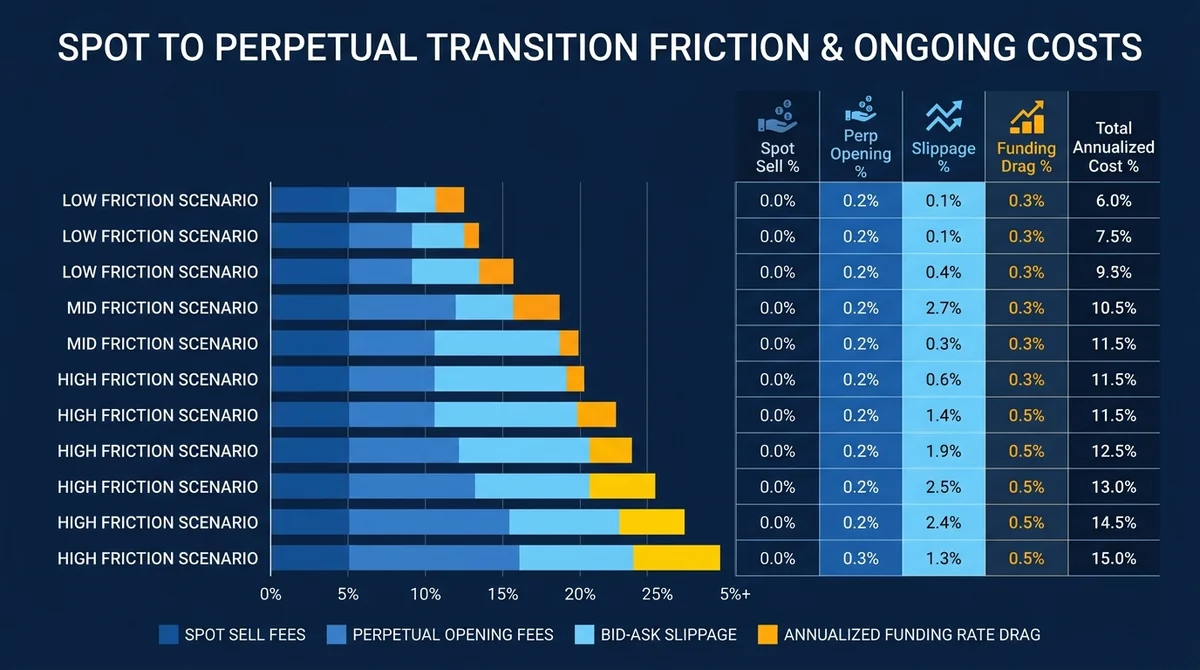
Perpetual contracts anchor to spot prices via the perpetual futures funding rate settlement schedule. In bullish markets, longs typically pay shorts (major exchanges set a baseline rate of around 0.01% per 8 hours, which can surge during extreme conditions). If annualized funding rates remain elevated, holding long perpetual positions results in noticeable net asset decay. As highlighted in BTC Spot vs BTC Perpetual 2026: Funding Rates, Liquidation, and Trading Cost Breakdown and Ethereum Spot vs Perpetual: Funding Rates, Liquidation, and Cost Comparison 2026, funding rate drag is a primary factor determining optimal holding duration.
#How to Calculate Spreads, Fees, and Slippage Friction During Rebalancing
Transitioning from spot to perpetuals involves a two-sided trade: "selling spot + buying perpetual contracts." Friction primarily consists of:
- Trading Fees: Combined spot sell Taker/Maker fees and perpetual contract opening fees.
- Bid-Ask Spread: Price gap friction caused by insufficient order book depth.
- Execution Slippage: Deviations in average fill price caused by large market orders.
#How to Design a Smooth Spot-to-Perpetual Transition Strategy
#Direct Market Order Execution vs. Batch Grid Rebalancing
- Direct Market Order Execution: Best suited for rapid execution during black swan events or breakout moments, but incurs the highest friction and immediate liquidity slippage.
- Laddered Limit Order Rebalancing: Splitting the total position into smaller batches and using Maker limit orders across key support/resistance zones to sell spot and open perpetuals simultaneously mitigates slippage and lowers fee expenditures.
#Sequencing Orders During Basis Contango and Backwardation
- Perpetual Premium (Contango): Perpetual prices exceed spot prices. Entering perpetual longs is costlier here; it is better to wait until funding settlement passes or the premium contracts before scaling in.
- Perpetual Discount (Backwardation): Perpetual prices trade below spot. Selling spot and purchasing discounted perpetual contracts provides a more favorable average entry price.
#Spot vs. Perpetual Position Decision: If-Then Scenario Matrix
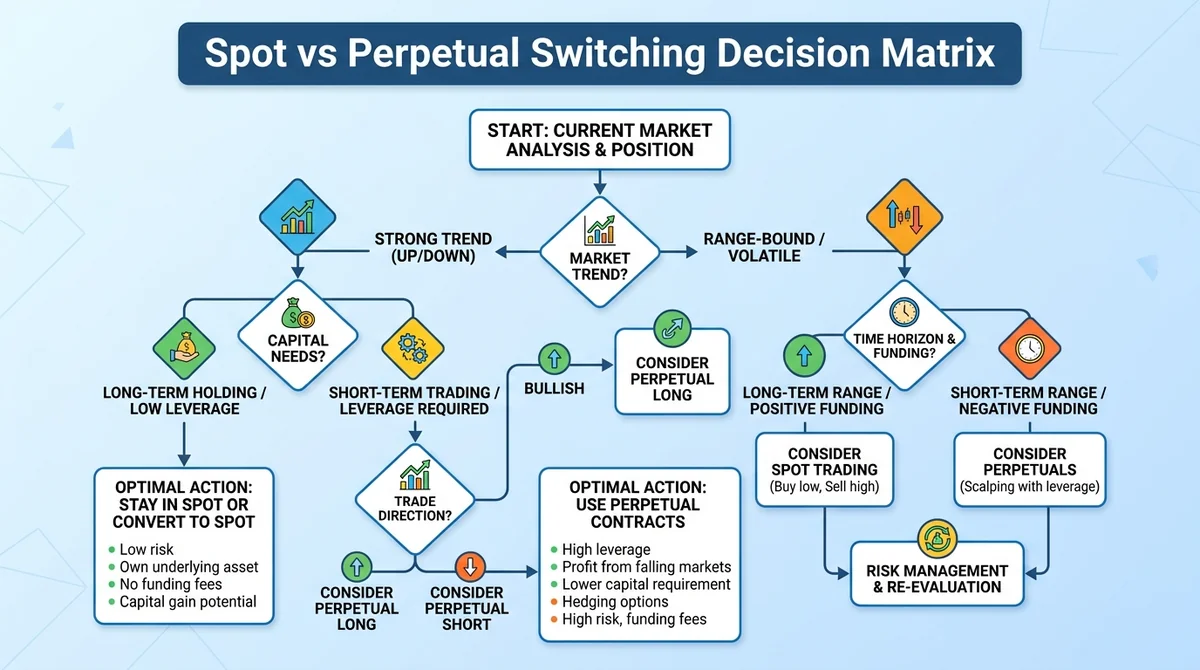
- Path 1: IF your holding horizon exceeds 3 months and focuses on long-term value capture, THEN maintain physical spot holdings to avoid capital decay from cumulative funding fees.
- Path 2: IF you seek to maximize capital efficiency and allocate into diverse assets, THEN convert spot into 1x–3x perpetual longs to free liquidity while setting strict maintenance margin alerts.
- Path 3: IF the market enters a sustained downtrend risking heavy unrealized drawdowns on spot, THEN open a 1:1 perpetual short to hedge downside exposure while retaining spot holdings.
- Path 4: IF intraday volatility is high and risk tolerance is limited, THEN avoid chasing rallies to switch into perpetuals; prioritize maintaining base spot positions to prevent forced liquidations.
#Action Checklist: 5 Steps Before Switching from Spot to Perpetual Contracts
- Calculate All-In Funding Costs: Check current annualized funding rates and project cumulative carrying costs over the planned holding period.
- Evaluate Exchange Depth: Compare liquidity and order book depth across major venues to assess slippage risks on large orders.
- Establish a Liquidation Margin of Safety: Calculate the estimated liquidation price based on leverage and ensure a sufficient buffer (recommended 30%+) relative to current prices.
- Create a Batch Execution Plan: Break down order sizes and prioritize limit Maker orders to systematically close spot and open futures contracts.
- Configure Stop-Loss and Alert Rules: Set conditional stop-losses and alerts based on TRUMPUSDT perpetual futures margin requirements explained thresholds on your trading interface to protect against unexpected volatility and account deficit risks.
#Crucial Risks When Transitioning Positions
- Forced Liquidation Risk: Perpetual contracts operate on margin. Even with low leverage, extreme adverse moves can trigger forced liquidation and permanent capital loss—a risk nonexistent in spot holdings. For a detailed comparison of liquidation models, review the MSX vs Binance vs Gate.io Perpetual Futures Comparison 2026: Funding Rates, Liquidation, and Leverage Costs.
- Depegging and Liquidity Wicks: During black swan events, derivative mark prices may briefly deviate sharply from the spot index (basis blowout), triggering liquidations even if spot stop-loss levels were never breached.
This content is compiled from public market mechanisms and does not constitute investment or trading advice. Data updated as of 2026-09-09. Market conditions and exchange rules may vary over time. Please refer to official platform documentation for exact parameters.
FAQ
How often are funding rates settled after switching to perpetual contracts?
Most major crypto derivatives exchanges settle funding rates every 8 hours (at 00:00, 08:00, and 16:00 UTC daily), though some platforms dynamically adjust settlement intervals during high-volatility events.
Is holding a 1x long perpetual contract identical to holding spot?
No. Although a 1x long shares the same nominal price exposure as spot, it incurs continuous funding fee drag and carries liquidation risk if maintenance margin falls short or severe account deficit events occur, whereas spot assets cannot be liquidated.
When is the optimal time window to switch from spot to perpetuals?
It is best to rebalance in batches during periods of low volatility and deep order book liquidity with narrow spreads, avoiding high-volatility basis fluctuations directly around funding settlement intervals.
How can one avoid directional exposure risk during the transition?
Use synchronized bilateral limit orders to buy an equivalent perpetual long immediately as each batch of spot is sold, or utilize native exchange rebalancing execution tools to minimize timing latency.
Related Terms
Picked your route? Ready to start?
Spot, perpetuals, tokenized US stocks and ETFs — all on one platform, MSX.
Quick Start Trading →New here? Registration takes three quick steps.