Spot vs Perpetual Futures: 2026 Trader Strategy and Platform Selection Guide
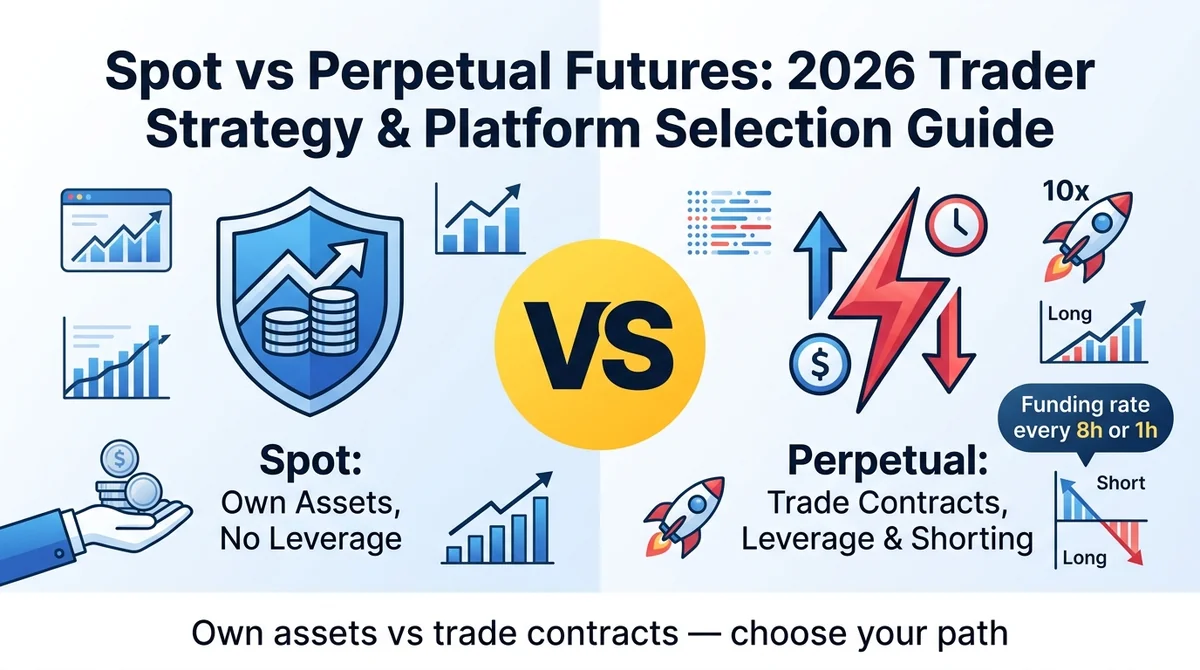
Spot holding vs leveraged perpetual futures differ in mechanics, costs, and risk. Covers fees, funding rates, and platform choice. Data as of 2026-09-03.
Answer: For most long-term investors with lower risk tolerance, spot trading is the safer choice. Perpetual futures are only valuable for active traders who need both long and short exposure, leverage, or hedging — but they must accept liquidation and funding rate costs.
Who it's for: Spot trading suits long-term holders, risk-averse investors, people who don't want to continuously pay funding rates, and users who need to actually use their assets (e.g., payments, staking). Perpetual futures suit short-term traders, hedgers, and traders who can tolerate liquidation risk. Not suitable for: users who dislike leverage or don't understand liquidation mechanics should avoid perpetual futures; for users seeking price exposure without taking on asset custody risk, spot is likely more straightforward.
#What Are the Core Differences Between Spot and Perpetual Futures?
Asset ownership and trading mechanics: Spot trading involves real buying and selling — once purchased, assets enter the user's account and the holder owns the asset. Perpetual futures are derivatives that do not involve actual delivery of the asset; the user holds a contract position tied to price movements, traded with margin and leverage, with no expiry date. Perpetual futures use the perpetual futures funding rate settlement schedule to anchor prices to the spot market, with funding payments settled between long and short positions. The funding rate settlement interval is typically every 8 hours or every 1 hour, depending on the platform.
Funding rates and fee structure: Spot trading charges only buy and sell trading fees, calculated as a percentage of trade volume; check each platform's published rates. Perpetual futures charge trading fees plus a funding rate during the holding period. The funding rate can be positive or negative: when positive, longs pay shorts; when negative, shorts pay longs. Over long holding periods, funding rates can become a significant cost. Check each platform's published rates for specific numbers, and refer to our internal comparisons.
#When Should You Choose Spot Trading?
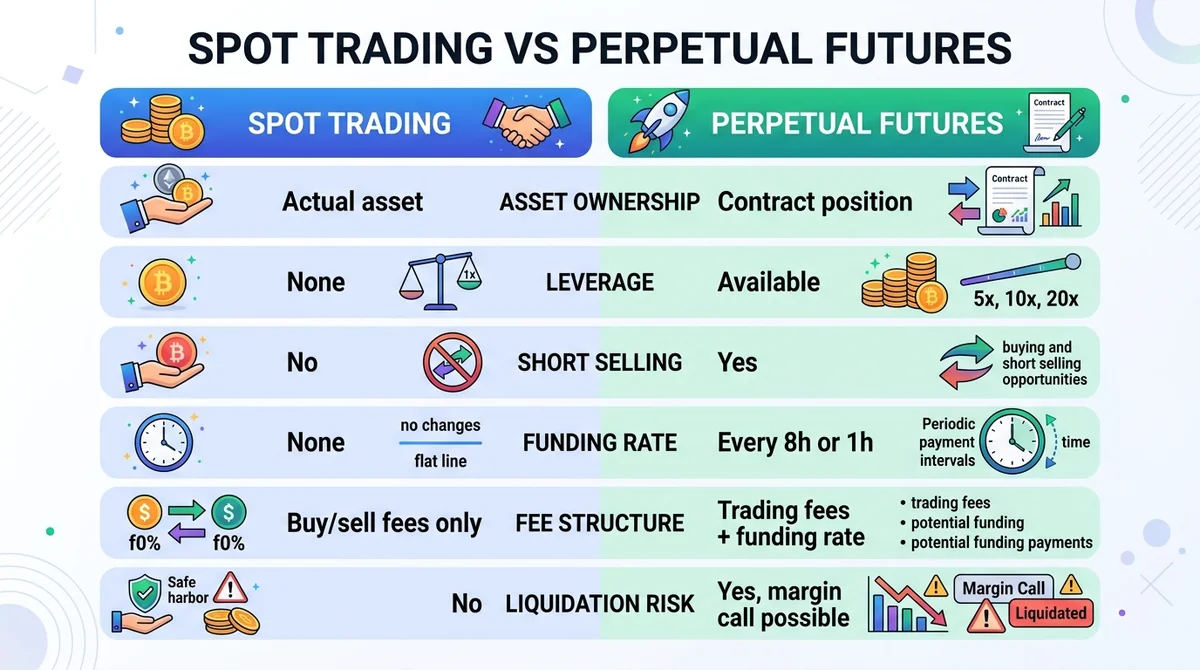
If you need to hold assets long term: If you plan to hold for months or years, spot trading better fits your goal because there is no leverage liquidation risk and no funding rate costs. Assets are truly credited to your account and can be used for transfers, staking, payments, and similar use cases.
Risk-averse traders: Spot trading has no leverage and no forced liquidation mechanism. If the platform operates normally, your maximum loss is usually limited to your invested principal; however, asset prices can still fall sharply or even go to zero. With no leverage and no funding rates, risk is relatively manageable. For users who don't want to watch the market constantly or set stop losses, spot is friendlier.
#When Should You Choose Perpetual Futures?
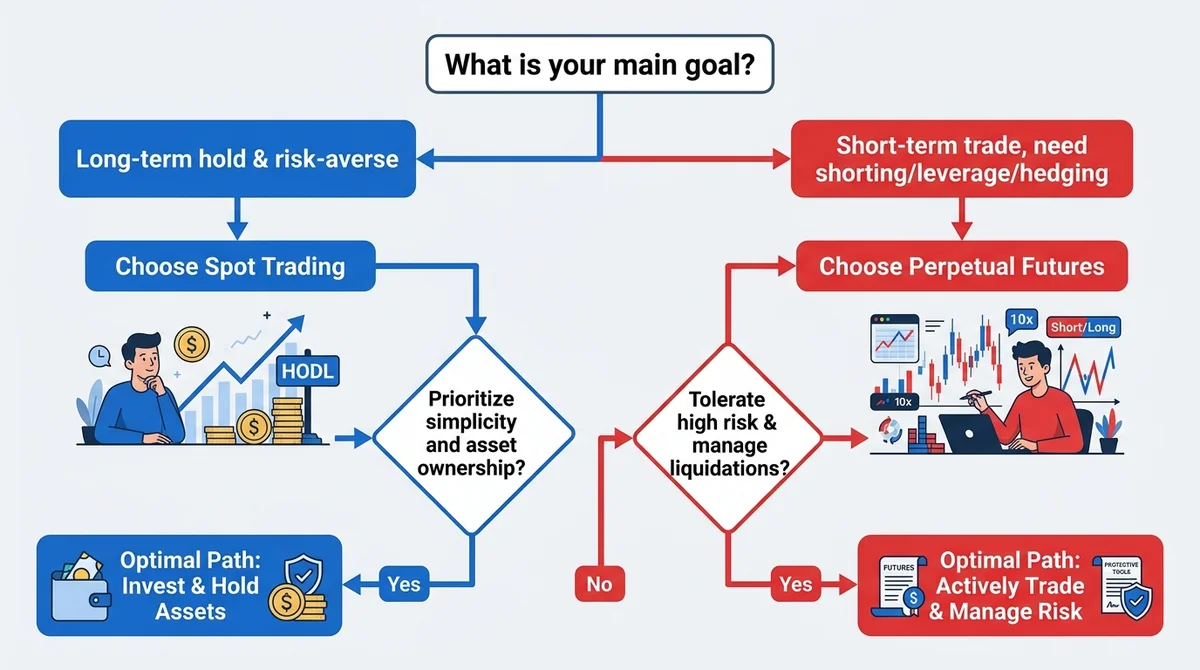
Long and short trading: Perpetual futures support short selling, so you can profit in down markets and hedge spot holdings. Spot trading only allows buying first and selling later; you cannot short directly.
Leverage and hedging needs: Perpetual futures offer leverage, which can amplify gains but also losses. Hedgers can open opposite positions in perpetual futures to lock in the value of spot assets, but they must account for funding rates and the liquidation price. Only traders who can tolerate liquidation risk should use leverage.
#How to Choose Based on Trading Fees and Funding Rates
Fee structure differences: Spot only charges buy and sell trading fees. Perpetual futures charge trading fees plus funding rates. For short-term trades, the funding rate impact is usually small; for long-term positions, cumulative funding rate costs can exceed spot trading fees. Use the platform's fee calculator to run actual numbers.
Impact of funding rates on holding costs: Funding rates can be volatile and may rise sharply during extreme market conditions. Traders should track actual rates and compare them with spot holding costs. If you hold perpetual futures long term, funding rates can erode most of your profits, so evaluate carefully.
#What Factors Should You Consider When Choosing a Trading Platform?
Platform security and liquidity: You can do an initial screen using third-party trust scores and 24-hour trading volume, but note that data definitions and security differ across platforms. Centralized and decentralized platforms have fundamental differences in compliance, liquidity, and custody models, so evaluate based on your own needs. Prioritize platforms with strong security track records and sufficient trading volume.
Product coverage and fee transparency: Confirm that the platform offers both spot and perpetual futures, and that trading fees, funding rates, and liquidation rules are publicly transparent. Some platforms may offer only certain products or charge extra fees on specific assets. Rely on official announcements and verify any unclear points with customer support.
#Scenario Guide: If You Are… Then…
- If you are a long-term holder: Holding period over several months and you want assets truly credited to your account — choose spot.
- If you are a short-term trader: You need frequent entries and exits, both long and short, and can accept leverage and liquidation risk — choose perpetual futures.
- If you need to hedge spot risk: Open an opposite position in perpetual futures, but calculate funding rates and the liquidation price to avoid excessive hedging costs.
- If you have a small capital base but want to amplify returns: You can try perpetual futures with a small position, but always set a stop loss and understand liquidation risk. Heavy positions are not recommended.
- If you need to actually use assets: For payments, staking, or on-chain activities, only spot assets work; perpetual futures positions cannot be used for these purposes.
#Action Checklist: Verify These Steps Before Allocating
- Clarify your trading goal: hold the asset or trade price movements?
- Compare the total cost of spot and perpetual futures, including trading fees, funding rates, and slippage.
- Check the platform's trust score, 24-hour trading volume, and security incident history.
- Confirm whether you can tolerate liquidation risk, and set stop losses.
- Start with a small test, and track actual holding costs and funding rate changes.
- Long-term holders should avoid substituting perpetual futures for spot to prevent funding rate erosion and liquidation risk.
#Common Misconceptions and Risk Warnings
Treating perpetual futures as spot for long-term holding: Perpetual futures do not give asset ownership and continuously incur funding rates. Long-term holding costs can be significantly higher than spot, and you also face liquidation risk. Ignoring funding rates: In extreme market conditions, funding rates can spike and eat into profits or even cause losses. Leverage is a double-edged sword: Leverage amplifies gains and losses, and when liquidated, losses can exceed your initial margin. Assuming spot is risk-free: Spot prices still carry volatility risk, but there is no leverage and no forced liquidation risk.
#FAQ
Q: Which has lower trading fees: spot or perpetual futures? A: It varies by platform. Perpetual futures charge trading fees plus funding rates, so long-term holding costs can be higher. Refer to our internal comparisons.
Q: Do perpetual futures expire? A: Perpetual futures have no expiry date. They use the perpetual futures funding rate settlement schedule to anchor prices to the spot market, and positions can be held indefinitely.
Q: Do I need to pay funding rates to hold spot? A: No. Spot only has buy and sell trading fees, with no ongoing holding costs.
Q: What does perpetual futures liquidation mean? A: When a leveraged position's losses reach the maintenance margin level, the platform will force-close the position, and losses can exceed the initial margin.
Q: Should I choose spot or perpetual futures for long-term crypto holding? A: Spot is more suitable because it has no leverage, no funding rates, clear asset ownership, and can be used for real-world purposes.
This content is compiled from public data and does not constitute investment or account-opening advice. Data is current as of 2026-09-03 and may change. Check official sources for the latest information.
FAQ
Which has lower trading fees: spot or perpetual futures?
It varies by platform. Perpetual futures charge trading fees plus funding rates, so long-term holding costs can be higher. Refer to our internal comparisons.
Do perpetual futures expire?
Perpetual futures have no expiry date. They use the perpetual futures funding rate settlement schedule to anchor prices to the spot market, and positions can be held indefinitely.
Do I need to pay funding rates to hold spot?
No. Spot only has buy and sell trading fees, with no ongoing holding costs.
What does perpetual futures liquidation mean?
When a leveraged position's losses reach the maintenance margin level, the platform will force-close the position, and losses can exceed the initial margin.
Should I choose spot or perpetual futures for long-term crypto holding?
Spot is more suitable because it has no leverage, no funding rates, clear asset ownership, and can be used for real-world purposes.
Related Terms
Picked your route? Ready to start?
Spot, perpetuals, tokenized US stocks and ETFs — all on one platform, MSX.
Quick Start Trading →New here? Registration takes three quick steps.