AMD vs Nvidia Comparison Cluster Extension: Three Ways to Hold AI Chip Exposure in 2026 — Holding Cost Comparison of Direct Shares, Tokenized Stocks, and Tokenized Stock Perpetuals
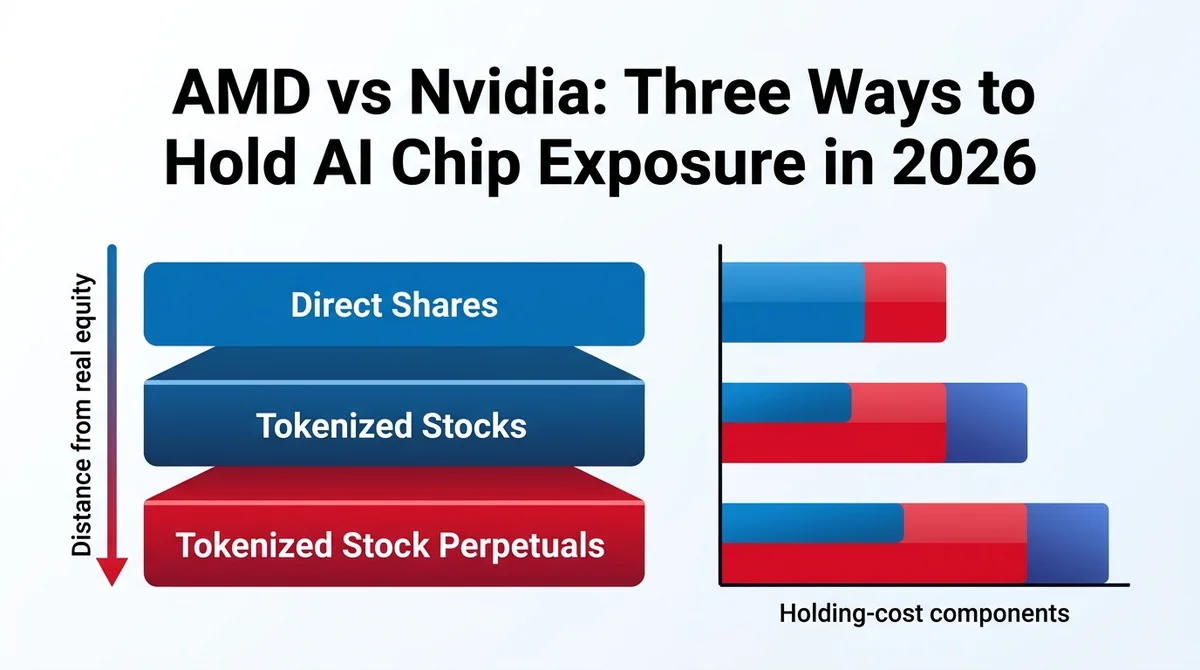
Direct shares, tokenized stocks, or tokenized stock perpetuals? Compare three AI chip exposure forms across holding object, price source, liquidation risk, cost structure, and horizon.
Conclusion: If the goal is long-term ownership of real equity in AI chip companies such as AMD or Nvidia, direct shareholding is the only form among the three that combines shareholder status with no leverage. If you only want price exposure and accept tokenized mechanics, tokenized stocks sit in the middle. Tokenized stock perpetuals are derivatives that stack leverage and ongoing costs, and suit only short-term traders who can bear liquidation risk. The holding cost structures of the three differ completely — comparing nominal fee rates alone is not enough.
Data cutoff: 2026. Note: Specific fee rates, funding rates, and tracking error figures in this article are unverified unless a source is cited; readers should refer to each platform's official documentation.
For long-term ownership of real equity, choose direct shareholding. Direct shareholding means holding the actual stock itself, with prices from real exchange matching, no leverage and no liquidation. During the holding period it corresponds to shareholder-status rights and corporate actions, making it suitable for medium- to long-term holding aligned with the company's fundamental cycle.
If you only want price exposure, choose tokenized stocks. Tokenized stocks track real US stock prices in token form and offer unleveraged price exposure, but they are not equivalent to holding real US stocks. The core of their holding cost is not the nominal fee rate but whether the token price can stably track the real share price.
Only consider tokenized stock perpetuals for short-term directional trading. A perpetual is a derivative contract with no expiry date, carries perpetual futures leverage, and adverse price moves may trigger forced liquidation, while funding-rate-type mechanisms generate ongoing costs that accumulate the longer you hold.
#What exactly is the difference between direct shares, tokenized stocks, and tokenized stock perpetuals?
Core difference: Direct shareholding holds the real stock itself; tokenized stocks hold price exposure to the real share price; tokenized stock perpetuals hold a leveraged derivative contract. The distance from real equity grows in that order.
#What does each of the three forms actually hold?
- Direct shareholding: Real buying and selling, holding the asset itself. Prices come from real exchange matching, and during the holding period it corresponds to shareholder-status rights and corporate actions.
- Tokenized stocks: Track real US stock prices in token form, providing price exposure but not equivalent to a real US stock position.
- Tokenized stock perpetuals: Derivative contracts with no expiry date, carrying perpetual futures leverage; adverse price moves may trigger forced liquidation.
#What is the relationship between tokenized stocks and real US stocks?
Tokenized stocks and real US stocks are in a tracking relationship, not the same asset. The US stock price is the cause; the token price is the effect. To judge whether a tokenized stock is good, the key is the tracking quality of the token price against the real share price, not the token's own narrative. Note also that redemption, conversion, and market-making mechanisms for tokenized stocks vary widely across platforms, which directly changes tracking quality.
#Why are tokenized stock perpetuals further from real stocks?
Because a perpetual is a derivative: it does not hold the stock, it only bets on price direction, stacking leverage and funding-rate-type ongoing costs. Leverage amplifies losses, and adverse price moves may trigger forced liquidation; ongoing costs erode the position over time.
#What are the holding costs of each of the three forms made up of?
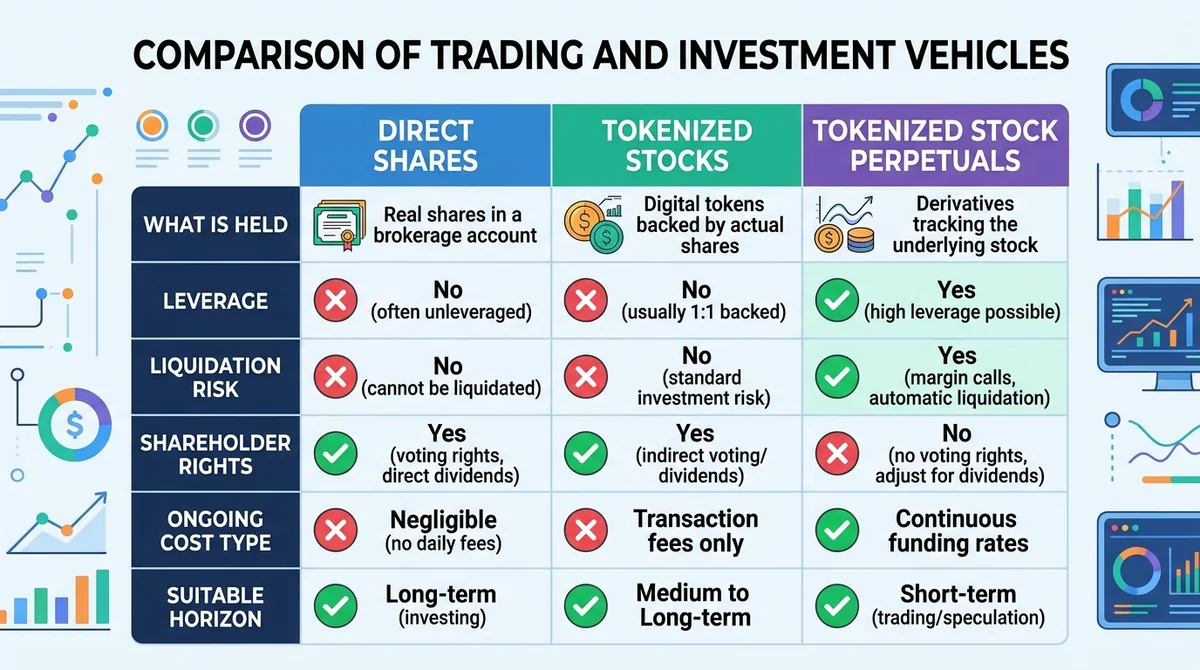
Core difference: The cost of direct shareholding revolves around trading and holding the real stock; the core cost of tokenized stocks is whether the tracking relationship is stable; tokenized stock perpetuals additionally bear leverage and funding-rate-type ongoing costs.
#What is the cost structure of direct shareholding?
It mainly consists of costs at the trading stage and related costs at the holding stage, tied to the real stock's broker rules and settlement arrangements. Specific fee rates vary by broker and region; this site does not give specific figures where verified data is lacking.
#What should you look at for the holding cost of tokenized stocks?
The core is not the nominal fee rate but whether the token price can stably track the real share price. Tracking deviation, premiums and discounts, and liquidity and redemption mechanisms all materially affect holding outcomes. For related mechanism differences, see the site's breakdown of ownership, tax, and platform risk.
#Why do tokenized stock perpetuals generate ongoing costs?
Perpetuals have no expiry date and use funding-rate-type mechanisms to keep the contract price anchored to the underlying, so the longer the position is held, the more ongoing costs accumulate. With leverage added, costs erode net value faster than in unleveraged forms. Specific funding rate figures: data not disclosed.
#See the key differences between the three forms in one comparison table
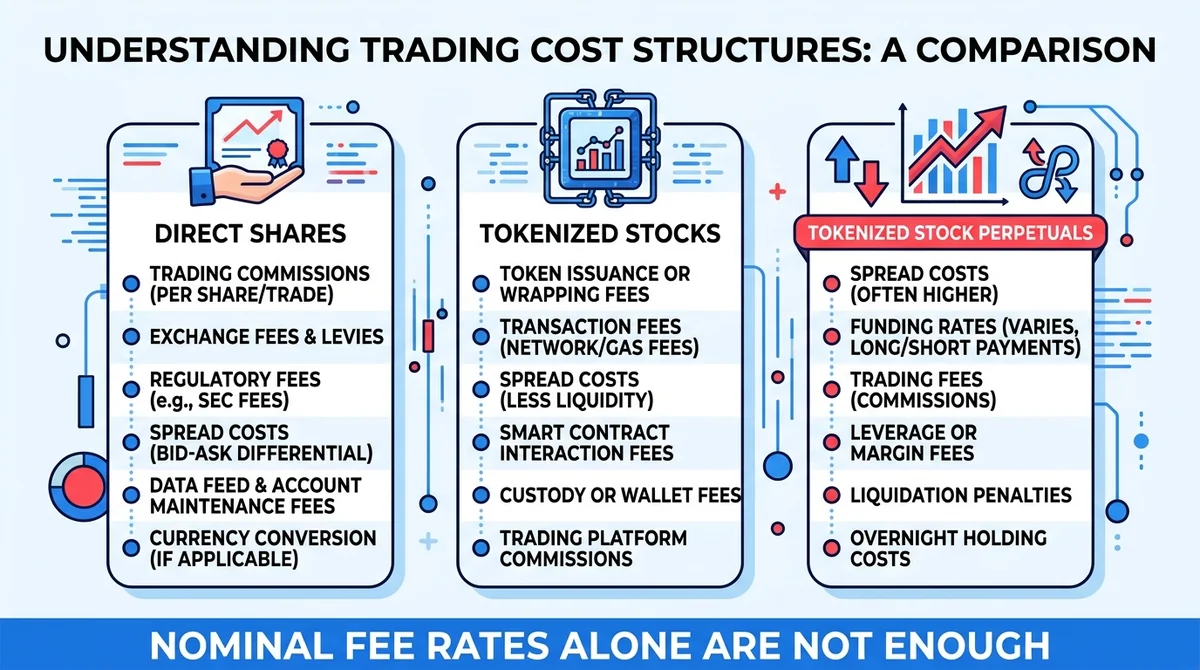
Core difference: Across dimensions such as holding object, price source, leverage and liquidation risk, cost structure, and holding horizon, direct shareholding is closest to real equity, tokenized stocks sit in the middle, and tokenized stock perpetuals have the most complex risk and cost structure.
| Dimension | Direct shares | Tokenized stocks | Tokenized stock perpetuals |
|---|---|---|---|
| Holding object | The real stock itself | Price exposure to the real share price | Leveraged derivative contract |
| Price source | Real exchange matching | Token market tracking of the real share price | Derivative market pricing |
| Leverage | None | None | Yes |
| Liquidation risk | None | No liquidation, but tracking deviation risk | Adverse price moves may trigger forced liquidation |
| Cost structure | Trading and holding costs, varying by broker rules | Core is tracking quality plus redemption and liquidity mechanisms | Funding-rate-type ongoing costs, accumulating with holding time |
| Suitable holding horizon | Medium- to long-term, aligned with fundamentals | Short- to medium-term price exposure allocation | Short-cycle directional trading |
#How do the holding object and price source differ?
Direct shareholding holds the stock itself, priced by real market matching; tokenized stocks hold price exposure, priced by the token market's tracking of the real share price; perpetuals hold a contract, priced by derivative market pricing.
#What about leverage and liquidation risk?
Direct shareholding has no leverage and no liquidation; tokenized stocks have no leverage but carry deviation risk from the tracking relationship; tokenized stock perpetuals carry perpetual futures leverage and may be liquidated.
#Is the suitable holding horizon the same?
No. Direct shareholding suits medium- to long-term holding aligned with the company's fundamental cycle; tokenized stocks suit short- to medium-term allocation for those wanting price exposure; tokenized stock perpetuals, due to ongoing costs and forced liquidation mechanics, suit shorter-cycle trading.
#Which holding form for AI chip exposure suits you?
Core difference: Route by holding purpose and risk tolerance, with no single recommendation.
- If you are long-term bullish on AI chip fundamentals and want to hold real equity, choose direct shareholding.
- If you only want price exposure, do not want leverage or liquidation risk, and accept tokenized mechanics, choose tokenized stocks.
- If you need to do directional trading, can bear leverage and forced liquidation risk, and understand that ongoing costs erode the position, only then consider tokenized stock perpetuals.
- If you are comparing the path length of different entry points, see the site's screening method for choosing between tokenized US stocks and real US stock entry points.
- If you care about differences in corporate actions and dividend reinvestment, tokenized forms and direct shareholding handle them differently and need separate verification.
#What risks need special attention in tokenized forms?
Core difference: Tokenized stocks are only price exposure, not real US stocks; perpetual futures leverage may trigger forced liquidation; ongoing costs erode long-term holding returns.
#Why are tokenized stocks not equivalent to real US stocks?
Because holding a tokenized stock is not holding the stock itself, and shareholder-status rights and corporate actions are handled differently. Mistaking price exposure for equity is the most common cognitive bias with these products. In addition, tokenized products stack extra risks such as issuer credit and custody fee and redemption mechanisms, which do not exist in direct shareholding.
#How do leverage and liquidation risk amplify losses?
Leverage amplifies both gains and losses; when an adverse price move reaches the maintenance margin requirement, forced liquidation may be triggered, and losses are no longer determined by holding time but by the price path.
#How do ongoing costs affect long-term holding?
Funding-rate-type costs accumulate with holding time, growing the longer you hold. For holding plans measured in months or quarters, ongoing costs can significantly change the final result, so cost estimates should be done before opening a position.
Next step: Check the official documentation and fee schedules for each of the three forms, and write the tracking mechanism, leverage rules, and ongoing costs into your own holding cost worksheet.
This content is compiled from public information and does not constitute investment or open account advice. Specific fee rates and figures without cited sources are unverified and subject to change.
#FAQ
#Are tokenized stocks the same as directly buying US stocks?
No. Direct shareholding holds the real stock itself; tokenized stocks provide price exposure to the real share price, are not equivalent to a real US stock position, and handle shareholder-status rights and corporate actions differently.
#Can tokenized stock perpetuals be liquidated?
Yes. A perpetual is a leveraged derivative; when an adverse price move reaches the maintenance margin requirement, forced liquidation may be triggered — the most fundamental difference from unleveraged forms.
#Which of the three forms has the lowest holding cost?
No blanket answer. Direct shareholding's costs revolve around trading and holding the real stock; tokenized stocks' core cost is tracking quality; perpetuals additionally bear funding-rate-type ongoing costs that accumulate the longer you hold. Specific fee rates should follow each platform's official documentation; where verified data is lacking, this article marks it as data not disclosed.
#If I only want AI chip price exposure without leverage, which should I choose?
On the premise that you accept tokenized mechanics, tokenized stocks are an unleveraged form; but first confirm the token price's tracking relationship with the real share price and its liquidity.
#Which form should long-term holders avoid?
Due to ongoing costs and forced liquidation mechanics, tokenized stock perpetuals are not suitable as a long-term holding tool; medium- to long-term holding is better matched by direct shareholding or tokenized stocks.
FAQ
Are tokenized stocks the same as directly buying US stocks?
No. Direct shareholding holds the real stock itself; tokenized stocks provide price exposure to the real share price, are not equivalent to a real US stock position, and handle shareholder-status rights and corporate actions differently.
Can tokenized stock perpetuals be liquidated?
Yes. A perpetual is a leveraged derivative; when an adverse price move reaches the maintenance margin requirement, forced liquidation may be triggered — the most fundamental difference from unleveraged forms.
Which of the three forms has the lowest holding cost?
No blanket answer. Direct shareholding's costs revolve around trading and holding the real stock; tokenized stocks' core cost is tracking quality; perpetuals additionally bear funding-rate-type ongoing costs that accumulate the longer you hold. Specific fee rates should follow each platform's official documentation; where verified data is lacking, this site marks it as data not disclosed.
If I only want AI chip price exposure without leverage, which should I choose?
On the premise that you accept tokenized mechanics, tokenized stocks are an unleveraged form; but first confirm the token price's tracking relationship with the real share price and its liquidity.
Which form should long-term holders avoid?
Due to ongoing costs and forced liquidation mechanics, tokenized stock perpetuals are not suitable as a long-term holding tool; medium- to long-term holding is better matched by direct shareholding or tokenized stocks.
Related Terms
Done comparing? Ready to place your first trade?
The crypto assets, tokenized US stocks and ETFs you just compared are all tradable on MSX — spot or perpetuals.
Quick Start Trading →New here? Registration takes three quick steps.