AMD vs Nvidia Stock: 2026 Valuation, AI GPU Share & Risk
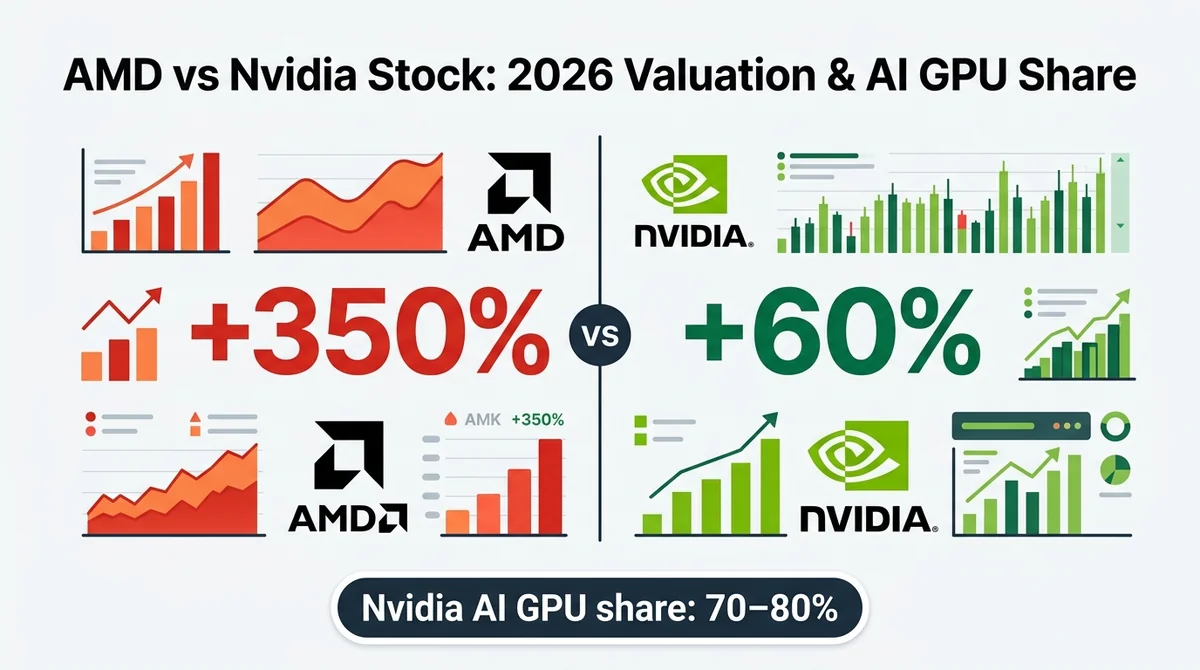
Compare AMD and Nvidia on forward P/E, AI GPU share, Q2 2026 earnings, and 2028 upside. See which semiconductor stock is cheaper and safer to buy now.
#AMD vs Nvidia Stock: 2026 Valuation, AI GPU Share & Risk Comparison
For investors deciding between AMD vs Nvidia stock in 2026, Nvidia looks like the safer buy: it trades at a lower forward P/E and holds a 70–80% share of the AI GPU market. AMD offers higher risk but higher potential upside if its data center AI execution improves. The data below explains why.
Key Takeaways
- AMD stock returned +350% over the past year versus Nvidia's +60%, but the outperformance is not fully backed by business gains.
- Nvidia's lower forward P/E and 70–80% AI GPU market share make it the safer investment.
- AMD's 39.4% server CPU share and Lisa Su's turnaround support a dark-horse 2028 case, but it remains a distant second in AI GPUs.
#AMD vs Nvidia Stock: Which Looks Cheaper on Forward P/E?
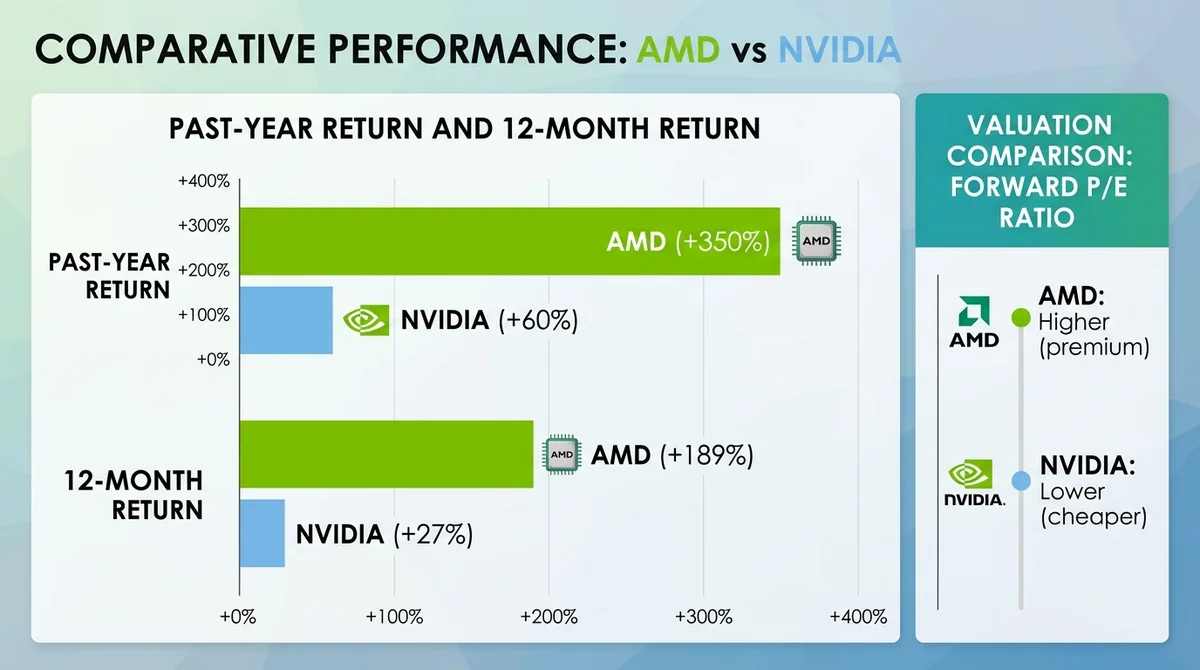
On a forward price-to-earnings basis, Nvidia clearly looks cheaper than AMD. According to Yahoo Finance, Nvidia is clearly the better buy on this metric, and Tickeron also notes NVDA trades at a comparatively lower valuation multiple relative to earnings growth. AMD's premium valuation is not supported by matching business growth, which raises concerns about sustainability. This gap is a key reason why Nvidia appears safer for value-focused investors. The table below summarizes the key differences using data from Yahoo Finance and Alpha Spread; note the return numbers differ because of measurement windows—we use Yahoo Finance's past-year data as our primary reference.
| Metric | AMD | Nvidia |
|---|---|---|
| Past-year return (Yahoo Finance) | +350% | +60% |
| 12-month return (Alpha Spread) | +189% | +27% |
| Forward P/E | Higher (premium) | Lower (cheaper) |
| AI GPU market share | Distant second | 70–80% |
| Latest quarter revenue | $11.5B, beat estimates | Consistent data center growth |
As the table shows, Nvidia's lower forward P/E and dominant market share stand out. AMD's higher valuation multiple relative to earnings growth, combined with its much smaller AI GPU footprint, makes it a less attractive value proposition for investors prioritizing downside protection.
#Who Leads the AI GPU Market and Why Does It Matter?
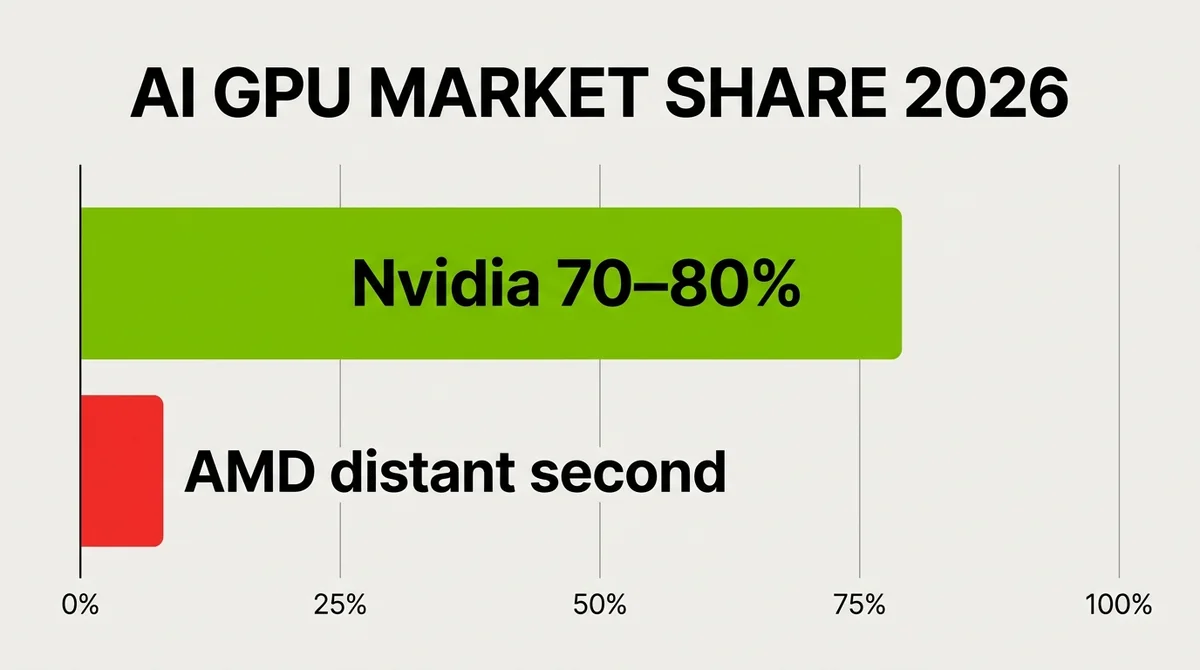
Nvidia dominates the AI GPU market with a 70–80% share, while AMD is gaining momentum but remains a distant second. Nvidia maintains a dominant 70–80% share of the AI graphics processing unit (GPU) market, according to Tickeron. AMD is expanding its data center GPU presence, but the gap in installed base and developer tooling remains wide. This leadership reinforces Nvidia's pricing power and high-margin software revenue, making it difficult for AMD to close the gap quickly. MSX Compare tracks these market share dynamics across semiconductor stocks as part of its proprietary scorecard, which weighs forward valuation, competitive moat, and execution risk when evaluating chip companies.
#What Do Recent Earnings Reveal About AMD and Nvidia?
AMD's latest reported quarter showed $11.5 billion in revenue, beating estimates, but its stock fell because major customers signaled a preference for Nvidia products. In the latest reported quarter (Q2 2026), AMD posted $11.5 billion in revenue, narrowly beating market expectations. However, shares declined after comments indicated that major customers were shifting preferences toward NVDA products. Meanwhile, Nvidia continues to demonstrate consistent revenue growth in data center segments, supported by its established ecosystem and high-margin software offerings. This earnings contrast highlights the market's focus on competitive positioning rather than just top-line beats. Market timing also matters; read our multi-asset market outlook before PCE and Nvidia earnings.
#Can AMD Overtake Nvidia by 2028?
AMD's history of overtaking larger rivals—most notably surpassing Intel in server CPUs with a 39.4% market share—supports a dark-horse scenario, but it depends heavily on AI GPU execution. CEO Lisa Su took over in 2014 when AMD was near bankruptcy and led a turnaround through the Zen architecture. That history supports the bullish case. However, AMD remains a distant second in AI GPUs, so the 2028 scenario requires significant execution in data center AI chips. Overall risk appetite in tech and crypto can signal sentiment shifts; see our Bitcoin's rise toward $80k and tokenized stock developments.
#Should You Buy AMD or Nvidia Stock Right Now?
For most investors, Nvidia is the safer buy right now because of its dominant AI GPU share, lower forward valuation, and consistent data center growth, while AMD is a higher-risk, higher-reward alternative. If you're struggling with the nvidia or amd stock decision, this AMD vs Nvidia stock comparison shows Nvidia is the lower-risk choice for 2026. Choose Nvidia if you want a lower forward valuation, market leadership, and steady data center revenue. Choose AMD if you can tolerate higher volatility and want exposure to a potential dark-horse AI comeback. For broader US stock selection, see our tokenized US stocks vs real US stocks: spread, slippage, and settlement.
FAQ
Which stock performed better over the past year, AMD or Nvidia?
AMD significantly outperformed Nvidia. Using Yahoo Finance's past-year data, AMD returned +350% versus Nvidia's +60%. Alpha Spread's 12-month comparison shows a milder +189% vs +27%, but both sources confirm AMD's outperformance. However, AMD's premium valuation raises sustainability concerns, so past performance alone may not predict future returns.
Is AMD or Nvidia cheaper on forward P/E?
Nvidia is cheaper on a forward price-to-earnings basis. Yahoo Finance and Tickeron both note Nvidia's lower valuation multiple relative to earnings growth. AMD trades at a premium that is not fully backed by equivalent business gains, making Nvidia the better value. This valuation gap is a key factor for long-term investors.
Who leads the AI GPU market, AMD or Nvidia?
Nvidia leads the AI GPU market with a dominant 70–80% share, while AMD remains a distant second. Nvidia's mature software ecosystem, CUDA developer tooling, and high-margin data center offerings reinforce this leadership. AMD is expanding its data center GPU presence, but the installed-base gap remains wide, giving Nvidia a durable competitive moat.
Can AMD overtake Nvidia by 2028?
It is possible, but it depends heavily on AMD's data center AI execution. AMD has a track record of catching larger rivals—it surpassed Intel in server CPUs with a 39.4% market share. CEO Lisa Su's turnaround from near-bankruptcy in 2014 gives credibility. However, AMD must significantly close the AI GPU gap, which is a high-risk stretch.
Should I buy AMD or Nvidia stock right now?
For most investors, Nvidia is the safer buy right now because of its lower forward P/E, dominant AI GPU share, and consistent data center revenue growth. AMD is a higher-risk, higher-reward alternative—it could deliver outsized returns if its AI strategy succeeds, but that requires tolerating higher volatility. Choose based on your risk tolerance and time horizon.
Related Terms
Done comparing? Ready to place your first trade?
The crypto assets, tokenized US stocks and ETFs you just compared are all tradable on MSX — spot or perpetuals.
Quick Start Trading →New here? Registration takes three quick steps.