Binance vs OKX Fees for Regular Users in 2026: One-Way and Round-Trip Spot and Perpetual Costs
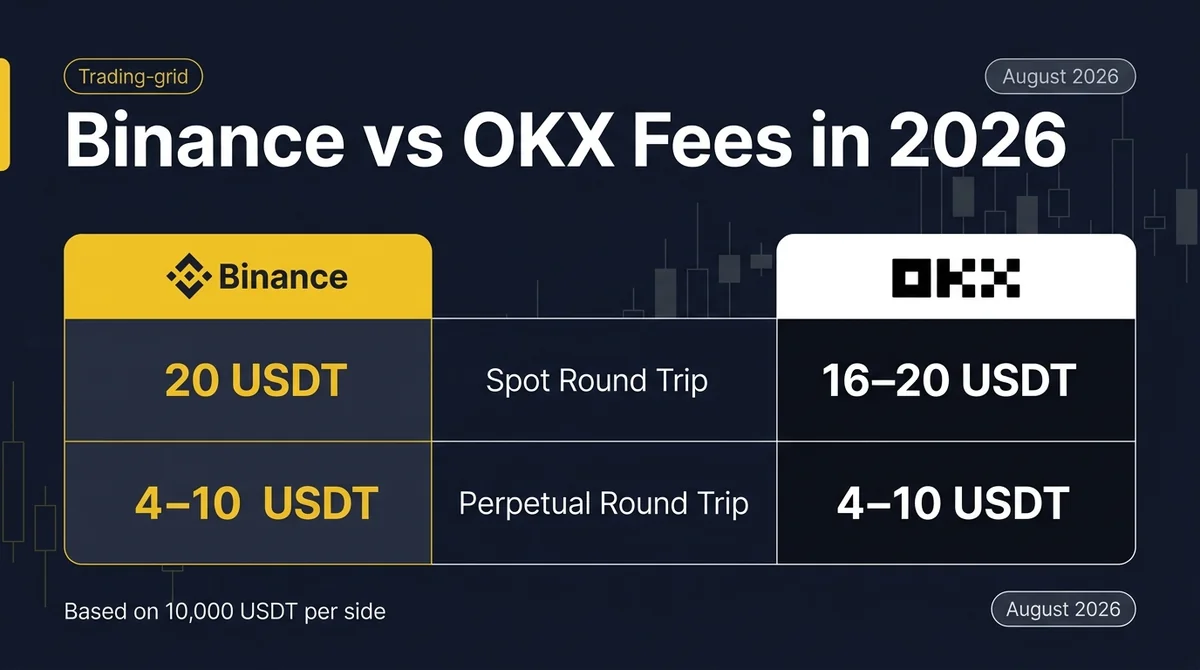
As of Aug 2026, Binance spot fees are 0.10%/0.10%, OKX 0.08%/0.10%; both charge 0.02%/0.05% on USDT perpetuals. See 10,000 USDT costs.
#Binance vs OKX Fees for Regular Users in 2026: One-Way and Round-Trip Spot and Perpetual Costs
Bottom line: Based on 10,000 USDT in trading volume per side, Binance's standard round-trip spot trading fee is 20 USDT, while OKX charges 16–20 USDT. Standard round-trip fees for USDT-margined perpetuals are 4–10 USDT on both exchanges, excluding funding rates, spreads, and slippage.
#Key Takeaways / TL;DR
- As of August 2026, Binance's regular-user spot Maker/Taker fees are both 0.1%, while OKX charges 0.08% for Maker and 0.10% for Taker trades.
- Binance and OKX have the same standard regular-user fees for USDT-margined perpetuals: 0.02% for Maker and 0.05% for Taker trades.
- For a spot purchase and sale of 10,000 USDT each, Binance's standard round-trip trading fee is 20 USDT, compared with 16–20 USDT on OKX.
- For opening and closing a perpetual position with a notional value of 10,000 USDT per side, the standard round-trip trading fee is 4–10 USDT on both exchanges, excluding funding rates.
- When BNB fee payment is enabled on Binance and the account has a sufficient balance, spot fees usually receive a 25% discount, while perpetual fees usually receive a 10% discount.
This Binance vs OKX fee comparison uses regular-user tiers and excludes VIP discounts. The calculations cover trading fees only. Spreads, slippage, and perpetual funding rates vary by market and contract and must be checked separately when calculating total costs.
Data verification note: The rates, discounts, and dates in this article are based on the dataset provided, but the input does not include URLs for official Binance or OKX fee pages or announcements. Before publication, verify the figures against each exchange's latest fee page. If platform rules differ from this article, the rates displayed by the platform in real time take precedence.
Disclaimer: This article is for informational and fee-calculation purposes only and does not constitute investment, trading, legal, or tax advice. Digital assets and leveraged contracts involve price volatility, liquidation, and the risk of losing principal. Fees, products, and regional availability may change. Users should review the latest platform rules before trading and accept responsibility for their own decisions.
#What Are the Differences Between Binance and OKX Fees for Regular Users in 2026?
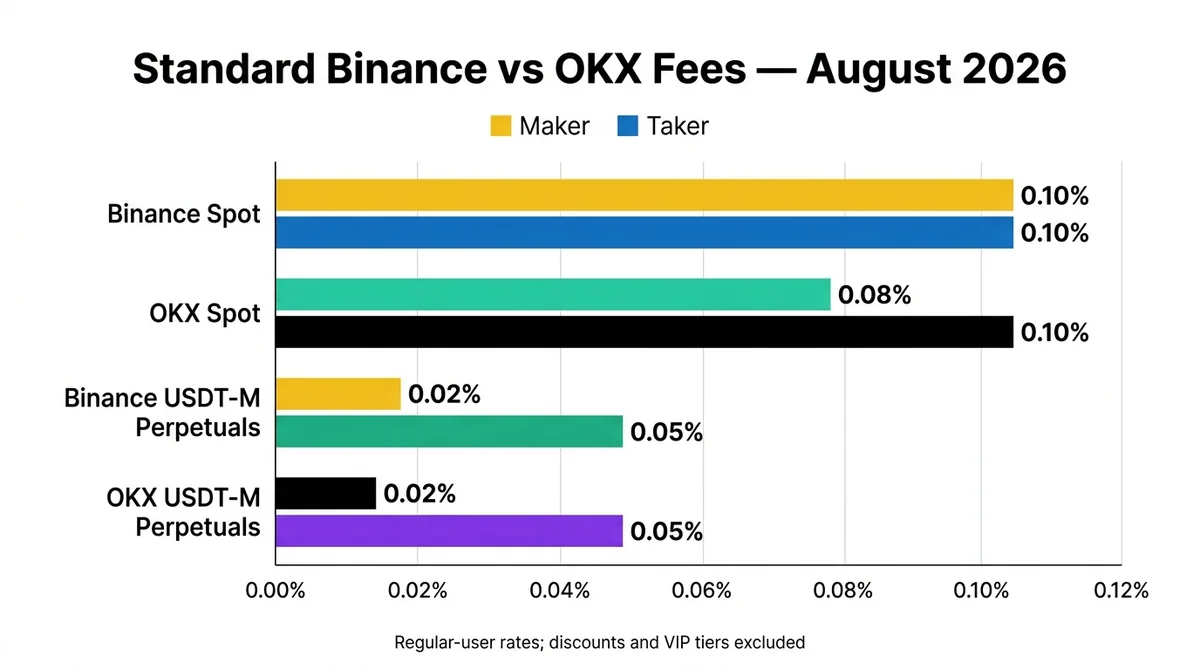
As of August 2026, OKX's spot Maker fee is 0.08%, compared with 0.1% on Binance. The two exchanges have the same spot Taker fees and standard USDT-margined perpetual fees.
Maker—the party whose order adds liquidity to the order book—and Taker—the party whose order immediately matches an existing order—fees are determined by the role of each actual fill, not simply by the order name shown on the order-entry page.
#Standard Binance and OKX Fees for Regular Users
| Platform and product (as of August 2026) | Regular-user Maker fee | Regular-user Taker fee | Fee basis |
|---|---|---|---|
| Binance spot trading | 0.10% | 0.10% | Excludes BNB discount and VIP rates |
| OKX spot trading | 0.08% | 0.10% | Standard regular-user rates |
| Binance USDT-margined perpetuals | 0.02% | 0.05% | Excludes BNB discount and VIP rates |
| OKX USDT-margined perpetuals | 0.02% | 0.05% | Standard regular-user rates |
As of August 2026, OKX's standard spot Maker fee is 0.08%, lower than Binance's 0.10%. Both exchanges charge 0.10% for spot Taker trades and 0.02%/0.05% for Maker/Taker trades on USDT-margined perpetuals.
In a Binance vs OKX fee comparison for regular users, the fee schedule answers only the question of fixed trading fees; it does not directly represent the final total cost. Check the following factors as well:
- Account tier: This article uses regular-user rates and does not apply VIP tiers.
- Execution role: Calculate fees using the Maker or Taker role shown in the final trade record.
- Discount requirements: Binance's BNB discount must be enabled separately, and the account must maintain a sufficient BNB balance.
- Cost coverage: Perpetual funding rates, spot spreads, and slippage are not included in the tables.
- Verification date: This article consistently uses input data current as of August 2026. Before trading, check the fee page for your account again.
This article uses a consistent comparison method: it first fixes the account at the regular-user tier and holds trading volume constant, then calculates Maker, Taker, and mixed execution paths separately. For perpetuals, it compares only the trading fees for opening and closing positions and does not incorporate dynamic funding rates into fixed fees. This avoids mixing VIP discounts, exchange-token discounts, and market-impact costs into a single result.
For a deeper explanation of Binance's spot fee structure, read Binance Spot Maker and Taker Fees 2026: Official Rate Structure Explained.
#How Much Are the One-Way and Round-Trip Spot Fees for 10,000 USDT on Binance and OKX?
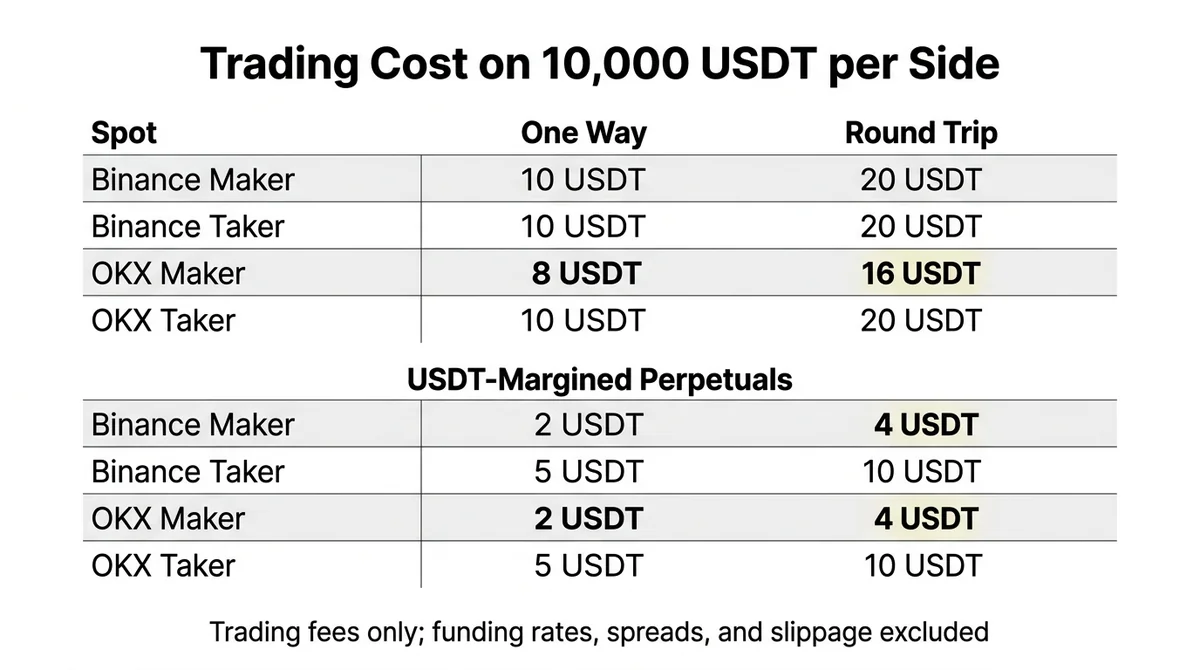
For a spot purchase and sale of 10,000 USDT each, the round-trip fee is 20 USDT on Binance and 16–20 USDT on OKX, depending on the execution role.
The formula for a one-way spot trading fee is:
One-way trading fee = Trade value × Applicable Maker or Taker fee
The round-trip trading fee is:
Round-trip trading fee = Purchase fee + Sale fee
#One-Way Spot Fee Calculations
Based on a trade value of 10,000 USDT per transaction:
| Platform and execution role (as of August 2026) | Calculation | One-way trading fee |
|---|---|---|
| Binance spot Maker | 10,000 × 0.10% | 10 USDT |
| Binance spot Taker | 10,000 × 0.10% | 10 USDT |
| OKX spot Maker | 10,000 × 0.08% | 8 USDT |
| OKX spot Taker | 10,000 × 0.10% | 10 USDT |
#Round-Trip Spot Fee Calculations
The following calculations assume separate purchase and sale transactions of 10,000 USDT, with the same trade value on both sides:
| Platform and spot round-trip path (as of August 2026) | Purchase fee | Sale fee | Round-trip total |
|---|---|---|---|
| Binance Maker → Maker | 10 USDT | 10 USDT | 20 USDT |
| Binance Maker → Taker | 10 USDT | 10 USDT | 20 USDT |
| Binance Taker → Taker | 10 USDT | 10 USDT | 20 USDT |
| OKX Maker → Maker | 8 USDT | 8 USDT | 16 USDT |
| OKX Maker → Taker | 8 USDT | 10 USDT | 18 USDT |
| OKX Taker → Taker | 10 USDT | 10 USDT | 20 USDT |
For a 10,000 USDT spot purchase and a 10,000 USDT spot sale, Binance charges a standard round-trip fee of 20 USDT for all three execution paths. On OKX, the fee is 16 USDT for two Maker fills, 18 USDT for one Maker and one Taker fill, and 20 USDT for two Taker fills.
#How Should Fees Be Added Up for Partial Fills?
A single order may be split into multiple fills, with some portions potentially charged at the Maker rate and others at the Taker rate. For an accurate calculation, do not simply multiply the total order amount by one rate. Calculate each fill separately and then add the results:
- Export or review every actual fill record.
- Record the value and Maker/Taker role of each fill.
- Calculate the fee for each fill using “trade value × applicable fee.”
- Add together all purchase and sale fees.
If the purchase value is 10,000 USDT but the sale value changes because of price movements, the sale fee must be calculated using the actual sale value rather than reusing 10,000 USDT. To compare product structures, see Perpetual Futures vs Spot Trading: Fees and Leverage Risks.
#How Much Are the One-Way and Round-Trip Perpetual Costs for 10,000 USDT on Binance and OKX?
With a notional value of 10,000 USDT per side, both exchanges charge 2 USDT for a one-way Maker trade and 5 USDT for a one-way Taker trade, producing a round-trip fee of 4–10 USDT.
Notional trade value—the total value of a contract position calculated at its price—is the basis for perpetual trading fees. Fees are not charged only on the margin committed. When leverage is used, the trading fee is still calculated from the actual notional value opened or closed, even if the margin is lower than the position value.
#One-Way Perpetual Fee Calculations
The formula is:
One-way perpetual trading fee = Notional trade value × Maker or Taker fee
| Platform and perpetual execution role (as of August 2026) | Calculation | One-way trading fee |
|---|---|---|
| Binance USDT-margined perpetual Maker | 10,000 × 0.02% | 2 USDT |
| Binance USDT-margined perpetual Taker | 10,000 × 0.05% | 5 USDT |
| OKX USDT-margined perpetual Maker | 10,000 × 0.02% | 2 USDT |
| OKX USDT-margined perpetual Taker | 10,000 × 0.05% | 5 USDT |
#Round-Trip Perpetual Opening and Closing Fee Calculations
The following calculations assume a notional trade value of 10,000 USDT for both opening and closing the position:
| Platform and perpetual round-trip path (as of August 2026) | Opening fee | Closing fee | Round-trip total |
|---|---|---|---|
| Binance or OKX Maker → Maker | 2 USDT | 2 USDT | 4 USDT |
| Binance or OKX Maker → Taker | 2 USDT | 5 USDT | 7 USDT |
| Binance or OKX Taker → Taker | 5 USDT | 5 USDT | 10 USDT |
As of August 2026, Binance and OKX have the same regular-user fees for USDT-margined perpetuals. With a notional value of 10,000 USDT per side, the one-way fee is 2 USDT for Maker trades and 5 USDT for Taker trades, while the standard round-trip trading fee is 4–10 USDT.
Opening and closing a position are separate transactions, so each side incurs a trading fee. If the position value changes by the time it is closed, use the opening notional value and closing notional value separately. Do not automatically multiply the opening fee by two.
Round-trip perpetual trading fees do not include funding rates. A funding rate—the periodic payment exchanged between long and short position holders to help anchor the contract price to the spot price—depends on whether the position remains open across a settlement time and on the direction of the applicable rate. For more cross-platform fee data, see Perpetual Futures Exchange Fee Comparison 2026.
#How Much Can Binance Spot and Perpetual Fees Be Reduced by Paying With BNB?
When BNB fee payment is enabled and the account has a sufficient balance, Binance usually offers a 25% discount on spot fees and a 10% discount on perpetual fees.
#Binance Spot Rates and Costs After the BNB Discount
Binance's standard regular-user Maker and Taker fees for spot trading are both 0.10%. Paying fees with BNB usually provides a 25% discount, reducing both rates to:
0.10% × 75% = 0.075%
Based on 10,000 USDT in trading volume per side:
| Binance spot BNB discount scenario (as of August 2026) | Discounted rate | Trading fee |
|---|---|---|
| One-way Maker or Taker trade of 10,000 USDT | 0.075% | 7.5 USDT |
| Purchase and sale of 10,000 USDT each | 0.075% per side | 15 USDT round trip |
Compared with the undiscounted round-trip fee of 20 USDT, this reduces the cost by 5 USDT on the same basis. This is the arithmetic result of applying the standard fee discount and does not include possible price fluctuations from holding BNB.
#Binance Perpetual Rates and Costs After the BNB Discount
The standard Binance fees for USDT-margined perpetuals are 0.02% for Maker trades and 0.05% for Taker trades. Paying with BNB usually provides a 10% discount, reducing the rates to:
- Maker: 0.018%
- Taker: 0.045%
| Binance perpetual BNB discount path (10,000 USDT per side, as of August 2026) | Opening fee | Closing fee | Round-trip total |
|---|---|---|---|
| Maker → Maker | 1.8 USDT | 1.8 USDT | 3.6 USDT |
| Maker → Taker | 1.8 USDT | 4.5 USDT | 6.3 USDT |
| Taker → Taker | 4.5 USDT | 4.5 USDT | 9 USDT |
Paying fees with BNB on Binance usually provides a 25% discount on spot fees and a 10% discount on perpetual fees. Based on 10,000 USDT per side, the spot round-trip fee is 15 USDT, while perpetual round-trip fees range from 3.6 to 9 USDT depending on the execution path.
Before enabling the discount, verify two conditions: BNB fee payment is enabled on the account, and the BNB balance is sufficient to cover the fees. The input data does not provide OKX exchange-token discount rates, so this article does not calculate a corresponding discount or estimate discounted OKX costs.
#Should Regular Users Choose Binance or OKX Based on Maker Fees, Taker Fees, or Total Trading Costs?
A Binance vs OKX fee comparison for regular users should start with the execution role, then incorporate discounts, trading frequency, spreads, and funding rates to evaluate total costs.
When considering standard rates only, use the following framework:
| Regular-user trading scenario (as of August 2026) | Standard fee comparison | Additional factors to check |
|---|---|---|
| Spot trades are primarily executed as Maker | OKX 0.08%; Binance 0.10% | Whether limit orders actually execute as Maker |
| Spot trades are primarily executed as Taker | Both exchanges charge 0.10% | BNB discount, spread, and slippage |
| USDT-margined perpetual trades are primarily executed as Maker | Both exchanges charge 0.02% | Funding rate, execution probability, and discount requirements |
| USDT-margined perpetual trades are primarily executed as Taker | Both exchanges charge 0.05% | Funding rate, slippage, and BNB discount |
#Why Should You Not Consider Fee Rates Alone?
Total trading costs usually consist of the following components, and no single component represents the entire cost:
- Trading fees: Trade value or notional value multiplied by the Maker/Taker fee.
- Bid-ask spread: The difference between the best ask price and the best bid price.
- Slippage: The difference between the actual average execution price and the expected price when the order was placed.
- Funding rate: A potential transfer between long and short position holders when a perpetual position remains open across a settlement time.
- Discount requirements: Exchange-token fee-payment settings, token balance, and eligible product coverage.
As of August 2026, Binance perpetual funding rates are generally settled every 8 hours, although the interval may be adjusted to 4 hours or 1 hour in extreme circumstances. OKX uses an 8-hour default settlement interval, which may be adjusted by contract to 6, 4, 2, or 1 hour. The settlement interval does not indicate a fixed rate; the actual amount must be checked using current data for the relevant contract.
#How Does Trading Frequency Magnify Fee Differences?
If every spot purchase and sale is 10,000 USDT and a user completes 10 equal-sized round trips in one month, the standard fees can be calculated by multiplying the cost of one round trip by 10:
- Any Binance spot execution combination: 20 × 10 = 200 USDT.
- OKX spot, two Maker fills: 16 × 10 = 160 USDT.
- OKX spot, one Maker and one Taker fill: 18 × 10 = 180 USDT.
- OKX spot, two Taker fills: 20 × 10 = 200 USDT.
This example only demonstrates how fixed trading fees accumulate with the number of transactions. It does not account for changes in trade value, BNB discounts, spreads, or funding rates. When evaluating exchanges, you can also refer to How to Compare Crypto Exchanges by Fees, Liquidity, and Compliance.
#What Other Questions Should You Consider When Calculating Binance and OKX Fees?
Accurate fee calculations require checking the execution role, trade value, account tier, and discount status for every fill. Perpetual funding rates must be calculated separately. The following questions cover order execution, opening and closing positions, regional availability, and risk controls for beginners.
#Is a Maker Order Always Charged the Maker Fee?
No. An order is charged the Maker fee only if it enters the order book, provides liquidity, and is subsequently filled. If it immediately matches an existing order, it may be charged the Taker fee. Always use the actual trade record.
#Do Both Opening and Closing a Perpetual Position Incur Trading Fees?
Yes. For regular users, Binance and OKX both charge 0.02% for Maker trades and 0.05% for Taker trades on USDT-margined perpetuals. Opening and closing fees should be calculated separately using the notional value of each transaction.
#Is the Funding Rate Included in the Round-Trip Perpetual Trading Fee?
No. The 4–10 USDT round-trip cost for a notional value of 10,000 USDT per side includes only the fees for opening and closing the position. Funding rates must be calculated separately based on whether the position remains open across a settlement time and the applicable rate for that period.
#Which Should You Choose for Spot Trading That Primarily Uses Maker Orders: Binance or OKX?
Considering standard rates only, OKX charges a 0.08% spot Maker fee, compared with 0.10% on Binance. When BNB fee payment is enabled and the account has a sufficient balance, Binance's rate usually falls to 0.075%. You should also compare spreads and actual fill rates.
#How Do You Calculate Your Own Round-Trip Spot or Perpetual Trading Fees?
Multiply the value or notional value of each fill by the applicable Maker/Taker fee, then add the purchase and sale fees or the opening and closing fees. Partial fills must be calculated individually rather than applying one rate to the entire order.
#What Should You Check Before Opening a Position on Binance or OKX?
Before opening a position, check the trading pair, order direction, order price, quantity, leverage, margin mode, and estimated trading fee. For perpetual trading, also review the liquidation price and current funding rate. Submit the order only after confirming the details, then check the trade record to verify whether the actual fill was classified as Maker or Taker.
#Are Binance and OKX Available in Every Country or Region?
Not necessarily. Platform products and account features may be affected by the user's location, identity-verification status, and local rules. Spot trading, perpetuals, or exchange-token fee discounts may be unavailable. The input does not provide a specific regional list, so users should refer to the official terms and account pages applicable to their registration location.
#How Can Beginners Manage Risk When Trading Perpetuals?
Beginners should control position size and leverage rather than choosing trades solely because fees are low. Fees are calculated using notional value, while leverage magnifies profits, losses, and liquidation risk. Before placing an order, set an affordable stop-loss level and include opening and closing fees, slippage, and potential funding rates in the budget.
#How Should Calculations Be Updated After Fee Rates Change?
First, record the latest Maker and Taker fees and discount requirements from the account fee page. Then apply them to the actual trade value or notional value using the formulas above. Do not simply replace the percentages in a table, because account tier, exchange-token discounts, and execution roles may also change the final cost.
Risk warning: Binance and OKX fee calculations can estimate only fixed trading fees. They cannot predict price movements, slippage, funding rates, or losses from liquidation. Before trading, verify real-time platform fees, regional restrictions, and order parameters, and make decisions based on your own risk tolerance.
FAQ
Is a Maker order always charged the Maker fee?
No. An order is charged the Maker fee only if it enters the order book, provides liquidity, and is subsequently filled. If it immediately matches an existing order, it may be charged the Taker fee. Always use the actual trade record.
Do both opening and closing a perpetual position incur trading fees?
Yes. For regular users, Binance and OKX both charge 0.02% for Maker trades and 0.05% for Taker trades on USDT-margined perpetuals. Opening and closing fees should be calculated separately using the notional value of each transaction.
Is the funding rate included in the round-trip perpetual trading fee?
No. The 4–10 USDT round-trip cost for a notional value of 10,000 USDT per side includes only the fees for opening and closing the position. Funding rates must be calculated separately based on whether the position remains open across a settlement time and the applicable rate for that period.
Which should you choose for spot trading that primarily uses Maker orders: Binance or OKX?
Considering standard rates only, OKX charges a 0.08% spot Maker fee, compared with 0.10% on Binance. When BNB fee payment is enabled and the account has a sufficient balance, Binance's rate usually falls to 0.075%. You should also compare spreads and actual fill rates.
How do you calculate your own round-trip spot or perpetual trading fees?
Multiply the value or notional value of each fill by the applicable Maker/Taker fee, then add the purchase and sale fees or the opening and closing fees. Partial fills must be calculated individually rather than applying one rate to the entire order.
Related Terms
Done comparing? Ready to place your first trade?
The crypto assets, tokenized US stocks and ETFs you just compared are all tradable on MSX — spot or perpetuals.
Quick Start Trading →New here? Registration takes three quick steps.