A-Share Blue Chip vs Growth Allocation Comparison
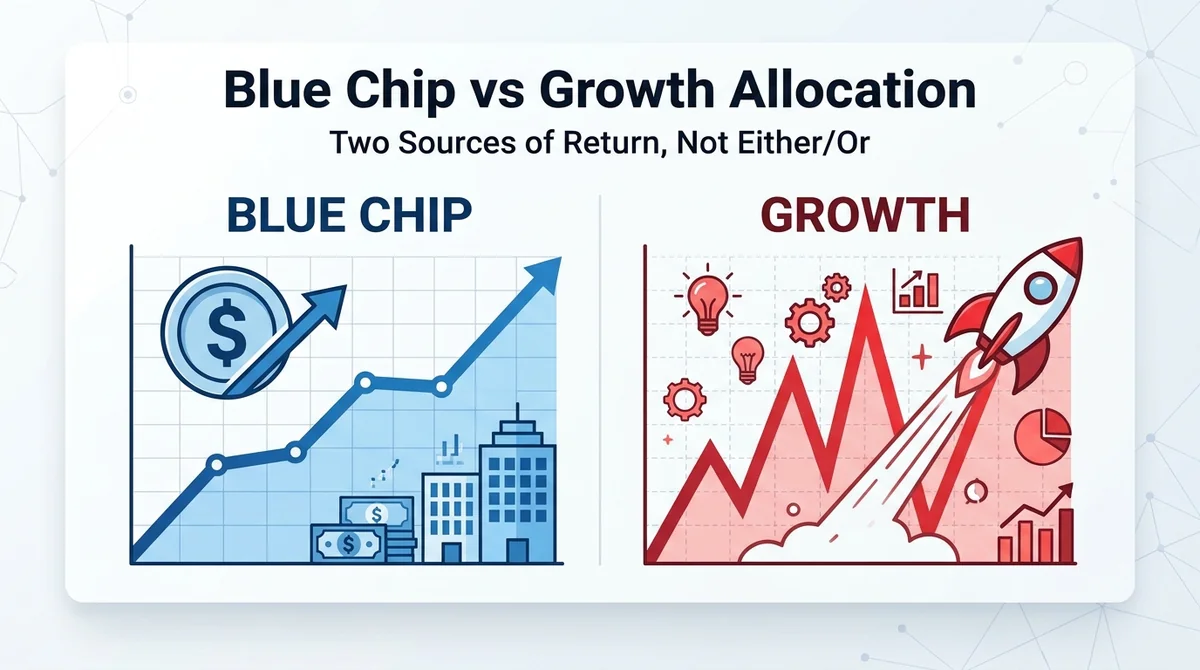
Compare A-share blue chip and growth styles across pricing logic, drawdowns, dividends, holding periods and risks, with allocation rules and an action checklist.
Conclusion: Blue chip and growth are not an either/or choice — they are two different sources of return. Blue chip returns are anchored mainly to current earnings and dividends, while growth returns are anchored mainly to future growth expectations and valuation expansion. The allocation ratio should first be determined by your goals and risk tolerance, and then rebalanced when style deviation triggers it.
#What exactly is the difference between A-share blue chip and growth stock allocation?
The core difference between blue chip and growth is not "good versus bad" but a difference in return sources and pricing anchors. Blue chip leans toward mature industries with stable earnings and a stronger dividend bias, so prices reflect current earnings and dividend returns more; growth leans toward high expected earnings growth, where valuation is sensitive to changes in expectations and prices reflect the discounted result of future growth more. Note that "typically" and "leans toward" here are relative characteristics at the style level, not a guarantee for any individual stock, and not a promise of future returns.
#Where do blue chip returns mainly come from?
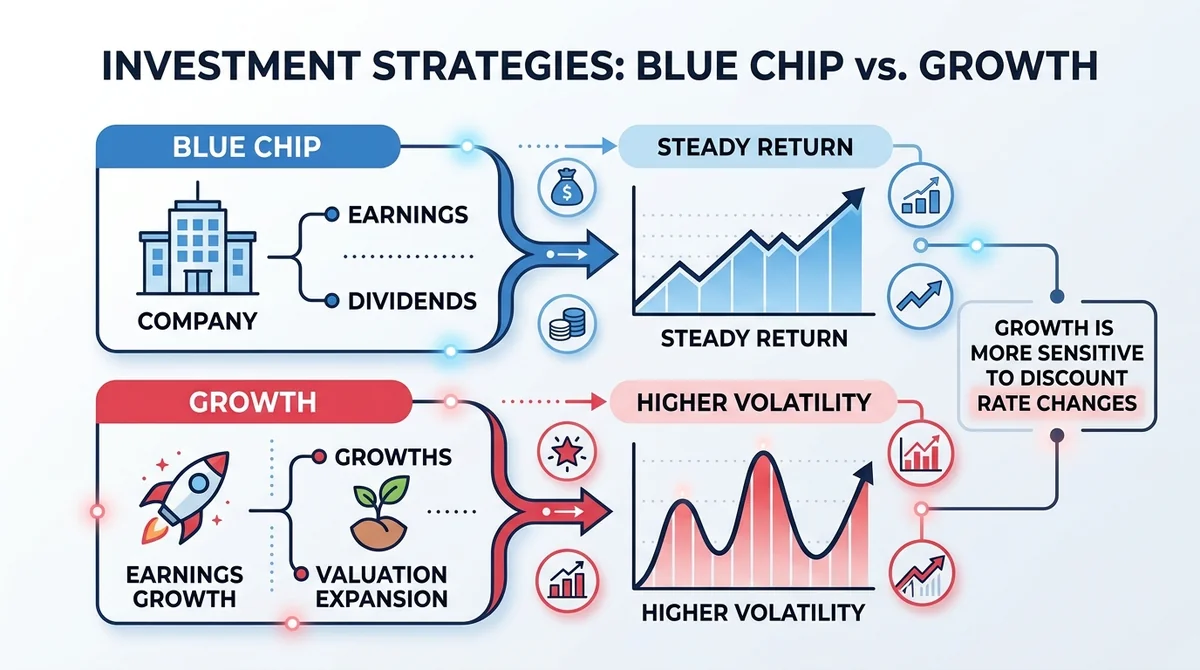
Blue chip return structure usually has two parts: the stable accumulation of earnings itself, and the cash return from dividends. Because these companies are mostly in mature-stage industries, earnings volatility is relatively contained, so return predictability is relatively higher — but upside elasticity is usually limited.
#Where do growth stock returns mainly come from?
Growth returns depend more on the combination of realized earnings growth and valuation expansion. When the market raises expectations for future growth, valuation may be pushed higher, creating a dual driver of "growth + valuation"; conversely, when expectations are revised down, the same dual pressure appears.
#How do the pricing logics of the two styles differ?
Blue chip pricing looks at earnings and dividends, close to a "discounted cash flow + dividend yield" framework; growth pricing looks at growth and valuation expansion, close to a "discounted forward earnings" framework. This determines their different sensitivity to interest rates and liquidity conditions: the longer-duration growth style is usually more sensitive to changes in the discount rate.
#How do blue chip and growth compare item by item on key dimensions?
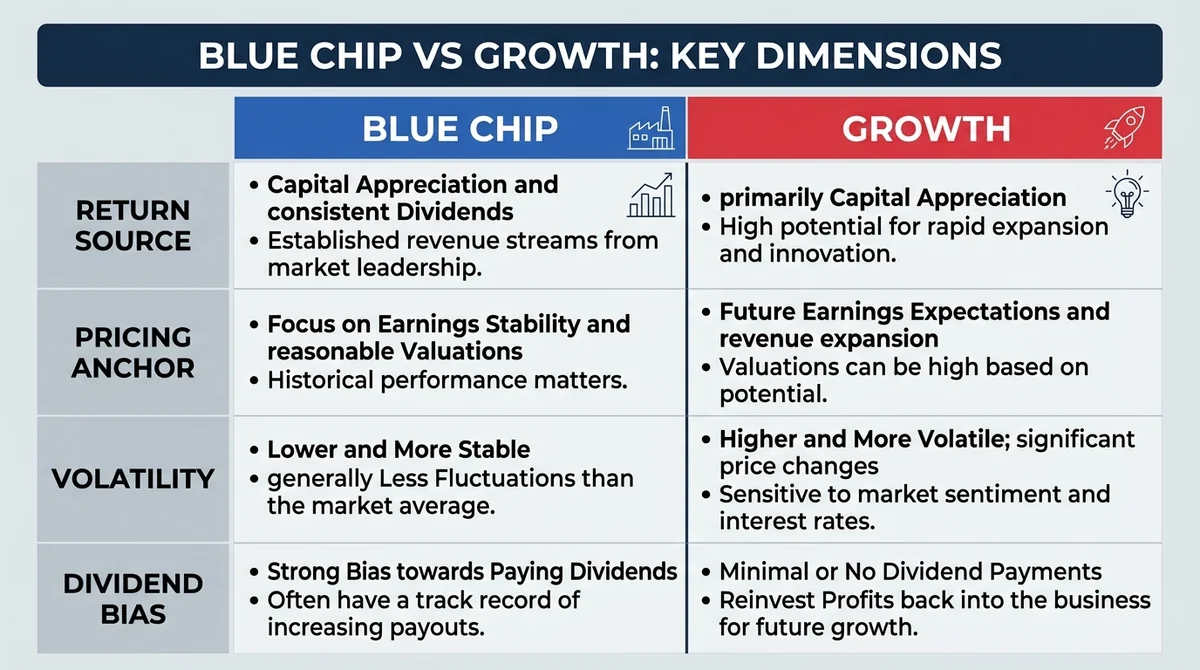
The value of an item-by-item comparison is that it replaces "feelings" with checkable conditions. The dimensions below are qualitative comparisons; this article does not cite specific numerical data. For quantitative comparison, refer to the latest methodology disclosed by the relevant index provider or exchange.
#How do volatility and drawdown differ?
Blue chip typically has relatively lower volatility, with milder drawdowns and recovery pace; growth typically has higher volatility and deeper interim drawdowns. This is one direct result of the difference in return sources, but it is not an absolute rule — there have also been historical periods of reversal.
#How do valuation levels and valuation sensitivity differ?
Blue chip valuation is supported more by current earnings and dividend yield, so its valuation range is relatively contained; growth valuation embeds more forward expectations, so it is more sensitive to expectation revisions, and the absolute magnitude of valuation swings is usually larger.
#How do dividends and cash flow characteristics compare?
Blue chip has a stronger dividend bias, making cash flow returns more tangible; growth has a weaker dividend bias, with profits reinvested more to support growth. If your goal is cash return, the difference in fit between the two is clear. Dividends themselves depend on company earnings and distribution policy — they are not a fixed return inherent to a style.
#Is the suitable holding period the same?
No. Blue chip's return realization path is relatively short with higher predictability; growth returns depend on the gradual validation of growth expectations, usually requiring a longer holding period to absorb volatility.
#When is it more suitable to allocate to blue chip, and when to growth?
Who this applies to: investors making style-weight decisions who want to turn "bullish" into an executable ratio. Who this does not apply to: users focused on short-term trading who do not plan to set a holding period and rebalancing rules.
#How to choose when seeking stability and cash return?
If the goal is controllable volatility and dividend return, the blue chip weight can be higher. The basis for the decision should be your own tolerance for drawdown, not a judgment about a particular market move.
#How to choose when bullish on industry trends and able to tolerate volatility?
If you can tolerate larger drawdowns and are bullish on long-term growth trends, the growth weight can be higher. The premise is a sufficiently long holding period to wait for growth validation.
#Should style be adjusted when the market environment changes?
Style selection should match your own risk tolerance and holding period, not follow short-term market moves. Environment changes are better used as a trigger reference for rebalancing, not as a reason to overturn the original allocation framework.
#Scenario branching
- If your primary goal is cash return and controllable volatility, the blue chip weight can be higher.
- If you can tolerate deeper drawdowns and have a growth-oriented goal with a holding period of several years or more, the growth weight can be higher.
- If your goal sits between the two, first set a baseline ratio, then trigger rebalancing based on style deviation.
- If you are sensitive to changes in the discount rate and liquidity environment, pay extra attention to the valuation pressure on growth weight during rate-hiking phases.
- If you are heavily concentrated in a single style, assess concentration risk first rather than adding more to the same style.
#How can blue chip and growth be combined rather than treated as either/or?
The two styles diverge in different phases, so combining them can reduce single-style concentration risk. The ratio should be determined by investment goals, holding period and risk tolerance; rebalancing can reference style deviation rather than short-term gains and losses.
#What does the correlation between the two styles mean?
Divergence means the two are not fully synchronized, so combining them can provide a buffer when one style is under pressure — but it cannot eliminate overall market risk: in a systemic decline, both asset types may draw down at the same time.
#By what logic should the allocation ratio be determined?
First set the goal (cash return priority or growth elasticity priority), then set the maximum drawdown you can tolerate, and finally work backward to the ratio. The ratio is a function of your goal, not of the market.
#What signals should rebalancing watch?
Watch the deviation of style weight relative to the baseline, not daily or weekly moves. Executing rebalancing after a deviation threshold is triggered helps avoid emotional decisions. Rebalancing itself incurs trading costs, so the threshold should not be set too narrow.
#What risks should you watch when allocating to blue chip or growth?
#What are the main risks of the growth style?
Valuation pullbacks and growth falling short of expectations. The two can occur together, creating a dual downgrade of valuation and earnings.
#What are the main risks of the blue chip style?
Slowing growth and industry downturn. A stable profile does not mean there is no downside risk — mature industries also face cyclical pressure.
#What problems does style concentration create?
Single-style concentration amplifies interim drawdowns and reduces the portfolio's adaptability to different market environments.
#Action checklist
- Clarify your primary goal: cash return priority or growth elasticity priority.
- Quantify the maximum drawdown you can tolerate as a constraint on the ratio ceiling.
- Set a holding period and check whether it matches the return realization pace of the chosen style.
- Set a baseline style ratio for the portfolio and record the basis for it.
- Set a style deviation threshold as the rebalancing trigger.
- Periodically review the growth weight's sensitivity to interest rates and liquidity conditions.
- Check whether there is excessive single-style concentration and assess concentration risk.
#FAQ
Q1: Is blue chip always more stable than growth? A: It cannot be put that way. Blue chip typically has relatively lower volatility and a stronger dividend bias, but it also carries risks of slowing growth and industry downturn; stability is a relative characteristic, not a guarantee.
Q2: Are growth stocks suitable for long-term holding? A: Growth returns depend on the gradual validation of growth expectations and usually require a longer holding period to absorb volatility. Whether it suits you depends on your personal risk tolerance and goals.
Q3: Can I choose just one of the two styles? A: Yes, but single-style concentration amplifies interim drawdowns. Combining them and rebalancing by deviation is more consistent with allocation logic.
Q4: Should rebalancing be based on gains and losses or on ratios? A: It is recommended to reference the deviation of style weight relative to the baseline rather than short-term gains and losses, to reduce emotional trading.
Q5: Does this article give specific valuation or volatility figures? A: No. This article does not cite specific valuation, volatility or drawdown figures; it only provides qualitative comparison and a decision framework. For quantitative data, refer to the latest methodology disclosed by the index provider or exchange.
This content is compiled from public information and is for methodology explanation only; it does not constitute investment advice or a recommendation to open account. No specific numerical data is cited, and relevant methodologies may change with the market; for verification, refer to official sources from the index provider or exchange.
FAQ
Is blue chip always more stable than growth?
It cannot be put that way. Blue chip typically has relatively lower volatility and a stronger dividend bias, but it also carries risks of slowing growth and industry downturn; stability is a relative characteristic, not a guarantee.
Are growth stocks suitable for long-term holding?
Growth returns depend on the gradual validation of growth expectations and usually require a longer holding period to absorb volatility. Whether it suits you depends on your personal risk tolerance and goals.
Can I choose just one of the two styles?
Yes, but single-style concentration amplifies interim drawdowns. Combining them and rebalancing by deviation is more consistent with allocation logic.
Should rebalancing be based on gains and losses or on ratios?
It is recommended to reference the deviation of style weight relative to the baseline rather than short-term gains and losses, to reduce emotional trading.
Does this article give specific valuation or volatility figures?
No. This article does not cite specific valuation, volatility or drawdown figures; it only provides qualitative comparison and a decision framework. For quantitative data, refer to the latest methodology disclosed by the index provider or exchange.
Done comparing? Ready to place your first trade?
The crypto assets, tokenized US stocks and ETFs you just compared are all tradable on MSX — spot or perpetuals.
Quick Start Trading →New here? Registration takes three quick steps.