BTC Spot vs BTC Perpetual 2026: Funding Rate, Liquidation Mechanism, and Trading Cost Differences
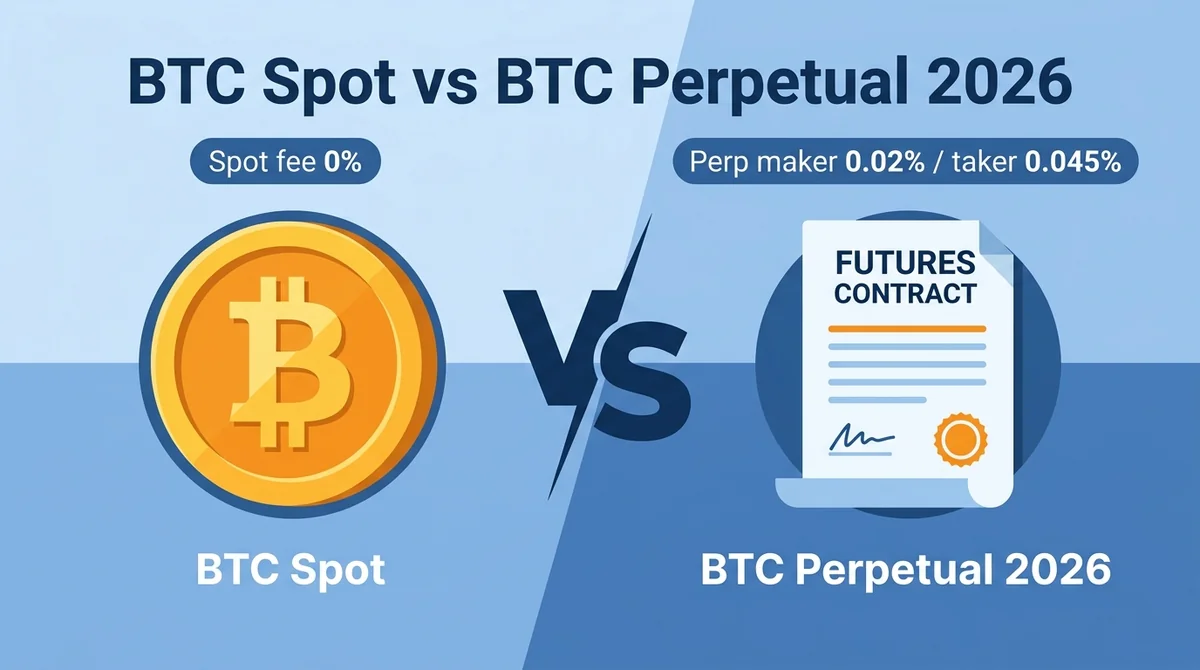
Compare BTC spot and perpetual futures: funding rate impact on costs, liquidation differences, fees and slippage, and how to choose based on goals.
Conclusion: BTC spot is suitable for long-term holding, no leverage, and those who want direct asset ownership; BTC perpetual futures are suitable for short-term trading, hedging, or advanced users seeking flexible long/short exposure, but they must bear funding rate and liquidation risk.
#Comparison Table
| Dimension | BTC Spot | BTC Perpetual |
|---|---|---|
| Underlying asset | Real BTC | Derivative contract |
| Holding method | Hold real BTC, including self-custody private keys or custodial account balance | Contract position in margin account |
| Price anchor | Market spot price | Anchored to spot index via perpetual futures funding rate settlement schedule |
| Liquidation mechanism | No forced liquidation without leverage | Liquidation triggered when margin rate falls below maintenance margin |
| Funding rate | None | Periodically collected or paid, transferred between longs and shorts |
| Leverage | Usually no or low leverage | Can provide higher leverage, amplifying gains and losses |
| Trading cost | Fee + spread | Fee + spread + funding rate |
| Settlement | Immediate delivery, real BTC transfer | No expiry, rolling position, P&L usually settled in cash or stablecoins |
| Use case | Long-term holding, payments, hodling | Short-term trading, hedging, arbitrage |
| Risk profile | Price volatility risk | Price volatility + leverage amplification + liquidation + funding rate risk |
#Detailed Dimensions
#What Is the Core Difference Between BTC Spot and BTC Perpetual?
How Do Underlying Asset Holding Methods Differ?
Spot: Directly hold BTC, usually meaning you own private keys or a BTC balance in a custodial account. Perpetual: Hold a contract position, with no actual BTC delivery; P&L is usually settled in cash or stablecoins.
How Does the Price Anchor Mechanism Work?
Spot: Price is directly determined by market supply and demand. Perpetual: The contract price is pulled back toward the spot index through the perpetual futures funding rate settlement schedule, preventing prolonged divergence.
#How Funding Rate Affects Perpetual Contract Holding Costs
What Are the Funding Rate Calculation Period and Direction?
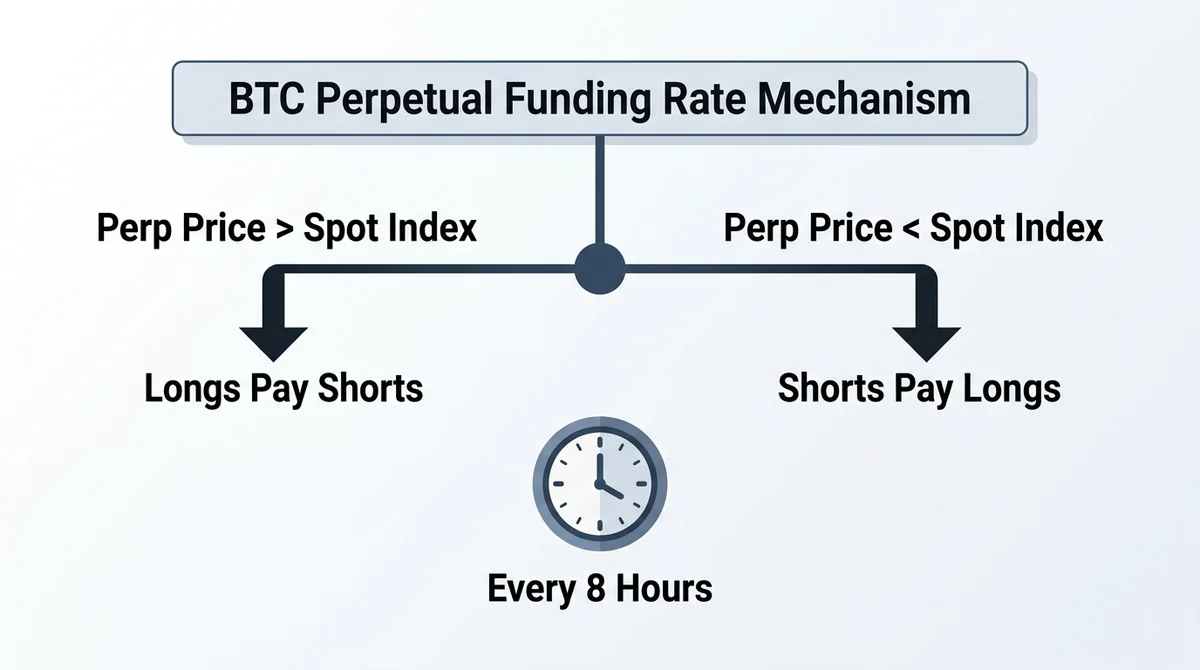
Perpetual: The funding rate is settled periodically according to the platform's schedule (commonly every 8 hours, but subject to platform announcements. This is how does perpetual futures funding rate work: when the perpetual price is above the spot index, longs pay shorts; otherwise, shorts pay longs. Spot: No such fee.
How Do Longs and Shorts Share Funding Costs?
Perpetual: Usually the funding rate transfers directly between longs and shorts, with the platform not taking a cut. Holding cost varies with the sign of the funding rate. Spot: No additional periodic holding fee.
#How Do Spot and Perpetual Liquidation Mechanisms Differ?
Does Spot Trading Have Liquidation Risk?
Spot: No forced liquidation in non-leveraged trading, but price declines can cause unrealized losses, and in extreme cases you may lose your entire principal.
What Are the Triggers for Perpetual Contract Liquidation?
Perpetual: The trigger for liquidation is when margin rate falls below the maintenance margin requirement. For details, TRUMPUSDT perpetual futures margin requirements explained. Higher leverage means greater liquidation risk.
#In Terms of Trading Costs, Which Is More Cost-Effective: Spot or Perpetual?
How Do Fee Structures Differ?
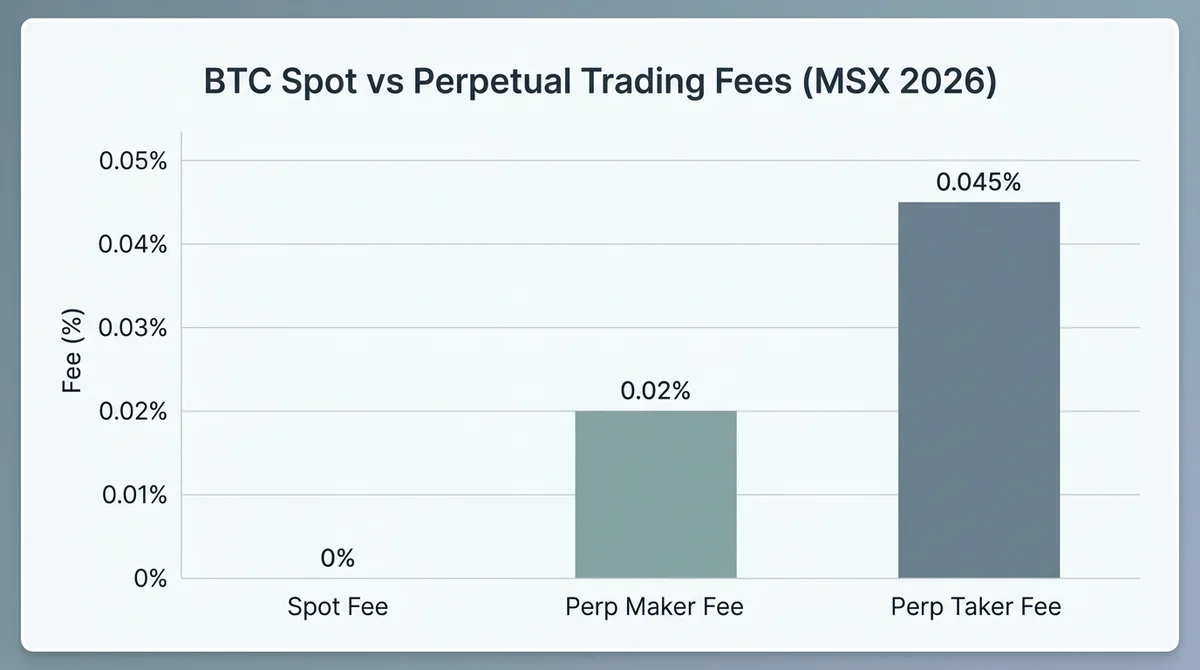
Spot and Perpetual both charge trading fees, but the rates may differ. Perpetual additionally involves funding costs, so long-term holding costs may be higher. Specific rates are subject to platform announcements. For example, MSX's spot trading fee is 0, while contract maker/taker fees are 0.02%/0.045%. See Gate vs Kraken 2026 Spot vs Perpetual Fees and Leverage Comparison.
How Do Slippage and Liquidity Affect Costs?
Slippage for both spot and perpetual depends on market depth. High-liquidity markets have smaller slippage. Perpetual contracts on major platforms usually have good liquidity, but depth varies by platform; leveraged trading may amplify slippage impact.
#How to Choose Between BTC Spot and Perpetual Based on Trading Goals?
Which Scenarios Are More Suitable for Holding Spot?
Spot: Long-term bullish on BTC, unwilling to take leverage risk, want real asset ownership, use for payments or transfers.
Which Strategies Are Suitable for Perpetual Contracts?
Perpetual: Short-term swing trading, hedging spot risk, arbitrage (such as how to arbitrage negative funding rate in perpetual futures), flexible long/short. But you must fully understand liquidation and funding rate risks.
What Risks Should You Understand Before Trading?
Perpetual: Leverage amplifies losses, liquidation risk, funding rate volatility. Spot: Price volatility risk. No trading guarantees returns.
#Scenario Recommendations
Suitable for BTC Spot: Long-term investors, hodlers, users who want private key control, and those with lower risk tolerance.
Suitable for BTC Perpetual: Short-term traders, hedgers, arbitrageurs, and advanced users who can strictly manage leverage and margin.
#Related Reading
- Ethereum Spot vs Perpetual Contracts: Funding Rate, Liquidation Mechanism, and Cost Comparison 2026
- MSX vs Binance 2026: Perpetual Contract Funding Rate, Liquidation Mechanism, and Arbitrage Cost Deep Comparison
#FAQ
Q1: What is the biggest difference between BTC spot and perpetual? Answer: Spot represents direct ownership of real Bitcoin, while perpetual is a non-deliverable derivative that stays aligned with spot price through the perpetual futures funding rate settlement schedule.
Q2: How often is the funding rate settled? What do positive and negative mean? Answer: The settlement period is set by the platform, commonly every 8 hours, but it may vary. When the funding rate is positive, longs pay shorts; when negative, shorts pay longs.
Q3: Will perpetual contracts definitely be liquidated? How to avoid it? Answer: Perpetual contracts are liquidated when the margin rate falls below the maintenance margin requirement. To avoid liquidation, control leverage, set stop losses, and maintain sufficient margin.
Q4: Is spot trading completely risk-free? Answer: Spot trading has no liquidation risk, but it still faces asset depreciation risk from falling prices.
Q5: Are beginners better suited to spot or perpetual? Answer: Beginners are advised to start with spot and get familiar with market volatility first. Perpetual contracts involve leverage and liquidation, which carry higher risk.
#Disclaimer
This content is compiled from public data and does not constitute investment or account-opening advice. Data is as of the time of publication and may change. For specific platform fees and terms, refer to the corresponding official sources.
FAQ
What is the biggest difference between BTC spot and perpetual?
Spot represents direct ownership of real Bitcoin, while perpetual is a non-deliverable derivative that stays aligned with spot price through the perpetual futures funding rate settlement schedule.
How often is the funding rate settled? What do positive and negative mean?
The settlement period is set by the platform, commonly every 8 hours, but it may vary. When the funding rate is positive, longs pay shorts; when negative, shorts pay longs.
Will perpetual contracts definitely be liquidated? How to avoid it?
Perpetual contracts are liquidated when the margin rate falls below the maintenance margin requirement. To avoid liquidation, control leverage, set stop losses, and maintain sufficient margin.
Is spot trading completely risk-free?
Spot trading has no liquidation risk, but it still faces asset depreciation risk from falling prices.
Are beginners better suited to spot or perpetual?
Beginners are advised to start with spot and get familiar with market volatility first. Perpetual contracts involve leverage and liquidation, which carry higher risk.
Related Terms
Done comparing? Ready to place your first trade?
The crypto assets, tokenized US stocks and ETFs you just compared are all tradable on MSX — spot or perpetuals.
Quick Start Trading →New here? Registration takes three quick steps.