BTC Spot vs Tokenized Gold: Safe-Haven Attributes, Holding Costs, and Liquidity Comparison 2026
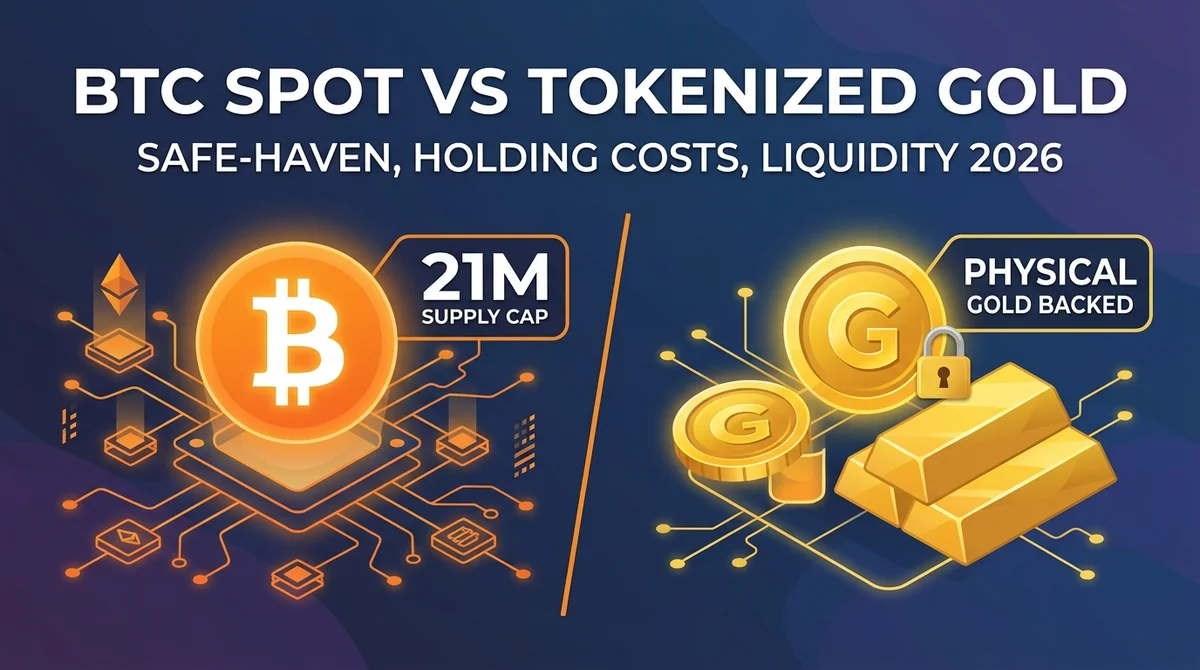
BTC spot vs tokenized gold: asset type, safe-haven nature, holding costs, liquidity, custody, counterparty risk. 2026 public info; not investment advice.
Conclusion: If your core need is to hold native digital assets and accept higher volatility, choose BTC spot; if you value traditional gold price anchoring and physical backing more, choose tokenized gold. The specific choice also depends on holding costs, liquidity, custody, and counterparty risk.
#What Are BTC Spot and Tokenized Gold?
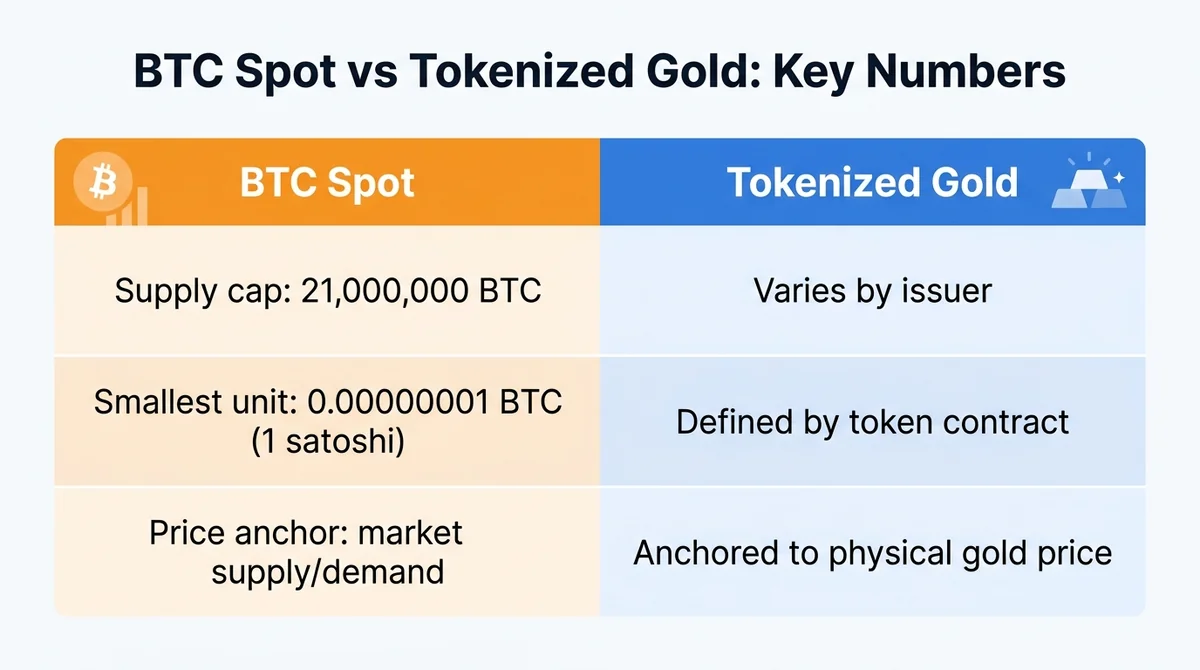
BTC spot: Holding Bitcoin directly, either through a self-custody wallet or an exchange account. Bitcoin is the native asset of a decentralized network with a hard cap of 21 million coins (source: Bitcoin.org).
Tokenized gold: An on-chain asset that maps to physical gold, usually issued by an issuer that custodies physical gold and issues tokens. Common examples include PAX Gold (PAXG) and Tether Gold (XAUT), where each token represents a certain amount of physical gold. The two have different underlying assets: BTC spot is backed by Bitcoin's native network asset, while tokenized gold is backed by physical gold or gold-related assets.
#8-Dimensional Comparison Table
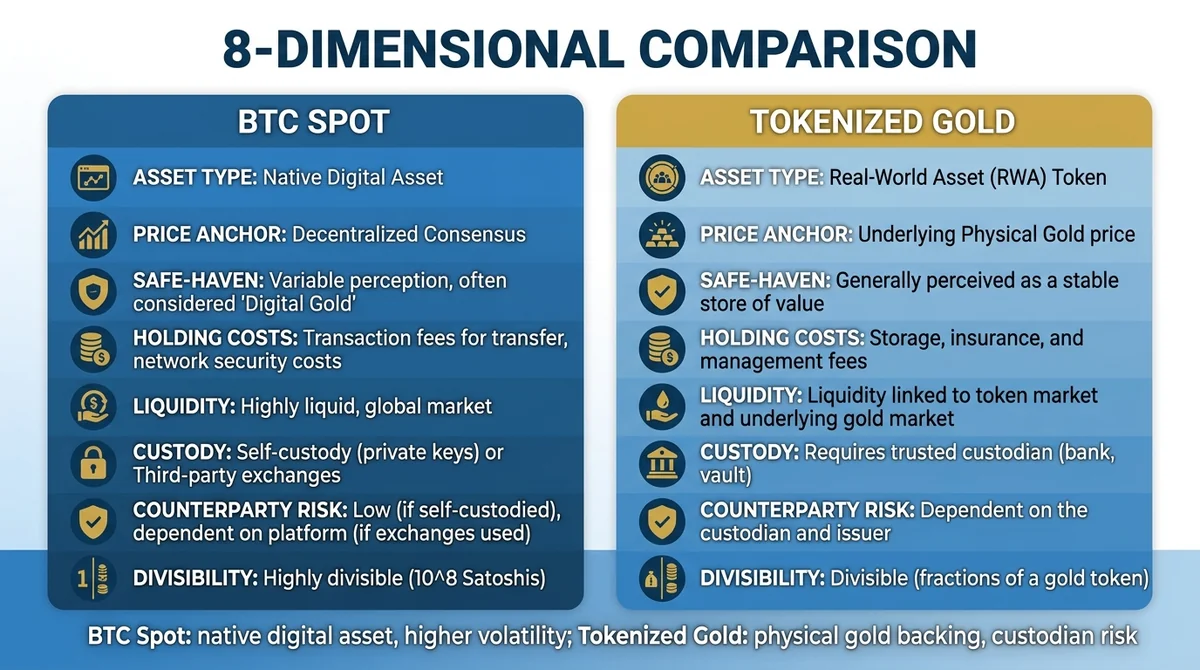
| Dimension | BTC Spot | Tokenized Gold |
|---|---|---|
| Asset type | Native cryptocurrency | On-chain tokenized asset |
| Price anchor | Market supply and demand pricing | Anchored to physical gold price |
| Safe-haven attribute | Digital scarcity hedge, fixed supply cap | Extension of traditional gold safe-haven, reliant on reserves |
| Holding costs | Mainly on-chain transfer fees; no fixed custody fee | Custody fees + on-chain transfer fees; rates vary by product |
| Liquidity | Deeper market depth, multiple trading pairs | Lower liquidity, fewer trading pairs |
| Custody method | Self-custody or exchange custody available | Physical gold typically custodied by issuer |
| Counterparty risk | Depends on custody method; self-custody requires securing private keys | Issuer/custodian risk and opaque reserves |
| Divisibility | Divisible down to 1 satoshi (0.00000001 BTC) | Divisible to the smallest unit defined by the token contract |
#Dimension Details
Asset type: BTC spot is the native asset of the Bitcoin network and does not rely on third-party issuance; tokenized gold is a token issued on-chain by an issuer, and its value depends on physical gold reserves.
Price anchor: BTC spot price is determined by public market buyers and sellers and is more volatile; tokenized gold price theoretically tracks physical gold but can deviate due to liquidity or premium/discount.
Safe-haven attribute: BTC spot reflects digital scarcity with a total supply cap of 21 million coins; tokenized gold extends gold's traditional safe-haven logic, but historical volatility and correlation data are not provided, so a direct strength comparison cannot be made. Based on broad market observations, Bitcoin volatility is typically significantly higher than gold.
Holding costs: BTC spot holding costs mainly include on-chain transfer fees (dynamic) and exchange withdrawal fees (set by the exchange); tokenized gold typically includes issuer custody fees (rates vary by product) and on-chain transfer fees. Specific rates are not standardized, so total long-term holding costs must be calculated for each specific product.
Liquidity: BTC spot, as the largest cryptocurrency by market cap (data source: CoinGecko), has deeper trading depth on major exchanges and DEXs; tokenized gold liquidity is usually concentrated in a small number of trading pairs, and slippage may widen under extreme market conditions.
Custody method: BTC spot can be self-custodied (you hold the private keys) or custodied on an exchange; tokenized gold usually has physical gold custodied by the issuer or a third party, and users hold tokens rather than the gold itself.
Counterparty risk: BTC spot self-custody carries lower counterparty risk, but you must keep private keys safe; if lost, they cannot be recovered. If custodied on an exchange, exchange risk exists (such as bankruptcy or theft). Tokenized gold carries risks including issuer default, custodian risk, and opaque reserves.
Divisibility: BTC spot's smallest unit is 1 satoshi (0.00000001 BTC); tokenized gold can be divided down to the smallest unit defined by the token contract, making small allocations convenient.
#Scenario Recommendations
BTC spot is suitable when: You want an on-chain native asset, self-custody, and can accept higher price volatility, or you want to hold Bitcoin itself for the long term.
Tokenized gold is suitable when: You want gold price exposure, prefer a relatively stable value anchor, and accept issuer custody and counterparty risk.
#FAQ
Q: Which is a better safe haven, BTC spot or tokenized gold? A: The two have different safe-haven logics. BTC spot reflects digital scarcity more, while tokenized gold is closer to traditional gold safe-haven attributes; historical volatility data is not provided, so a direct strength comparison cannot be made. Market experience suggests gold is usually less volatile, but tokenized gold may experience premium or discount due to on-chain liquidity.
Q: Which has lower holding costs? A: It cannot be generalized. BTC spot holding costs mainly include on-chain transfer fees, while tokenized gold typically includes custody fees and on-chain transfer fees. Specific rates vary by product; check the issuer's documentation.
Q: Can tokenized gold be redeemed for physical gold? A: It depends on the specific product. For example, PAX Gold supports redemption for physical gold under certain conditions, but this article does not constitute a recommendation of any specific product. Please review the issuer's terms.
Q: Which has better liquidity in extreme market conditions? A: BTC spot usually has deeper trading depth, but both can experience slippage in extreme conditions. Tokenized gold liquidity can dry up more easily, so pay attention to trading depth and slippage.
Q: How can tokenized gold reserves be verified? A: Some projects publish proof of reserves or audit reports, but verification standards vary. Investors should review the issuer's transparency measures.
This content is based on publicly available information and does not constitute investment advice. Data is as of 2026-09-06 and may change. Please check official sources for further verification.
FAQ
Which is a better safe haven, BTC spot or tokenized gold?
The two have different safe-haven logics. BTC spot reflects digital scarcity more, while tokenized gold is closer to traditional gold safe-haven attributes; historical volatility data is not provided, so a direct strength comparison cannot be made. Market experience suggests gold is usually less volatile, but tokenized gold may experience premium or discount due to on-chain liquidity.
Which has lower holding costs?
It cannot be generalized. BTC spot holding costs mainly include on-chain transfer fees, while tokenized gold typically includes custody fees and on-chain transfer fees. Specific rates vary by product; check the issuer's documentation.
Can tokenized gold be redeemed for physical gold?
It depends on the specific product. For example, PAX Gold supports redemption for physical gold under certain conditions, but this article does not constitute a recommendation of any specific product. Please review the issuer's terms.
Which has better liquidity in extreme market conditions?
BTC spot usually has deeper trading depth, but both can experience slippage in extreme conditions. Tokenized gold liquidity can dry up more easily, so pay attention to trading depth and slippage.
How can tokenized gold reserves be verified?
Some projects publish proof of reserves or audit reports, but verification standards vary. Investors should review the issuer's transparency measures.
Related Terms
Done comparing? Ready to place your first trade?
The crypto assets, tokenized US stocks and ETFs you just compared are all tradable on MSX — spot or perpetuals.
Quick Start Trading →New here? Registration takes three quick steps.