How Beginners Choose Crypto Assets: BTC vs ETH Long-Term Allocation & Risk Comparison 2026
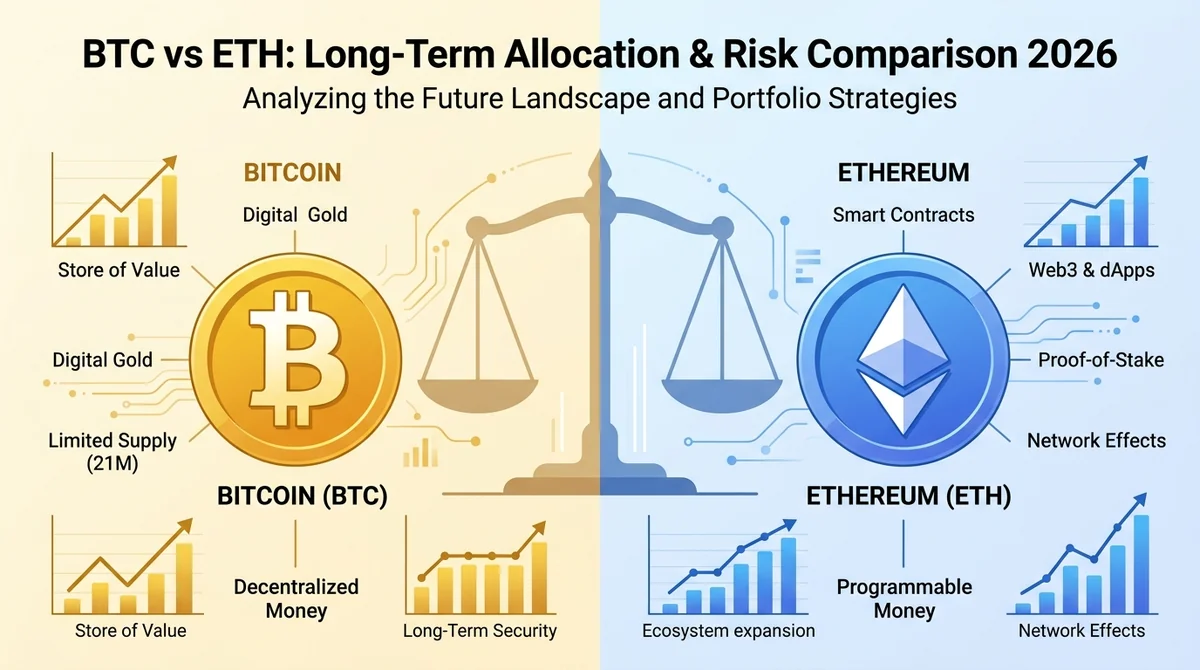
How should beginners choose BTC vs ETH for long-term allocation? Compare positioning, consensus, risk, and allocation ratios based on public data.
For beginners allocating crypto assets long-term, if a simple store of value and lower complexity are primary goals, BTC is a better match; if you are willing to accept higher volatility and believe in the long-term growth of the smart contract ecosystem, ETH can serve as a satellite allocation. The two are not substitutes; diversifying and controlling the proportion of any single asset is a more prudent path.
#Core Differences Comparison
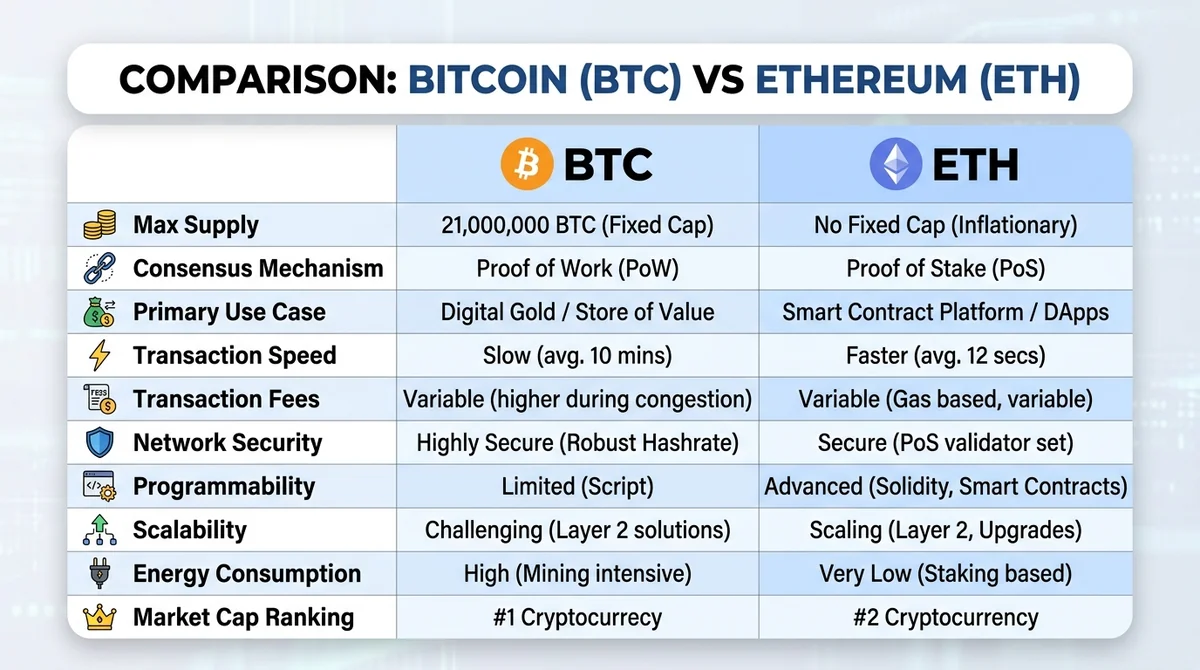
The following compares them across 10 dimensions. For specific quantitative metrics not provided here, refer to official sources or data platforms.
#Dimension Details
#Positioning and Core Use Cases
Positioning: BTC is a decentralized store of value designed as a censorship-resistant monetary system, often called "digital gold"; ETH is a programmable smart contract platform supporting dApps, DeFi, NFTs, and other on-chain ecosystems, leaning toward platform utility.
Core use cases: BTC addresses peer-to-peer electronic cash and store of value; ETH addresses programmable trust and decentralized application infrastructure.
#Consensus and Supply Mechanisms
Consensus mechanism: BTC primarily uses PoW (Proof of Work); ETH has shifted to PoS (Proof of Stake). The two differ fundamentally in energy consumption, participation thresholds, and validation methods.
Supply mechanism: BTC has a fixed total supply capped at 21 million coins, giving it predictable scarcity; ETH's supply is dynamic with no fixed cap, and its current supply can be checked publicly, but specific figures are not provided here. Differences in supply rules affect long-term inflation expectations.
#Value Drivers and Correlation
Value drivers: BTC's value derives more from monetary properties, including scarcity, censorship resistance, and network effects; ETH's value derives more from platform utility, including on-chain economic activity, gas demand, and ecosystem network effects.
Correlation: Both are crypto assets with historically high price correlation, but different drivers. Macro liquidity and market sentiment significantly affect both.
#Risk Characteristics
BTC risks: regulatory changes, technological iteration, market volatility. Long-term spot holding does not involve liquidation, but price swings can cause significant drawdowns.
ETH risks: smart contract vulnerabilities, ecosystem competition, upgrade risks. ETH additionally faces application-layer security issues and challenges from competing chains. Both are affected by macro liquidity; spot holding does not involve leverage or liquidation, but volatility risk remains high.
#Liquidity and Ecosystem Maturity
Liquidity: BTC and ETH are both mainstream crypto assets, generally with high liquidity, but specific quantitative data should be checked on exchanges or data platforms.
Ecosystem maturity: BTC's monetary network is relatively stable but its application layer is narrow; ETH has a rich smart contract ecosystem with broad DeFi, NFT, and other applications. Their maturity is difficult to compare directly in quantitative terms.
#Scenario Recommendations
#Situations Favoring BTC
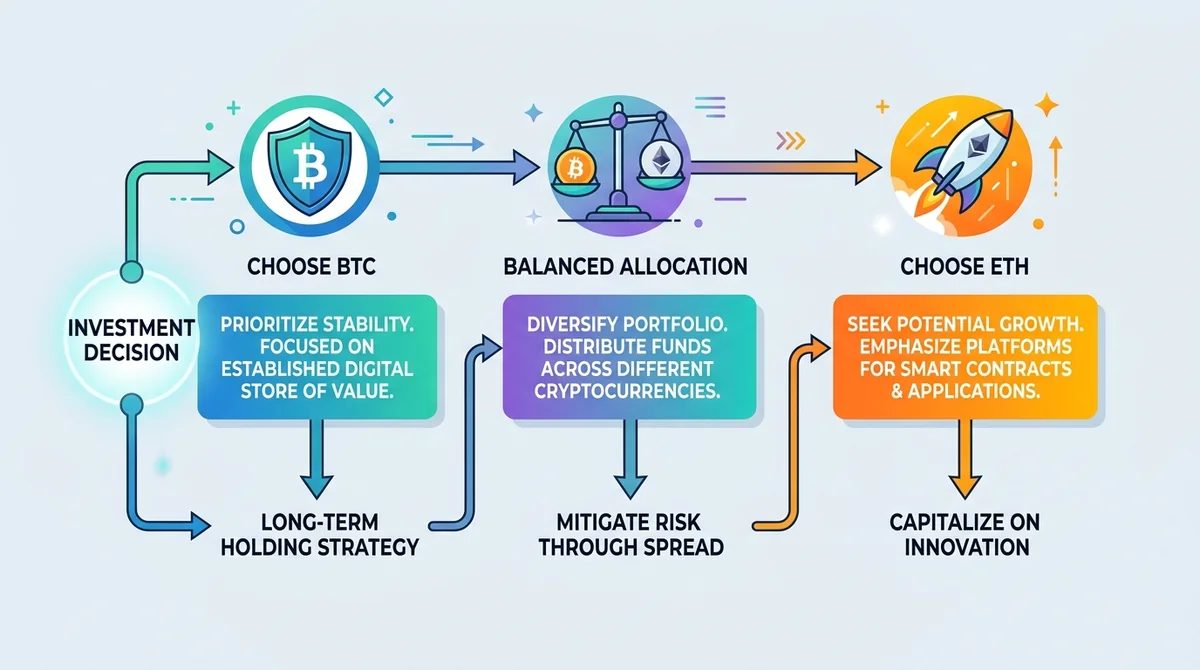
Lower risk appetite: seeking a simple store of value without frequent attention to technological iterations and ecosystem changes.
Single long-term holding goal: treating crypto assets as an alternative allocation to digital gold, without pursuing on-chain application yields.
#Situations Favoring ETH
Belief in smart contract ecosystem growth: believing that decentralized applications, DeFi, NFTs, and similar sectors have long-term potential.
Ability to tolerate higher volatility: willing to accept uncertainty from technology upgrades and competition, with a longer investment horizon.
#Balanced Allocation of Both
Diversified allocation: There is no standard ratio; it should be determined by personal risk tolerance and investment horizon. Consider buying in batches to reduce timing risk, rebalance periodically but avoid frequent trading, and do not change long-term plans because of short-term volatility.
#FAQ
Q: Should beginners buy BTC or ETH first?
A: There is no absolute answer. If simple store of value and reducing complexity are primary goals, BTC is a better match among crypto assets; if you are optimistic about on-chain ecosystems and able to tolerate higher volatility, ETH can be included. It is advisable to first understand the core differences between the two asset types, then allocate based on personal risk appetite.
Q: Which is riskier, BTC or ETH?
A: Both are high-volatility assets, but risk sources differ. BTC mainly faces regulatory and market volatility risks; ETH additionally faces smart contract vulnerabilities, ecosystem competition, and upgrade risks. The actual risk level depends on individual tolerance for technical risk.
Q: Do long-term BTC or ETH holders need to worry about liquidation?
A: Spot holding does not involve leverage or liquidation, but price swings can cause significant drawdowns of principal. If using leverage or derivatives, pay attention to forced liquidation risk.
Q: Is there a standard BTC/ETH allocation ratio?
A: There is no standard ratio. It should be determined by personal investment horizon, risk tolerance, and conviction in the two asset types. Consider building positions in batches and rebalancing periodically.
This content is compiled from public data and does not constitute investment or account opening advice. Data is as of 2026-09-04 and may change; refer to official sources for the latest information.
FAQ
Should beginners buy BTC or ETH first?
There is no absolute answer. If simple store of value and reducing complexity are primary goals, BTC is a better match among crypto assets; if you are optimistic about on-chain ecosystems and able to tolerate higher volatility, ETH can be included. It is advisable to first understand the core differences between the two asset types, then allocate based on personal risk appetite.
Which is riskier, BTC or ETH?
Both are high-volatility assets, but risk sources differ. BTC mainly faces regulatory and market volatility risks; ETH additionally faces smart contract vulnerabilities, ecosystem competition, and upgrade risks. The actual risk level depends on individual tolerance for technical risk.
Do long-term BTC or ETH holders need to worry about liquidation?
Spot holding does not involve leverage or liquidation, but price swings can cause significant drawdowns of principal. If using leverage or derivatives, pay attention to forced liquidation risk.
Is there a standard BTC/ETH allocation ratio?
There is no standard ratio. It should be determined by personal investment horizon, risk tolerance, and conviction in the two asset types. Consider building positions in batches and rebalancing periodically.
Related Terms
Done comparing? Ready to place your first trade?
The crypto assets, tokenized US stocks and ETFs you just compared are all tradable on MSX — spot or perpetuals.
Quick Start Trading →New here? Registration takes three quick steps.