AMD vs NVDA: Which AI Chip Stock Fits Your Portfolio in 2026?
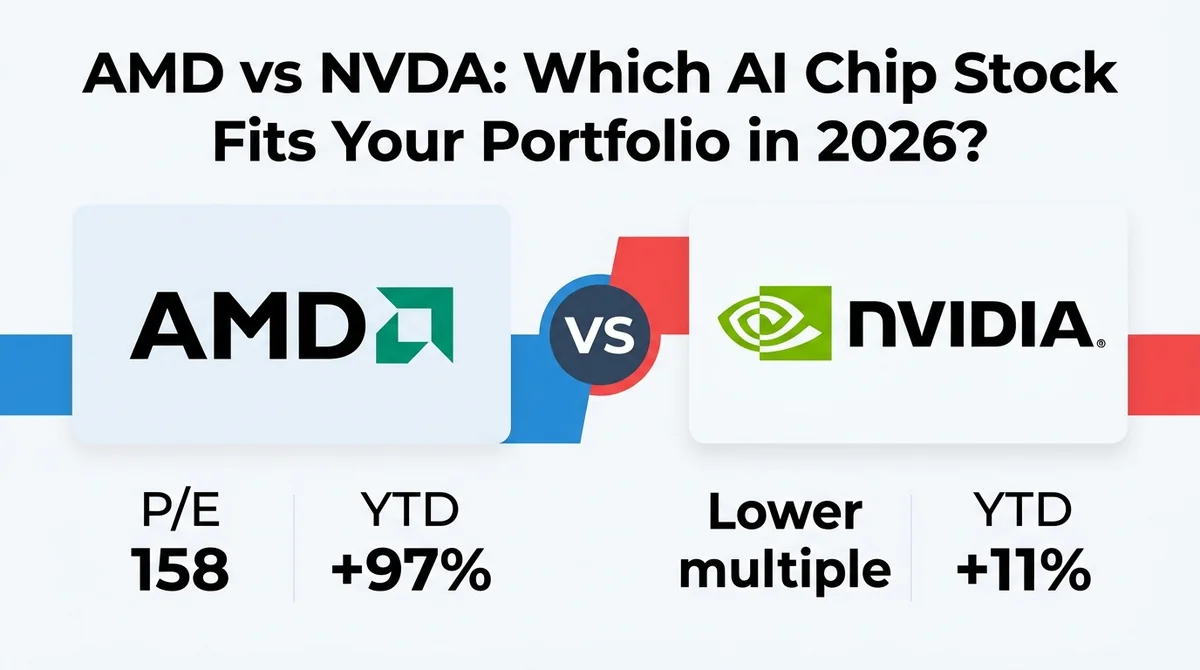
Compare AMD and NVDA on valuation, momentum, customer deals, and long-term fit. NVIDIA is cheaper on earnings, but AMD's 97% YTD surge reflects faster growth.
#AMD vs NVDA: Which AI Chip Stock Fits Your Portfolio in 2026?
NVIDIA trades at a much lower earnings multiple than AMD, making it the more value-oriented choice. AMD, however, is outpacing NVIDIA in growth momentum, with accelerating revenue and a strong data center segment. Your decision hinges on whether you prioritize compounding at a lower multiple or momentum and inflection.
Key Takeaways
- NVIDIA's net income of $120.07B on a $5.18T market cap implies a cheaper earnings multiple than AMD's P/E of 158.
- AMD's Q1 FY2026 revenue was $10.25B, up 38% YoY, with data center revenue up 57%.
- AMD stock is up 97% YTD vs NVIDIA's 11% YTD.
- Meta and OpenAI have committed to large-scale AMD Instinct GPU deployments.
- NVIDIA suits value-oriented investors; AMD suits growth-oriented investors willing to accept higher valuation.
#AMD vs NVDA: Key Differences in Valuation
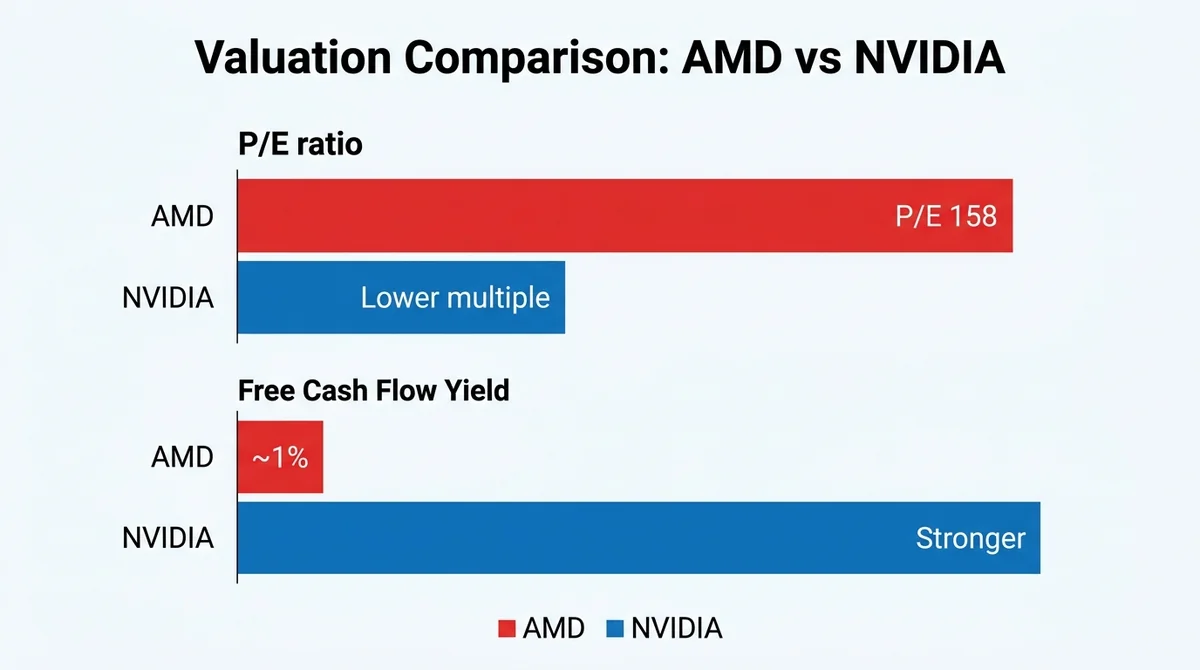
NVIDIA currently trades at a significantly lower earnings multiple than AMD, making it the more value-oriented choice. AMD trades at a P/E of 158 and a P/FCF of 102, a growth-stock multiple priced for perfection. NVIDIA, by contrast, generated $120.07B in net income on a $5.18T market cap in FY2026, which works out to a meaningfully cheaper earnings multiple on trailing profits. NVIDIA is the lower-multiple compounder here; there is no ambiguity.
#Which stock has a lower P/E ratio?
NVIDIA has the lower P/E ratio. AMD's P/E of 158 dwarfs NVIDIA's implied multiple. NVIDIA's massive net income relative to its market cap gives it a much cheaper earnings multiple. For investors focused on valuation, NVIDIA is the clear winner.
#How do free cash flow yields compare?
AMD's free cash flow yield is just under 1%, reflecting its premium valuation. NVIDIA's free cash flow yield is not explicitly stated in the provided data, but its higher net income and lower earnings multiple suggest a stronger free cash flow profile relative to its price.
#Which AI Chip Stock Has Stronger Momentum?
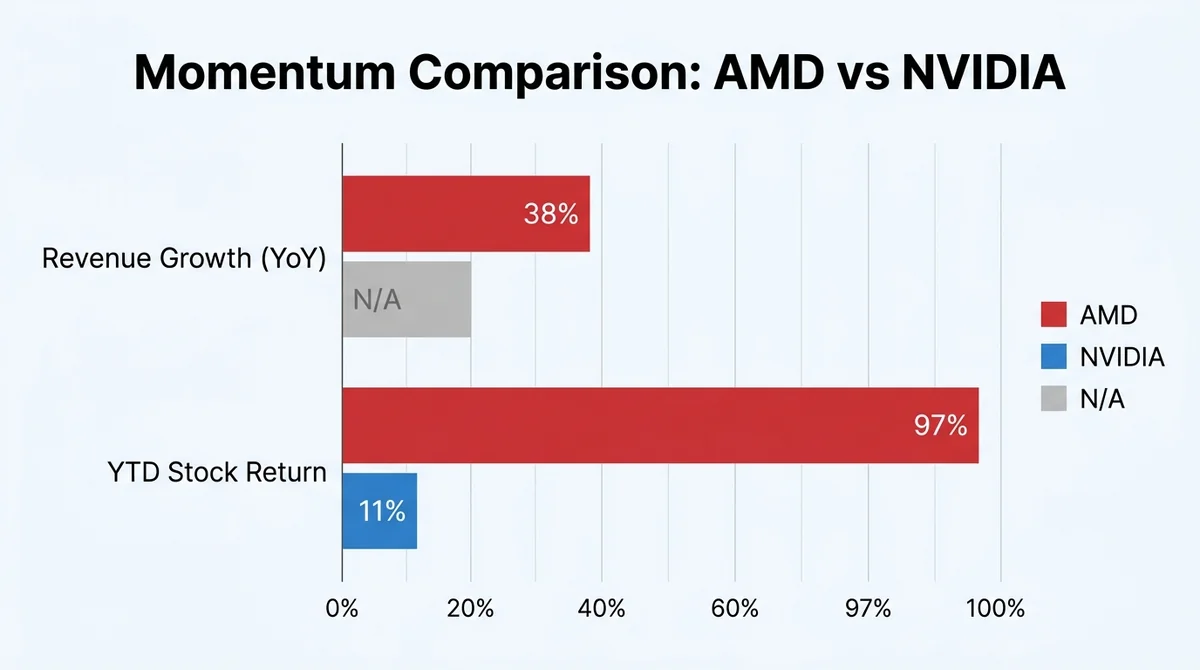
AMD is currently outpacing NVIDIA in growth momentum, with accelerating revenue and a strong data center segment. AMD's Q1 FY2026 revenue was $10.25B, up 38% YoY. Data center revenue reached $5.78B, up 57% YoY. Q2 guidance implies 46% growth, showing acceleration. AMD stock is up 97% YTD vs NVIDIA's 11% YTD.
#What were AMD's latest quarterly results?
AMD reported Q1 FY2026 revenue of $10.25B, up 38% YoY. Data center revenue was $5.78B, up 57% YoY. Free cash flow jumped 253% to $2.566B, and operating income rose 83%. Management guided Q2 to roughly $11.2B, implying 46% growth.
#How does AMD's growth rate compare to NVIDIA's?
AMD's revenue growth is accelerating, with Q2 guidance implying 46% growth. NVIDIA's revenue growth is not detailed in the provided data, but its stock is up only 11% YTD compared to AMD's 97% YTD. AMD is clearly in a stronger momentum phase.
#Customer Deals: AMD vs NVDA
AMD has secured large-scale commitments from Meta and OpenAI, indicating strong enterprise adoption. Meta committed to a 6 GW Instinct GPU deployment. OpenAI signed for 6 GW of MI450. NVIDIA's customer base is not detailed in the provided data.
#Which major companies are using AMD Instinct GPUs?
Meta and OpenAI are using AMD Instinct GPUs. Meta committed to a 6 GW deployment, and OpenAI signed for 6 GW of MI450. These commitments validate AMD's data center inflection.
#How do NVIDIA's customer relationships compare?
NVIDIA's customer relationships are not detailed in the provided data, so a direct comparison cannot be made. However, NVIDIA's dominant market position and massive net income suggest a broad and deep customer base.
#Which AI Chip Stock Belongs in a 10-Year Portfolio?
For a 10-year portfolio, NVIDIA fits value-oriented investors, while AMD fits growth-oriented investors willing to accept higher valuation for faster momentum. NVIDIA suits investors prioritizing lower valuation and established profitability. AMD suits investors seeking high growth and inflection potential. The decision hinges on whether you value compounding at a lower multiple or momentum and inflection.
#Should long-term investors choose AMD or NVDA?
Long-term investors should choose based on their risk tolerance and investment style. NVIDIA is the lower-multiple compounder, suitable for those who want a proven, profitable business at a reasonable price. AMD is the high-growth, higher-valuation play, suitable for those willing to pay up for faster momentum and potential inflection.
#How does investor profile affect the choice?
Investor profile is the deciding factor. Value-oriented investors should lean toward NVIDIA for its lower earnings multiple and established profitability. Growth-oriented investors should lean toward AMD for its accelerating revenue and strong data center segment, accepting the higher P/E of 158.
#Fees and Costs of Investing in AMD and NVDA
Investing in AMD and NVDA involves standard brokerage fees and potential management fees if using funds. Specific fee structures are not detailed in the provided data. Investors should compare brokerage commissions, account fees, and any expense ratios of ETFs that hold these stocks. Trading costs can vary by platform, so it's important to evaluate total cost of ownership.
#Which One Fits You?
Choose NVIDIA if you prioritize a lower earnings multiple and established profitability. Choose AMD if you seek high growth and are willing to accept a higher valuation. Consider your investment horizon and risk tolerance. A balanced approach might include both, but the core decision depends on whether you value compounding at a lower multiple or momentum and inflection.
FAQ
Which is cheaper, AMD or NVDA stock?
NVIDIA is cheaper on an earnings basis. AMD trades at a P/E of 158, while NVIDIA's net income of $120.07B on a $5.18T market cap implies a much lower multiple.
Is AMD growing faster than NVIDIA?
Yes, AMD's revenue growth is accelerating. Q1 FY2026 revenue was up 38% YoY, and Q2 guidance implies 46% growth. AMD stock is up 97% YTD vs NVIDIA's 11% YTD.
Which companies are using AMD Instinct GPUs?
Meta and OpenAI are using AMD Instinct GPUs. Meta committed to a 6 GW deployment, and OpenAI signed for 6 GW of MI450.
Is AMD or NVDA better for a 10-year portfolio?
It depends on investor profile. NVIDIA fits value-oriented investors seeking a lower multiple and established profitability. AMD fits growth-oriented investors willing to accept higher valuation for faster momentum.
What is AMD's P/E ratio?
AMD's P/E ratio is 158, based on the provided data. Its P/FCF is 102, indicating a premium valuation.
Done comparing? Ready to place your first trade?
The crypto assets, tokenized US stocks and ETFs you just compared are all tradable on MSX — spot or perpetuals.
Quick Start Trading →New here? Registration takes three quick steps.