Corning vs Nvidia vs AMD Stock: Which AI Infrastructure Play Fits Your Portfolio in 2026?
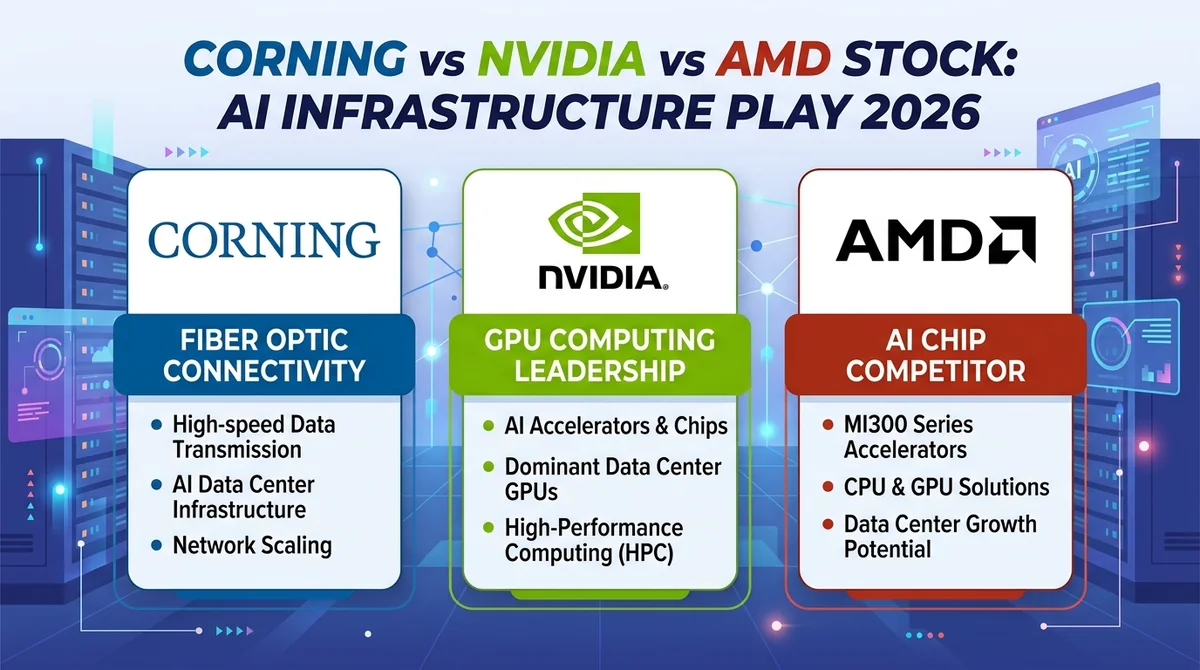
Compare Corning, Nvidia, and AMD stocks on AI growth drivers, valuation, risks, and investor fit. See the key differences to make a smarter 2026 decision.
#Corning vs Nvidia vs AMD Stock: Which AI Infrastructure Play Fits Your Portfolio in 2026?
Direct answer: Corning, Nvidia, and AMD all benefit from the AI boom, but they play very different roles. Nvidia dominates AI compute with its GPUs and CUDA ecosystem; AMD is the strongest challenger in both CPUs and AI accelerators; Corning supplies the fiber-optic cables that move data inside AI data centers. There is no single "best" stock — the right choice depends on your valuation preference, risk tolerance, and conviction in AI infrastructure trends.
Key Takeaways
- Corning is a specialty glass and ceramics maker whose optical fiber business is surging on AI data center demand.
- Nvidia generates most revenue from data center GPUs, gaming, and professional visualization, with a powerful CUDA moat.
- AMD competes in CPUs, GPUs, and adaptive computing, and its MI300 accelerators are gaining traction as a lower-cost alternative.
- Corning trades at a lower forward P/E than Nvidia or AMD, but its growth rate is also lower.
- Nvidia suits aggressive growth investors; Corning appeals to value investors; AMD offers a middle ground.
#Corning vs Nvidia vs AMD: Key Differences in Business Models
Corning is a specialty glass and ceramics maker with a fast-growing optical fiber segment. Its fiber-optic cables are essential for AI data centers because they transmit data much faster than traditional copper cables. In fact, Corning's Multicore Fiber (MCF) packs four cores into a standard 125-micron strand, quadrupling data capacity. Nvidia, on the other hand, generates most of its revenue from data center GPUs, gaming, and professional visualization. Its GPUs are the de facto standard for AI training, and the CUDA software ecosystem creates strong lock-in. AMD competes in CPUs, GPUs, and adaptive computing, with data center as its fastest-growing segment. Its MI300 series accelerators are gaining traction, offering competitive performance per dollar.
#How Does Corning Make Money in AI Infrastructure?
Corning's optical fiber business is the key AI growth driver. The company supplies fiber-optic cables that connect the advanced chips used in AI development. Demand is surging because AI models now use "reasoning," which requires processing far more data per query — making transfer speeds critical. Corning's MCF product quadruples capacity per strand, giving data center operators a cost-effective way to boost throughput.
#What Are Nvidia's Primary Revenue Segments?
Nvidia's revenue comes mainly from data center GPUs, gaming, and professional visualization. Data center is now the largest and fastest-growing segment, driven by AI training and inference workloads. The CUDA ecosystem makes it hard for competitors to displace Nvidia in AI compute.
#What Are AMD's Key Product Lines?
AMD competes in CPUs, GPUs, and adaptive computing. Its EPYC server CPUs and Instinct MI300 accelerators are the main AI-related products. AMD is positioning itself as a strong second source for AI compute, with a focus on performance per dollar.
#How Do Their AI Growth Drivers Compare?
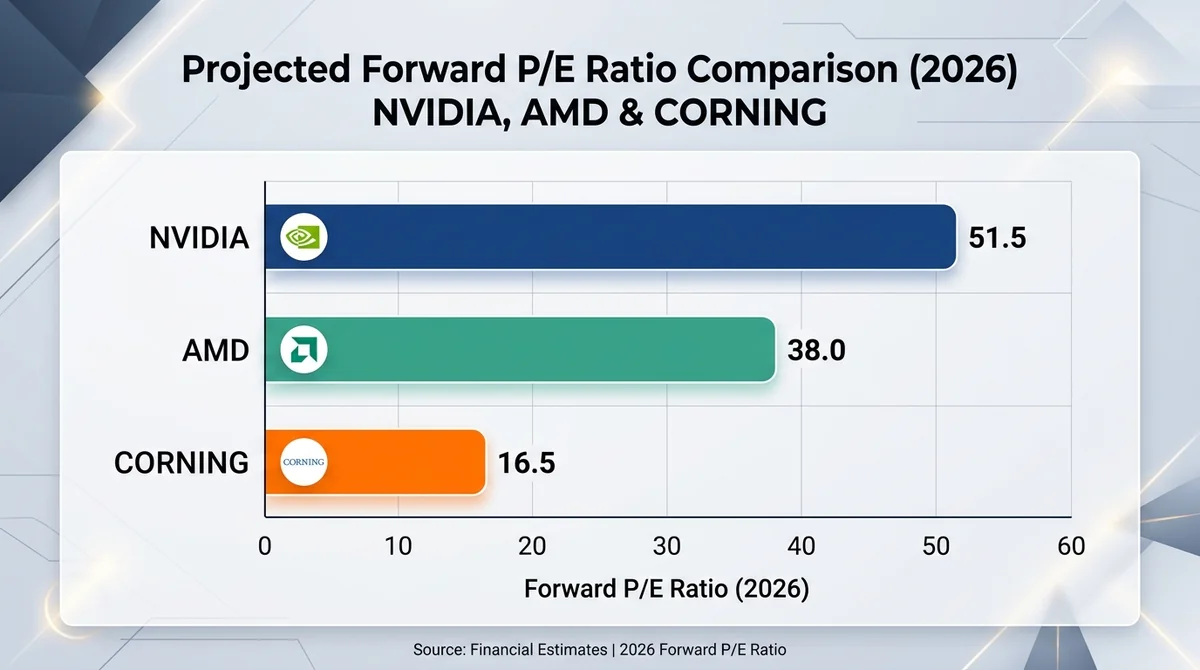
All three companies benefit from AI, but through different channels. Corning benefits from the need for faster data transfer inside data centers. Nvidia benefits from AI compute dominance. AMD benefits from being a growing alternative in AI accelerators.
#Why Is Corning's Optical Fiber Critical for AI?
AI data centers require extremely fast data transfer between GPUs, CPUs, memory, and storage. Fiber-optic cables transmit data faster and over longer distances than copper, with minimal data loss. Corning's Multicore Fiber packs four cores in a standard strand, quadrupling data capacity. This directly addresses the AI industry's need for speed and cost efficiency.
#How Is Nvidia Benefiting from AI Model Training and Inference?
Nvidia's GPUs are the de facto standard for AI training, and the CUDA ecosystem locks in developers. As AI models grow larger and more complex, demand for Nvidia's data center GPUs continues to rise. The company also benefits from inference workloads as AI moves into production.
#What Is AMD's Strategy to Capture AI Market Share?
AMD's MI300 series accelerators are gaining traction by offering competitive performance per dollar. The company is also investing in its ROCm software ecosystem to challenge Nvidia's CUDA moat. AMD's strategy is to be the credible second source for AI compute, especially for customers seeking to avoid vendor lock-in.
#Which Stock Offers Better Valuation Right Now?
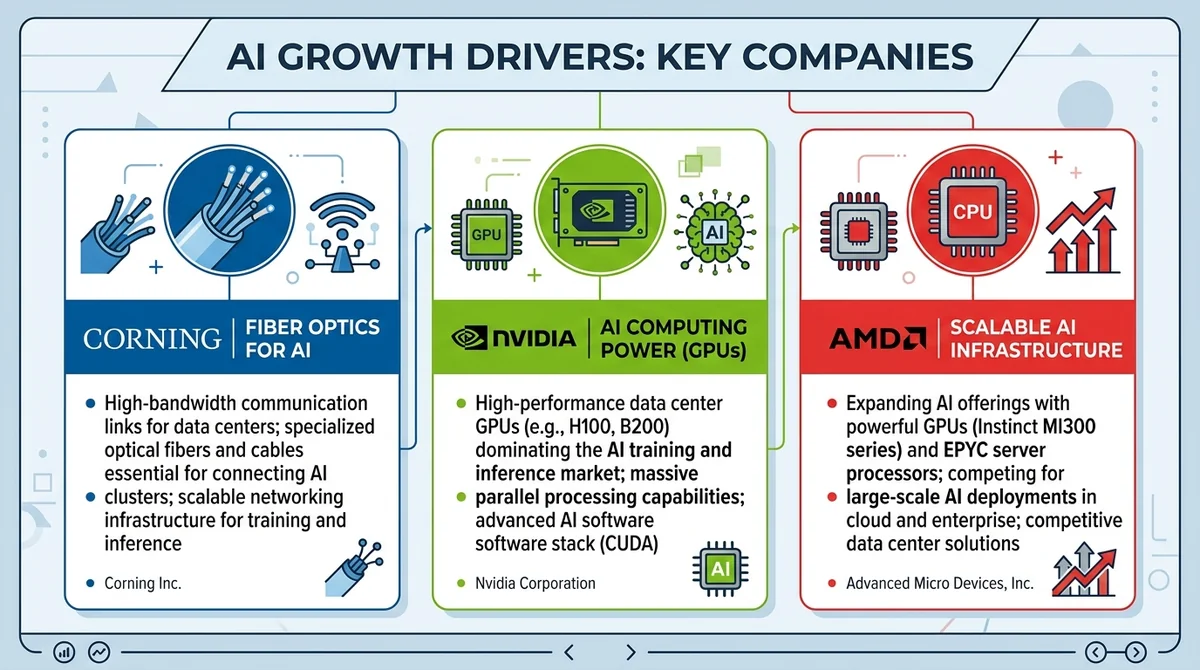
Corning is the cheapest on a trailing basis, but Nvidia and AMD justify higher multiples with faster revenue growth. Corning's forward P/E is lower than Nvidia's and AMD's, but its growth rate is also lower. Nvidia trades at a premium due to its AI leadership, but its PEG ratio may be reasonable. AMD's valuation has compressed after recent pullbacks, but still reflects high growth expectations.
#How Do Forward P/E Ratios Compare?
Corning's forward P/E is lower than Nvidia's and AMD's. However, Nvidia and AMD have much faster expected revenue growth, which supports their higher multiples. Exact forward P/E values are not provided in the source data, so we avoid citing specific numbers.
#What About Price-to-Sales and PEG Ratios?
Price-to-sales and PEG ratios are not explicitly given in the source pages. Qualitatively, Nvidia's premium is justified by its AI leadership, while AMD's valuation has compressed. Corning's lower multiple reflects its slower growth but also its more diversified revenue base.
#Are Any of These Stocks Undervalued Relative to Growth?
Based on the available data, none of the three is clearly undervalued. Corning is cheaper but grows slower; Nvidia and AMD are more expensive but grow faster. Investors must weigh valuation against growth potential.
#What Are the Key Risks for Each Stock?
All three stocks face concentration risk in AI-driven demand, but Corning is more diversified across consumer and industrial end markets.
#What Could Derail Corning's Fiber Optic Growth?
Corning's optical fiber demand depends on data center capex cycles and potential technology shifts. If AI data center spending slows, Corning's growth could stall. The company is also exposed to consumer electronics cycles through its glass business.
#What Risks Does Nvidia Face from Competition and Regulation?
Nvidia faces rising competition from AMD and custom silicon (like Broadcom's AI accelerators). Export restrictions to China also limit a key market. Additionally, any slowdown in AI capex could hit Nvidia's data center revenue.
#What Are AMD's Biggest Execution Challenges?
AMD must execute on its software ecosystem (ROCm) to challenge Nvidia's CUDA moat. If ROCm lags, customers may stick with Nvidia despite higher prices. AMD also faces intense competition in both CPUs and GPUs.
#Which Stock Is Better for Different Investor Profiles?
There is no single "best" stock; the right choice depends on your risk tolerance, valuation preference, and conviction in AI infrastructure trends.
#Best for Growth Investors?
Nvidia suits aggressive growth investors betting on continued AI compute dominance. Its CUDA moat and data center leadership make it the most direct AI play.
#Best for Value Investors?
Corning appeals to value-oriented investors seeking AI infrastructure exposure at a lower multiple. It offers a diversified business with a fast-growing optical fiber segment.
#Best for Balanced AI Exposure?
AMD offers a middle ground with strong growth potential and a more reasonable valuation than Nvidia. It is suitable for investors who want AI exposure but are wary of Nvidia's premium.
#Corning vs Nvidia vs AMD: Fees and Costs of Owning the Stocks
Owning these stocks directly through a broker involves standard brokerage commissions and potential currency conversion fees for non-US investors. Alternatively, tokenized stock products on some crypto exchanges may offer fractional ownership with different fee structures. However, specific fee comparisons are outside the scope of this analysis and are not provided in the source data. Investors should compare brokerage fees and any platform-specific costs before investing.
#Which One Fits You? A Decision Path
- Aggressive growth investor → Nvidia: highest AI compute exposure, highest growth, premium valuation.
- Value-oriented investor → Corning: lower multiple, diversified revenue, AI infrastructure via fiber optics.
- Balanced investor → AMD: strong growth, more reasonable valuation than Nvidia, credible AI challenger.
No single stock is objectively better for everyone. Your choice should align with your risk tolerance and investment horizon.
Disclaimer: This content is for informational purposes only and does not constitute financial advice. Always do your own research before making investment decisions.
FAQ
Which stock is better: Corning, Nvidia, or AMD?
There is no single best stock. Nvidia is the AI compute leader, AMD is a strong challenger, and Corning supplies essential fiber-optic cables for AI data centers. Your choice depends on your valuation preference and risk tolerance.
Is Corning stock a good AI investment?
Corning offers AI infrastructure exposure through its optical fiber business, which is growing rapidly due to data center demand. It trades at a lower valuation than Nvidia or AMD, making it appealing to value-oriented investors.
What are the main risks of investing in Nvidia?
Nvidia faces rising competition from AMD and custom silicon, export restrictions to China, and potential slowdowns in AI capital expenditure. Its premium valuation also leaves less room for error.
How does AMD compete with Nvidia in AI?
AMD's MI300 accelerators offer competitive performance per dollar, and the company is investing in its ROCm software ecosystem to challenge Nvidia's CUDA moat. AMD aims to be a credible second source for AI compute.
Why is Corning stock rising?
Corning's stock has surged because its fiber-optic cables are essential for AI data centers. The company's Multicore Fiber quadruples data capacity, and demand is soaring as AI models require faster data transfer.
Done comparing? Ready to place your first trade?
The crypto assets, tokenized US stocks and ETFs you just compared are all tradable on MSX — spot or perpetuals.
Quick Start Trading →New here? Registration takes three quick steps.