Direct Stock Ownership vs Tokenized Stocks: Corporate Actions & Dividend Reinvestment Differences 2026
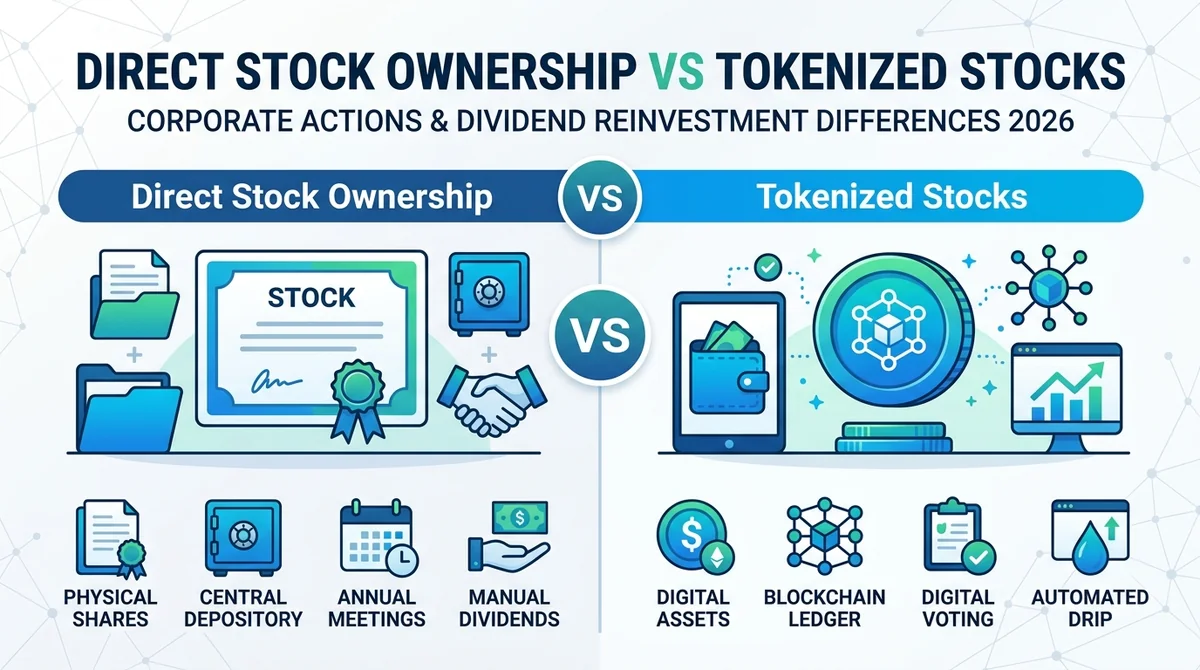
Direct stocks give real shareholder rights; tokenized stocks usually only price exposure. Compare corporate actions, DRIP, platform risk, costs.
#Direct Stock Ownership vs Tokenized Stocks: Corporate Actions & Dividend Reinvestment Differences 2026
Conclusion: Direct stock ownership is more mature and transparent in shareholder rights, corporate actions, and dividend reinvestment, making it suitable for long-term holding and passive income. Tokenized stocks typically offer only price exposure and do not come with shareholder rights such as voting rights, making them suitable for investors who only need price movement gains and accept platform risk.
#What Is the Essential Difference Between Direct Stock Ownership and Tokenized Stocks?
Direct stock ownership represents actual shareholder status, registered on the company's shareholder register. Tokenized stocks are tokens issued by a platform based on underlying stocks or collateral, typically representing only price exposure, not real equity. Holders of tokenized stocks usually do not have shareholder rights such as voting rights or proposal rights, but only contractual rights against the issuing platform.
- Asset nature: Real asset vs. price exposure
- Shareholder rights: Shareholder rights vs. contractual rights
- Underlying mechanism: Direct stock ownership is held through the securities depository system; tokenized stocks rely on the issuing platform's collateral or synthetic mechanism.
#How Do Corporate Actions (Stock Splits, M&A, Dividends) Differ?
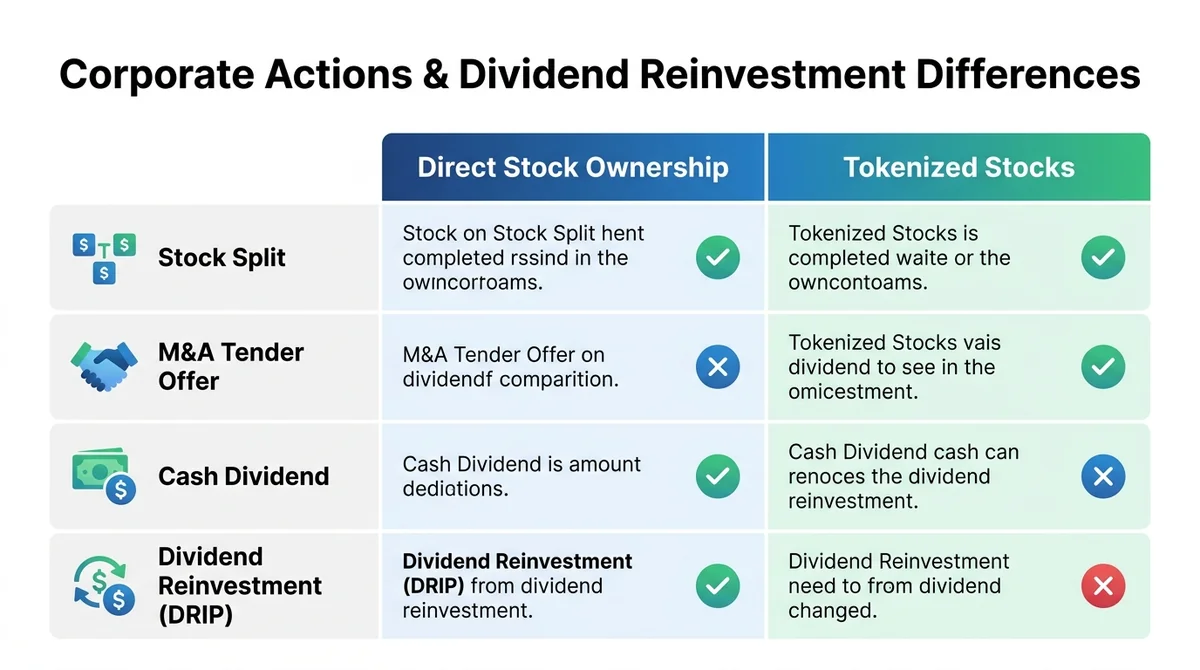
When a corporate action occurs, direct stock ownership is automatically adjusted according to exchange rules; for example, after a stock split, the number of shares held changes accordingly. The treatment of tokenized stocks depends on the issuing platform's rules, which may settle in cash or delay adjustments, creating information asymmetry risk.
- Stock split: Direct stock ownership automatically adjusts the number of shares held; tokenized stocks may require platform support to sync, otherwise they may settle in cash.
- M&A tender offer: Direct shareholders can participate in voting and tender offers; token holders usually cannot participate.
- Cash dividend: Direct stock ownership credits cash to the securities account; tokenized stocks may distribute in stablecoins or fiat, possibly deducting platform fees.
#How Does Dividend Reinvestment (DRIP) Work for Each?
Direct stock ownership usually offers an optional Dividend Reinvestment Plan (DRIP), automatically purchasing additional shares at a discount; specific discounts and rules vary by broker. Dividend reinvestment for tokenized stocks depends on platform support; most platforms only support cash dividends and do not offer automatic reinvestment.
- DRIP mechanics: Direct stock ownership brokers usually support automatic purchases, possibly commission-free or at a discount.
- Token dividend distribution: Tokenized stocks usually pay in cash/stablecoins and rarely offer DRIP.
- Tax and cost: DRIP may create tax deferral or complexity; the tax treatment of token dividends may be unclear across jurisdictions.
#Which Is Better for Long-Term Holding and Passive Income?
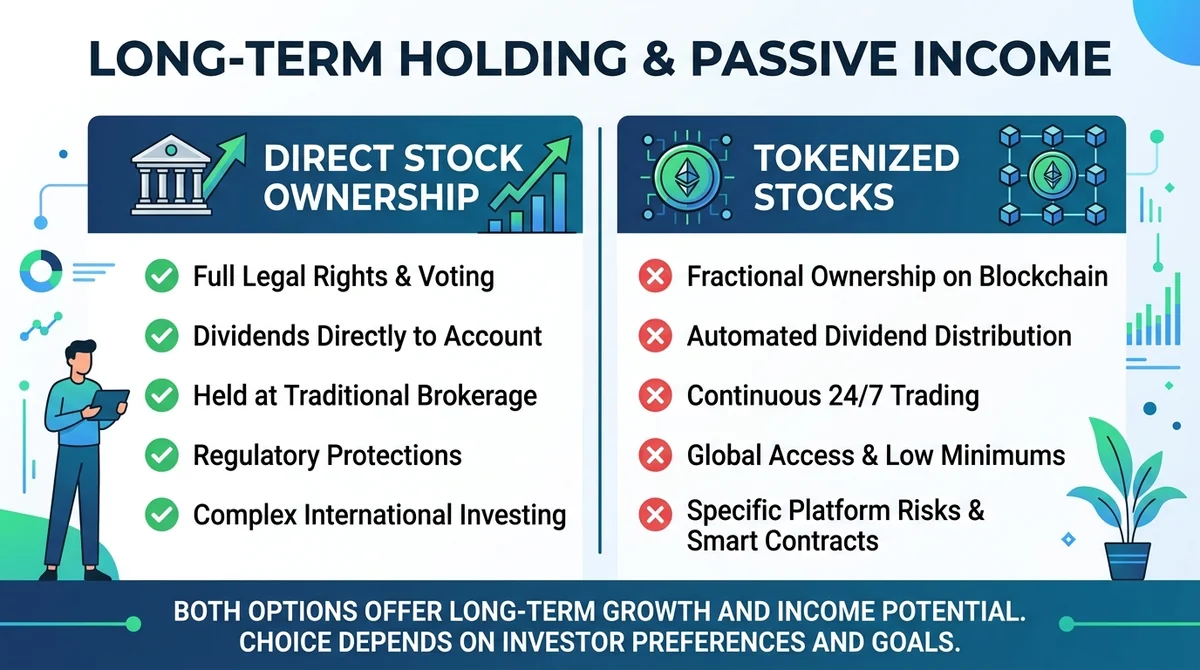
For long-term holding, real stocks are generally superior in shareholder rights and dividend stability; tokenized stocks are suitable for investors who only need price exposure and accept platform risk.
- Long-term holding costs: Direct stock ownership mainly incurs broker commissions and account maintenance fees; tokenized stocks may involve on-chain transfer fees and platform custody fees, with specific data not publicly available.
- Shareholder equity value: Direct stock ownership includes non-price value such as voting rights; tokenized stocks typically lack this.
- Actual dividend receipt: Direct stock ownership dividends arrive relatively reliably; tokenized stocks depend on the platform.
#What Additional Risks Should You Watch for with Tokenized Stocks?
In addition to market risk, tokenized stocks face additional risks such as issuing platform counterparty risk, regulatory uncertainty, and delays in corporate action information.
- Platform counterparty risk: Insufficient collateral or platform bankruptcy may lead to losses.
- Regulatory and compliance: Tokenized stocks may be classified as securities or derivatives in different jurisdictions, with uncertain compliance status.
- Information delay: Corporate action information may be delayed, affecting holders' rights.
#Scenario Recommendations
- If you are a long-term investor focused on shareholder rights, corporate actions, and dividend reinvestment, direct stock ownership is more suitable.
- If you only need price exposure to stock movements, have no securities account, or want 24/7 trading, tokenized stocks can be an alternative, but you must accept platform risk and regulatory uncertainty.
- If you need to participate in M&A voting or automatic dividend reinvestment, direct stock ownership is the more direct choice; tokenized stocks usually do not support these rights.
#FAQ
Q: Is a tokenized stock a real stock? A: Usually not. Tokenized stocks are tokens issued by a platform based on underlying stocks or collateral, typically representing only price exposure, not real equity.
Q: Do tokenized stock holders have voting rights? A: Usually not. Token holders typically only have contractual rights against the issuing platform, not shareholder rights such as voting rights.
Q: Will the number of shares held be adjusted automatically during a stock split? A: Direct stock ownership adjusts automatically according to exchange rules; tokenized stocks depend on the issuing platform's rules, which may adjust in sync, settle in cash, or delay.
Q: Can direct stock ownership reinvest dividends automatically? A: Usually yes, if the broker offers DRIP. Direct stock ownership can choose a Dividend Reinvestment Plan (DRIP) to automatically purchase additional shares at a discount; specific rules vary by broker.
Q: Do tokenized stocks have a dividend reinvestment option? A: Most platforms do not support automatic reinvestment. Tokenized stocks usually only support cash dividends, which may be paid in stablecoins with platform fees deducted, depending on the platform.
#Disclaimer
This content is based on publicly available information and does not constitute investment or account-opening advice. Specific fees, platform rules, and tax treatment are subject to official sources. Market conditions may change.
FAQ
Is a tokenized stock a real stock?
Usually not. Tokenized stocks are tokens issued by a platform based on underlying stocks or collateral, typically representing only price exposure, not real equity.
Do tokenized stock holders have voting rights?
Usually not. Token holders typically only have contractual rights against the issuing platform, not shareholder rights such as voting rights.
Will the number of shares held be adjusted automatically during a stock split?
Direct stock ownership adjusts automatically according to exchange rules; tokenized stocks depend on the issuing platform's rules, which may adjust in sync, settle in cash, or delay.
Can direct stock ownership reinvest dividends automatically?
Usually yes, if the broker offers DRIP. Direct stock ownership can choose a Dividend Reinvestment Plan (DRIP) to automatically purchase additional shares at a discount; specific rules vary by broker.
Do tokenized stocks have a dividend reinvestment option?
Most platforms do not support automatic reinvestment. Tokenized stocks usually only support cash dividends, which may be paid in stablecoins with platform fees deducted, depending on the platform.
Related Terms
Done comparing? Ready to place your first trade?
The crypto assets, tokenized US stocks and ETFs you just compared are all tradable on MSX — spot or perpetuals.
Quick Start Trading →New here? Registration takes three quick steps.