Direct Stock Ownership vs Tokenized Stocks: Ownership, Tax, and Platform Risk 2026
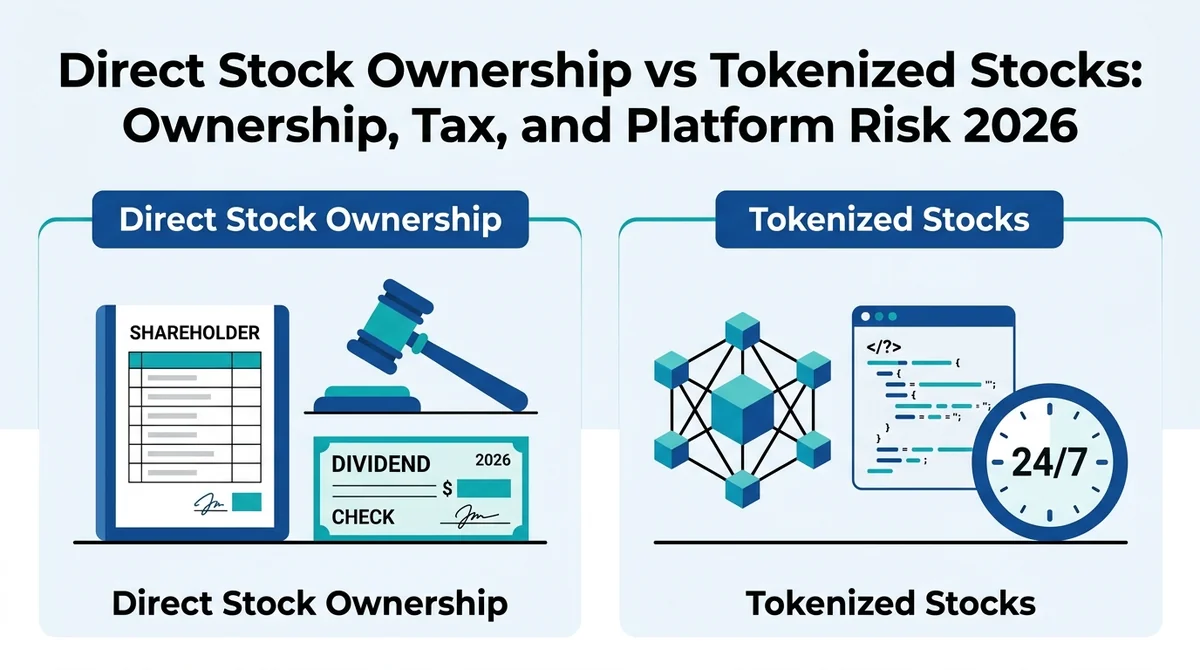
Direct and tokenized stocks differ in ownership, tax, platform risk, and use cases. MSX Compare analysts break down each dimension for 2026.
Conclusion: If you prioritize legal clarity and low platform risk, choose direct stock ownership. If you seek 24/7 liquidity, fractional investing, and cross-border convenience, tokenized stocks may be an option, but you must accept platform and regulatory uncertainty. Tokenized stocks are not a single product; actual rights depend on whether they are asset-backed tokens, synthetic tokens, or other structures.
Comparison Table
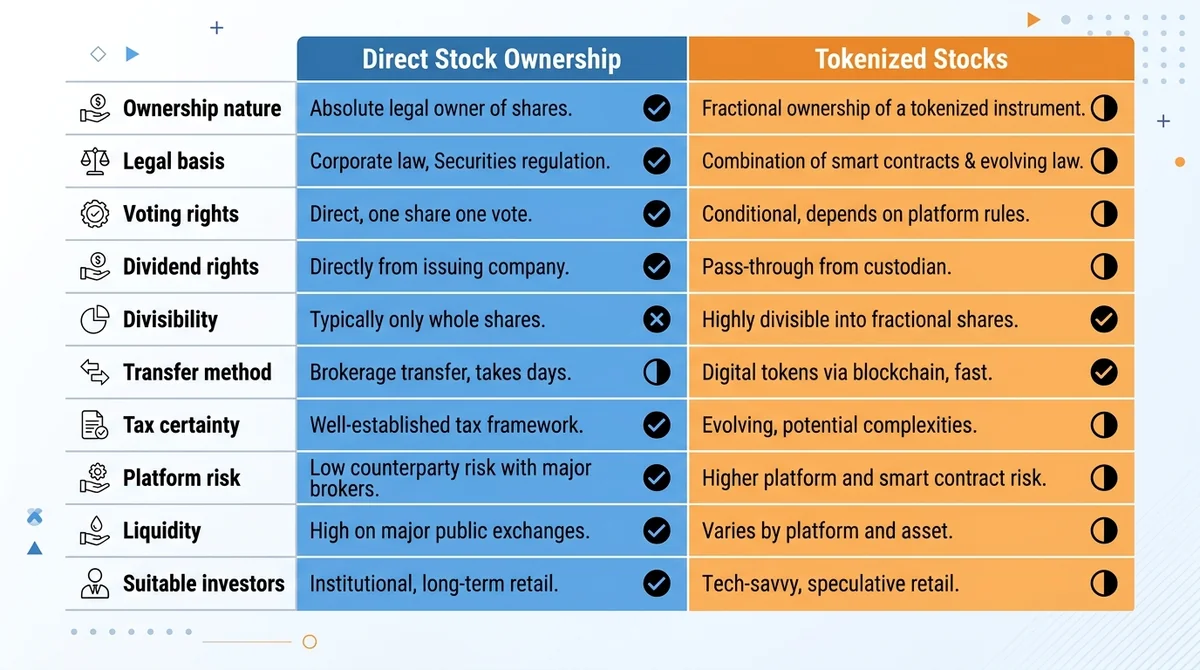
| Dimension | Direct Stock Ownership | Tokenized Stocks |
|---|---|---|
| Ownership nature | Recorded in the shareholder register; directly confirmed by law | Blockchain tokens map to share interests or synthetic exposure; legal validity depends on underlying structure |
| Legal basis | Clear under company/securities law | Depends on compliant structure; may be subject to securities, commodities, or new asset regulations |
| Voting rights | Usually fully retained | Depends on tokenization scheme; may be restricted or exercised by custodians (unverified) |
| Dividend rights | Receive dividends directly | Distributed via smart contracts or platform; may have delays or fees |
| Divisibility | Limited by share par value and exchange lot size, though some brokers support fractional shares | Can be divided to multiple decimal places, lowering the entry barrier |
| Transfer method | Through brokers/exchanges; requires settlement cycle | On-chain peer-to-peer, 24/7, no traditional settlement (but withdrawals may be restricted) |
| Tax certainty | Mature rules; dividend tax and capital gains tax are clear | Tax treatment varies by jurisdiction; higher uncertainty |
| Platform risk | Broker/custodian risk, covered by investor protection schemes | Additional risks such as smart contract vulnerabilities, exchange custody, and insufficient liquidity |
| Liquidity | Affected by trading hours; depth is usually better | Can trade 24/7, but niche tokens may have insufficient depth (unverified) |
| Suitable investors | Large, long-term, compliance-first investors | Small, high-frequency, cross-border investors who accept emerging risks |
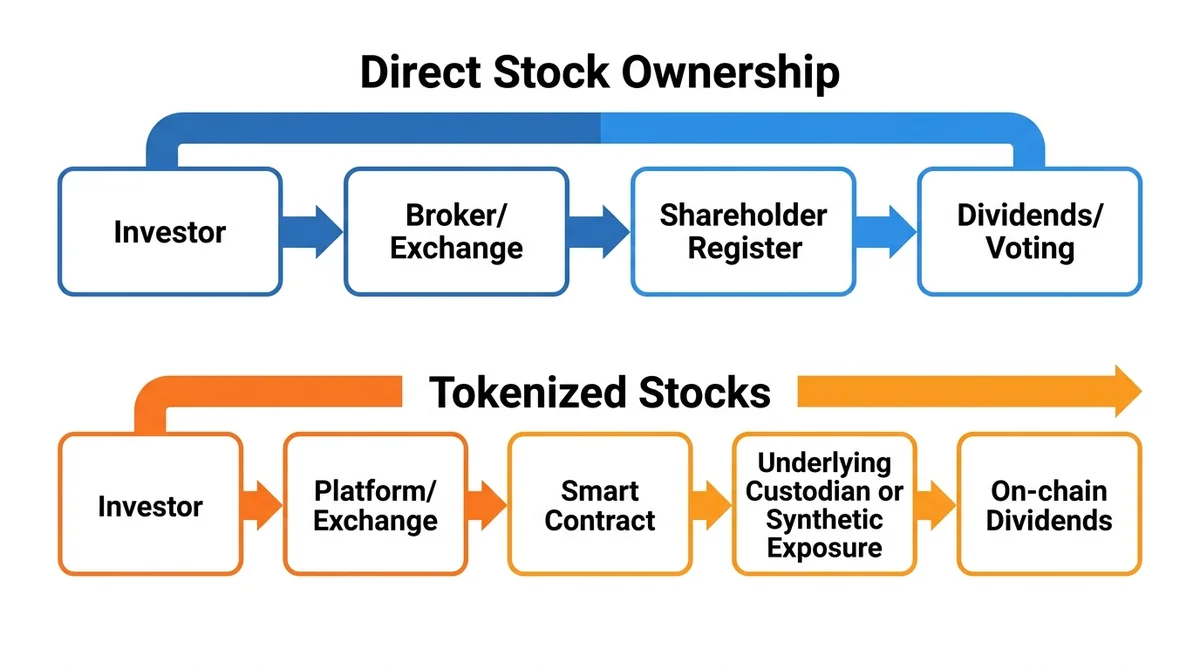
Ownership nature: In direct stock ownership, registration in the shareholder register carries final legal effect. Tokenized stock tokens may be asset-backed (with underlying real shares held in custody) or synthetic (price exposure only); actual rights depend on the contractual arrangement between the issuer and custodian. Legal basis: Direct stock ownership is protected by securities law. Tokenization may span multiple jurisdictions; the boundary of regulatory classification is still evolving, and different structures may receive different legal treatment. Voting rights: Most tokenization schemes keep voting rights with the underlying share holder or delegate them through the platform; token holders may not be able to exercise them directly (this statement lacks specific statistical support). Dividend rights: Direct stock ownership has a clear dividend path; tokenized dividends require on-chain distribution and may incur gas fees and delays. Divisibility: Tokenization inherently supports fractionalization, lowering the investment threshold; direct stock ownership usually requires whole shares, though some brokers support fractional shares with more restrictions. Transfer method: Direct stock transfers require brokers and clearing houses, with settlement cycles varying by market (e.g., U.S. stocks T+1); tokenized stocks can settle on-chain but are affected by network congestion and confirmation times, and fiat withdrawals may take days. Tax certainty: Direct stock ownership has mature tax rules, but specific rates vary by residency status; tokenized tax classification is not unified and may be treated as securities, commodities, or income rights, increasing filing complexity. Platform risk: Direct stock ownership platform risk is mainly broker bankruptcy risk, with investor protection in most jurisdictions; tokenized stocks carry additional exposure to smart contract vulnerabilities, private key loss, and exchange custody risk, and tokenization platforms may not receive equivalent protection. Liquidity: Both may experience insufficient liquidity, but tokenized market depth is usually shallower and spreads may be wider (lacking cross-market quantitative data); tokenized stocks trade 24/7, while direct stock ownership is limited by exchange hours. For further reading, see Tokenized US Stocks vs Real US Stocks 2026: Spread, Slippage, and Settlement Time Comparison and NVIDIA Tokenized Stock Contract vs Real NVIDIA Stock 2026: Trading Hours, Dividends, and Settlement Comparison. Platform competition: Tokenized stock infrastructure is evolving; see Tokenized Stock Competition: Broker-Backed L2 vs Exchange L2 DeFi Route Battle.
Scenario Recommendations
Best for direct stock ownership: You are a long-term investor with a large holding, need voting and dividend rights delivered directly, have a simple tax status, prioritize legal clarity, and do not want to take on smart contract and private key management risks.
Best for tokenized stocks: You are a small investor who wants to participate in high-priced stocks with a low entry barrier; need instant trading across time zones and prefer 24/7 liquidity; and have understood and accepted the risks of platform custody, smart contracts, and regulatory uncertainty. Note: Some traditional brokers also offer fractional shares, which may be an alternative without taking on additional risk.
FAQ
Q1: Are tokenized stocks equivalent to real stocks? A1: Not exactly. Tokenized stocks may represent economic interests in underlying shares, or they may be synthetic exposure that only tracks prices; legal ownership, voting rights, and dividend rights may be limited by the tokenization scheme and custody arrangements.
Q2: Which has lower tax burden: direct stock ownership or tokenized stocks? A2: There is no absolute answer. Direct stock ownership has relatively clear tax rules, but actual tax burden depends on holding period, residency status, and jurisdiction. Tokenized tax classification varies greatly by platform architecture and legal jurisdiction, introducing significant uncertainty; consult a professional.
Q3: What happens if a tokenized stock platform collapses? A3: It depends on whether the platform uses a custodial or non-custodial architecture. In centralized custody, assets may be frozen, misappropriated, or caught up in bankruptcy proceedings; smart contract vulnerabilities may also cause asset loss, and investor protection is usually weaker than traditional brokers.
Q4: Can tokenized stocks be converted back to real stocks at any time? A4: It depends on the specific tokenization scheme. Some asset-backed schemes allow redemption of underlying shares, usually with thresholds, fees, and time limits; synthetic schemes only provide price exposure and cannot be converted.
Q5: Can direct stock ownership be transferred through tokenization? A5: In theory, you could first custody the stocks with a compliant issuer, then issue tokens for on-chain transfer, but KYC/AML and compliance procedures are required, making it practically difficult.
This content is based on publicly available data and does not constitute investment or account-opening advice. Data is current as of 2026-09-01 and may change.
FAQ
Are tokenized stocks equivalent to real stocks?
Not exactly. Tokenized stocks may represent economic interests in underlying shares, or they may be synthetic exposure that only tracks prices; legal ownership, voting rights, and dividend rights may be limited by the tokenization scheme and custody arrangements.
Which has lower tax burden: direct stock ownership or tokenized stocks?
There is no absolute answer. Direct stock ownership has relatively clear tax rules, but actual tax burden depends on holding period, residency status, and jurisdiction. Tokenized tax classification varies greatly by platform architecture and legal jurisdiction, introducing significant uncertainty; consult a professional.
What happens if a tokenized stock platform collapses?
It depends on whether the platform uses a custodial or non-custodial architecture. In centralized custody, assets may be frozen, misappropriated, or caught up in bankruptcy proceedings; smart contract vulnerabilities may also cause asset loss, and investor protection is usually weaker than traditional brokers.
Can tokenized stocks be converted back to real stocks at any time?
It depends on the specific tokenization scheme. Some asset-backed schemes allow redemption of underlying shares, usually with thresholds, fees, and time limits; synthetic schemes only provide price exposure and cannot be converted.
Can direct stock ownership be transferred through tokenization?
In theory, you could first custody the stocks with a compliant issuer, then issue tokens for on-chain transfer, but KYC/AML and compliance procedures are required, making it practically difficult.
Related Terms
Done comparing? Ready to place your first trade?
The crypto assets, tokenized US stocks and ETFs you just compared are all tradable on MSX — spot or perpetuals.
Quick Start Trading →New here? Registration takes three quick steps.