DOGE Spot vs. Derivatives Liquidity Compared
Compare DOGE spot and perpetual liquidity via order book depth, spreads, open interest, funding rates and liquidation mechanics, plus tokenized stock volatility.
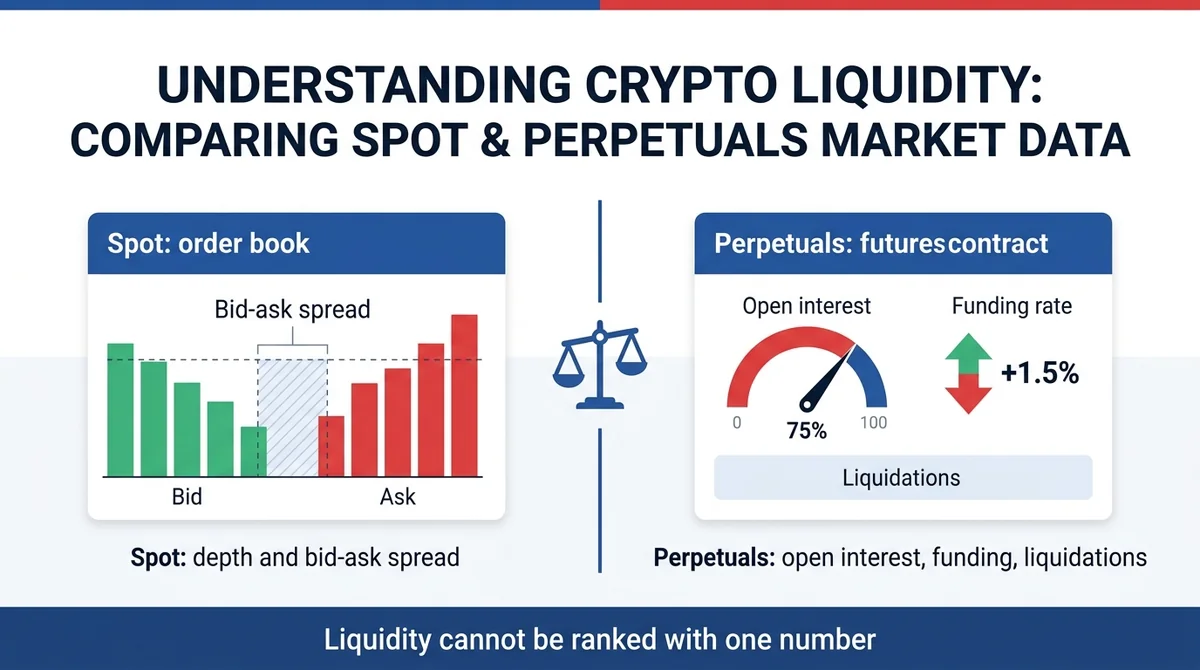
Bottom line: DOGE spot and derivatives are not the same asset class, and their liquidity cannot be ranked with a single number — spot liquidity is about order book depth and bid-ask spreads, while perpetuals add open interest, how does perpetual futures funding rate work, and liquidation mechanics. Users who want to hold DOGE long term without liquidation risk should look at spot; only users pursuing two-way long/short exposure and perpetual futures leverage, and who can tolerate liquidation risk, should consider perpetuals.
#What exactly is the difference between DOGE spot and derivatives?
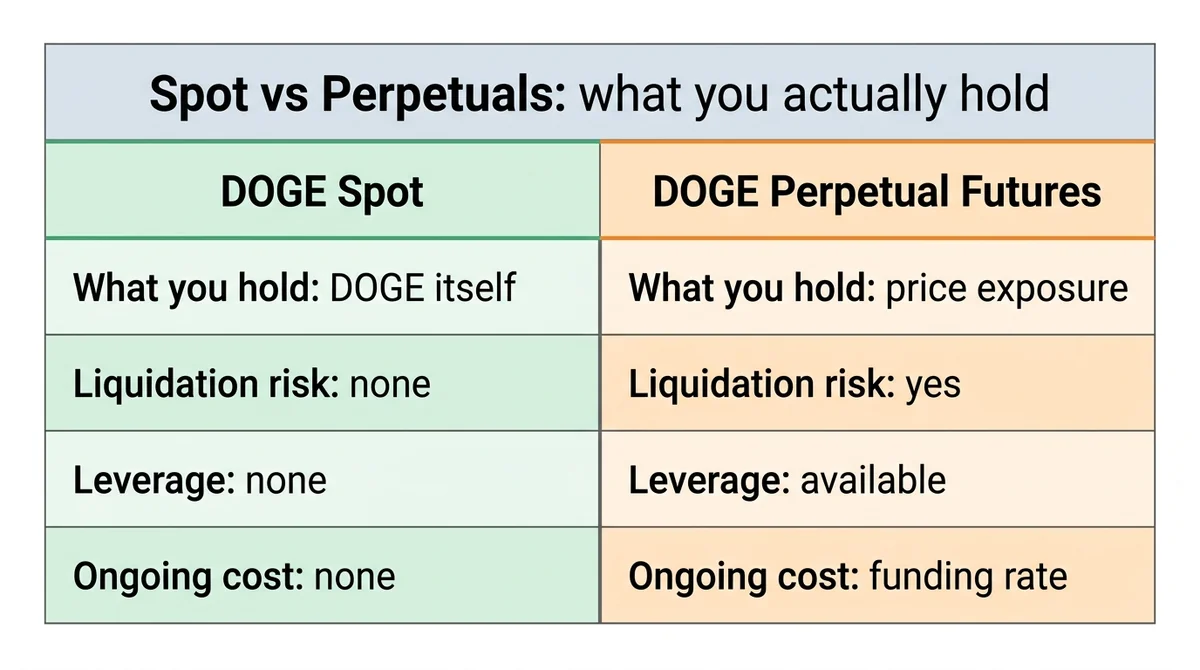
One-line distinction: DOGE spot means buying and holding DOGE itself, whereas DOGE derivatives (perpetual futures) are leveraged price contracts with no expiry date that anchor to the spot price through funding. The object you hold is fundamentally different.
#What does spot hold, and what do derivatives trade?
After a spot trade settles, the DOGE in your account is the asset itself, and price moves show up directly in the market value of your holdings; there is no forced liquidation mechanism. A perpetual futures contract trades a price exposure: you do not hold DOGE, you only bet on DOGE's price direction, and profit and loss are amplified by contract notional and perpetual futures leverage.
#Why do perpetual futures have no expiry date?
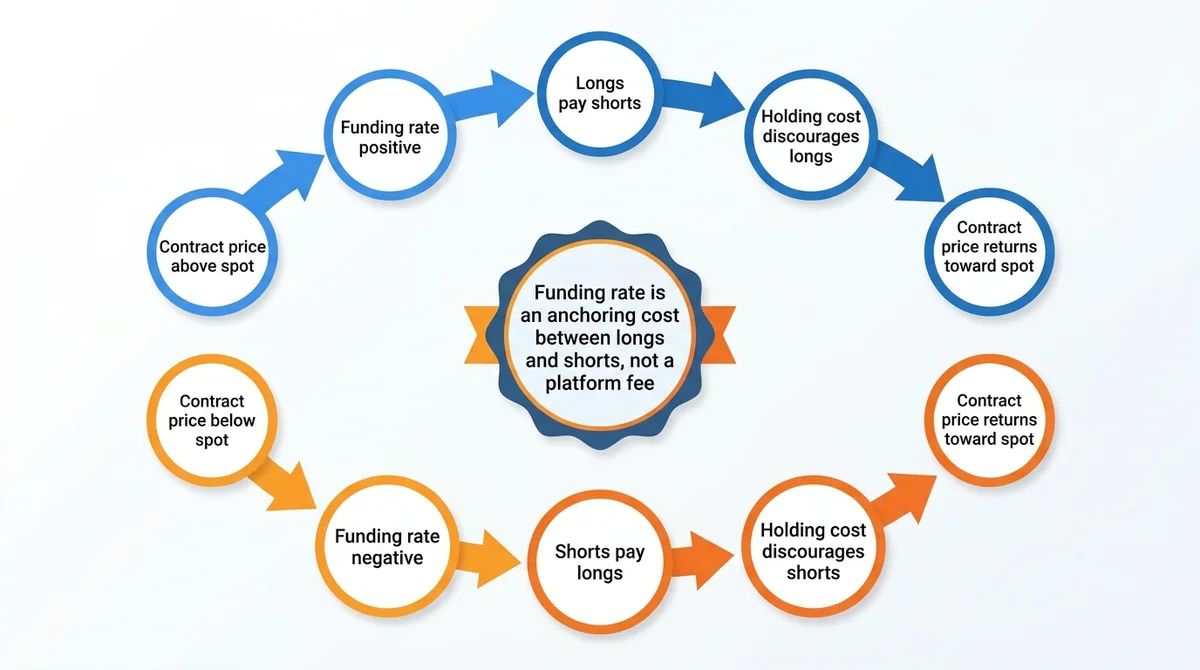
Traditional futures have a delivery date, and at expiry you must settle or roll over. Perpetual futures remove the expiry date and instead use the perpetual futures funding rate settlement schedule to periodically transfer costs between longs and shorts, so that the contract price does not drift far from spot for long.
#How does funding pull the contract price back to spot?
When the contract price is above spot, the funding rate is usually positive, and longs pay shorts; the higher holding cost discourages long positions and encourages shorts, pushing the contract price back toward spot — and vice versa. Note: the funding rate is an anchoring cost between longs and shorts, not a platform fee; it does not become exchange revenue but is transferred between position holders.
#How should DOGE spot and derivatives liquidity be compared?
One-line method: Compare DOGE spot and derivatives liquidity dimension by dimension — spot looks at depth and bid-ask spreads, while derivatives also require open interest, funding rates and liquidation mechanics; the metrics differ, so they cannot be ranked with a single number.
#Which metrics matter: depth, bid-ask spread or open interest?
- Order book depth: the notional amount executable within a certain percentage of the mid price, measuring the impact cost of large orders.
- Bid-ask spread: the difference between the best bid and best ask, measuring the friction cost of immediate execution.
- Open interest (open contracts): applies only to derivatives, measuring outstanding market risk and crowding in closing.
- Funding rate: applies only to perpetuals, measuring the ongoing cost of holding a directional exposure.
#Why can't spot depth and contract depth be compared directly?
Spot depth corresponds to delivery of the real asset, while contract depth corresponds to margin-backed exposure. For the same notional amount, the contract market may require only a small amount of margin to establish a position, so contract notional depth is naturally larger — but this does not mean liquidity is better; it also means more leverage buildup and more concentrated liquidation risk. The two should be presented side by side, not merged into a single ranking.
#Are funding rates and leverage costs part of liquidity cost?
Strictly speaking, the funding rate is a holding cost rather than a liquidity cost, but in practice it affects willingness to hold and order placement behavior, and thus indirectly affects depth. It is therefore advisable to list "trading friction cost (spread + fees)" and "holding cost (funding rate)" separately.
Data note: This article does not provide specific exchange figures for DOGE spot depth, contract open interest or funding rates, because those fields were not disclosed in this data source; for actual comparisons, refer to each platform's live market page and official fee page.
#How does the volatility of DOGE differ from LTC tokenized stocks?
One-line distinction: DOGE's volatility comes from supply and demand within the crypto market itself, whereas tokenized stocks (including LTC-related tokenized instruments) derive their volatility from real US stock prices — the token price is only the result — and tokenized stock perpetuals sit even further from the real stock.
#Where does DOGE's volatility come from?
DOGE has no underlying cash flow or earnings support; its price is driven mainly by supply and demand, sentiment and capital rotation within the crypto market, and its volatility is usually higher than that of assets anchored by fundamentals.
#Why does tokenized stock volatility follow US stocks?
The price exposure of tokenized stocks tracks real US stocks: the US stock price is the cause, and the token price is the effect. Its volatility rhythm is therefore shaped by US trading hours, earnings and macro data, and is out of sync with the crypto market's own 24/7 sentiment cycle.
#How far are tokenized stock perpetuals from real stocks?
Tokenized stock perpetuals are derivatives, adding perpetual futures leverage, funding rates and liquidation mechanics, and are further from the shareholder status and corporate-action rights of real stocks. For this layer of difference, see our comparison of tokenized stock perpetual vs tokenized stock perpetual settlement and dividends.
#Who should choose DOGE spot, and who should choose DOGE derivatives?
One-line split: Users who want to hold DOGE long term and avoid liquidation risk are suited to spot; only users pursuing two-way long/short exposure and leverage efficiency, and who can tolerate liquidation risk, should consider DOGE derivatives.
#Which should I choose if I want to hold DOGE long term?
Choose spot. The longer the holding period, the more the cumulative funding cost matters, and spot has no liquidation price, so you will not be forced out by short-term volatility.
#Which should I choose for long/short trading with leverage?
Choose perpetual futures. Perpetuals are one of the relatively low-cost tools for expressing a bearish view, and require no borrowing of coins. But you must predefine your liquidation price and maximum acceptable loss.
#How do I judge my risk tolerance?
Self-check with three questions: Can you accept losing your entire principal? Can you monitor the market daily to manage margin? Do you understand the positive and negative direction of the funding rate? If any answer is no, stay with spot.
#What risks should I watch when trading DOGE derivatives?
One-line warning: DOGE derivatives with perpetual futures leverage amplify gains and losses; an adverse price move may trigger liquidation or a total loss, and you must keep paying the funding rate — both cost and risk are higher than spot.
#Why does leverage amplify losses?
Leverage amplifies gains and losses proportionally. At 10x perpetual futures leverage, an adverse move of about 10% in the underlying price can wipe out your entire margin (excluding fees and funding), rather than losing only 10%.
#How do liquidation and total loss happen?
When the TRUMPUSDT perpetual futures margin requirements explained threshold is breached, the position is forcibly closed; in extreme markets or when liquidity is thin, liquidation may execute at a worse price, causing additional losses.
#How important is the ongoing cost of funding?
A single funding payment looks small, but accumulated daily and multiplied by perpetual futures leverage, its cost impact on long holding periods can exceed trading fees. For a position that is directionally right but slow to pay off, funding can eat all the profit.
#FAQ
Q1: Between DOGE spot and perpetual futures, which has better liquidity? A: They cannot be compared directly. Spot liquidity looks at order book depth and bid-ask spreads, while perpetual liquidity also requires open interest, funding rates and liquidation mechanics; the metrics differ, so they should be presented side by side by dimension rather than as a single ranking.
Q2: Is the funding rate a fee charged by the exchange? A: No. The funding rate is a periodic transfer payment between longs and shorts, used to anchor the contract price back to the spot price, and does not become platform fee revenue.
Q3: Can holding DOGE spot be liquidated? A: No. Spot involves no margin or leverage and has no liquidation mechanism; however, a price decline still causes market value losses.
Q4: Is tokenized stock volatility the same as DOGE's? A: No. DOGE volatility comes from supply, demand and sentiment within the crypto market; tokenized stock price exposure tracks real US stocks, where the US stock price is the cause and the token price is the effect.
Q5: Since perpetual futures have no expiry date, can I hold them indefinitely? A: Technically yes, but you must keep paying or receiving the funding rate, and you will be liquidated if margin is insufficient; the actual cost and risk of long-term holding must be calculated separately.
#Risk Warning and Disclaimer
This article only compares DOGE spot and derivatives conceptually and by dimension; it is not investment advice, does not predict prices, and does not recommend buying any instrument. Derivatives trading carries the risk of total loss of principal. To verify specific fee and depth figures, refer to each platform's official source pages.
This content is compiled from public information and does not constitute investment or open account advice. It does not cite live depth, open interest or funding rate figures from any specific exchange; refer to each platform's official pages for such data.
FAQ
Between DOGE spot and perpetual futures, which has better liquidity?
They cannot be compared directly. Spot liquidity looks at order book depth and bid-ask spreads, while perpetual liquidity also requires open interest, funding rates and liquidation mechanics; the metrics differ, so they should be presented side by side by dimension rather than as a single ranking.
Is the funding rate a fee charged by the exchange?
No. The funding rate is a periodic transfer payment between longs and shorts, used to anchor the contract price back to the spot price, and does not become platform fee revenue.
Can holding DOGE spot be liquidated?
No. Spot involves no margin or leverage and has no liquidation mechanism; however, a price decline still causes market value losses.
Is tokenized stock volatility the same as DOGE's?
No. DOGE volatility comes from supply, demand and sentiment within the crypto market; tokenized stock price exposure tracks real US stocks, where the US stock price is the cause and the token price is the effect.
Since perpetual futures have no expiry date, can I hold them indefinitely?
Technically yes, but you must keep paying or receiving the funding rate, and you will be liquidated if margin is insufficient; the actual cost and risk of long-term holding must be calculated separately.
Related Terms
Done comparing? Ready to place your first trade?
The crypto assets, tokenized US stocks and ETFs you just compared are all tradable on MSX — spot or perpetuals.
Quick Start Trading →New here? Registration takes three quick steps.