EquityZen vs Forge: 2026 Pre-IPO Platform Liquidity Depth and Execution Efficiency Compared
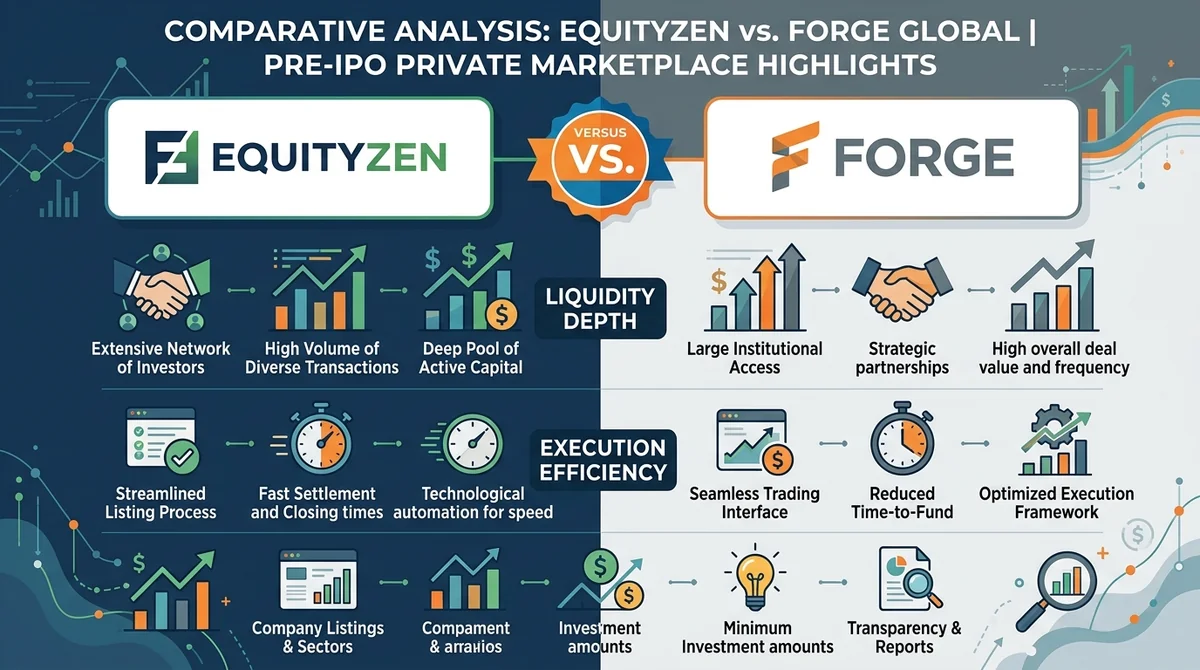
Compare EquityZen and Forge order book structure, liquidity depth, execution efficiency, and target users. Objective analysis based on public info.
Conclusion: Individual accredited investors and small orders should prioritize EquityZen; institutional investors and large orders should prioritize Forge. Forge's continuous order book and institutional participation deliver deeper liquidity, while EquityZen's batch auction model concentrates depth in specific assets. Data as of 2026-02-28, for reference only, not investment advice.
#What are the fundamental differences in liquidity depth between EquityZen and Forge?
| Dimension | EquityZen | Forge |
|---|---|---|
| Order book structure | Periodic batch auctions | Continuous order book |
| Liquidity characteristics | Concentrated depth in specific assets | Overall deeper, high institutional participation |
| Target users | Individual accredited investors, small orders | Institutional investors, large orders |
| Execution efficiency | Fast execution after matching, but wait for auction window | Instant matching, large orders may need splitting |
| Price discovery | Concentrated bidding, lower volatility | Real-time price discovery, large orders may face slippage |
#Order book structure: batch auctions vs continuous order book
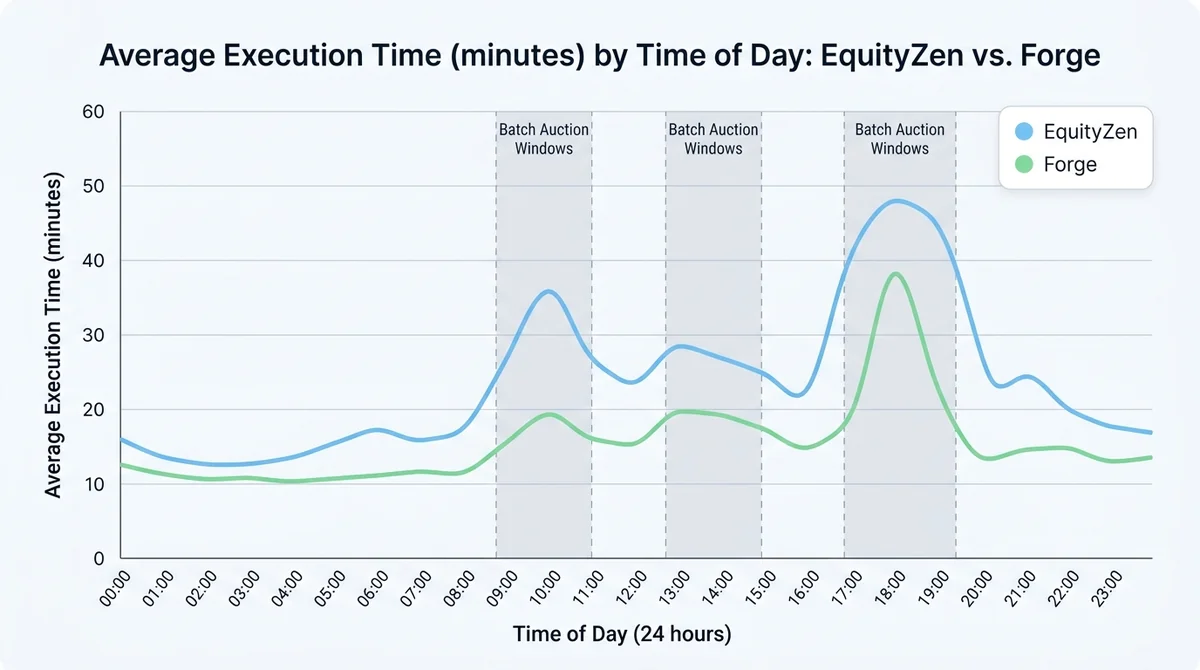
EquityZen uses a periodic batch auction model, while Forge offers a continuous order book. Under batch auctions, orders are matched collectively at specific times, creating short-term concentrated depth, but liquidity outside auction windows is limited. A continuous order book allows investors to submit and match orders at any time, providing more persistent liquidity, but depth depends on participants' ongoing limit orders. Forge's continuous order book and institutional participation deliver deeper liquidity, while EquityZen's batch auction model concentrates depth in specific assets.
#How does the number and coverage of tradable assets affect depth?
The number of tradable assets directly affects the overall distribution of platform liquidity. Forge covers more pre-IPO companies and has high institutional participation, resulting in a broader order book, but individual asset depth may be reduced due to dispersion. EquityZen has concentrated liquidity in specific popular assets because its auction mechanism attracts more orders targeting those companies. Platforms with broader asset coverage can attract more investors, but depth still depends on trading activity for specific assets.
#Which platform has higher execution efficiency?
#Average time from order placement to execution compared
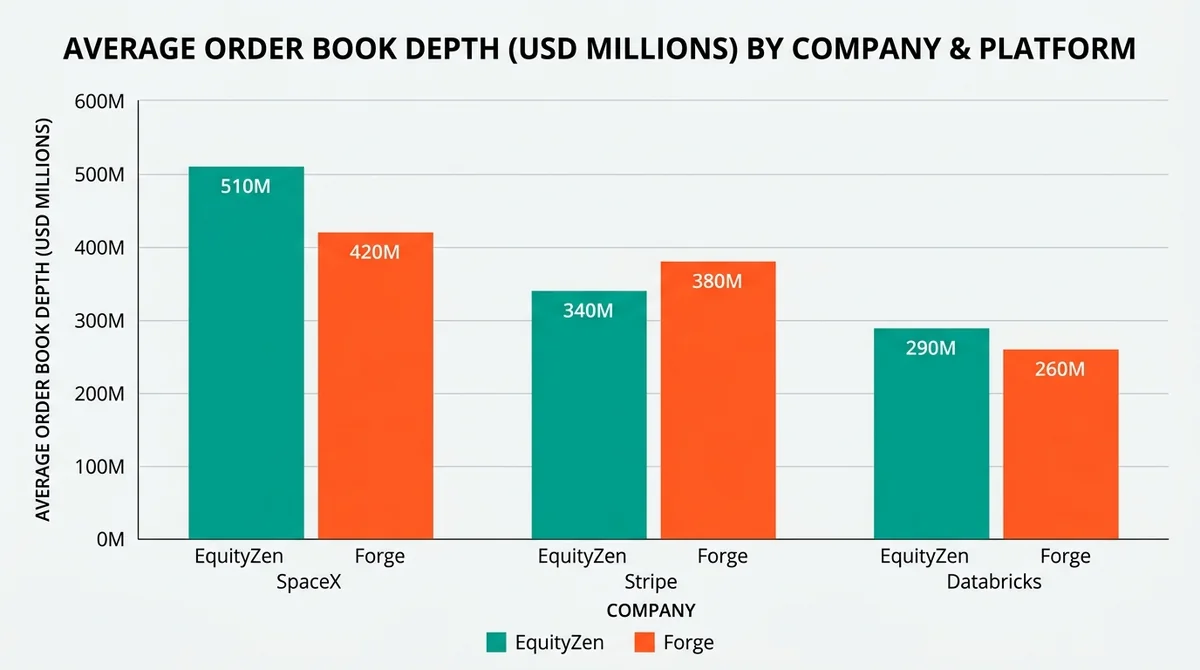
EquityZen's periodic auctions cause waiting periods, but execution is fast after matching. Investors need to wait for the next auction window; once matched, trade execution is rapid. Forge's continuous trading allows instant matching, but large orders may need to be split. A continuous order book enables instant matching, but large orders may need to be broken up to reduce market impact, thereby extending overall execution time. Execution efficiency is affected by asset liquidity and order size.
#How does the price discovery mechanism affect execution speed?
EquityZen's auction mechanism determines prices through concentrated bidding, reducing price volatility, but execution speed is limited by auction frequency. Forge's continuous order book provides more real-time price discovery, quickly reflecting supply and demand changes, but large orders may face slippage. EquityZen's batch auctions are more suitable for fast matching of small and medium orders, while Forge's continuous order book offers higher execution efficiency for institutional large orders.
#What factors influence liquidity depth on pre-IPO platforms?
#Accredited investor thresholds and participant numbers
The number of accredited investors directly affects order book depth. Platforms with lower thresholds attract more individual investors, but individual order sizes are smaller; platforms with higher thresholds attract institutional investors, with larger order sizes but fewer participants. Specific threshold data for both platforms is not publicly available, but institutional participation is an important factor affecting depth.
#Target company funding rounds and shareholder structure
Companies in later funding rounds typically have better liquidity because their valuation is clearer and shareholder structure more complex, potentially with more willingness to sell. Shareholder selling willingness and lock-up period restrictions also affect tradable supply. Liquidity depth is jointly determined by the accredited investor base, target company funding stage, and shareholder selling willingness; the two platforms differ in these factors.
#Who should choose EquityZen, and who should choose Forge?
#Individual accredited investors vs institutional investors
Individual accredited investors should prioritize EquityZen: user-friendly interface, batch auctions reduce impact costs, and the auction mechanism allows small order participation with relatively simple operations. Institutional investors should prioritize Forge: they need deep order books and block trading capabilities, and the continuous order book and institutional participation better meet their needs.
#Small fast execution vs large deep execution
Choose a platform based on order size and frequency. Small orders match faster in EquityZen's auctions with lower impact costs. Large orders can be split and executed in Forge's continuous order book, but market impact should be noted. Individual accredited investors and small orders should prioritize EquityZen; institutional investors and large orders should prioritize Forge.
#What are the risks of using pre-IPO equity trading platforms?
#Liquidity risk: what if you can't sell?
Pre-IPO equity has poor liquidity and may not be exited in a timely manner. Even if an order is placed on the platform, it may not be filled due to lack of buyers. Investors need to assess their liquidity needs and exit timeline.
#Information asymmetry and valuation risk
Valuation information is not transparent, and pricing discrepancies exist. Pre-IPO company financial information is limited, and valuations may be based on limited data, leading to inaccurate pricing. Differences in platform trading rules and fees also need attention; different fee structures and trading rules may affect actual returns.
#Conclusion
Individual accredited investors and small orders should prioritize EquityZen; institutional investors and large orders should prioritize Forge. Forge's continuous order book and institutional participation deliver deeper liquidity, while EquityZen's batch auction model concentrates depth in specific assets. When choosing a platform, consider your order size, investment horizon, and risk tolerance.
This content is compiled from public information and does not constitute investment or account opening advice. Data as of 2026-02-28; actual conditions may change. Check official sources for the latest information.
FAQ
Which platform has deeper liquidity, EquityZen or Forge?
Forge's continuous order book and institutional participation generally may deliver deeper liquidity, but EquityZen may have concentrated depth in specific popular assets. Specific depth varies by asset and time.
What are the pros and cons of EquityZen's batch auction model?
Pros: fast execution after matching, possibly lower impact costs; Cons: need to wait for auction windows, cannot trade outside auction periods.
Is Forge suitable for individual investors?
Forge primarily targets institutional investors, but individual accredited investors can also use it; however, large order execution may be more advantageous.
What are the risks of pre-IPO equity trading?
Main risks include liquidity risk (possible inability to exit in a timely manner), information asymmetry, and valuation risk.
How to choose between EquityZen and Forge?
Individual accredited investors and small orders may be more suitable for EquityZen, while institutional investors and large orders may be more suitable for Forge. It is recommended to evaluate based on your own needs.
Related Terms
Done comparing? Ready to place your first trade?
The crypto assets, tokenized US stocks and ETFs you just compared are all tradable on MSX — spot or perpetuals.
Quick Start Trading →New here? Registration takes three quick steps.