Ethereum Spot vs Perpetual Contracts: Funding Rates, Liquidation Mechanisms, and Cost Comparison 2026
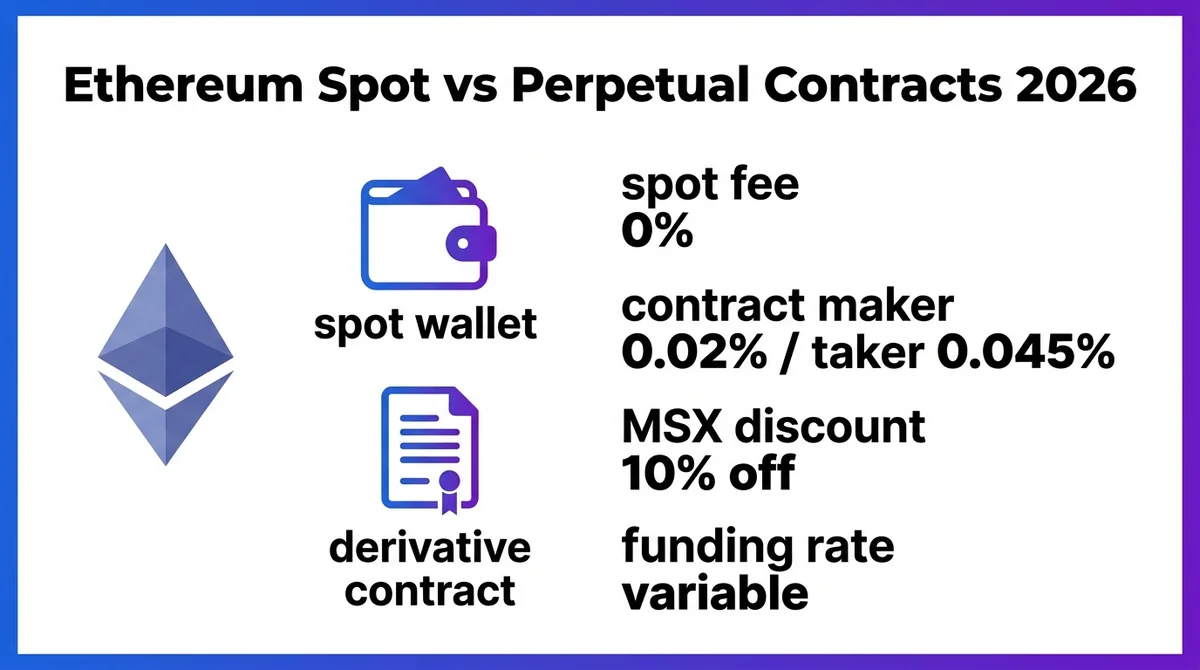
Compare Ethereum spot vs perpetual contracts: asset ownership, funding rates, liquidation mechanisms, and total trading costs. Long-term hold or short-term trade? Data as of 2026-06-01.
Conclusion: For users who hold Ethereum long-term and want asset ownership, choose spot. For short-term long/short, hedging, or leveraged users, choose perpetual contracts. The core differences lie in asset ownership, funding rates, and liquidation risk.
#Comparison Table
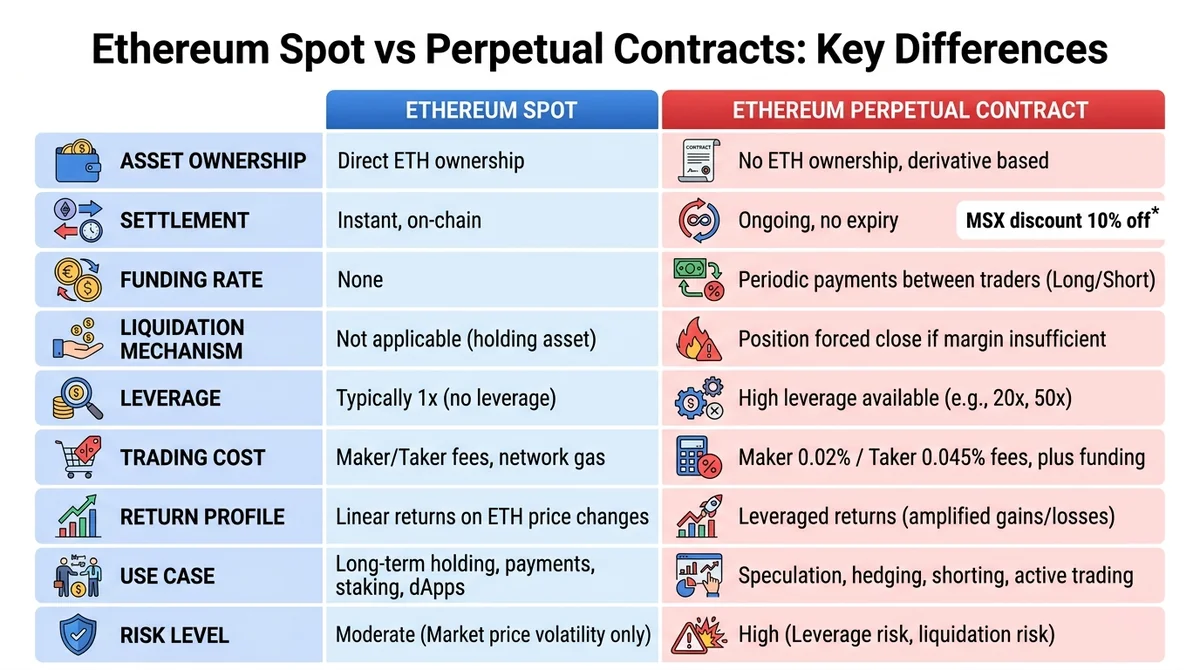
| Dimension | Ethereum Spot | Ethereum Perpetual Contract |
|---|---|---|
| Asset ownership | Holds real ETH, can withdraw/transfer | Derivative contract, does not hold real ETH |
| Settlement method | Instant delivery | Periodic funding rate settlement (specific period varies by platform; MSX not disclosed) |
| Expiry date | None | No expiry, but ongoing funding rate payments/receipts |
| Funding rate | None | Yes, paid between longs and shorts, rate varies with market |
| Liquidation mechanism | No leverage, no liquidation risk | Liquidation triggered when margin ratio falls below maintenance margin |
| Leverage | Usually none or very low | Leverage available (specific multiple varies by platform; MSX not disclosed) |
| Trading cost | Fees + spread (MSX spot fee is 0) | Fees + funding rate + potential slippage/liquidation loss (MSX contract maker 0.02%, taker 0.045%, MSX discount 10% off) |
| Return profile | Follows ETH price, long-term hold | Can amplify gains or losses, can also short |
| Use case | Long-term allocation, store of value | Short-term trading, hedging, arbitrage |
| Risk level | Lower (market risk only) | Higher (market + leverage + liquidation risk) |
#Detailed Breakdown
#Asset Ownership
Asset ownership: Spot holds real ETH, can freely withdraw, transfer, or use for staking; perpetual contracts are only price exposure, no asset ownership, and no ETH can be withdrawn after closing the position.
#Settlement and Expiry
Settlement method: Spot trades complete asset delivery immediately after execution; perpetual contracts have no expiry date but settle periodically through the perpetual futures funding rate settlement schedule, anchoring the contract price to the spot index. The specific settlement period (e.g., hourly, every 8 hours) varies by platform; MSX has not disclosed the specific period.
#Funding Rate
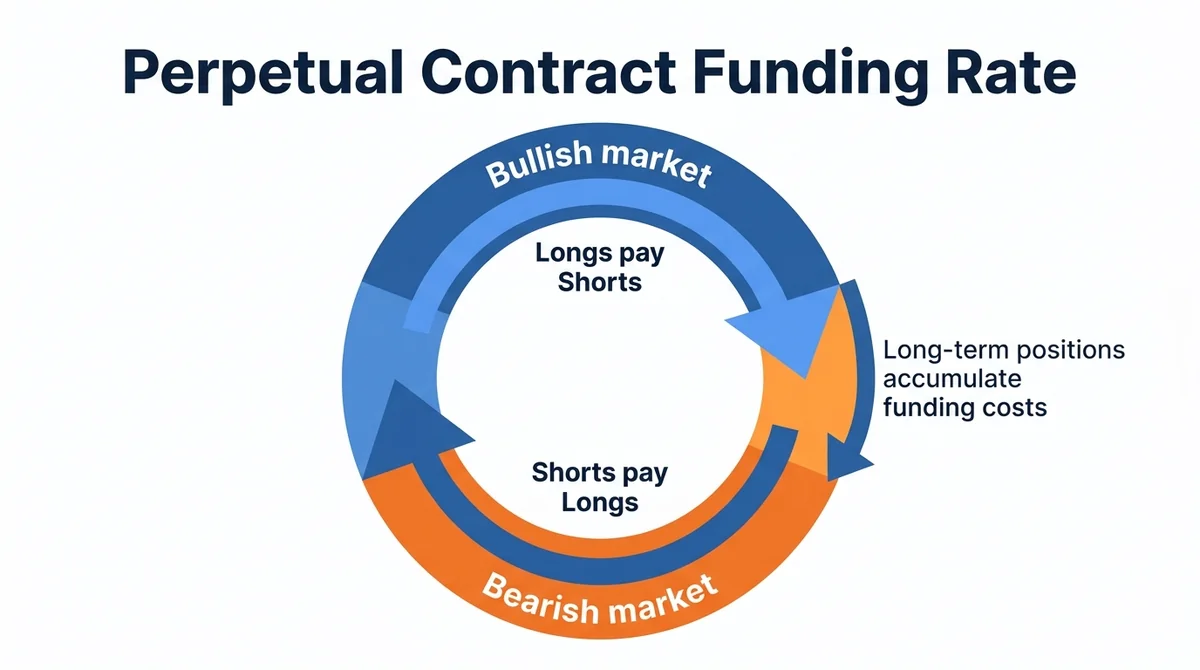
Funding rate: A fee mechanism unique to perpetual contracts. Longs and shorts pay each other; when the market is bullish, longs pay shorts, and when bearish, shorts pay longs. The rate reflects market sentiment; long-term positions accumulate funding costs, directly increasing holding costs. The specific rate changes dynamically; check platform real-time data.
#Liquidation Mechanism
Liquidation mechanism: Perpetual contracts use margin trading; when the margin ratio (TRUMPUSDT perpetual futures margin requirements explained) falls below the maintenance margin requirement, liquidation is triggered. The liquidation price is affected by leverage, position size, maintenance margin rate, etc. Isolated margin mode isolates risk, while cross margin mode shares margin. Reducing leverage and setting stop-loss can lower liquidation probability.
#Leverage
Leverage: Spot usually has no or very low leverage; perpetual contracts offer leverage, but the specific maximum varies by platform and asset; MSX has not disclosed the specific multiple. Leverage amplifies both gains and losses.
#Trading Cost
Trading cost: Spot costs are mainly trading fees and bid-ask spread; perpetual contracts include fees plus funding rate and potential liquidation loss. Taking MSX as an example, Ethereum spot (spot trading) fee is 0, so the main cost is the spread; perpetual contract fees are maker 0.02%, taker 0.045%, and using $MSX discount gives 10% off (i.e., maker 0.018%, taker 0.0405%), plus funding rate. Always refer to platform real-time rates.
#Return Profile
Return profile: Spot returns follow ETH price fluctuations, suitable for long-term holding; perpetual contracts can go long or short, and returns are related to the multiple of price change, suitable for short-term directional trading or hedging.
#Use Case
Use case: Spot is suitable for long-term allocation, store of value, and on-chain use; perpetual contracts are suitable for short-term swings, risk hedging, and arbitrage.
#Risk Level
Risk level: Spot mainly faces market volatility risk; without leverage there is no liquidation risk. Perpetual contracts add leverage, funding rate, and liquidation risk, significantly higher risk.
#Scenario Recommendations
Suitable for choosing Ethereum spot: You are a long-term ETH bull, want to hold real assets and use them in the on-chain ecosystem, with lower risk tolerance.
Suitable for choosing Ethereum perpetual contracts: You are a short-term trader, need to short or hedge spot holdings, and can strictly manage leverage and stop-loss.
#FAQ
Q: Which is cheaper, spot or perpetual?
A: On MSX, Ethereum spot (spot trading) fee is 0, while perpetual contract fees are maker 0.02%, taker 0.045% (10% off with $MSX discount), plus funding rate. Therefore, long-term holding spot is cheaper; for short-term trading, calculate funding rate and fees carefully.
Q: What happens when a perpetual position is liquidated?
A: When the margin ratio falls below the maintenance margin rate, the position will be force-liquidated, potentially losing all margin.
Q: How often is the funding rate settled?
A: It varies by platform; commonly hourly or every 8 hours. MSX has not disclosed the specific settlement period; check platform rules.
Q: Can I use spot ETH as margin?
A: MSX supports Portfolio Margin with multi-asset collateral, which may include ETH, but specific support depends on platform rules.
#Disclaimer
This content is compiled from public data and does not constitute investment or account opening advice. Data as of 2026-06-01; actual conditions may change. Check official sources for latest information.
FAQ
Which is cheaper, spot or perpetual?
On MSX, Ethereum spot (spot trading) fee is 0, while perpetual contract fees are maker 0.02%, taker 0.045% (10% off with $MSX discount), plus funding rate. Therefore, long-term holding spot is cheaper; for short-term trading, calculate funding rate and fees carefully.
What happens when a perpetual position is liquidated?
When the margin ratio falls below the maintenance margin rate, the position will be force-liquidated, potentially losing all margin.
How often is the funding rate settled?
It varies by platform; commonly hourly or every 8 hours. MSX has not disclosed the specific settlement period; check platform rules.
Can I use spot ETH as margin?
MSX supports Portfolio Margin with multi-asset collateral, which may include ETH, but specific support depends on platform rules.
Related Terms
Done comparing? Ready to place your first trade?
The crypto assets, tokenized US stocks and ETFs you just compared are all tradable on MSX — spot or perpetuals.
Quick Start Trading →New here? Registration takes three quick steps.