Hong Kong Market RWA Spot Comparison
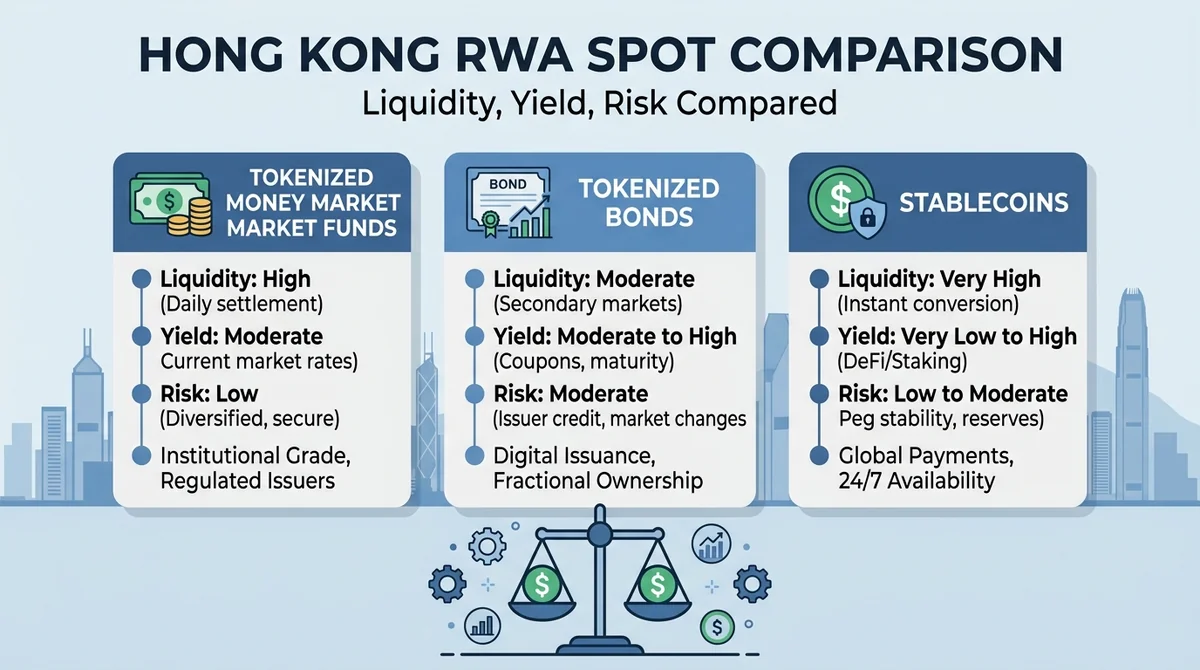
Compare Hong Kong RWA spot types: tokenized money market funds, tokenized bonds, and stablecoins by liquidity, yield, risk, and how to choose.
Conclusion: Among Hong Kong market RWA spots, tokenized money market funds suit short-term cash management and low risk appetite, stablecoins suit immediate liquidity needs, and tokenized bonds suit long-term allocation for those who can bear credit risk and seek higher returns. However, the liquidity, yield, and risk of specific products must be verified individually, and the regulatory environment is still evolving.
#What are the main RWA spot types in the Hong Kong market?
The RWA spots currently accessible in the Hong Kong market mainly include three categories: tokenized money market funds, tokenized bonds, and stablecoins. Their underlying assets and risk-return profiles differ, as explained below.
#What are tokenized money market funds?
Tokenized money market funds are traditional money market fund shares tokenized via blockchain technology. The underlying assets are typically highly liquid, low-risk short-term money market instruments such as government short-term bonds, commercial paper, and bank deposits. Token holders enjoy the economic rights of the corresponding fund shares, but the specific rights distribution mechanism varies by product, and relevant data is not disclosed, so the specific product documents must be consulted.
#How do tokenized bonds differ from traditional bonds?
Tokenized bonds record the rights of traditional bonds (such as government bonds, corporate bonds) on the blockchain in token form. Compared with traditional bonds, tokenized bonds may improve settlement efficiency and divisibility, but the credit risk is the same as the underlying bonds. In Hong Kong, the issuance and trading of tokenized bonds must comply with the Securities and Futures Ordinance, and investor eligibility may be restricted.
#Are stablecoins considered RWA spots?
Stablecoins are typically pegged to fiat currencies (such as HKD, USD) and backed by reserve assets, so they can be regarded as a special type of RWA spot. The main use of stablecoins is as a payment and transaction medium rather than investment appreciation, and their yield is usually zero or extremely low. Hong Kong's regulation of stablecoins is being improved, and some stablecoins may need to be licensed to operate.
#What are the differences in liquidity, yield, and risk among different RWA spots?
#What are the liquidity differences?
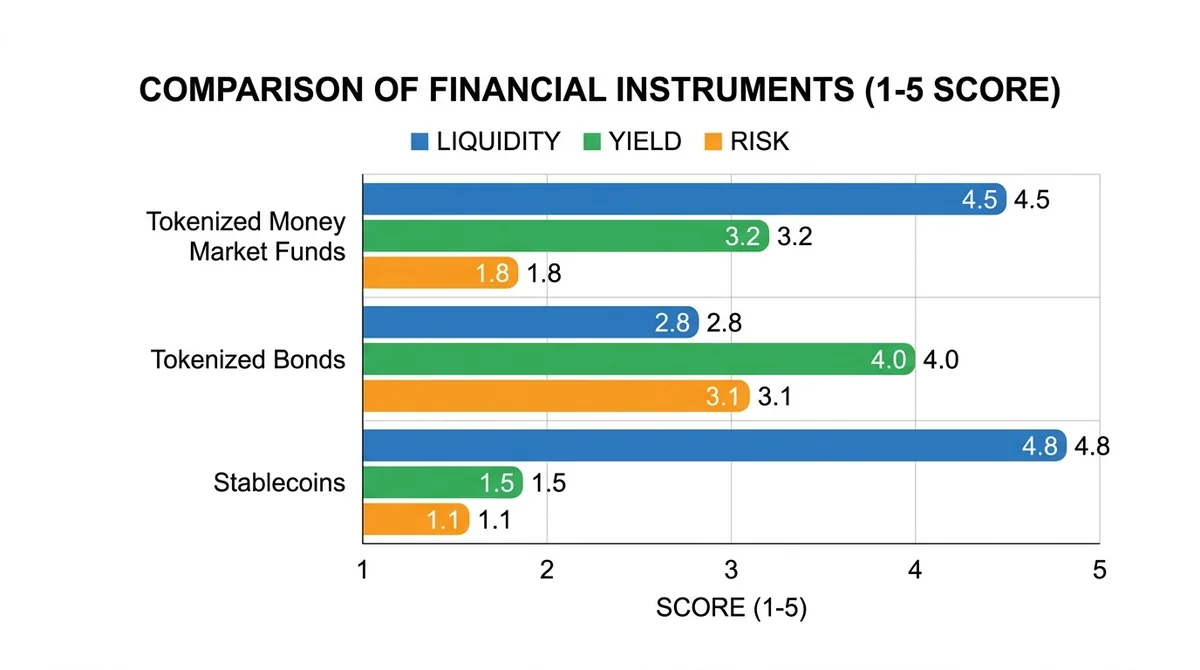
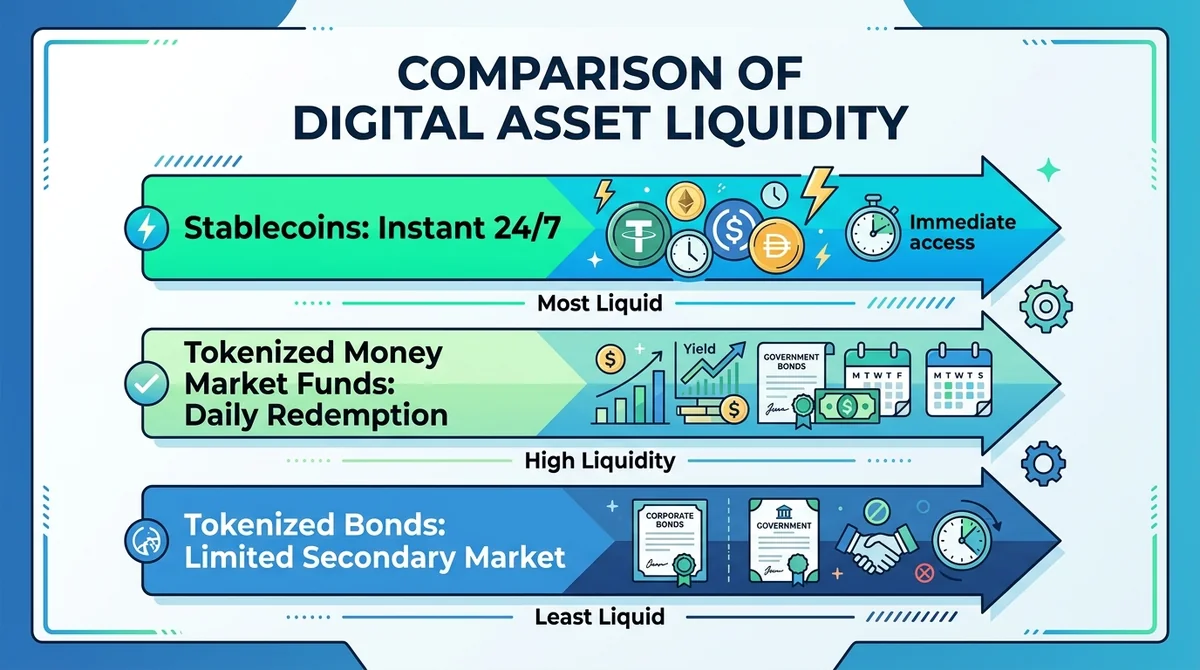
- Stablecoins: Extremely high liquidity, can be transferred instantly 24/7, but affected by exchange and on-chain liquidity.
- Tokenized money market funds: Relatively high liquidity, usually can be subscribed and redeemed daily, but may be subject to fund contract restrictions.
- Tokenized bonds: Lower liquidity, limited secondary market depth, and may be difficult to realize in a timely manner.
#Where does the yield come from?
- Stablecoins: Usually no yield; some platforms may offer lending yield, but it is not the stablecoin's own yield.
- Tokenized money market funds: Yield comes from interest on underlying money market instruments, linked to market interest rates.
- Tokenized bonds: Yield comes from bond coupons and price changes, depending on credit risk and duration.
#What are the main risks?
- Stablecoins: Reserve asset risk, issuer credit risk, regulatory risk.
- Tokenized money market funds: Underlying asset credit risk, interest rate risk, fund operational risk.
- Tokenized bonds: Credit risk (default), interest rate risk, liquidity risk.
#How to choose RWA spots based on your needs?
#How to choose for short-term cash management?
If funds need to remain highly liquid within days to weeks and you are unwilling to bear principal fluctuations, prioritize tokenized money market funds or stablecoins. Stablecoins suit immediate payments, while money market funds suit earning some interest.
#How to choose for long-term asset allocation?
If the investment horizon exceeds one year and you can tolerate some volatility, consider tokenized bonds to earn coupons and potential capital gains. But you need to assess the issuer's credit and secondary market liquidity.
#How to match risk tolerance?
- Low risk appetite: Stablecoins or high-rated money market funds.
- Medium risk appetite: Investment-grade tokenized bonds.
- High risk appetite: High-yield tokenized bonds, but you must accept the possibility of default.
#What compliance and risk issues should be noted when investing in Hong Kong RWA spots?
#What is the Hong Kong regulatory framework?
The Hong Kong Securities and Futures Commission treats tokenized securities as securities, subject to the Securities and Futures Ordinance. Tokenized money market funds may need to comply with the Code on Unit Trusts and Mutual Funds. Stablecoin issuers may need to obtain a license under the Payment Systems and Stored Value Facilities Ordinance. Whether a specific product is compliant must be verified individually, and the regulatory framework may be adjusted.
#What are the investor eligibility restrictions?
Some tokenized bonds and funds may be limited to professional investors only. The range of RWA spots available to retail investors is narrower, and product terms must be checked.
#What are the operational risks?
- Smart contract vulnerabilities: Tokenized assets rely on smart contracts, and code defects may lead to asset loss.
- Custody risk: Improper private key custody or custodian issues may lead to asset theft.
- Settlement risk: On-chain settlement may be delayed or fail.
#Scenario Recommendations
- If you are a short-term cash manager: Prioritize tokenized money market funds or stablecoins, and pay attention to redemption mechanisms and reserve transparency.
- If you are a long-term investor: You may research tokenized bonds, but you need to verify the issuer's credit rating and secondary market liquidity.
- If you need an instant payment tool: Stablecoins are a more direct choice, but you should choose regulated stablecoins.
- If you seek compliance and stability: Choose products issued by SFC-approved or licensed institutions.
#FAQ
Q: Are tokenized money market funds principal-protected?
A: No. Although money market funds have lower risk, they still have net asset value fluctuations and credit risk, and tokenization may introduce technical risks.
Q: Which has higher yield, stablecoins or tokenized money market funds?
A: Usually tokenized money market funds have higher yield because their underlying assets generate interest; stablecoins themselves usually have no yield.
Q: Can Hong Kong retail investors buy tokenized bonds?
A: Some tokenized bonds are limited to professional investors only. Retail investors need to check the specific product terms and regulatory requirements.
Q: How is the liquidity of tokenized bonds?
A: Liquidity is usually lower than traditional bonds, secondary market depth is limited, and it may be difficult to sell in a timely manner.
Q: Should I worry about smart contract risk when investing in RWA spots?
A: Yes. Smart contract vulnerabilities may lead to asset loss, so you should choose products that have been audited and issued by reliable institutions.
This content is compiled from public data and does not constitute investment or account opening advice. Data as of 2026-09-19, actual conditions may change. For more official information, please refer to the websites of relevant product issuers and Hong Kong regulatory authorities.
FAQ
Are tokenized money market funds principal-protected?
No. Although money market funds have lower risk, they still have net asset value fluctuations and credit risk, and tokenization may introduce technical risks.
Which has higher yield, stablecoins or tokenized money market funds?
Usually tokenized money market funds have higher yield because their underlying assets generate interest; stablecoins themselves usually have no yield.
Can Hong Kong retail investors buy tokenized bonds?
Some tokenized bonds are limited to professional investors only. Retail investors need to check the specific product terms and regulatory requirements.
How is the liquidity of tokenized bonds?
Liquidity is usually lower than traditional bonds, secondary market depth is limited, and it may be difficult to sell in a timely manner.
Should I worry about smart contract risk when investing in RWA spots?
Yes. Smart contract vulnerabilities may lead to asset loss, so you should choose products that have been audited and issued by reliable institutions.
Done comparing? Ready to place your first trade?
The crypto assets, tokenized US stocks and ETFs you just compared are all tradable on MSX — spot or perpetuals.
Quick Start Trading →New here? Registration takes three quick steps.