Intel vs TSMC: 2026 Capital Expenditure and Capacity Expansion Comparison
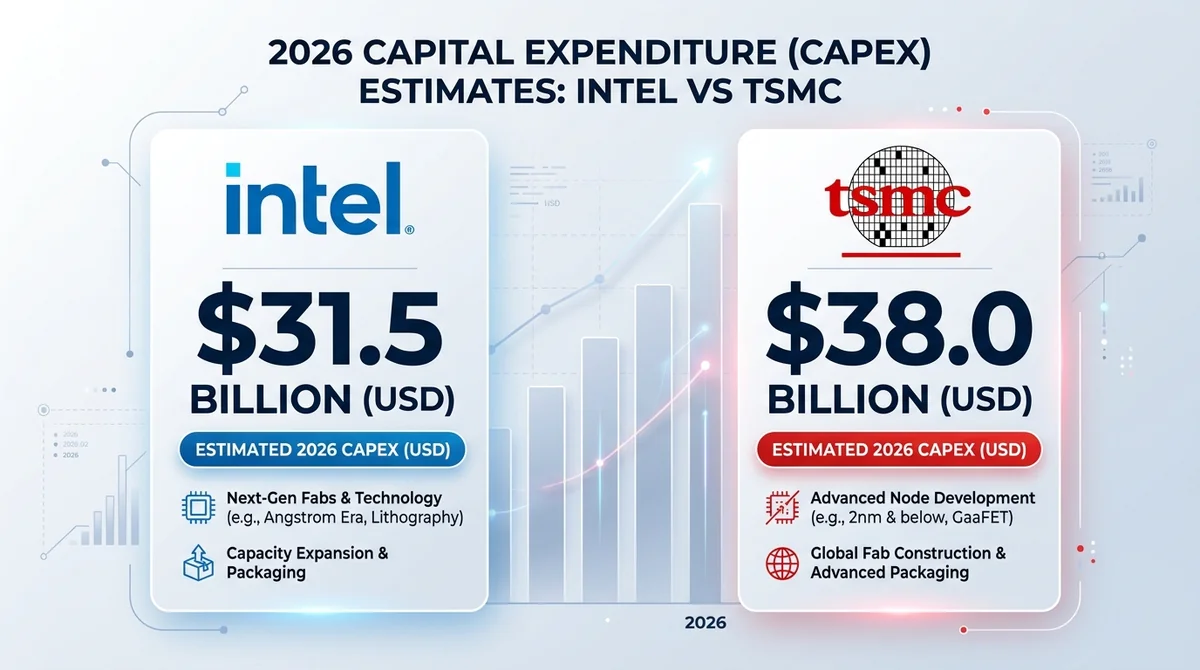
Compare Intel and TSMC 2026 capex plans, advanced node progress, global capacity and foundry competitiveness. Data-driven analysis of who leads.
Conclusion: Entering 2026, TSMC still holds a leading position over Intel in capital expenditure scale, advanced process capacity, and customer ecosystem. Intel is accelerating its catch-up through IDM 2.0 and expanding production in the US and Europe, but technology validation and external customer onboarding still need time to mature.
Data as of 2026-10-05
#How do Intel and TSMC's 2026 capital expenditure plans differ?
Intel's 2026 capital expenditure focuses on advanced process breakthroughs and foundry service catch-up, with funds mainly flowing to Intel 18A/20A nodes and fab construction in the US and Europe. TSMC continues its high-intensity investment pace, prioritizing resources for advanced nodes such as N2/N3 while promoting global capacity expansion to maintain technology leadership and stay close to regional customers. The gap in spending scale and growth rate between the two reflects completely different strategic stages: Intel is still climbing in its transformation catch-up phase, while TSMC has entered a mature expansion phase.
#Which areas does Intel's 2026 capital expenditure go to?
Intel concentrates its capital expenditure on advanced process R&D and mass production, foundry capacity construction (such as fabs in Ohio and Arizona), and packaging/testing capability upgrades. With the support of the US CHIPS Act subsidies, its willingness to expand production in the US and Europe has significantly increased.
#What are TSMC's 2026 capital expenditure priorities?
TSMC's capital expenditure priorities cover N2/N3 advanced process expansion, global fab construction (Kumamoto, Japan; Arizona, USA; Dresden, Germany), and advanced packaging (such as CoWoS) capacity enhancement. Facing sustained growth in AI and high-performance computing demand, its capital expenditure scale is expected to remain high.
#What are the key differences in advanced process capacity expansion between the two companies in 2026?
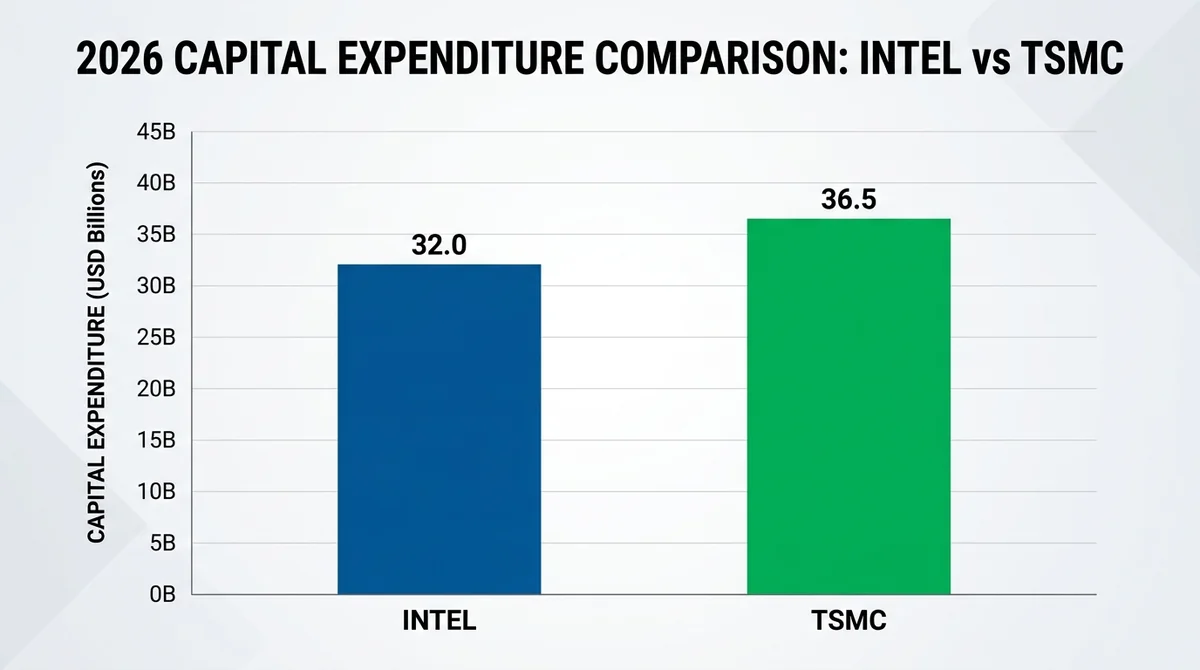
TSMC continues to lead in advanced process capacity scale and customer adoption, while Intel attempts to accelerate catch-up with nodes like Intel 18A. 2026 is a critical validation year for Intel.
#How is Intel's Intel 18A/20A process progressing?
Intel's Intel 18A process is planned for mass production in 2025, entering the capacity ramp-up phase in 2026, and has already secured some external customer interest. Intel 20A serves as a transitional node mainly for internal products. Yield and cost control remain the main challenges.
#What is TSMC's N2/N3 process capacity plan?
TSMC's N3 process has already achieved large-scale mass production, and the N2 process is expected to begin pilot production in the second half of 2025, with gradual volume ramp in 2026. Its advanced process customers include top players such as Apple, NVIDIA, and AMD, with high order visibility.
#Mature nodes and global capacity layout: How do Intel and TSMC's strategies differ?
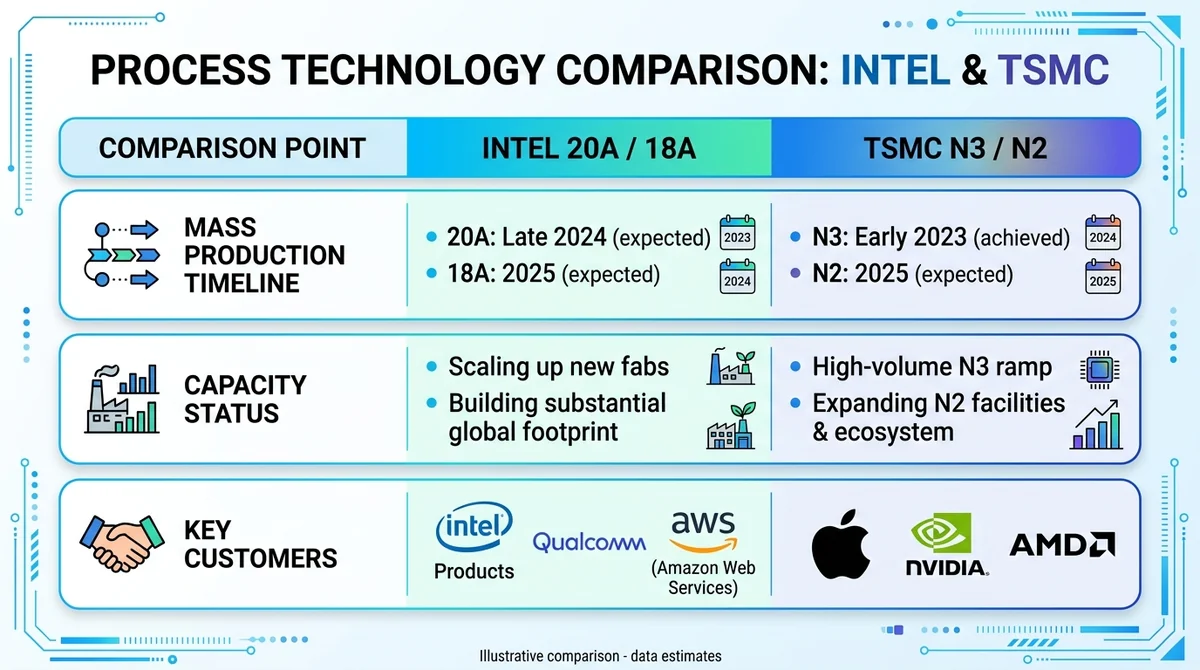
Intel's capacity expansion is more concentrated in the US and Europe, benefiting from government subsidies; TSMC insists on globally dispersed fab construction to reduce geopolitical risks and stay close to customers.
#How does Intel adjust its mature node capacity?
Intel's mature node capacity mainly serves internal products while gradually opening up to foundry services. Its fab expansions in the US and Europe will increase mature node capacity, but may face the risk of underutilization.
#Which regions does TSMC's global fab construction plan cover?
TSMC's global fab construction plan covers Japan (Kumamoto), the United States (Arizona), Europe (Dresden, Germany), and its home base in Taiwan, China. This dispersed layout aims to reduce geopolitical risks and meet the needs of customers in different regions.
#Technology roadmap and customer structure: Who is more competitive in the foundry market?
TSMC maintains its foundry leadership through customer diversification and an advanced packaging ecosystem, while Intel opens its foundry through IDM 2.0 and gradually wins external customers, but ecosystem building still takes time.
#How does Intel's IDM 2.0 strategy affect its foundry business?
Intel's IDM 2.0 strategy includes opening its foundry, expanding outsourcing, and internal manufacturing. Its foundry business has secured some customer orders, but the number and scale of customers are far behind TSMC, and it needs to prove its process performance and yield.
#What advantages does TSMC's customer structure and technology ecosystem have?
TSMC's customer structure is diversified, covering smartphones, HPC, automotive, and other fields. Its advanced packaging technologies (such as CoWoS, InFO) form a synergistic ecosystem with process nodes, enhancing customer stickiness.
#What common risks do wafer foundry capacity expansions face in 2026?
Both companies face risks from geopolitics, overcapacity, and long investment return cycles, but TSMC's global layout gives it stronger risk resilience.
#How significant is the impact of geopolitics and export controls?
Geopolitical tensions lead to supply chain regionalization, which may increase operating costs and compliance risks. Export controls may restrict the flow of advanced equipment and technology, affecting expansion progress.
#What about overcapacity and demand fluctuation risks?
Mature nodes may face oversupply, leading to price competition and lower utilization rates. Advanced node investments have long payback periods; if demand falls short of expectations, profitability will be affected.
#Comparison Table
| Dimension | Intel | TSMC |
|---|---|---|
| Capital expenditure scale | Not disclosed | Not disclosed |
| Advanced process nodes | Intel 18A/20A | N2/N3 |
| Capacity expansion focus | US & Europe local | Global dispersion |
| Customer structure | Mainly internal, external onboarding | Diversified top customers |
| Advanced packaging | In-house packaging capabilities | Leading ecosystem like CoWoS |
| Government subsidies | US CHIPS Act support | Multi-country subsidies |
| Geopolitical risk exposure | Concentrated in US & Europe | Dispersed layout |
| Technology maturity | Catching up | Leading |
| Foundry market share | Smaller | Higher |
| Investment return cycle | Longer | Relatively stable |
#Scenario Recommendations
- Suitable for choosing Intel: Investors who are bullish on US domestic manufacturing revival, willing to bear uncertainty during transformation, and focus on cost advantages from government subsidies.
- Suitable for choosing TSMC: Investors seeking stable technology leadership, diversified customer base, and global capacity layout.
#FAQ
Q: Will Intel's 2026 capital expenditure exceed TSMC's? A: According to available data, neither company's specific capital expenditure amounts are disclosed, so direct comparison is impossible. However, TSMC's capital expenditure scale is usually higher than Intel's.
Q: Can Intel's advanced processes catch up with TSMC in 2026? A: Intel's Intel 18A process may approach TSMC's N2 in transistor density, but yield, cost, and customer adoption still need validation. TSMC remains ahead in capacity scale and ecosystem.
Q: How does global capacity expansion affect the two companies differently? A: TSMC's globally dispersed layout reduces geopolitical risk but increases management complexity; Intel's concentration in the US and Europe benefits from subsidies but faces regional demand fluctuation risks.
Q: Who is more affected by mature node overcapacity risk? A: Intel's mature node utilization may be more affected by weak demand because it has fewer foundry customers; TSMC has a broader customer base for mature nodes, giving it stronger resilience.
Q: What indicators should investors watch when investing in wafer foundry stocks? A: Pay attention to capital expenditure efficiency, advanced process yield, customer orders, capacity utilization, and geopolitical risks.
Q: What is the main difference between Intel and TSMC's 2026 capital expenditure? A: Intel focuses on advanced process catch-up and domestic expansion, while TSMC focuses on advanced process expansion and global dispersed layout; specific amounts are undisclosed, but TSMC's scale is usually larger.
This content is compiled from public data and does not constitute investment or account opening advice. Data as of 2026-10-05, actual conditions may change. For more information, refer to official sources.
FAQ
Will Intel's 2026 capital expenditure exceed TSMC's?
According to available data, neither company's specific capital expenditure amounts are disclosed, so direct comparison is impossible. However, TSMC's capital expenditure scale is usually higher than Intel's.
Can Intel's advanced processes catch up with TSMC in 2026?
Intel's Intel 18A process may approach TSMC's N2 in transistor density, but yield, cost, and customer adoption still need validation. TSMC remains ahead in capacity scale and ecosystem.
How does global capacity expansion affect the two companies differently?
TSMC's globally dispersed layout reduces geopolitical risk but increases management complexity; Intel's concentration in the US and Europe benefits from subsidies but faces regional demand fluctuation risks.
Who is more affected by mature node overcapacity risk?
Intel's mature node utilization may be more affected by weak demand because it has fewer foundry customers; TSMC has a broader customer base for mature nodes, giving it stronger resilience.
What indicators should investors watch when investing in wafer foundry stocks?
Pay attention to capital expenditure efficiency, advanced process yield, customer orders, capacity utilization, and geopolitical risks.
Related Terms
Done comparing? Ready to place your first trade?
The crypto assets, tokenized US stocks and ETFs you just compared are all tradable on MSX — spot or perpetuals.
Quick Start Trading →New here? Registration takes three quick steps.