Invest in Nvidia or AMD? NVDA Stock vs AMD Stock
Nvidia leads AI accelerator revenue, AMD offers broader CPU/GPU exposure. Compare 2026 NVDA vs AMD stock growth, valuation, and risks to decide which to buy.
#Invest in Nvidia or AMD? NVDA Stock vs AMD Stock
If you are deciding whether to invest in Nvidia or AMD, the direct answer is that Nvidia leads in AI accelerator revenue and recent stock momentum, while AMD is emerging as a credible challenger with a broader CPU/GPU product mix. Your choice depends on risk tolerance: growth investors may favor NVDA; value investors may consider AMD.
#Key Takeaways
- Nvidia dominates AI accelerators and has delivered stronger recent stock gains, while AMD is scaling data center GPUs but remains a smaller competitor.
- AMD's broader product mix across CPUs and GPUs provides diversified exposure to AI and traditional computing, reducing single-segment risk.
- A recent CFA analysis by Parkev Tatevosian asks whether AMD now offers a more attractive risk-reward than Nvidia, signaling a potential shift in market sentiment.
- Nvidia has higher revenue scale and gross margins driven by AI demand, while AMD trades at a lower valuation on some metrics but has less explosive growth.
- Both stocks face semiconductor cycle and AI spending risks; owning both can diversify AI exposure but requires balancing growth and value preferences.
#Performance and Growth: NVDA vs AMD
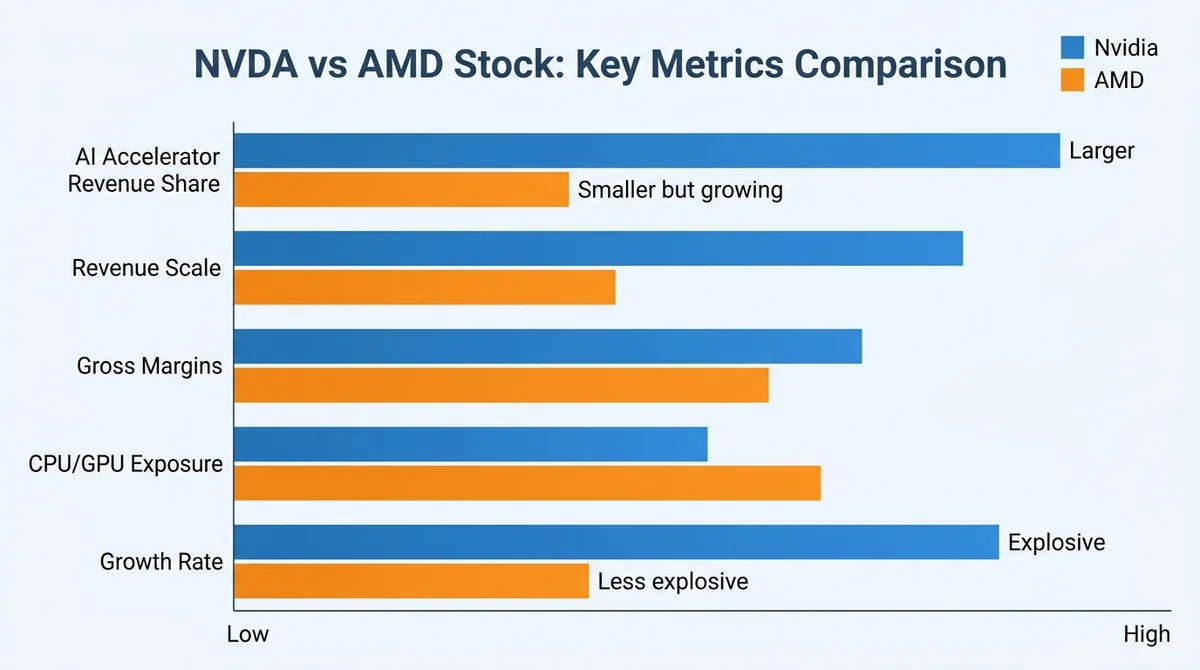
This NVDA stock vs AMD stock comparison highlights the key differences in financial performance, AI positioning, and valuation. Nvidia has delivered stronger returns in recent years, driven by its first-mover advantage in AI accelerators, while AMD's gains have been more modest but still tied to AI and data center momentum. In a recent breakdown, Parkev Tatevosian, CFA, examined whether investors should buy AMD stock instead of Nvidia, highlighting Nvidia's dominant AI position and AMD's improving data center GPU lineup (source: YouTube video "Should Investors Buy AMD Stock Instead of Nvidia? | NVDA Stock vs. AMD Stock"). Market sentiment toward AMD has been shifting, with some analysts viewing its risk-reward as improving relative to Nvidia, though Nvidia's AI training hardware lead remains intact.
#Revenue and profitability: How do NVDA and AMD compare?
Nvidia's financial profile reflects its AI dominance, with higher revenue scale and gross margins, while AMD generates lower revenue but offers a diversified portfolio across CPUs and GPUs. Both companies are profitable, but Nvidia's data center segment has grown faster than AMD's. The source material does not provide exact revenue figures or growth rates, so investors should verify current quarterly results from official filings. For a broader view of AI stock rankings, see our AI stocks to buy or avoid ranking.
| Metric | Nvidia | AMD |
|---|---|---|
| AI accelerator revenue share | Larger | Smaller but growing |
| Revenue scale | Higher due to AI demand | Lower but diversified |
| Gross margins | Higher | Lower |
| CPU/GPU exposure | Primarily GPU | Broader CPU/GPU |
| Growth rate | Faster in data center | Broader but less explosive |
This financial gap makes Nvidia the larger AI winner today, while AMD offers broader but less explosive growth across CPU and GPU segments.
#AI and Data Center Business: NVDA vs AMD
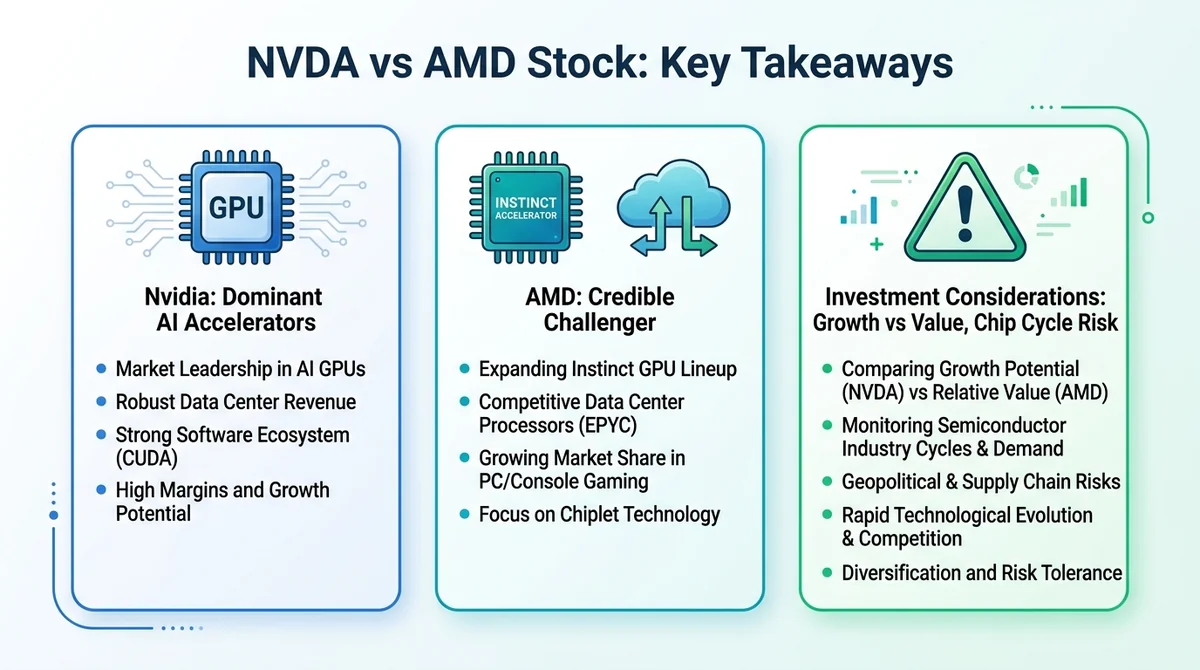
Nvidia leads in AI accelerator revenue due to its GPU ecosystem and first-mover advantage in AI training hardware. AMD is a credible challenger, scaling its Instinct accelerators and partnering with major cloud providers, but it still trails Nvidia in AI accelerator revenue and ecosystem maturity.
#Which company leads in AI accelerators?
Nvidia dominates AI training hardware with its GPU ecosystem, which has translated into a larger share of AI accelerator revenue and stronger AI-related stock performance. The company's early lead has become a durable competitive moat in data center GPUs.
#What is AMD's AI strategy and market position?
AMD is scaling its Instinct accelerators and has partnerships with major cloud providers, positioning it as a credible challenger in data center GPUs. However, AMD still trails Nvidia in AI accelerator revenue and ecosystem maturity. For a related semiconductor comparison, see our NVDA vs TSMC 2026 comparison.
#Valuation and Risk: Which Stock Is a Better Buy?
Nvidia trades at a premium valuation due to its AI leadership, while AMD may be cheaper on some metrics. The better buy depends on whether you prioritize AI dominance or diversification and potential value.
#What valuation metrics should investors watch?
Investors should watch forward price-to-earnings, PEG, and price-to-sales ratios. Nvidia's premium valuation reflects higher expected AI growth, while AMD's lower valuation could offer more upside if it executes on data center GPUs. The source video does not provide specific numbers, so these metrics should be checked against current market data. For an analysis of direct vs tokenized stock ownership, see our direct stock vs tokenized stock comparison.
#What are the main risks for Nvidia and AMD?
Nvidia faces concentration risk in AI hardware: if AI spending slows or competition intensifies, its high expectations could lead to sharp drawdowns. AMD risks execution delays in scaling its data center GPUs and intense competition from Nvidia. Both stocks are tightly linked to the semiconductor cycle and enterprise AI spending; a downturn in data center capex or a broader tech sell-off would likely pressure both.
#Conclusion: How to Choose Between Nvidia and AMD
There is no one-size-fits-all answer. Growth-oriented investors with high conviction in AI leadership may favor Nvidia, while value-oriented investors seeking diversification may consider AMD. Owning both can reduce single-stock risk, but the mix should depend on your investment time horizon, risk tolerance, and existing semiconductor exposure. AI demand remains the key driver for both, and any shift in AI spending or competition could reshape the risk-reward profile. Before deciding, verify the latest quarterly results and valuation metrics, and consider whether tokenized stock exposure fits your portfolio needs. At MSX Compare, we track these dynamics alongside platform-level analysis to help you make data-driven comparisons.
FAQ
Is Nvidia or AMD a better stock to buy in 2026?
Nvidia leads in AI accelerator revenue and recent stock performance, but AMD is a credible challenger with a broader CPU/GPU mix. The better buy depends on your risk tolerance: growth investors may favor NVDA, value investors may consider AMD.
What does the source analysis say about Nvidia vs AMD?
Parkev Tatevosian, CFA, asks whether AMD now offers a more attractive risk-reward than Nvidia, highlighting Nvidia's AI leadership while noting AMD's improving data center GPU lineup.
Does AMD have a credible AI data center strategy?
Yes. AMD is scaling Instinct accelerators and partnering with major cloud providers, but it still trails Nvidia in AI accelerator revenue and ecosystem maturity.
What are the main risks of investing in Nvidia and AMD?
Nvidia faces AI hardware concentration risk and high expectations; AMD risks execution delays and intense competition. Both are sensitive to semiconductor cycle and AI spending trends.
Should I invest in both Nvidia and AMD?
Owning both can diversify AI exposure and reduce single-stock risk. Investors with high AI conviction may overweight Nvidia, while value-oriented investors may add AMD.
Which stock has higher margins, Nvidia or AMD?
Nvidia has higher gross margins due to AI demand, while AMD's margins are lower but its CPU/GPU portfolio is more diversified.
Done comparing? Ready to place your first trade?
The crypto assets, tokenized US stocks and ETFs you just compared are all tradable on MSX — spot or perpetuals.
Quick Start Trading →New here? Registration takes three quick steps.