MSX vs Binance vs Gate.io Perpetual Futures Deep Comparison 2026: Funding Rates, Liquidation Mechanics, and Leverage Costs
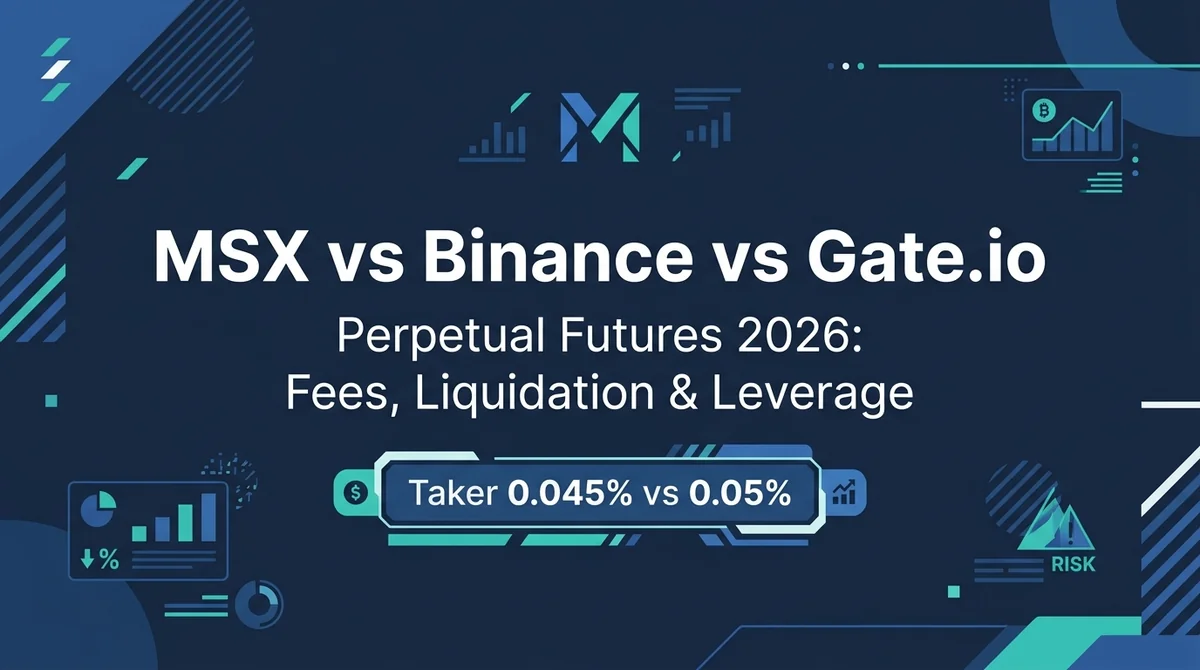
Perpetual fees: Binance & Gate both Maker 0.02%/Taker 0.05%; MSX Taker 0.045% lower, $MSX 10% off; BNB 10% off; Gate 200x; MSX other data TBD.
#MSX vs Binance vs Gate.io Perpetual Futures Deep Comparison 2026: Funding Rates, Liquidation Mechanics, and Leverage Costs
Bottom line: For regular users, perpetual funding rates are the same on Binance and Gate (Maker 0.02% / Taker 0.05%), while MSX's Taker fee is slightly lower at 0.045%, and $MSX discounts give 10% off. Binance futures offers 10% off with BNB, while Gate futures has no unified GT discount. Binance has larger reserves and liquidity; Gate offers 200x max leverage and slightly lower BTC MMR; MSX has not disclosed key data such as liquidation mechanics and max leverage, so we need to wait for official disclosures.
| Dimension | Binance | Gate.io | MSX |
|---|---|---|---|
| Standard user perpetual fee rate | Maker 0.02% / Taker 0.05% | Maker 0.02% / Taker 0.05% | Maker 0.02% / Taker 0.045% |
| Platform token discount | BNB payment gives 10% off (reduces 10%) | No unified GT discount for futures | $MSX discount gives 10% off |
| Funding rate settlement interval | 8 hours (can adjust to 4h/1h in extremes) | 8 hours | Not disclosed |
| Max leverage | BTC/ETH 150x | BTC/ETH 200x | Not disclosed |
| BTC minimum maintenance margin rate | 0.4% (first tier) | 0.3% | Not disclosed |
| VIP fee ceiling | VIP9 Maker 0% / Taker 0.017% | VIP16 Maker 0% / Taker 0.016% (Group A) | Not disclosed |
| Reserve size | $163.3B | $6.68B | Not disclosed (promises >100% reserve ratio) |
| Net asset reserves | $138.87B | $5.77B | Not disclosed |
| USDT-margined perpetual pairs | About 530 | About 867 | Not disclosed |
| 24h trading volume (BTC) | 119110.46 | 19656.49 | Not disclosed |
#how does perpetual futures funding rate work? Binance, Gate, and MSX Compared: Which Is Cheaper?
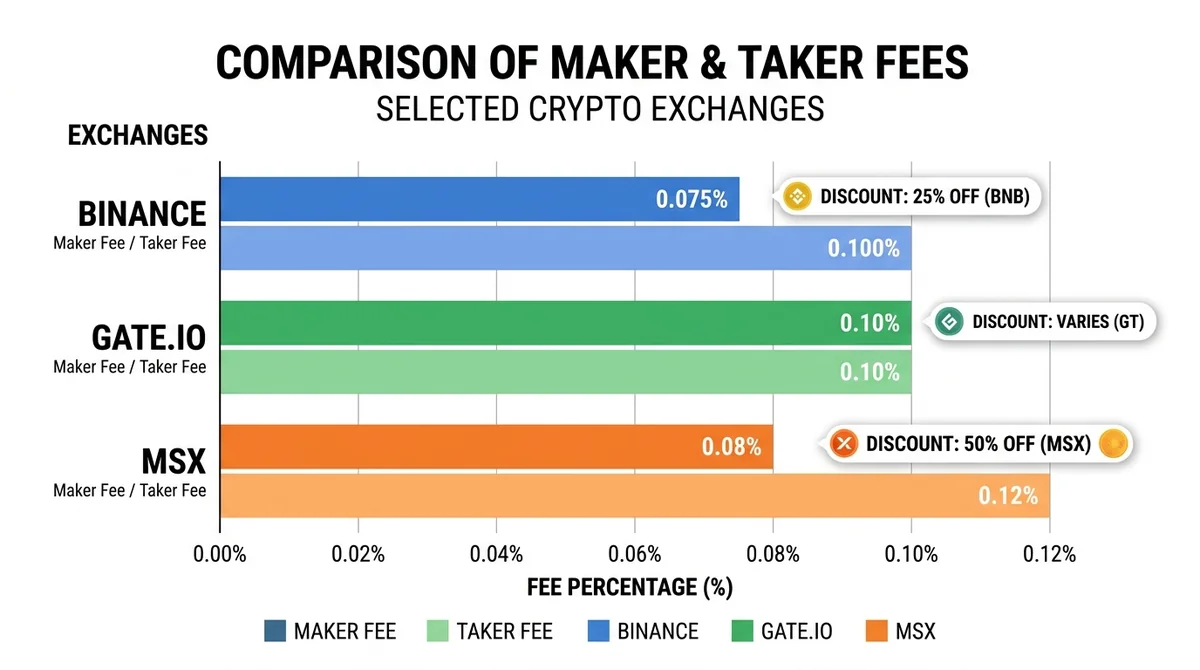
Standard user fees: For USDT-margined perpetuals, regular users on Binance and Gate both pay Maker 0.02% / Taker 0.05%; MSX regular users pay Maker 0.02% / Taker 0.045%, so the Taker fee is 0.005 percentage points lower.
Platform token discounts: Binance futures usually offers 10% off trading fees when paying with BNB; Gate does not have a unified GT discount for futures, so it cannot be applied to contracts; MSX futures offers 10% off when paying with $MSX discount. Therefore, regular users have a clear fee-reduction path on Binance and MSX for futures.
Funding rate settlement interval: Binance and Gate both settle every 8 hours. Binance can adjust to 4 hours or 1 hour under extreme market conditions; Gate data shows an 8-hour interval (API funding_interval 28800 seconds) with no disclosed emergency adjustment mechanism. MSX has not disclosed its funding rate settlement interval.
#TRUMPUSDT perpetual futures margin requirements explained: How Do Liquidation Mechanics and Maintenance Margin Rates Differ? Is Liquidation Risk the Same?
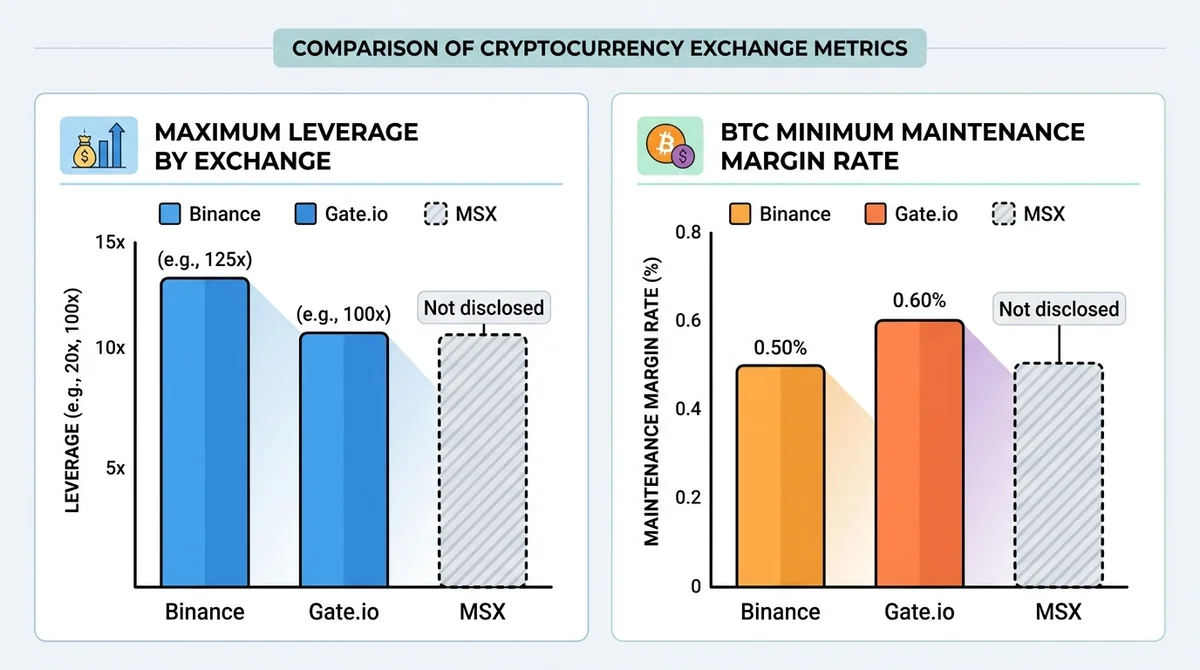
Minimum maintenance margin rate: Binance BTCUSDT first tier (notional 0–300,000 USDT) has an MMR of 0.4%; Gate BTC_USDT first tier is 0.3%. Gate is slightly lower by 0.1 percentage points. MSX has not disclosed specific maintenance margin rates, but claims to have a multi-layered risk control system, including margin monitoring, risk alerts, auto-deleveraging, and forced liquidation; specific parameters are not disclosed.
Max leverage: Binance's mainstream USDT-margined perpetuals offer up to 150x; Gate BTC_USDT/ETH_USDT offer up to 200x. Higher leverage means liquidation distance is closer, and liquidation risk increases as leverage increases. MSX has not disclosed its max leverage.
Impact of maintenance margin differences: A lower MMR allows Gate users to keep a larger margin buffer for the same position size, but 200x leverage brings a closer liquidation threshold under price volatility, so risk must be calculated independently. MSX cannot be evaluated due to missing data.
#Do Leverage Costs and VIP Tiers Matter Much for Regular Users?
Actual fees for regular users: Gate and Binance standard tiers are the same; MSX Taker fee is slightly lower, but the difference is very small.
VIP tier ceilings: Binance VIP9 (30-day contract volume ≥25 billion + BNB ≥5,500) can reach Maker 0% / Taker 0.017%; Gate VIP16 (30-day total trading volume ≥3 billion or assets ≥100 million path) can reach Maker 0% / Taker 0.016% (Group A). The high-tier Taker difference is only 0.001 percentage points, with no practical impact for the vast majority of users. MSX's VIP tiers are not disclosed; it is only known that $MSX tokens can be used for VIP benefits, with specific rates undisclosed.
Reserves and liquidity: Binance has reserves of $163.3B and net asset reserves of $138.87B; Gate has reserves of $6.68B and net asset reserves of $5.77B. 24h trading volume is 119,110.46 BTC on Binance and 19,656.49 BTC on Gate. Binance's reserve scale is about 24x Gate's, and liquidity differences may affect slippage for large orders. MSX has not disclosed reserve amounts, only promising over 100% physical reserves; actual liquidity is unknown.
#Who Should Choose Binance, Gate.io, or MSX?
Choose Binance: If you need larger reserve scale and liquidity, use BNB to discount futures fees, or prefer more transparent settlement rules under extreme market conditions, consider Binance first.
Choose Gate.io: If you want 200x max leverage, slightly lower BTC maintenance margin rates, or need more USDT-margined perpetual pairs (about 867 vs 530), consider Gate.io.
Choose MSX: If you value the lower Taker fee (0.045%) and 10% off with $MSX, consider MSX; but note that key data such as liquidation mechanics, max leverage, and maintenance margin rates are not disclosed, so risk is unknown. We recommend waiting for official disclosures before deciding.
#What Risks and Disclaimers Should You Note Before Opening a Position?
Common risks of perpetual futures: Leverage amplifies gains and losses and may trigger liquidation; funding rate costs accumulate with holding time, and settlement intervals may adjust under extreme market conditions.
Security incident history: Binance had a hot wallet security incident in 2019 (about $40M) and the Binance Bridge incident in 2022 (about $570M). Gate-related entity records include a private key leak of about $235M in 2018, a GateHub private key leak of about $9.5M in 2019, and a Gatecoin access control issue of about $2M in 2016. Historical events do not represent current risk, but they show that no platform is zero-risk. MSX has not disclosed historical security incident records; you should pay attention to its open-source nature, audit reports, and proof of reserves.
Disclaimer: This content is compiled from public data and does not constitute investment or account-opening advice. Data is as of 2026-08-03, and actual conditions may change. Check the official PoR disclosure pages of Binance and Gate for the latest reserve data; MSX-related data is subject to official announcements.
FAQ
Which has lower regular-user perpetual fees, Binance or Gate.io?
Both have regular-user fees of Maker 0.02% / Taker 0.05%; however, Binance offers 10% off when paying with BNB for futures, while Gate has no unified GT discount for futures. MSX's Taker fee of 0.045% is lower.
Is 200x leverage always better than 150x?
Not necessarily. 200x provides higher capital efficiency, but the liquidation distance under price volatility is closer, and risk is amplified accordingly.
What is the difference between a 0.3% and 0.4% maintenance margin rate?
The first tier differs by 0.1 percentage points; Gate is slightly lower, but actual liquidation risk is also affected by leverage, position size, and liquidation mechanics.
How much can platform token discounts save?
Binance futures usually offers 10% off when paying with BNB; Gate has not disclosed a unified GT discount for futures; MSX offers 10% off when paying with $MSX.
Why is MSX not included in the liquidation comparison?
MSX's liquidation mechanics, max leverage, and maintenance margin rates are not disclosed, so a horizontal comparison on this dimension is not possible.
What are MSX's futures fees?
MSX futures Maker 0.02% / Taker 0.045%, with 10% off when using $MSX.
Related Terms
Done comparing? Ready to place your first trade?
The crypto assets, tokenized US stocks and ETFs you just compared are all tradable on MSX — spot or perpetuals.
Quick Start Trading →New here? Registration takes three quick steps.