MSX vs Binance vs Gate Tokenized Stock Trading Comparison 2026: Fees, Liquidity, and Compliance Differences
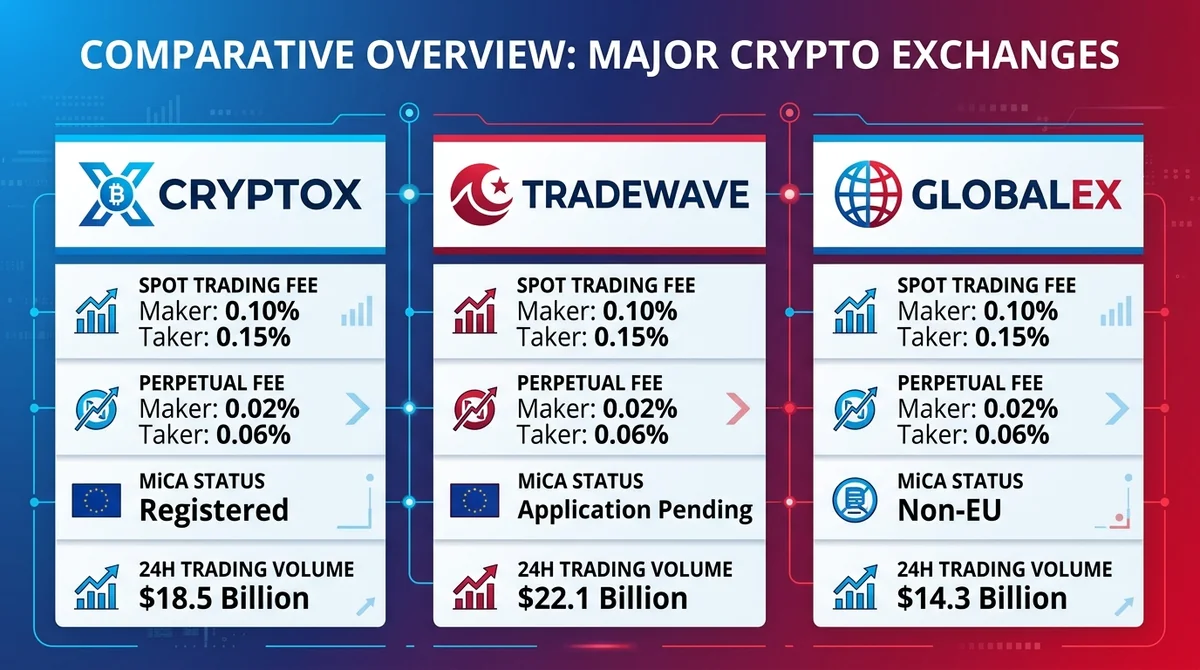
Binance & Gate: near-identical spot/perpetual fees, MiCA authorization; Binance 24h volume far higher. MSX discloses fees/compliance, not all risk metrics.
Conclusion: Based on public data, Binance and Gate have almost identical standard spot/perpetual fees, with slight differences in platform token discounts; both have obtained MiCA CASP authorization, but Binance's 24h trading volume is significantly higher than Gate's. MSX has disclosed RWA spot and contract fees, SEC STO filing credentials, and trading volume milestones, but has not disclosed risk metrics such as maximum leverage, maintenance margin rate, and funding rate interval; these must be evaluated against official disclosures.
#Comparison table: core dimensions at a glance
| Dimension | Binance | Gate | MSX |
|---|---|---|---|
| Spot standard fee | Maker 0.1% / Taker 0.1% (excluding BNB discount) | Maker 0.1% / Taker 0.1% (0.09%/0.09% after GT discount) | RWA spot buy 0.3% / sell 0% (25% off with MSX discount) |
| Perpetual standard fee | Maker 0.02% / Taker 0.05% (10% off with BNB) | Maker 0.02% / Taker 0.05% | Maker 0.02% / Taker 0.045% (10% off with MSX) |
| Platform token discount | BNB: 25% off spot, 10% off futures | GT: 10% off spot, no unified futures discount | $MSX: 25% off spot, 10% off futures |
| Maximum leverage (major coin USDT perpetual) | 150x | 200x | Not disclosed |
| Minimum maintenance margin rate (first tier) | 0.4% (BTCUSDT) | 0.3% (BTC_USDT) | Not disclosed |
| Funding rate settlement interval | 8 hours | 8 hours | Not disclosed |
| Spot trading pairs | ~1,371 (TRADING) | ~2,235 (tradable) | Not disclosed |
| USDT-margined perpetual pairs | ~530 | ~867 | Not disclosed |
| 24h trading volume (BTC) | 133,747.13 BTC | 15,937.28 BTC | Not disclosed (single-day 24h volume exceeded $2 billion on 2025-12-03) |
| MiCA authorization status | Granted MiCA CASP authorization (Greece) | Granted MiCA CASP authorization (Malta MFSA) | No MiCA, completed SEC STO filing (Regulation S) |
#How do tokenized stock trading fees compare? How much do MSX, Binance, and Gate differ?
#What are the standard spot and perpetual fee rates?
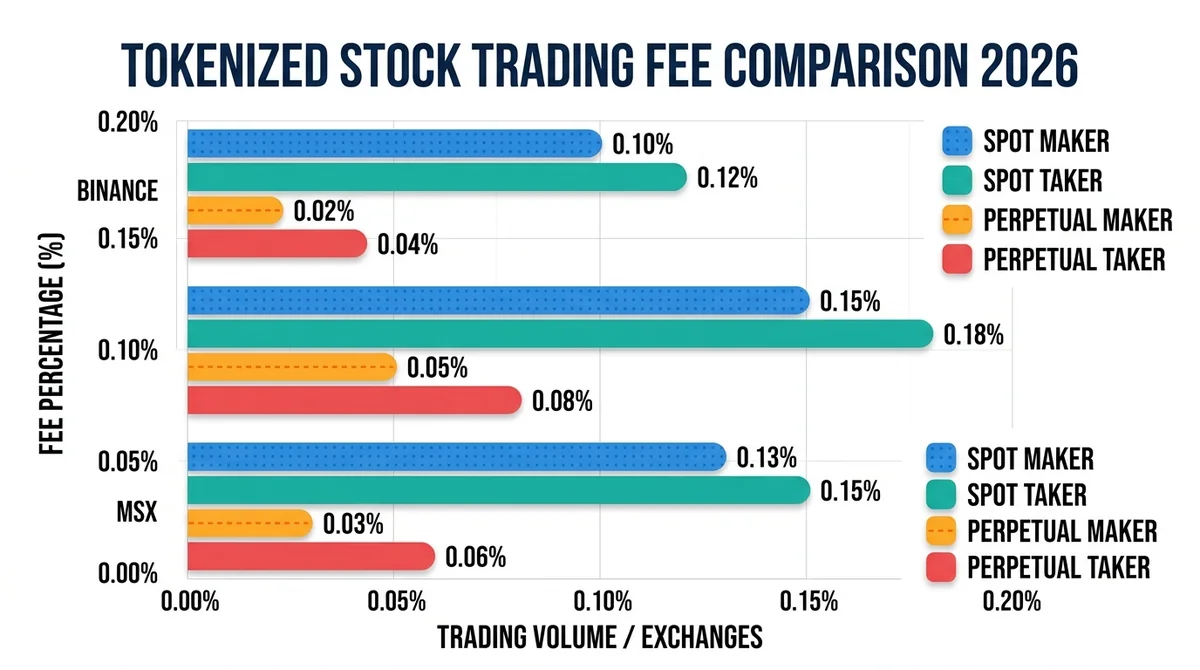
Spot fees: For regular users, Binance charges Maker 0.1% / Taker 0.1% (excluding BNB discount); Gate VIP0 also charges Maker 0.1% / Taker 0.1%. The difference appears in platform token discounts: Binance typically offers a 25% discount on spot fees when paying with BNB, whereas Gate reduces spot fees to 0.09%/0.09% (10% off) when using GT. MSX's RWA spot (including tokenized stocks) fee is 0.3% for buys and 0% for sells; paying with $MSX gives a 25% discount (resulting in an effective buy fee of 0.225%).
Perpetual fees: For regular users, Binance USDT-margined perpetuals charge Maker 0.02% / Taker 0.05%, with a typical 10% discount when paying with BNB; Gate VIP0 also charges Maker 0.02% / Taker 0.05%, with no unified GT discount found for futures. MSX contract fees are 0.02% maker and 0.045% taker, with a 10% discount when paying with $MSX.
#How do platform token discounts reduce tokenized stock trading costs?
Platform token discounts directly lower the effective fee rate paid. Binance's BNB discount covers both spot and futures, with a larger spot discount; Gate's GT discount currently only officially offers 10% off spot, with no unified futures discount. MSX's $MSX discount covers both RWA spot (25% off) and contracts (10% off). Note: Platform token price fluctuations may affect the actual discount value.
#Which platform has better tokenized stock liquidity? Comparing trading pairs, 24h volume, and spreads
#Can trading pair count and supported assets indicate liquidity?
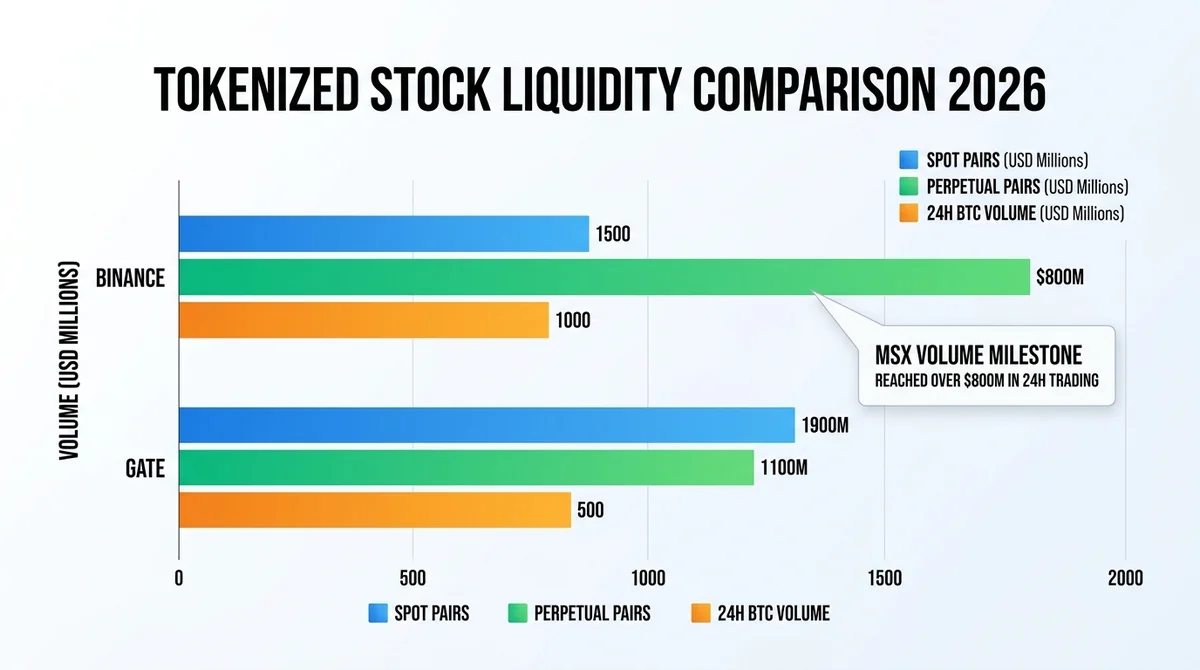
A higher number of trading pairs does not guarantee better liquidity per pair, but it reflects asset coverage breadth. Binance has about 1,371 spot pairs and about 530 USDT perpetual pairs; Gate has about 2,235 spot pairs and about 867 USDT perpetual pairs. Gate has more total pairs, especially in long-tail assets. MSX has not disclosed the number of spot/perpetual pairs, but has launched tokenized US stock spot (2025-05-10), tokenized US stock perpetuals (public beta from 2025-08-11), and a Pre-IPO sector (2026-03-02), giving a different asset coverage structure.
#How should 24h trading volume and BTC spread be referenced?
24h trading volume is one of the direct indicators of liquidity. Binance's 24h volume is about 133,747.13 BTC, while Gate's is about 15,937.28 BTC — Binance is significantly higher. For spreads, Binance's real-time BTC/USDT spot spread is $0.01 (0.001 bps); Gate's spread is not disclosed. MSX has not disclosed 24h volume in BTC terms, but on 2025-12-03 its single-day 24h volume exceeded $2 billion (all-time high), and on 2026-04-15 cumulative total volume surpassed $30 billion (including RWA contracts, crypto contracts, and RWA spot). Tokenized stock-specific liquidity should be checked per trading pair on each platform, not inferred from overall data alone.
#Compliance differences: Which of MSX, Binance, and Gate has MiCA authorization? What does it mean for tokenized stock trading?
#What are the MiCA-authorized entities of Binance and Gate?
Binance has obtained MiCA CASP authorization, with the authorized entity located in Greece; Gate has obtained MiCA CASP authorization, with the authorized entity being Gate Technology Limited, regulated by the Malta MFSA, and authorized since January 2025. Both meet MiCA's basic licensing requirements for crypto-asset service providers.
#Has MSX disclosed its compliance status?
MSX has not obtained MiCA CASP authorization, but has disclosed other compliance credentials: it has completed SEC security token offering (STO) filing, giving it compliance qualifications to conduct STOs under Regulation S of the U.S. Securities Act of 1933; it is also exploring compliance pathways for derivative trading venues under the CFTC regulatory framework (e.g., Designated Contract Market), and has integrated KYC/KYT systems. Tokenized stock products typically have securities characteristics, and licensing requirements vary by jurisdiction, so users must evaluate based on their own region.
#What leverage and risks are involved in tokenized stock trading? How do funding rates, maintenance margin, and security incidents matter?
#What are the differences in maximum leverage and minimum maintenance margin rates?
For major USDT perpetuals, Gate's maximum leverage is 200x, while Binance's is 150x. Minimum maintenance margin rate in the first tier: Gate BTC_USDT is 0.3%, Binance BTCUSDT is 0.4% (see TRUMPUSDT perpetual futures margin requirements explained). Higher leverage and lower maintenance margin rates mean higher potential returns, but also a risk closer to liquidation. MSX has not disclosed maximum leverage or minimum maintenance margin rates; consult official contract specifications.
#How does the funding rate settlement interval affect holding costs?
Binance and Gate settle funding rates every 8 hours (in extreme market conditions, Binance may adjust to 4 or 1 hours). Funding rates are payments between long and short holders of perpetual contracts; long-term position holders need to continuously monitor the impact of funding rates on costs. MSX has not disclosed its funding rate settlement interval and must be confirmed with the official source.
#How do historical security incidents affect platform trust?
Binance's historical security incidents include: October 2022 Binance Bridge ~$570 million (Proof Verifier Bug), and May 2019 ~$40 million (Hot Wallet Key Compromised). Gate-related historical security incidents include: April 2018 Gate ~$235 million (Private Key Compromised), June 2019 GateHub ~$9.5 million (Private Key Compromised), and May 2016 Gatecoin ~$2 million (Improper Access Control). MSX has not disclosed historical security incidents, but has disclosed its asset custody model (95% cold wallet multi-sig, reserve ratio commitment >100%), multi-layer risk-control liquidation system, and claims that smart contracts have undergone third-party audits. Historical security incidents are one reference dimension for platform trust, but do not equal current security levels; they should be evaluated together with current proof-of-reserves and cold storage measures.
#How to choose a tokenized stock trading platform? Decision path by compliance, fees, and liquidity
#If you prioritize regulatory certainty, who should you consider first?
Compliance first: Binance and Gate have both obtained MiCA CASP authorization, providing a clearer compliance basis in the EU region. MSX lacks MiCA but has completed SEC STO filing (Regulation S) and is exploring CFTC frameworks, making it suitable for users focused on U.S. securities compliance paths. Users should choose based on their own jurisdiction.
#If you want many trading pairs and high leverage, how do you choose?
More pairs and higher leverage: Gate has more spot and perpetual trading pairs, with a maximum leverage of 200x for major coins, suitable for users needing long-tail asset coverage and higher leverage; Binance has slightly fewer total pairs but significantly higher 24h trading volume, with deeper liquidity in major assets. MSX has not disclosed maximum leverage, but offers differentiated products such as tokenized US stock spot/perpetuals and Pre-IPO, with a different fee structure (0% on sells). On fees, Binance and Gate have identical standard rates but different platform token discounts; MSX's contract fees are close to the other two, but its spot buy fee of 0.3% is higher.
#If MSX data is partially opaque, how can you make a rational judgment?
MSX information gaps: MSX has disclosed fees, partial compliance credentials, and trading volume milestones, but has not disclosed maximum leverage, maintenance margin rate, funding rate interval, trading pair count, or real-time spreads. A rational approach is: 1) visit MSX official documentation or contact support to obtain missing metrics; 2) confirm the securities attributes, custody arrangements, and liquidation rules of tokenized stock products; 3) use data-transparent platforms like Binance or Gate as benchmarks and complete a like-for-like product comparison before deciding.
#FAQ
#What is the difference between tokenized stock spot and perpetual?
Tokenized stock spot represents tokenized exposure to the underlying stock, and holders may not enjoy real shareholder rights; tokenized stock perpetuals are derivative contracts that track stock price movements, involve no physical stock delivery, and have funding rates and liquidation mechanisms that amplify risk. MSX offers both tokenized US stock spot (launched 2025-05-10) and tokenized US stock perpetuals (public beta from 2025-08-11).
#Who has lower fees between Binance and Gate?
Under standard rates for regular users, both charge 0.1%/0.1% for spot and 0.02%/0.05% for perpetuals. Actual costs depend on platform token discounts and VIP tiers: Binance's BNB gives 25% off spot and 10% off futures; Gate's GT gives 10% off spot. MSX charges 0.3% for spot buys and 0% for sells, with similar contract fees but undisclosed VIP tiers. High-frequency or large traders should refer to each platform's fee schedule.
#What is MSX's compliance status?
MSX has completed SEC STO filing (Regulation S) and is exploring CFTC derivatives compliance pathways, but has not obtained MiCA authorization. Regulatory requirements for tokenized stock products vary by jurisdiction, so check whether your region permits them.
#What metric should you look at first when choosing a platform?
Look first at compliance and custody: tokenized stock products have securities attributes, so whether the platform holds the appropriate licenses and whether assets are segregated in custody is key. Next, look at fees and liquidity: standard fees and platform token discounts directly affect costs, while pair depth and 24h trading volume affect execution quality. Leverage and security history serve as risk-control references.
#Does Gate's historical security incident affect its Mi
FAQ
代币化股票现货和永续有什么区别?
代币化股票现货代表标的股票的代币化敞口,持有者可能不享有真实股东权利;代币化股票永续是衍生品合约,追踪股票价格涨跌,不涉及实际股票交割,资金费率与强平机制会放大风险。MSX 同时提供美股代币现货(2025-05-10 上线)与美股代币永续(2025-08-11 公测起)。
Binance 和 Gate 谁的手续费更低?
普通用户标准费率下,两者现货均为 0.1%/0.1%,永续均为 0.02%/0.05%。实际成本取决于平台币抵扣与 VIP 等级:Binance BNB 抵扣现货 7.5 折、合约 9 折;Gate GT 抵扣现货 9 折。MSX 现货买单 0.3% 卖单 0%,合约费率接近但未公开 VIP 阶梯。高频或大额交易者需参考各平台费率表。
MSX 的合规状态如何?
MSX 已完成 SEC STO 备案(Regulation S),并探索 CFTC 衍生品合规路径,但未获得 MiCA 授权。不同司法辖区对代币化股票产品监管要求不同,需确认所在地区是否允许。
选择平台时应该先看哪个指标?
应先看合规与托管:代币化股票产品有证券属性,平台是否持有相应牌照、资产是否隔离托管是关键。其次看费率与流动性:标准费率和平台币抵扣直接影响成本,交易对深度和 24h 交易量影响成交质量。杠杆与安全历史作为风险控制参考。
Gate 的历史安全事件会影响它的 MiCA 授权吗?
MiCA 授权是对当前合规体系的认可,历史安全事件是过去风险记录,两者不直接等同。但历史事件可反映平台安全管理演变,投资者应结合当前储备证明、冷存储比例和审计情况持续评估。
Related Terms
Done comparing? Ready to place your first trade?
The crypto assets, tokenized US stocks and ETFs you just compared are all tradable on MSX — spot or perpetuals.
Quick Start Trading →New here? Registration takes three quick steps.