NVIDIA Tokenized Stock Contracts vs Real NVIDIA Stock 2026: Trading Hours, Dividends, and Settlement Comparison
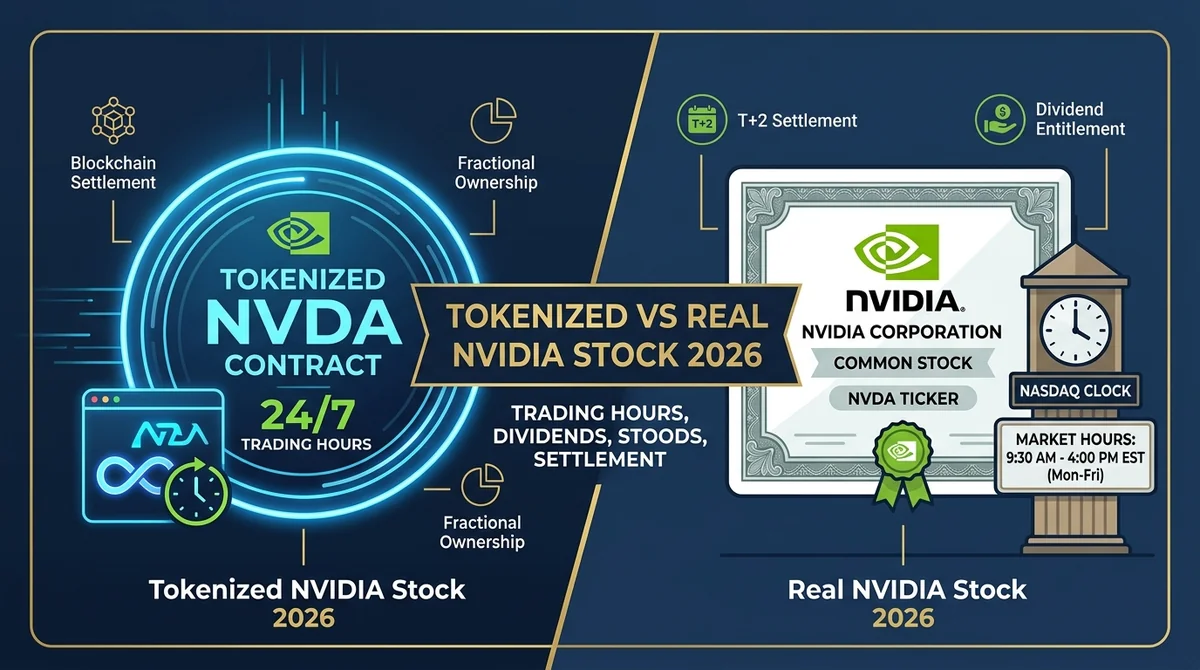
Compare NVIDIA tokenized stock contracts vs real NVIDIA stock on ownership, trading hours, dividends, settlement, leverage, liquidity, and risks. US stocks now settle T+1; verify tokenized contract flexibility and counterparty risk.
#NVIDIA Tokenized Stock Contracts vs Real NVIDIA Stock 2026: Trading Hours, Dividends, and Settlement Comparison
Bottom line: Investors seeking true ownership, cash dividends, and traditional regulatory protection should choose real NVIDIA stock; short-term traders needing more flexible trading hours and potential leverage may consider tokenized stock contracts, but must independently verify platform rules, accept additional platform and counterparty risks, and be wary of discrepancies between platform marketing and reality.
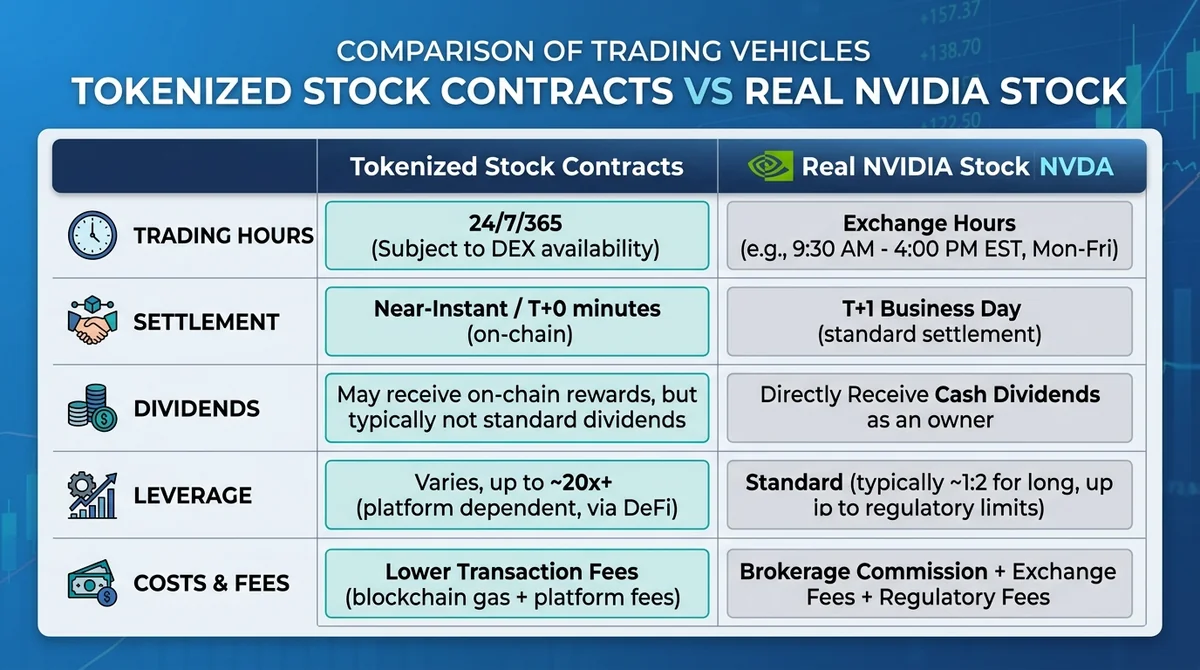
Comparison table: The following is a comparison of key dimensions (some data comes from platform disclosures or public market rules; please refer to the latest announcements from each platform and exchange; unverified or undisclosed items are noted).
| Dimension | NVIDIA Tokenized Stock Contracts | Real NVIDIA Stock |
|---|---|---|
| Asset nature | Mostly synthetic price exposure, not directly holding underlying stock (need to distinguish asset-backed tokens) | Company ownership certificate |
| Trading hours | May support 24/7 or near-24/7 trading (depends on platform, no unified public standard) | NASDAQ regular session 9:30–16:00 ET, limited pre-market/after-hours |
| Dividend handling | May be handled via price adjustment or equivalent distribution, need to confirm platform policy; some platforms do not provide | Direct cash dividend (if company distributes) |
| Settlement mechanism | Some platforms claim T+0 on-chain instant settlement (e.g., MSX disclosed, not independently verified) | US stock standard settlement cycle is T+1 (since May 28, 2024) |
| Leverage | May support higher leverage, subject to platform rules (no unified public standard) | Subject to FINRA/SEC margin rules, initial margin typically 50%, maintenance margin 25% |
| Ownership rights | Usually no shareholder voting rights etc. | Full shareholder rights including voting |
| Liquidity | Depends on tokenization platform, data not public | NASDAQ market relatively high liquidity (specific order book depth not public) |
| Availability | May be available through crypto platforms, subject to regional regulatory restrictions; platform reliability needs verification | Through licensed brokers, subject to geographic and account restrictions |
| Regulatory/platform risk | Faces platform operational, counterparty, smart contract, and price deviation risks | Regulated by securities laws, but still market risk |
| Costs | May have spread, funding rate, on-chain gas, etc., data not public; some platforms disclose fees (e.g., MSX RWA spot buy 0.3%, sell 0%) | Mainstream US brokers mostly offer zero commission, but still small costs such as SEC fees, exchange fees |
Detailed dimensions:
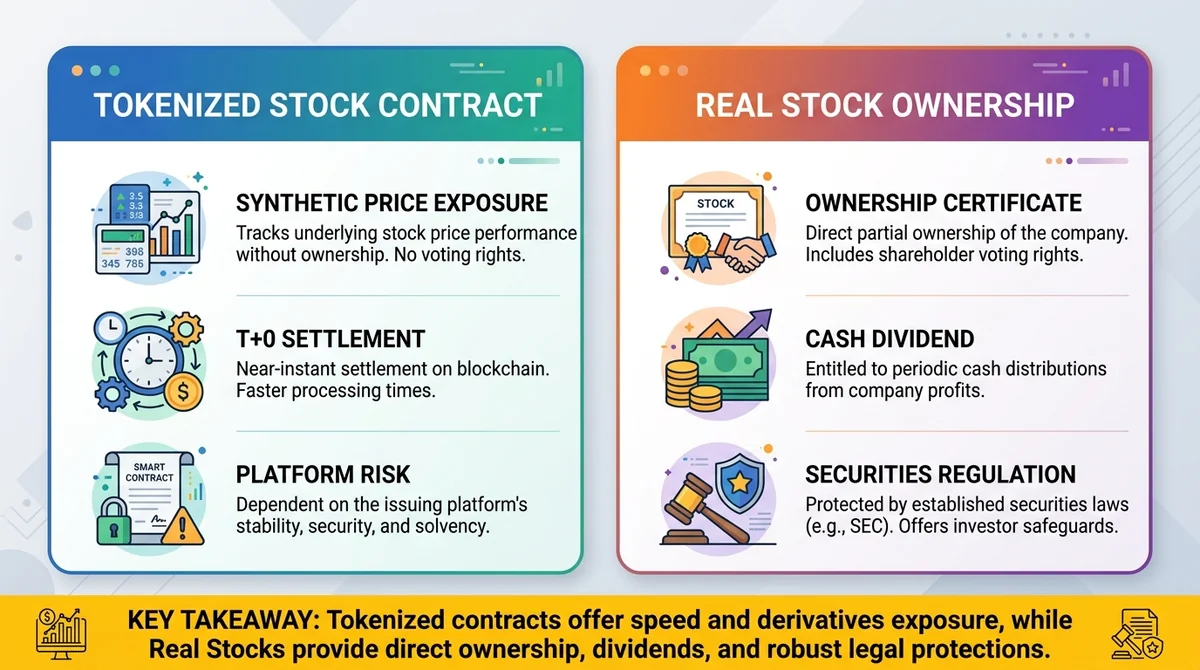
Asset nature: Tokenized stock contracts typically represent synthetic exposure to the underlying stock; investors generally do not directly hold NVIDIA shares and therefore do not enjoy shareholder rights. However, note that 'asset-backed tokens' also exist in the market, i.e., tokens backed by custody of real stock, and their rights may differ. Investors must review the legal documents of specific products. Real stock represents company ownership, and holders have voting rights, dividend rights, etc.
Trading hours: Real NVIDIA stock trades during NASDAQ regular session (9:30–16:00 ET) and has pre-market/after-hours sessions, but liquidity may be lower. Tokenized stock contracts may offer wider trading windows, even close to 24/7, but specific trading hours vary by platform and there is no unified standard across platforms. Extended hours may bring additional volatility risk, especially when liquidity is insufficient, spreads may widen.
Dividend handling: Real shareholders receive cash dividends directly (if NVIDIA distributes). Tokenized stock contracts handle dividends differently by platform: some reflect dividends through price adjustments, some provide equivalent distributions, and some do not provide any dividend entitlement. Investors must confirm whether the platform provides equivalent dividend entitlement and understand the specific calculation method, otherwise they may underestimate total return differences.
Settlement mechanism: The standard US stock settlement cycle has been shortened from T+2 to T+1 since May 28, 2024 (SEC rule). Real NVIDIA stock trades follow this cycle. Tokenized stock contracts may support instant or shorter settlement; for example, some platforms (e.g., MSX) disclose that their US stock token spot trading uses T+0 on-chain instant settlement, but this data comes from unilateral platform disclosure and has not been independently audited. Faster settlement may improve capital turnover efficiency, but one must consider on-chain confirmation time, network congestion, and withdrawal delays.
Leverage: Tokenized stock contracts may support higher leverage; the specific multiple must be checked in platform rules, and differences between platforms are huge. Real US stocks can be leveraged through margin trading, but are limited by FINRA/SEC rules, with initial margin typically 50% and maintenance margin not less than 25%; in practice brokers may require higher. High leverage magnifies losses; investors should avoid excessive use.
Ownership rights: Tokenized contract holders generally do not own NVIDIA shares, so they have no voting rights, dividend collection rights, or other shareholder rights. Real shareholders enjoy full shareholder rights, including voting at shareholder meetings.
Liquidity: Real NVIDIA stock has relatively high liquidity on NASDAQ, but specific order book depth data is not public. Tokenized stock contract liquidity depends on the specific platform and varies greatly; it may be affected by platform volume, market maker depth, etc., with no public data. Investors should be wary of liquidity drying up on small platforms.
Availability: Real NVIDIA stock must be purchased through licensed brokers, subject to geographic and account restrictions. Tokenized stock contracts may be obtained through crypto platforms, but are also subject to regional regulatory restrictions, and platform reliability needs verification. Some platforms may not have obtained securities or derivatives licenses in major jurisdictions, posing compliance risks.
Regulatory/platform risk: Real stock is supervised by securities regulators and uses central clearing to reduce counterparty risk. Tokenized stock contracts face additional platform operational risk, counterparty risk, smart contract vulnerability risk, and price deviation risk. If a platform has problems, asset safety and even exit may be affected.
Costs: Real stock trading through mainstream US brokers mostly offers zero commission, but there are still small costs such as SEC fees and exchange fees. Tokenized stock contracts may involve spreads, funding rates, on-chain gas fees, platform fees, etc.; specific costs must be checked in the platform fee schedule. Some platforms disclose fees (e.g., MSX RWA spot buy side 0.3%, sell side no fee), but these data come from unilateral platform disclosure, differ greatly between platforms, and may have hidden costs.
Scenario recommendations:
- If you are a long-term holder focused on dividend income and shareholder rights, choose real NVIDIA stock.
- If you are a short-term trader needing more flexible trading hours and potential leverage, you may consider tokenized stock contracts, but you must strictly control risk and verify the platform's actual tradable hours and leverage rules.
- If you want to avoid traditional broker account opening procedures, you may be more interested in tokenized contracts, but you need to verify platform compliance, asset custody methods, and exit paths.
- If you value asset safety and regulatory protection, real stock is more secure because investor protection mechanisms and central clearing exist.
- If your region cannot directly buy US stocks, tokenized contracts may provide an alternative channel, but you need to confirm the channel's compliance in your jurisdiction and evaluate platform counterparty risk.
Risk warning: Tokenized stock contracts may have price deviation (i.e., contract price trading at premium or discount to the underlying stock), de-pegging risk, liquidation risk, and regulatory uncertainty. Tax treatment is also unclear and may differ from direct stock holding. Investors should carefully read platform terms and consider consulting professional advisors.
Disclaimer: This content is compiled from public data and platform disclosures and does not constitute investment or account opening advice. Data is as of publication in 2026; actual conditions may change. Please check official sources for the latest information and independently verify platform claims.
FAQ
What is the main difference between tokenized NVIDIA stock contracts and real NVIDIA stock?
The main differences lie in ownership and trading mechanics. Real stock represents company ownership and carries shareholder rights; tokenized contracts are typically synthetic exposure, do not directly hold the underlying stock, may offer more flexible trading hours and leverage, but come with platform, counterparty, and price deviation risks.
Can holding tokenized NVIDIA contracts earn dividends?
It depends on the platform policy. Some platforms may handle dividends via price adjustments or equivalent distributions, but not all platforms provide this, and some may completely ignore dividend entitlements. Investors must verify platform terms item by item.
Which settles faster?
Mainstream US stock settlement cycle is T+1; some tokenized platforms claim T+0 settlement, but this data has not been independently verified. Even if advertised as instant, on-chain confirmation and withdrawal time must be considered, so actual capital efficiency may be lower than advertised.
Are tokenized NVIDIA contracts suitable for long-term investment?
Generally not, because most tokenized contracts do not provide ownership or dividend entitlements, and platform risk is high. For long-term holding, real stock should be prioritized, unless a tokenized product is backed by real assets and has a clear legal structure.
Do tokenized contracts have leverage?
They may support leverage, but the specific multiple varies by platform and there is no unified regulatory cap. High leverage magnifies losses; investors need to independently verify platform rules and use it cautiously.
Related Terms
Done comparing? Ready to place your first trade?
The crypto assets, tokenized US stocks and ETFs you just compared are all tradable on MSX — spot or perpetuals.
Quick Start Trading →New here? Registration takes three quick steps.