NVDA Tokenized Stock Perpetual Contracts vs Spot Tokenized Stocks: 2026 Leverage Exposure and Funding Rate Comparison
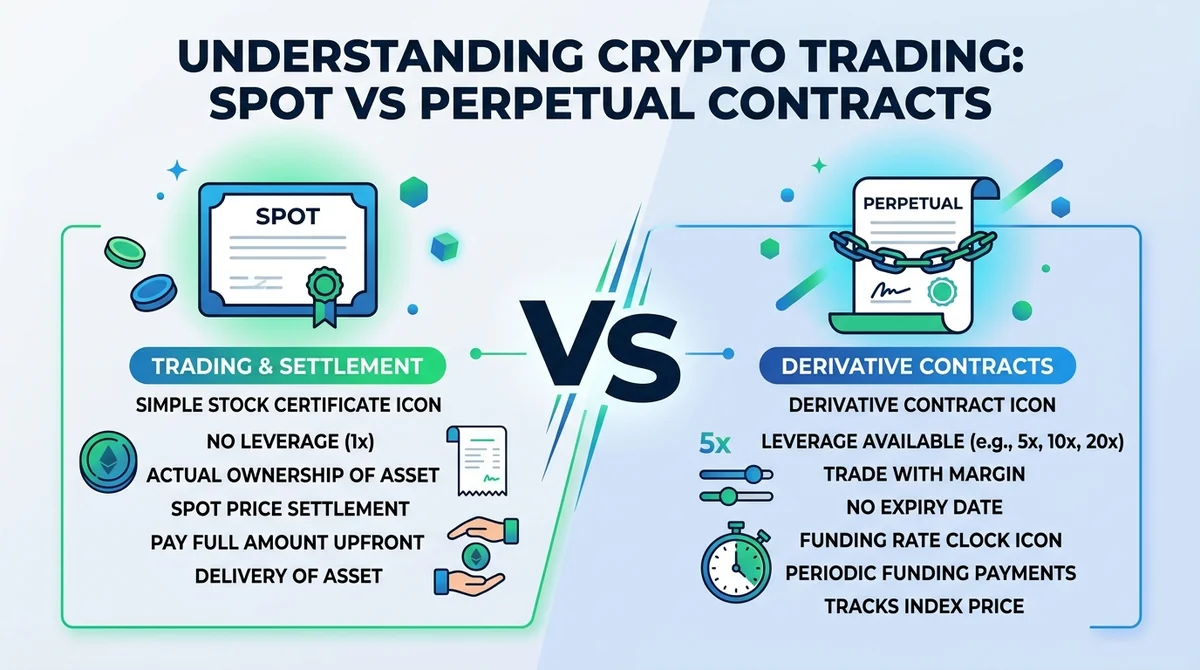
Key differences between NVDA tokenized spot and perpetual contracts: leverage, funding rates, liquidation risk. Data-driven 2026 long/short strategies and costs.
Conclusion: NVDA tokenized spot stocks are suitable for long-term price exposure, while perpetual contracts are suitable for two-way leveraged trading; the core differences lie in leverage, funding rates, and liquidation risk.
#What are the core differences between NVDA tokenized spot stocks and perpetual contracts?
NVDA tokenized spot stocks are assets that directly hold NVDA price exposure, while perpetual contracts are derivatives with no expiry, leverage, and a perpetual futures funding rate settlement schedule that anchors the price to the spot market.
#What do spot and perpetual contracts represent respectively?
Spot represents holding the asset itself and its price movements, while perpetual contracts represent leveraged bets on price fluctuations through margin trading.
#How does the funding rate affect perpetual contract prices?
The funding rate is a fee periodically exchanged between long and short positions to converge the perpetual contract price toward the spot price. When the perpetual price is higher than the spot price, longs pay the funding rate to shorts, and vice versa.
#Who is suitable for NVDA tokenized spot stocks?
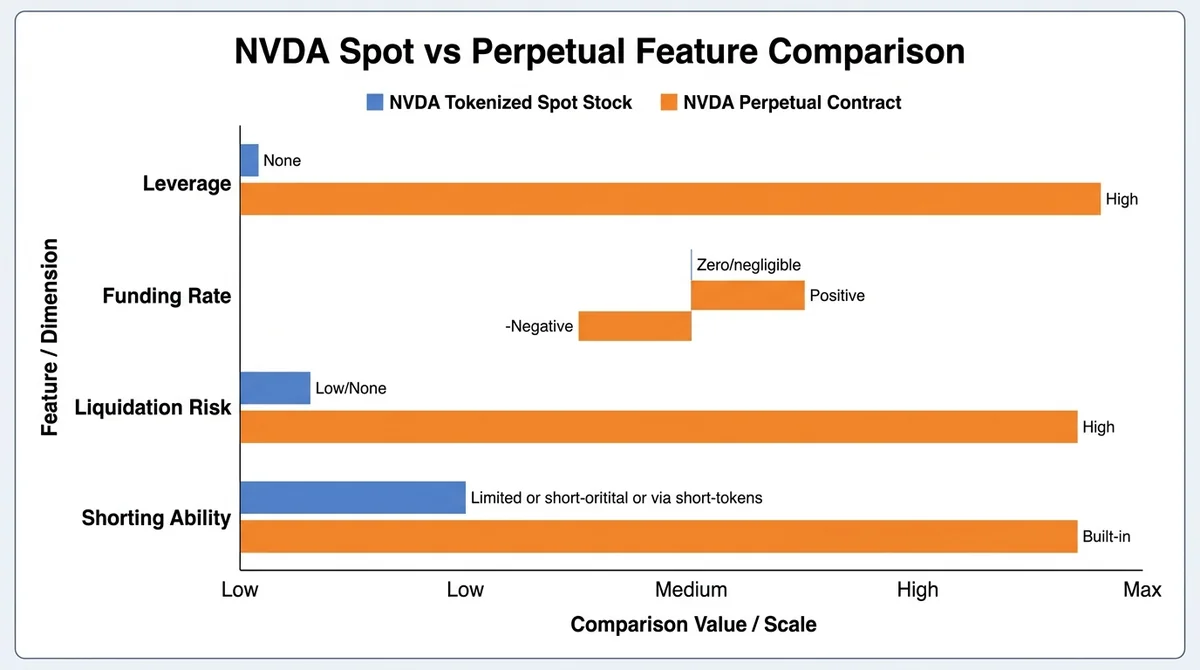
Suitable for investors who are long-term bullish on NVDA and unwilling to bear leverage and liquidation risks, allowing low-cost holding of tokenized spot stocks.
#Which investors are suitable for long-term spot holding?
Investors who want NVDA price exposure, have a longer holding period, and are unwilling to trade frequently or bear leverage risk.
#What are the main costs and risks of spot?
Costs mainly include bid-ask spreads and platform trading fees. The main risk is asset depreciation from NVDA price declines, without leverage amplification.
#Who is suitable for NVDA tokenized stock perpetual contracts?
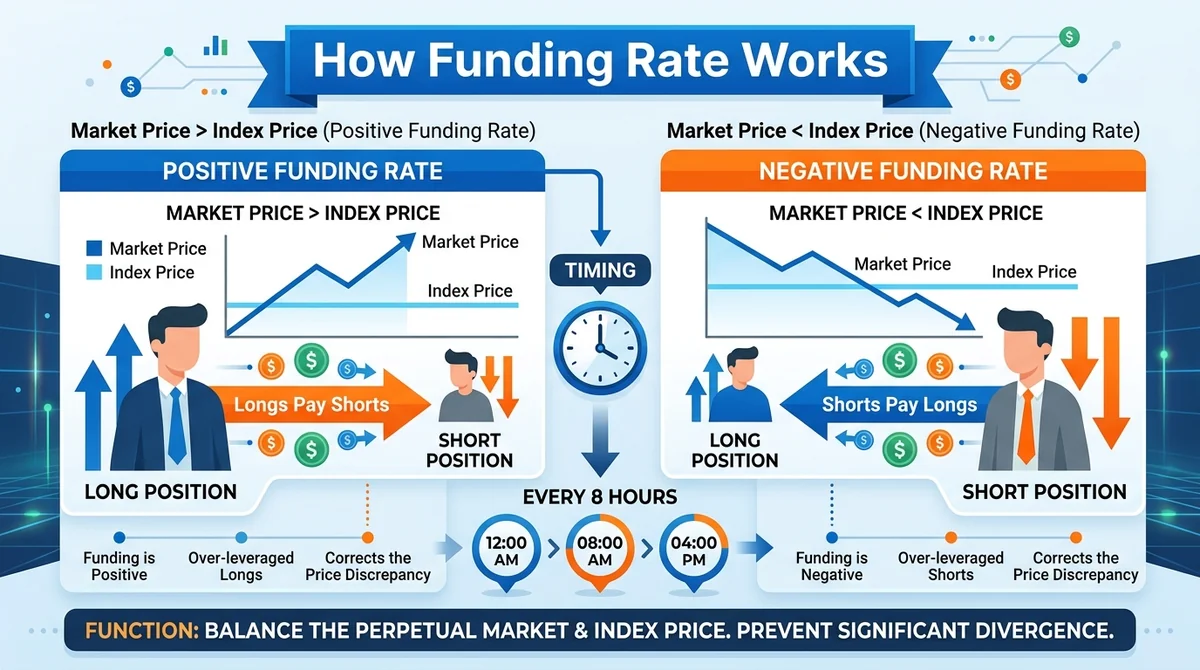
Suitable for active traders seeking two-way long/short trading and willing to bear high leverage and liquidation risk, but they must continuously pay funding rates.
#What trading strategies are suitable for perpetual contracts?
Suitable for strategies that require leverage to amplify returns or two-way operations, such as going long, short, hedging, or arbitrage.
#How to assess your own risk tolerance?
You need to assess the maximum acceptable loss, acceptance of liquidation, and cash flow ability to continuously pay funding rates.
#What are the key risks of NVDA tokenized stock perpetual contracts?
Perpetual contracts with leverage amplify profits and losses. Adverse price movements can trigger forced liquidation or bankruptcy, and continuous funding rate payments increase holding costs.
#Why is leverage dangerous?
Leverage amplifies profits and losses by a multiple. When prices rise, gains increase proportionally; when prices fall, losses expand equally.
#How do forced liquidation and bankruptcy occur?
When margin is insufficient to maintain the position, the platform will force-close it (forced liquidation). If extreme price volatility causes account equity to reach zero or negative, bankruptcy occurs.
#How much cost does the funding rate incur?
The funding rate is typically settled every 8 hours, with the specific rate determined by market long/short ratios. Holding perpetual contracts long-term requires continuous funding rate payments, and cumulative costs can be significant.
#Comparison Table
| Dimension | NVDA Tokenized Spot Stock | NVDA Tokenized Stock Perpetual Contract |
|---|---|---|
| Asset nature | Spot asset | Derivative contract |
| Leverage | None | Typically 1-20x |
| Funding rate | None | Yes, settled periodically |
| Liquidation risk | None | Yes |
| Shorting ability | Not supported | Supported |
| Holding cost | Bid-ask spread and platform fees | Funding rate + trading fees |
| Price anchoring | Directly reflects spot price | Anchored via funding rate |
| Suitable scenarios | Long-term holding | Short-term trading/hedging |
| Expiry date | None | None |
| Equity nature | Holds price exposure | Only price exposure |
#Detailed Dimensions
- Asset nature: Spot is an actual asset; perpetual is a derivative and does not hold the underlying asset.
- Leverage: Spot has no leverage; perpetual can provide leverage, amplifying profits and losses.
- Funding rate: Spot has no such fee; perpetual requires periodic payments, and costs accumulate with holding time.
- Liquidation risk: Spot price declines only cause unrealized losses; perpetual under leverage can trigger forced liquidation or bankruptcy.
- Shorting ability: Spot typically only allows going long; perpetual allows shorting for profit.
- Holding cost: Spot costs are mainly trading fees; perpetual also includes funding rates.
- Price anchoring: Spot prices are directly determined by market supply and demand; perpetual prices converge to spot via the funding rate mechanism.
- Suitable scenarios: Spot is suitable for long-term investment; perpetual is suitable for short-term trading or hedging.
- Expiry date: Neither has an expiry date, but perpetual requires continuous margin management.
- Equity nature: Spot holders own price exposure; perpetual holders only own the right to price movement gains.
#Scenario Recommendations
Situations suitable for NVDA tokenized spot stocks:
- Long-term bullish on NVDA and want to hold the asset itself
- Unwilling to bear leverage and liquidation risk
- Prefer a simple and transparent cost structure
Situations suitable for NVDA tokenized stock perpetual contracts:
- Want to go long or short on NVDA price
- Need leverage to improve capital efficiency
- Can tolerate high volatility and liquidation risk
- Willing to continuously pay funding rates
#FAQ
Q1: Which is riskier, NVDA tokenized spot stocks or perpetual contracts? A1: Perpetual contracts are riskier because leverage amplifies profits and losses, and there is liquidation risk. Spot has no leverage, and the main risk is price decline.
Q2: How is the funding rate calculated? A2: The funding rate is usually calculated by the platform based on long/short position ratios and settled every 8 hours. Specific rates are subject to each platform's announcement.
Q3: Can perpetual contracts be held long-term? A3: Yes, but you must continuously pay funding rates and maintain margin levels. Long-term holding costs can be high.
Q4: Will spot and perpetual contract prices always be the same? A4: No, perpetual contract prices may deviate from spot, but the funding rate mechanism will drive price convergence.
Q5: How to choose the right product for yourself? A5: Choose based on investment horizon, risk tolerance, and trading strategy. Choose spot for long-term holding, and perpetual for short-term trading or hedging.
This content is compiled from public data and does not constitute investment or account opening advice. Data as of 2026-09-15 and may change. Please refer to official sources for the latest information.
FAQ
Which is riskier, NVDA tokenized spot stocks or perpetual contracts?
Perpetual contracts are riskier because leverage amplifies profits and losses, and there is liquidation risk. Spot has no leverage, and the main risk is price decline.
How is the funding rate calculated?
The funding rate is usually calculated by the platform based on long/short position ratios and settled every 8 hours. Specific rates are subject to each platform's announcement.
Can perpetual contracts be held long-term?
Yes, but you must continuously pay funding rates and maintain margin levels. Long-term holding costs can be high.
Will spot and perpetual contract prices always be the same?
No, perpetual contract prices may deviate from spot, but the funding rate mechanism will drive price convergence.
How to choose the right product for yourself?
Choose based on investment horizon, risk tolerance, and trading strategy. Choose spot for long-term holding, and perpetual for short-term trading or hedging.
Related Terms
Done comparing? Ready to place your first trade?
The crypto assets, tokenized US stocks and ETFs you just compared are all tradable on MSX — spot or perpetuals.
Quick Start Trading →New here? Registration takes three quick steps.