Nvidia vs AMD AI Chips: Which Is Better in 2026?
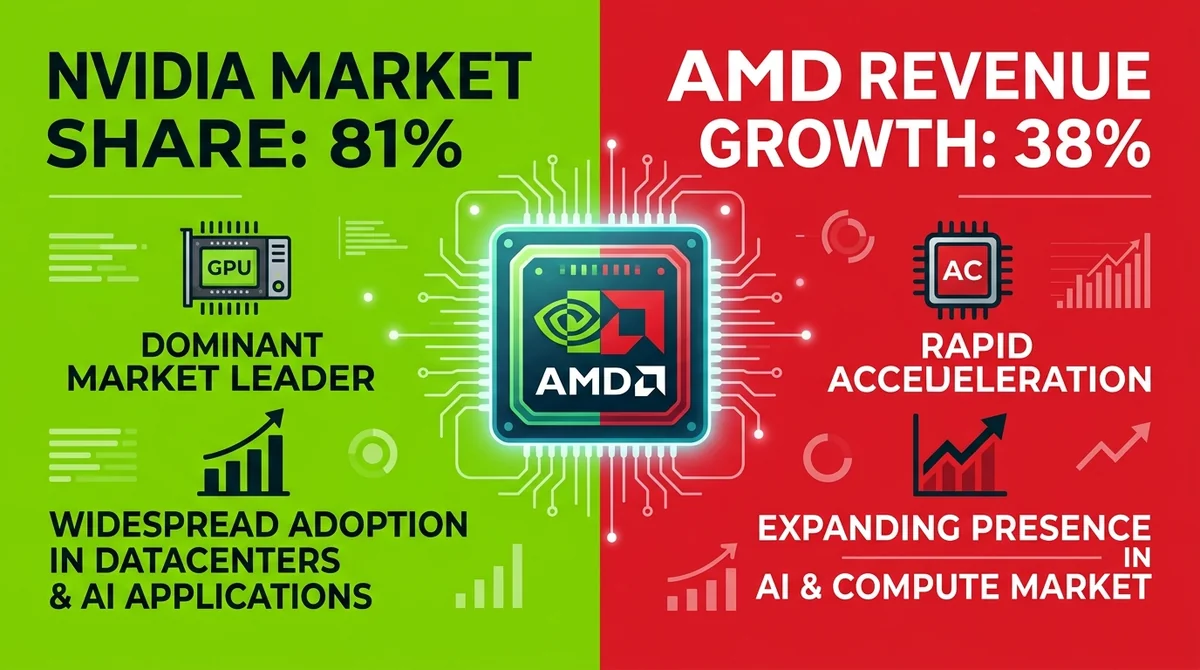
Nvidia holds 81% market share, but AMD is closing the gap. Compare inference performance, costs, software ecosystems, and use cases to pick the right GPU.
#Nvidia vs AMD AI Chips: Which Is Better in 2026?
Nvidia dominates the AI chip market with an estimated 81% share, but AMD is closing the gap with strong revenue growth and new GPU releases. For owned GPUs, AMD can match or beat Nvidia on performance per dollar in some inference workloads, while Nvidia remains the better value for short-term rentals due to a more competitive market. Your choice depends on whether you own or rent GPUs and the type of AI workload.
Key Takeaways
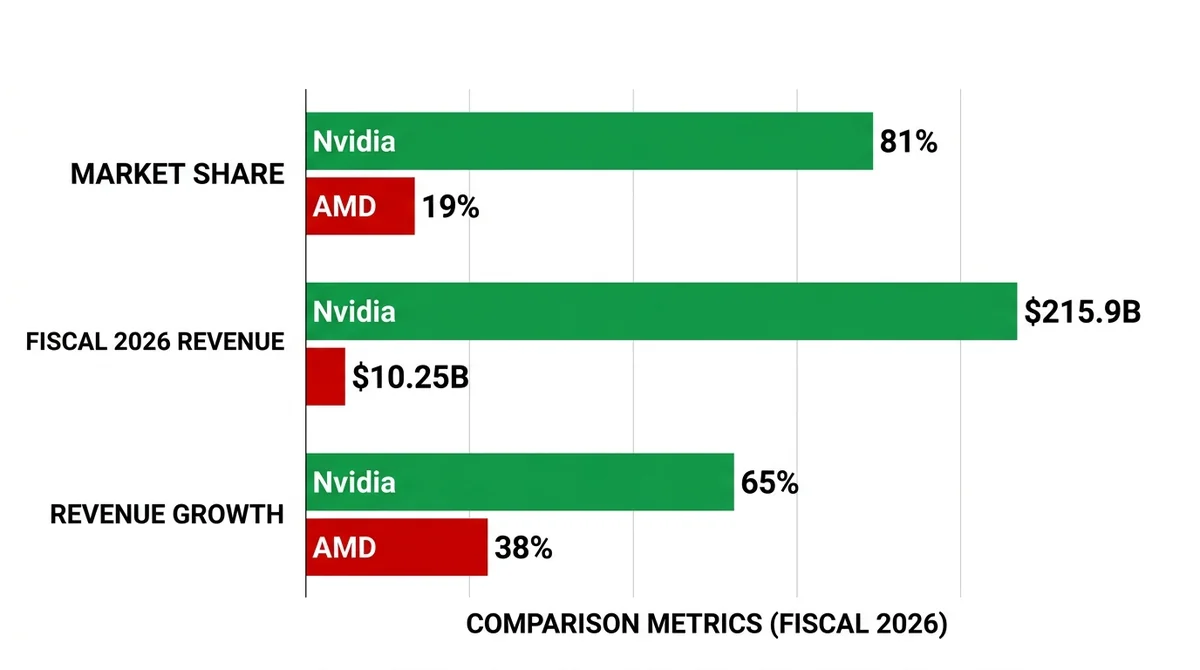
- Nvidia holds an estimated 81% AI chip market share, with fiscal 2026 revenue of $215.9 billion (up 65% YoY).
- AMD's Q1 2026 revenue grew 38% YoY to $10.25 billion, with adjusted earnings up 43%.
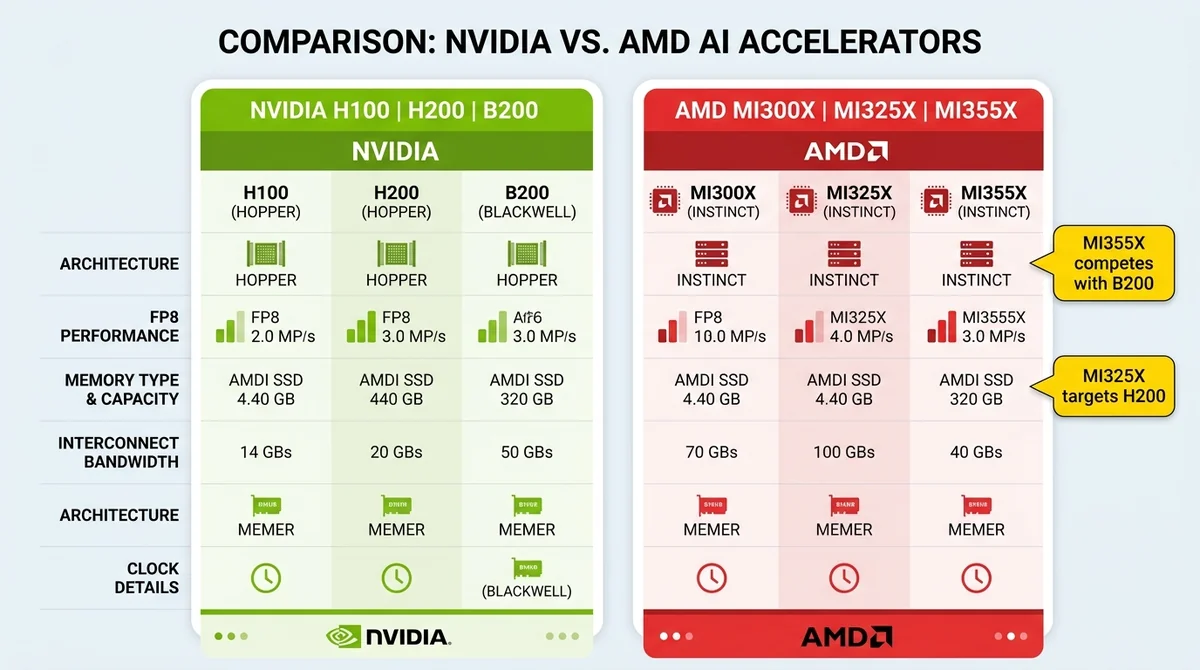
- AMD's MI355X competes with Nvidia's B200, while MI325X targets H200.
- For owned infrastructure, AMD can beat Nvidia on performance per dollar in certain inference tasks; for short-term rentals, Nvidia always wins on performance per dollar.
- Nvidia's CUDA ecosystem is more mature than AMD's ROCm, though ROCm is improving with added CI tests since Q3 2024.
#Nvidia vs AMD AI Chips: What Are the Key Differences in 2026?
Nvidia leads the AI chip market with an estimated 81% share, according to IDC. This dominance is reflected in financials: Nvidia's fiscal 2026 revenue reached a record $215.9 billion, up 65% year over year. In contrast, AMD's Q1 2026 revenue grew 38% year over year to $10.25 billion, with adjusted earnings up 43%. AMD's product lineup includes MI300X, MI325X, and MI355X, while Nvidia offers H100, H200, and B200. AMD's MI355X is positioned as a competitor to Nvidia's B200, while MI325X targets H200.
#Market share and revenue growth comparison
Nvidia's 81% market share translates into higher revenue and earnings. However, AMD stock has outperformed, rising 114% in 2026 compared to Nvidia's 18%, driven by growing AI prominence. This suggests investors see AMD as a strong second player.
#Product lineup: H100, H200, B200 vs MI300X, MI325X, MI355X
Nvidia's H100, H200, and B200 cater to training and inference, while AMD's MI300X, MI325X, and MI355X target similar workloads. The MI355X is designed to compete with B200, but MI325X shipment delays led many customers to skip it for B200.
#Which AI Chip Offers Better Inference Performance and Cost Efficiency?
For owned GPUs, performance per dollar varies by workload: Nvidia wins in some tasks, AMD in others. For short-term rentals (sub-6 months) from Neoclouds, Nvidia always wins on performance per dollar due to a more competitive rental market. AMD's lack of Neoclouds leads to inflated rental prices for MI300X and MI325X.
#Performance per dollar for owned GPUs
SemiAnalysis benchmarks show that for hyperscalers and enterprises owning GPUs, Nvidia has stronger performance per dollar in some workloads, while AMD has stronger performance per dollar in others. This depends on the specific AI task.
#Performance per dollar for short-term rentals
For customers using short to medium term rentals (sub-6 month) from Neoclouds, Nvidia always wins on performance per dollar. This is due to the lack of AMD Neoclouds, which has led to elevated rental market rates for MI300X and MI325X. In contrast, hundreds of Neoclouds offer Nvidia H100 and H200, creating competitive pricing.
#Workload-specific results: chat, document processing, reasoning
Performance differs across chat applications, document processing/retrieval, and reasoning tasks. AMD may excel in some inference scenarios, but Nvidia's broader ecosystem often provides more consistent performance.
#How Do Nvidia CUDA and AMD ROCm Compare for AI Development?
Nvidia's CUDA ecosystem is well-established and widely adopted, while AMD's ROCm is improving but still lags. AMD has been adding continuous integration automated tests since Q3 2024, but gaps in CI coverage and developer experience remain.
#Software ecosystem maturity
CUDA is the industry standard for AI development, with extensive libraries and tools. ROCm is catching up but has a smaller developer base and fewer optimized frameworks.
#Continuous integration and developer experience
AMD has taken action to improve its inference solution's developer experience and quality, adding some CI automated tests. However, nearly six months later, gaps remain in CI coverage and overall software polish.
#Framework support: VLLM, SGLang, TRT-LLM
Both ecosystems support VLLM, SGLang, and TRT-LLM, but optimization levels differ. Nvidia's frameworks are more mature, while AMD's support is improving but not yet at parity.
#Nvidia vs AMD AI Chips: Which Is Better for Your Use Case?
Your choice depends on whether you own or rent GPUs and the type of AI workload; there is no universal winner. Owners may choose AMD for cost efficiency in specific inference tasks, while renters should prefer Nvidia due to better availability and competitive pricing. Training workloads still favor Nvidia's mature ecosystem and high-performance interconnect, while inference workloads are more competitive, with AMD showing strength in certain scenarios.
#For hyperscalers and enterprises owning GPUs
If you own GPUs, AMD can be cost-effective for certain inference tasks. Evaluate your specific workloads to see if AMD's performance per dollar advantage applies.
#For short-term rental users
If you rent GPUs for less than six months, Nvidia is the better choice due to competitive rental pricing and availability.
#For specific AI workloads: training vs inference
Training workloads still favor Nvidia's mature ecosystem and high-performance interconnect. Inference workloads are more competitive, with AMD showing strength in certain scenarios.
#What Are the Pros and Cons of Nvidia and AMD AI Chips?
Nvidia offers a mature ecosystem and strong training performance, while AMD provides cost-effective inference for owned hardware but struggles with software maturity and availability.
#Nvidia advantages and disadvantages
Advantages: dominant market share, mature CUDA, competitive rental pricing, strong training performance.
Disadvantages: higher cost for owned hardware in some inference workloads.
#AMD advantages and disadvantages
Advantages: competitive inference performance per dollar for owners, improving software, aggressive pricing.
Disadvantages: smaller market share, less mature software ecosystem, shipment delays, limited Neocloud availability.
#How to Choose Between Nvidia and AMD AI Chips
Start by determining whether you own or rent GPUs. If you own, benchmark your specific workloads to see if AMD's cost advantage applies. If you rent, Nvidia is the safer choice. Also consider software ecosystem maturity and long-term support.
#Step-by-step decision path
- Determine GPU ownership model: own vs rent.
- Identify primary workload: training, inference, or mixed.
- If owning: run benchmarks on representative tasks; compare performance per dollar.
- If renting: check availability and pricing for Nvidia vs AMD; Nvidia likely wins.
- Evaluate software ecosystem: CUDA maturity vs ROCm improvements.
- Consider total cost of ownership including hardware, power, and software.
#Common mistakes to avoid
- Assuming AMD is always cheaper for inference without benchmarking your specific workloads.
- Ignoring software ecosystem maturity, which can increase development time.
- Overlooking rental market dynamics if you plan to rent GPUs.
- Not considering shipment delays for AMD products.
FAQ
Is Nvidia or AMD better for AI chips in 2026?
Nvidia leads with an 81% market share and a more mature ecosystem, but AMD offers competitive performance per dollar for owned GPUs in certain inference workloads. There is no universal winner; it depends on your use case.
Which AI chip is more cost-effective for inference?
For owned GPUs, AMD can be more cost-effective in some inference tasks. For short-term rentals, Nvidia is always more cost-effective due to a competitive rental market.
How does AMD's MI355X compare to Nvidia's B200?
AMD's MI355X is positioned as a competitor to Nvidia's B200. However, MI325X shipment delays led many customers to skip it for B200.
Is CUDA better than ROCm for AI development?
CUDA is more mature and widely adopted, while ROCm is improving but still has gaps in continuous integration coverage and developer experience.
Should I choose Nvidia or AMD for AI training?
Training workloads still favor Nvidia's mature ecosystem and high-performance interconnect. AMD is more competitive for certain inference tasks.
Done comparing? Ready to place your first trade?
The crypto assets, tokenized US stocks and ETFs you just compared are all tradable on MSX — spot or perpetuals.
Quick Start Trading →New here? Registration takes three quick steps.