Pre-IPO Platform Liquidity Comparison 2026: Exit Mechanisms and Pricing Differences Between MSX and Forge
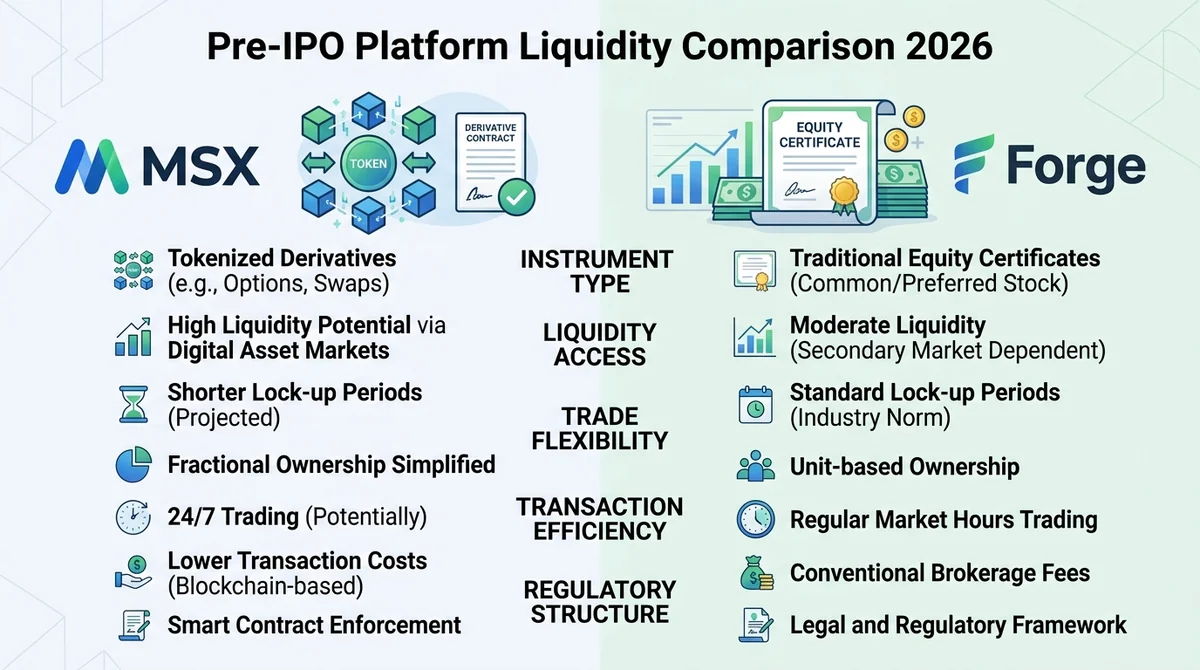
Compare MSX and Forge Pre-IPO liquidity: tokenized stock derivatives vs real equity transfers in exit speed, pricing transparency, and suitability.
Conclusion: If your goal is to quickly establish price exposure and enjoy secondary market liquidity, MSX may be a more convenient tool; if you value obtaining real equity and are willing to accompany the company's growth over the long term, Forge is more suitable. But be clear-headed: MSX's derivative structure carries counterparty risk, Forge's equity transfer process is slower, and both have their own compliance thresholds to cross.
#How Do MSX and Forge's Pre-IPO Liquidity Mechanisms Differ?
MSX and Forge take completely different paths in Pre-IPO liquidity: MSX uses tokenized stock derivatives to let you "bet on price," while Forge enables real equity transfers to let you "own the company." This fundamental divergence directly shapes the rights investors hold, the risks they bear, and the future exit paths.
#How Does MSX Provide Pre-IPO Liquidity?
MSX's approach is to issue tokenized stock derivatives—such as tokenized stock perpetual contracts—to bring the price fluctuations of Pre-IPO companies onto the trading desk. According to MSX's official disclosure, its Pre-IPO section officially launched on March 2, 2026, extending from secondary market US stock tokens to primary market share tokenization. Investors can buy and sell these derivatives on the secondary market without ever touching real equity. MSX's trading mechanism also allows going long or short on Pre-IPO company prices, often with leverage options. At its core, this system is about "tracking price" rather than "transferring ownership."
#How Does Forge Provide Pre-IPO Liquidity?
Forge plays the role of matchmaker: it connects existing shareholders of Pre-IPO companies (employees, early investors, etc.) with qualified buyers. Every transaction on the platform involves the transfer of real equity; buyers receive actual shares in the company, which may carry voting rights and dividend rights depending on the share class. Forge's liquidity comes from the efficiency of matching buyers and sellers, and the entire process must pass through compliance review, pricing negotiation, and equity transfer.
#What Is the Core Difference in Asset Type Between the Two?
The most essential difference lies in the legal nature of the asset: MSX gives you a derivative contract, a "price barometer"; Forge gives you real equity, a "certificate of company ownership." Derivative contracts typically do not come with shareholder rights and are exposed to platform counterparty risk; real equity involves corporate governance rights and a more cumbersome compliance process.
#How Do MSX and Forge's Exit Mechanisms Work Respectively?
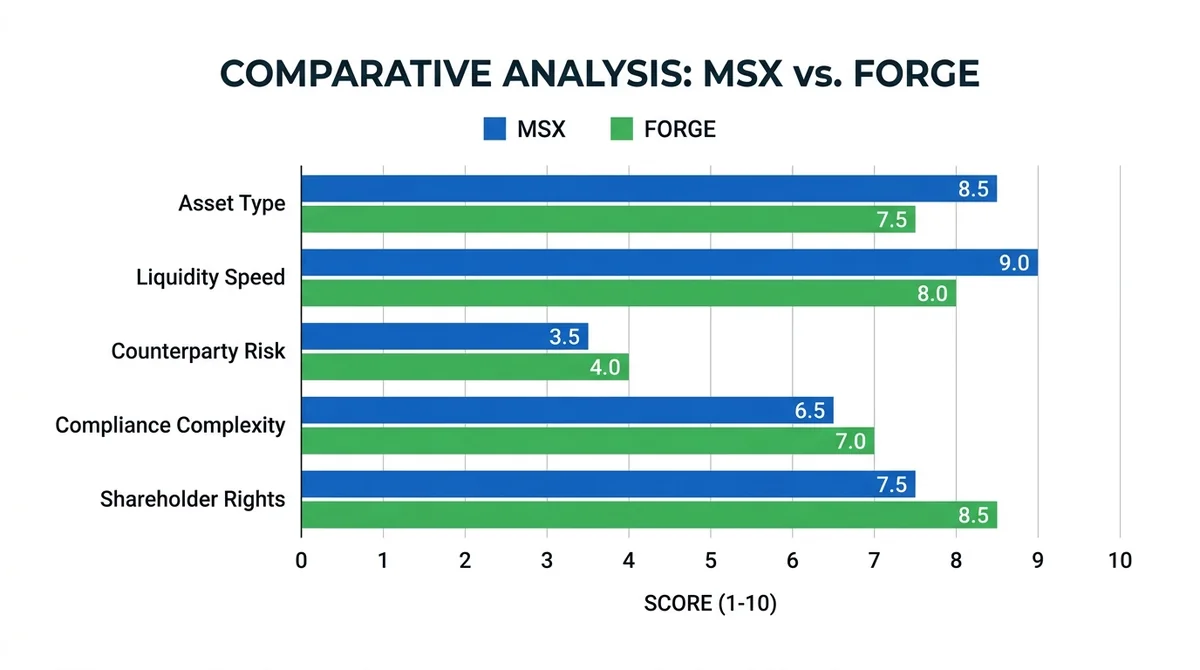
How to exit is one of the most anxiety-inducing questions in Pre-IPO investing. MSX's exit relies on buying and selling in the derivative secondary market, while Forge's exit depends on matching transfers of real equity. The gap in speed and complexity between the two is quite significant.
#How Do You Exit a Pre-IPO Position on MSX?
On MSX, to leave the market, you simply sell your tokenized stock derivatives on the secondary market. Because derivatives are listed on an exchange, exits can usually be executed instantly, with liquidity depending on market depth. As long as the order book is active enough, investors can quickly close positions and leave without waiting for a buyer to appear or equity transfer to complete. But don't forget that derivative trading may involve leverage and funding rates, and closing a position may incur additional costs.
#How Do You Exit a Pre-IPO Position on Forge?
On Forge, exiting is not so quick. You must first wait for a willing buyer. The platform will help match you, but the entire cycle depends on buyer interest, price negotiation, and the pace of compliance review. Equity transfers can take weeks or even months, and you may encounter company-level transfer restrictions along the way—such as the exercise of rights of first refusal or the need for board approval.
#What Are the Differences in Exit Speed and Process Complexity?
MSX's exit is like taking the fast lane—fast and with fewer procedures, suitable for those who need to adjust positions at any time; Forge's exit is like passing through customs—slow and with many steps, more suitable for long-term holders willing to patiently wait for the right buyer. However, MSX's "speed" comes with a prerequisite—it relies on market liquidity, and in extreme market conditions, you may encounter slippage or even be unable to close your position.
#What Are the Pricing Differences Between MSX and Forge in Pre-IPO?
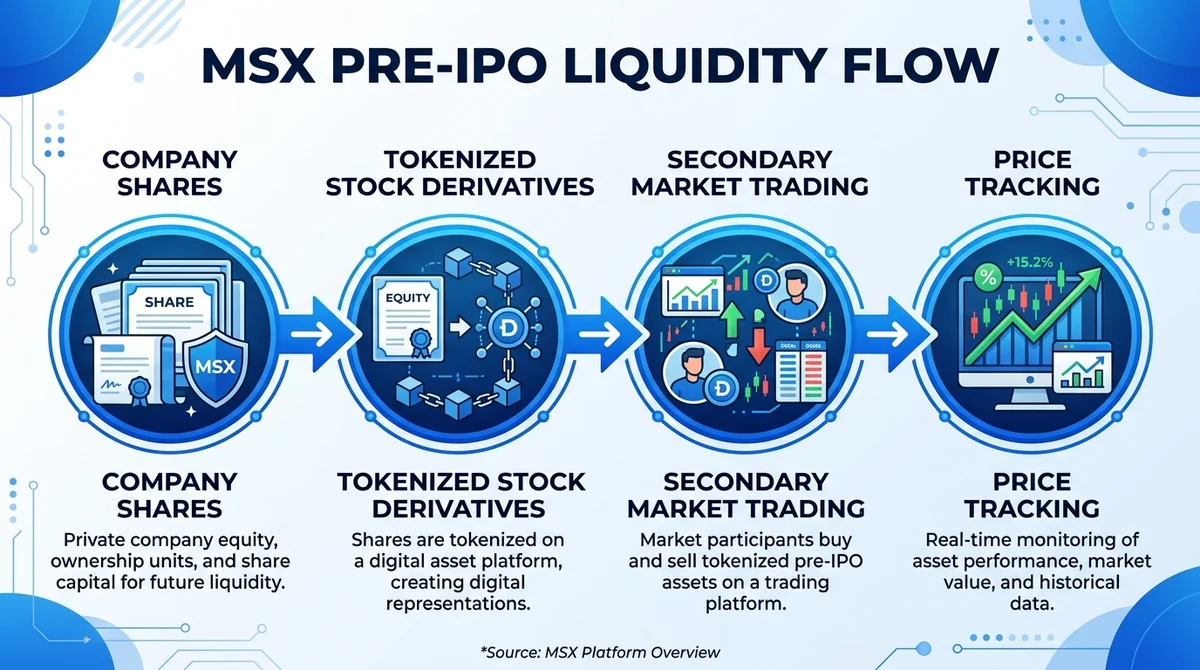
Pricing logic is another watershed: MSX's price is determined by supply and demand dynamics in the derivatives market, while Forge's price comes from bargaining between buyers and sellers or historical transaction records. Both have their own shortcomings in transparency and fairness.
#How Does MSX Determine Tokenized Stock Prices?
Tokenized stock prices on MSX are the result of market supply and demand interacting with derivative pricing models. Because they trade on a public market, prices are usually transparent and update in real time. But factors like leverage and funding rates can interfere, causing prices to deviate from the true valuation of the underlying company.
#How Does Forge Determine Equity Transfer Prices?
Equity transfer prices on Forge are more like the product of private negotiation. Buyers and sellers will consider the company's latest funding round valuation, financial performance, and market sentiment. Price information is often not publicly disclosed, and transparency is limited. The same company's equity may sell at different prices depending on buyer qualifications, share class, and transaction size.
#What Is the Impact of Pricing Mechanisms on Investors?
MSX's pricing is transparent and real-time, but may run ahead of fundamentals; Forge's pricing is closer to the true value of equity, but the pit of information asymmetry is deeper. Which to choose depends on how much you value price discovery efficiency.
#How Should Investors Choose Between MSX and Forge Based on Their Needs?
Choosing MSX or Forge ultimately comes down to three things: Do you want real equity or price exposure? How much risk can you bear? Does your compliance qualification pass muster?
#Which Investors Are More Suited to MSX?
- Those who only want to profit from price fluctuations and have no interest in being shareholders
- Traders who need to enter and exit quickly and pursue high liquidity
- Investors who can bear derivative risks (counterparty risk, leverage risk)
- Those who want to profit from declines in Pre-IPO company prices
#Which Investors Are More Suited to Forge?
- Those who want real equity and plan to hold long-term
- Investors who hope to obtain voting rights and potential dividend returns
- Investors who can accept long exit cycles and cumbersome compliance processes
- Qualified investors who meet the platform's net worth or income thresholds
#What Key Factors Should Be Considered When Choosing?
- Asset Nature: Derivative contract or real equity?
- Liquidity Needs: Short-term flexible trading or long-term patient holding?
- Risk Tolerance: Counterparty risk and price volatility, or equity dilution and transfer restrictions?
- Compliance Requirements: Qualified investor status, jurisdictional restrictions
- Cost Structure: Trading fees and funding rates, or platform commissions and legal fees?
#Action Checklist
- First clarify your investment goal: Is it to gain from price fluctuations, or to become a shareholder of the company?
- Assess your liquidity needs: Do you need to be able to exit at any time?
- Verify compliance qualifications: Do you meet the qualified investor standards of platforms like Forge?
- Calculate the cost ledger: MSX's trading fees and funding rates vs Forge's commissions and legal fees
- Understand platform risks: MSX's counterparty risk vs Forge's equity transfer risk
- Research the target company's fundamentals and valuation, and don't be led by market sentiment
#FAQ
Are tokenized stocks on MSX real equity? No. MSX offers tokenized stock derivatives, which only represent price exposure and do not confer any shareholder rights.
How long does an equity transfer on Forge take? There is no fixed timeline; it depends on buyer matching speed, pricing negotiation, and compliance processes, and can range from a few weeks to several months.
Does MSX support shorting Pre-IPO companies? According to public information, MSX's derivative trading may support shorting, but specifics depend on contract design and platform rules.
Are equity prices on Forge public? Usually not. Equity transfer prices on Forge are privately negotiated between buyers and sellers, with low transparency.
Can ordinary investors use Forge? Forge typically requires investors to be accredited investors (meeting certain net worth or income standards), subject to platform rules.
This content is based on public data and does not constitute investment or account opening advice. Data as of 2026-09-12; actual conditions may change. For the latest information, please refer to official sources of MSX and Forge.
FAQ
Are tokenized stocks on MSX real equity?
No. MSX offers tokenized stock derivatives, which represent price exposure and do not confer shareholder rights.
How long does an equity transfer on Forge take?
The time is not fixed; it depends on buyer matching, pricing negotiation, and compliance processes, and may range from several weeks to several months.
Does MSX support shorting Pre-IPO companies?
According to public information, MSX's derivative trading may support shorting, but specifics depend on contract design and platform rules.
Are equity prices on Forge public?
Usually not. Equity transfer prices on Forge are negotiated between buyers and sellers, with low transparency.
Can ordinary investors use Forge?
Forge typically requires investors to be accredited investors (meeting certain net worth or income standards), subject to platform rules.
Related Terms
Done comparing? Ready to place your first trade?
The crypto assets, tokenized US stocks and ETFs you just compared are all tradable on MSX — spot or perpetuals.
Quick Start Trading →New here? Registration takes three quick steps.