Pre-IPO Tokens vs Buying After Listing: Spread and Dilution Risk for the Same Asset at Two Entry Points in the 2026 Uptrend
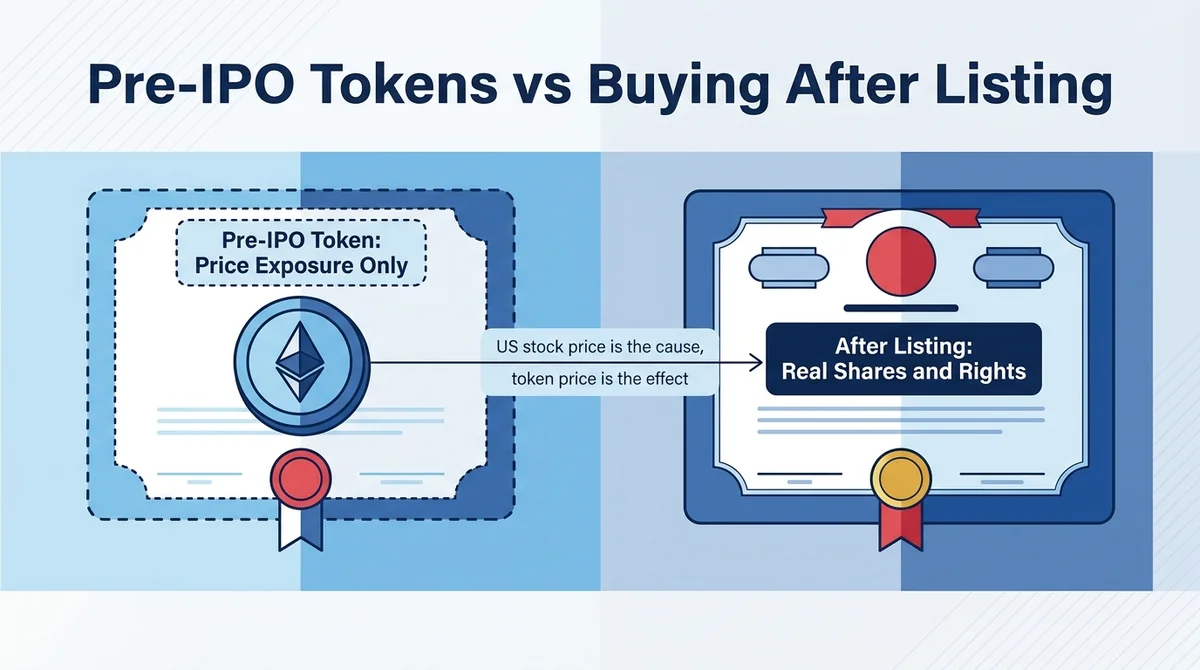
Pre-IPO tokens vs buying real shares after listing compared across exposure type, spread sources, dilution, and exit terms, with scenarios and a checklist.
Bottom line: Pre-IPO tokens give you pre-listing price exposure, not real equity; buying after listing gives you real shares and shareholder rights. If you cannot verify the dilution terms and exit path, it is better to wait and buy after listing.
#What is the essential difference between Pre-IPO tokens and buying after listing?
In one sentence: A Pre-IPO token is "directional exposure to the pre-listing price of a given asset"; buying after listing is "holding actual shares in the company." These are not two quotes for the same asset, but two forms of exposure to the same underlying at two different points in time.
#What exactly does a Pre-IPO token represent?
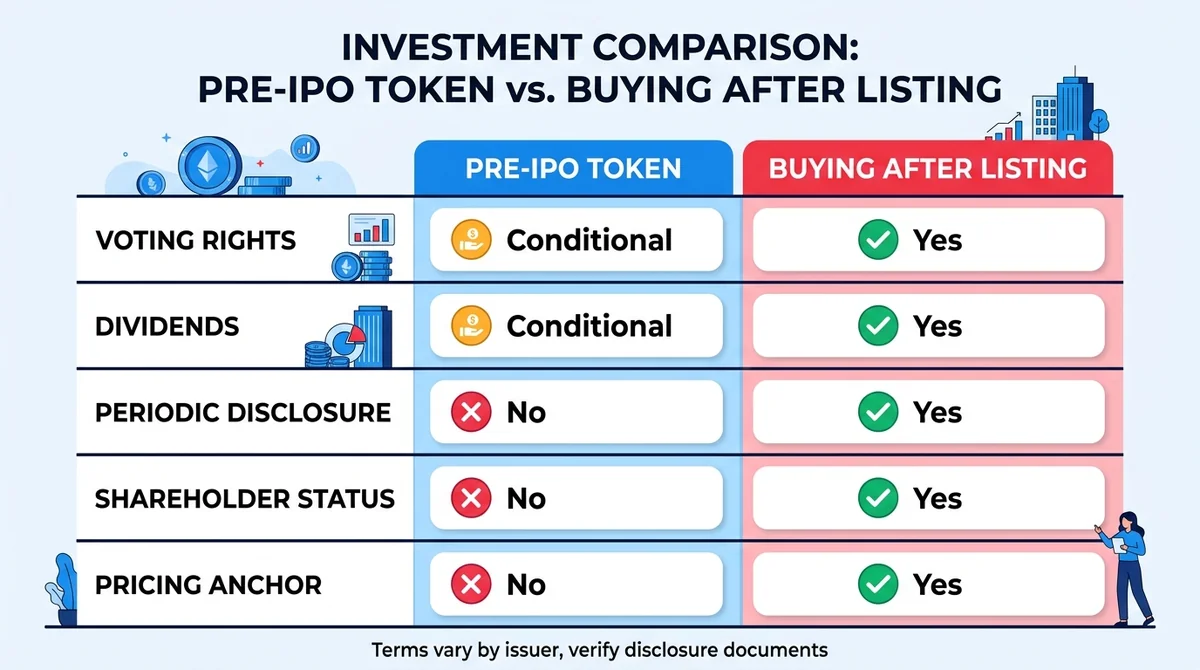
It usually represents a contractual or tokenized price exposure that tracks the valuation changes of the target company before listing. Holders get the economic result of price movements, not registered shareholder status. This means: generally no voting rights, no regular dividend claims, and no listed-company-level periodic disclosure obligations. The specific terms of any given issuer (whether there is underlying share backing, whether there is a redemption mechanism) fall within the issuer's disclosure scope, and this article does not speculate on them.
#When you buy after listing, do you get real shares?
Yes. Buying on the public market makes you a registered shareholder (or a holder through a broker/custodian nominee structure), entitled to the corresponding shareholder rights and subject to public-market disclosure rules. One distinction matters: tokenized stocks ≠ real US stocks. Tokenized stocks provide price exposure; shareholder status and the handling of corporate actions (dividends, voting, stock splits) depend on the issuance structure and differ from direct shareholding.
#Are the two just two forms of exposure to the same asset?
Yes, but the causality runs one way: the US stock price is the cause, the token price is the effect. The continuous quote of the real stock on the public market is the pricing anchor; the token price fluctuates around that anchor and adds a liquidity discount or premium. The reverse does not hold — quotes in the token market generally do not determine the execution price of the real stock.
#For the same asset, where does the spread between Pre-IPO tokens and buying after listing come from?
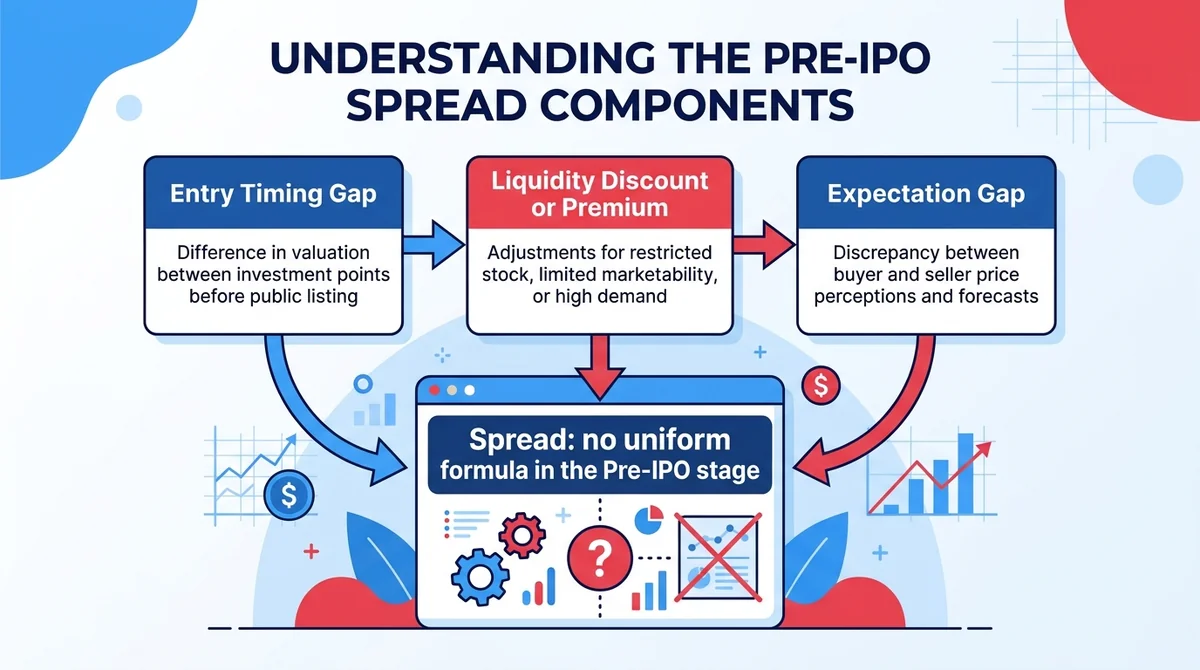
In one sentence: The spread mainly comes from three places — entry timing, liquidity discount or premium, and market expectations. The Pre-IPO stage lacks public continuous quotes, so the spread cannot be calculated with a uniform formula.
#What spread sources does different entry timing create?
- Timing gap: Months or longer of information-update cycles separate the Pre-IPO stage from the IPO pricing, during which fundamental expectations may already have changed.
- Liquidity discount or premium: Tradable depth for Pre-IPO exposure is usually weaker than the public market; buyers demand a discount and sellers demand a premium, with the direction depending on supply and demand at the time.
- Expectation gap: Pre-IPO pricing reflects more the primary market's expectations for the listing valuation, while the public market reflects the ex-post pricing of all participants.
#What does Pre-IPO token pricing reference?
References include the valuation of the most recent primary-market funding round, the valuation multiples of listed companies in the same sector, and the token market's own order book. None of these are continuous public quotes, so pricing transparency is inherently lower than in the public market. This article does not forecast specific spread levels; where relevant data is not public, it is marked as unverified.
#Between the post-listing price and the token price, which affects which?
The real stock price is the pricing anchor, and the token price follows. Understanding this is key: if what you are assessing is "how much the company will be worth after listing," what you really need to study is public-market valuation logic, not the token order book.
#How does equity dilution risk differ between the two entry methods?
In one sentence: Dilution comes from newly issued shares such as subsequent financing, option pools, and convertible bonds; Pre-IPO exposure is more sensitive to dilution due to the lack of public disclosure, while buying after listing also faces dilution but can be judged on the basis of public information.
#What is equity dilution, and why does it affect Pre-IPO exposure?
Dilution means an increase in total share capital reduces the equity percentage each share represents. Common sources: subsequent funding rounds, expansion of employee option pools, and conversion of convertible debt into equity. During the Pre-IPO stage these actions are disclosed infrequently, making it hard for holders to quantify in time how much they have been diluted.
#Does buying after listing still carry dilution risk?
Yes. Listed companies also issue new shares, grant options, and do merger share swaps. The difference is that these actions must be disclosed under disclosure rules, so shareholders can learn about them in advance or concurrently through announcements, financial reports, and shareholder meeting materials, and have participation channels such as voting. The risk does not disappear, but its observability is significantly higher.
#How does dilution change the actual meaning of token exposure?
Dilution does not change the "price exposure" attribute, but it changes the economic meaning of each unit of exposure. If total share capital expands through financing while the valuation does not rise in tandem, the value corresponding to each unit of exposure is diluted. For Pre-IPO token holders, this means the tracked valuation figure on paper may diverge from the actual per-unit equity, and the size of that divergence is hard to verify when disclosure is lacking.
#Liquidity and exit terms: which entry method is more controllable?
In one sentence: Pre-IPO token liquidity depends on token market depth and may be subject to transfer restrictions; buying after listing allows trading on the public market, with a relatively clearer exit path.
- Pre-IPO tokens: Exit depends on the depth of the token secondary market and the transfer rules set by the issuer. When depth is insufficient, bid-ask spreads widen and the price impact of large exits is more pronounced.
- Buying after listing: You can exit during trading hours at the public order book; liquidity is determined by overall market depth, and you choose the exit timing.
- Lock-ups and transfer restrictions: After an IPO, original shareholders usually have a lock-up period, which affects the pace of share supply rather than the exit rights of new buyers; however, transfer terms under tokenized structures must be verified case by case, and this article makes no assumptions about specific terms — anything not public is marked as unverified.
#Who is suited to Pre-IPO tokens, and who should wait to buy after listing?
In one sentence: Users who only want price exposure and can tolerate liquidity and dilution uncertainty may consider Pre-IPO tokens; users who value shareholder rights, public disclosure, and a clear exit path should wait to buy after listing.
#Scenario breakdown
- If you only want price exposure and can accept that dilution terms cannot be verified, you can use Pre-IPO tokens as an exposure tool, but you must confirm the issuance structure and transfer rules yourself.
- If you need shareholder rights (voting, dividends, participation in corporate actions), wait to buy real shares after listing; tokenized structures usually do not provide equivalent rights.
- If you cannot judge the dilution terms, prioritize buying after listing — observability itself is a form of risk control.
- If you need a clear exit timing, prioritize the public market, because token market depth and transfer restrictions may delay your exit.
- If you are building a multi-asset portfolio, treat Pre-IPO exposure as a high-uncertainty satellite position rather than a core holding.
#Action checklist
- Confirm whether the Pre-IPO token is backed by underlying shares or equivalent rights, or is purely price tracking.
- Request or review the valuation of the most recent funding round and the total share capital basis to judge dilution sensitivity.
- Verify the specific terms of transfer restrictions, lock-ups, and redemption mechanisms.
- Assess token market depth: average daily volume, bid-ask spread, and price impact of large orders.
- Compare valuation multiples of listed companies in the same sector to form your own valuation range.
- Clarify whether you want "price exposure" or "shareholder status," and choose your entry method accordingly.
- Record the data cutoff date to avoid making judgments on stale valuations.
#What risks does each entry method carry?
In one sentence: Pre-IPO tokens mainly carry liquidity, dilution, and pricing-opacity risk, while buying after listing mainly carries market price and fundamental volatility risk; this article only compares structures and does not forecast prices.
- Pre-IPO tokens: Exit discounts caused by insufficient liquidity, unobservable dilution, limited pricing references, exposure that is not real equity, and issuer structure and counterparty risk.
- Buying after listing: Market price volatility, dilution from subsequent share issuance, macro rates and sector cycles, and company fundamental execution risk.
This article does not forecast the price of any asset or recommend specific assets; any ranking or classification in the text reflects structural characteristics only and does not constitute a rating.
To further compare different entry paths, see the related comparison pages on this site and official disclosure information.
This content is compiled from public information and does not constitute investment or open account advice. It does not include specific asset quotes or spread data; where relevant data is not public, it is marked as unverified, and actual conditions may change.
FAQ
Are Pre-IPO token holders shareholders of the company?
Usually not. Pre-IPO tokens provide pre-listing price exposure rather than registered shareholder status, so they generally do not carry voting rights or regular dividend claims. The specific structure depends on the issuer's terms, and anything not public should not be assumed.
Can shares bought after listing also be diluted?
Yes. Listed companies may also issue new shares, grant options, or conduct share-swap mergers. The difference is that these actions must be disclosed under disclosure rules, so shareholders can judge them from announcements and financial reports, and have participation channels such as voting.
What is the relationship between the token price and the real stock price?
The continuous public-market quote of the real stock is the pricing anchor; the token price fluctuates around that anchor and adds a liquidity discount or premium. The causal direction is that the US stock price affects the token price, not the reverse.
Why doesn't the article give specific spread levels?
The Pre-IPO stage lacks public continuous quotes, and the spread is jointly affected by entry timing, liquidity supply and demand, and expectation gaps, so it cannot be calculated with a uniform formula. Giving specific numbers when the data is not public would be fabrication.
Does the lock-up period affect my exit if I buy after listing?
Post-IPO lock-ups usually bind original shareholders and affect the pace of share supply; a new buyer's exit rights depend on public-market liquidity. Transfer terms under tokenized structures must be verified case by case.
Related Terms
Done comparing? Ready to place your first trade?
The crypto assets, tokenized US stocks and ETFs you just compared are all tradable on MSX — spot or perpetuals.
Quick Start Trading →New here? Registration takes three quick steps.