rtoken vs Real US Stocks: Custody Structure, Bankruptcy Protection, and Redemption Rights 2026
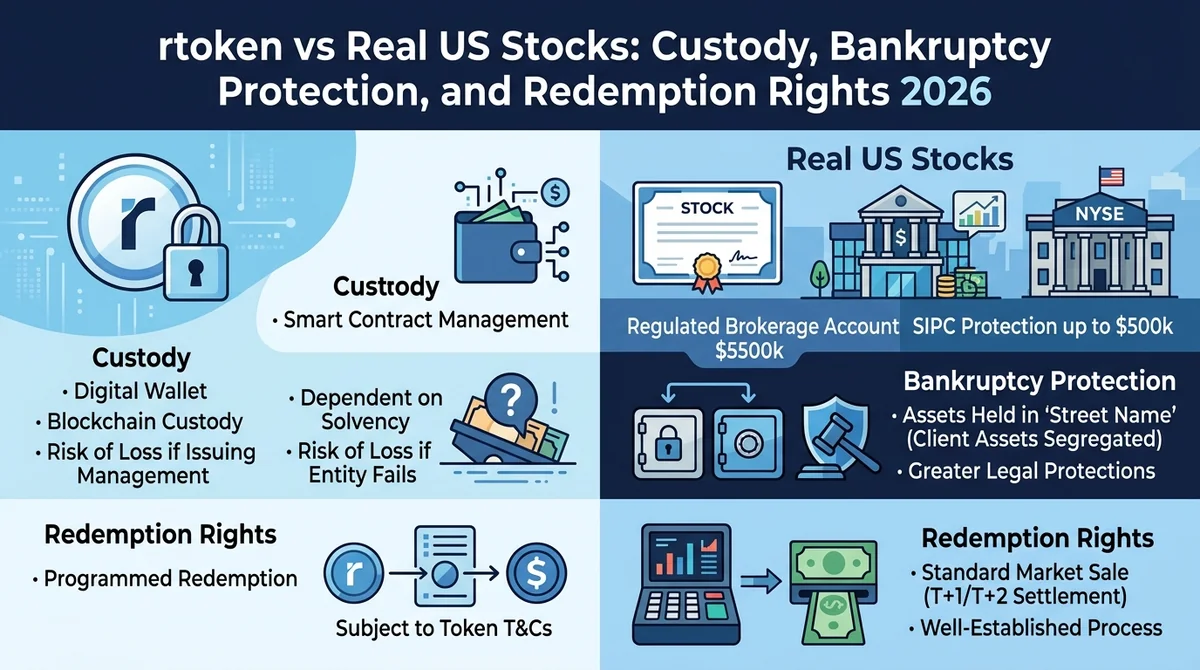
rtoken vs real US stocks: tokenized price exposure isn't ownership. Compare custody, bankruptcy protection, and redemption rights to assess risks.
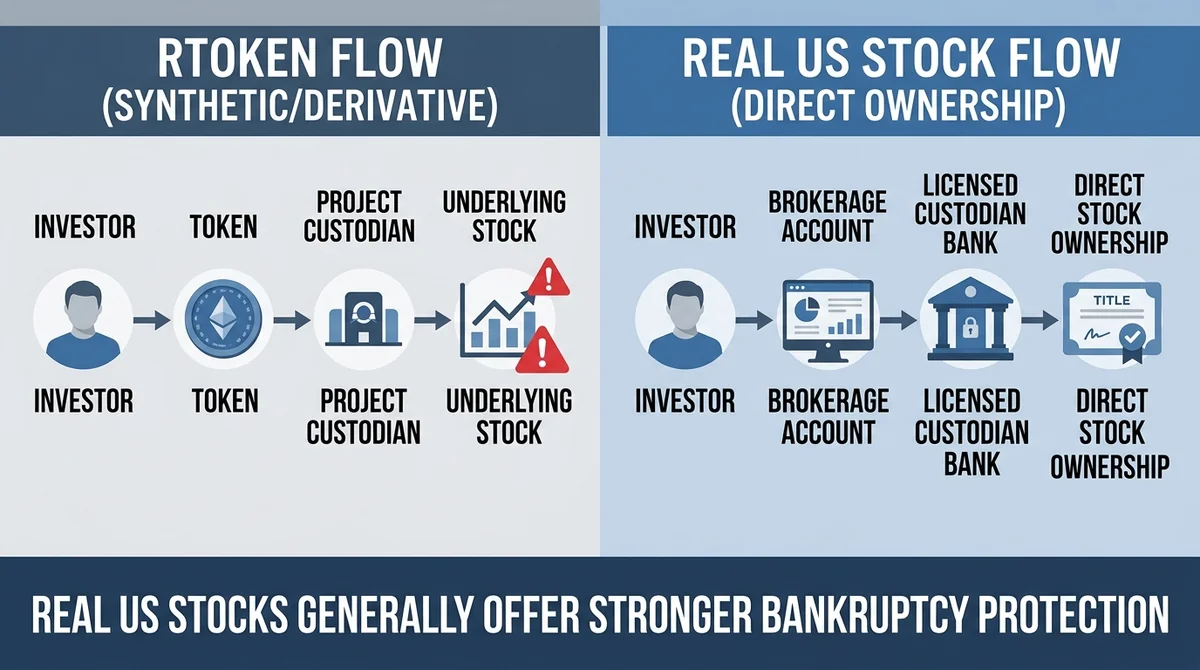
Conclusion: If you need stock ownership, brokerage bankruptcy protection, and redemption at any time, you should generally prioritize directly holding real US stocks; rtoken only provides price exposure, and the underlying asset custody and redemption rights depend on the issuance agreement. Most long-term holders may be better suited with real US stocks.
#Comparison Table
| Dimension | rtoken (tokenized stock) | Real US stocks |
|---|---|---|
| Ownership | No shareholder status; token holder only | Directly holds the stock itself |
| Price exposure | Tracks US stock prices, but token price may deviate | The stock price itself directly affects wealth |
| Custody structure | Held by the project or a third-party custodian, with custodian credit risk | Held by licensed brokers or custodian banks, regulated |
| Bankruptcy protection | Depends on the agreement and jurisdiction; may not have equivalent protection | Securities are typically segregated in broker bankruptcy and belong to investors |
| Redemption rights | Subject to agreement restrictions; may only be redeemable for other tokens or limited | Can be sold anytime for cash (subject to market liquidity) |
| Liquidity | Platform-dependent, may be lower | Usually higher, good liquidity for large-cap stocks |
| Barriers and accessibility | Lower barrier, can participate with small amounts | Requires a brokerage account, may have minimum investment |
| Dividends/corporate actions | Usually not passed through, no voting rights | Can enjoy dividends, voting, and other shareholder rights |
| Smart contract risk | Exists, code vulnerabilities or attacks | None |
| Regulatory compliance | Often in gray or restricted areas | Protected by securities regulations |
#Detailed Dimensions
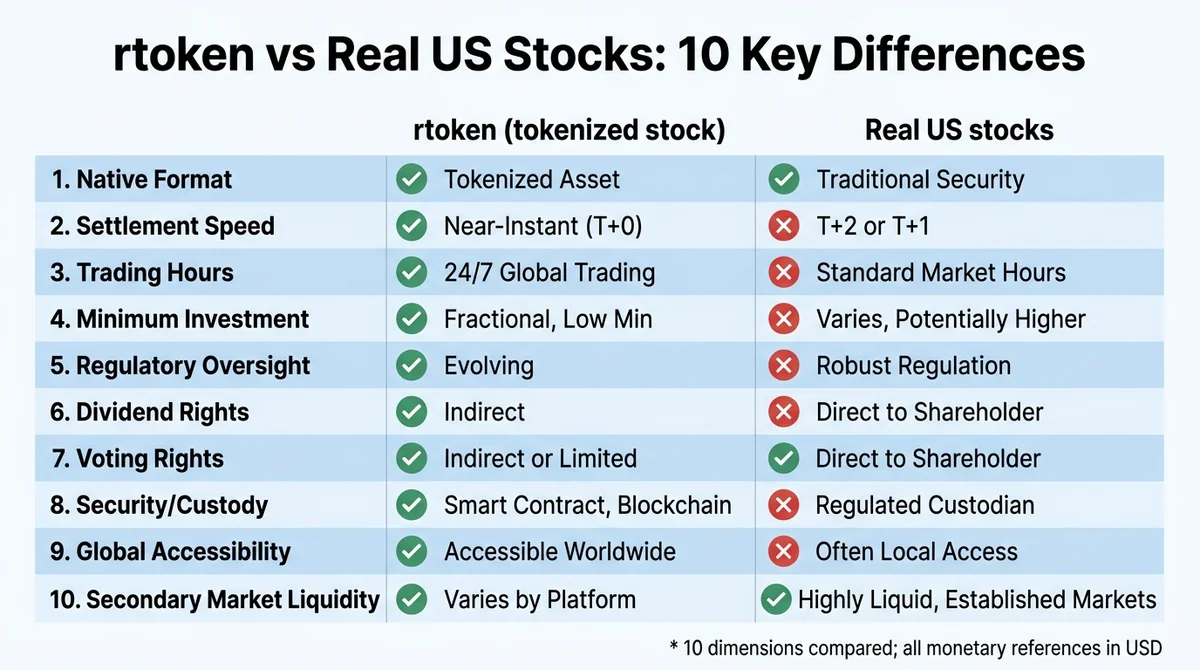
Ownership and price exposure: rtoken represents tokenized stock price exposure, not real US stock ownership. Real US stocks directly hold the stock itself. US stock prices usually directly determine token value, but token prices may deviate due to liquidity, risk premium, and other factors.
Custody structure: Real US stocks are usually held by licensed brokers or custodian banks; the underlying stocks of rtoken may be held by the project or its partner custodian. Different custody structures bring additional credit risk.
Bankruptcy protection: Real US stocks typically still belong to investors when a broker goes bankrupt, but this depends on the broker's jurisdiction and customer asset segregation rules. rtoken's bankruptcy protection depends on the custody agreement and jurisdiction, may not have equivalent protection, and some products do not disclose data.
Redemption rights: Real US stocks can be sold anytime for cash, but subject to market liquidity and trading hours. rtoken redemption rights are determined by the issuance agreement; they may only be redeemable for other tokens or be restricted, with redemption limits and delays. Investors should review the specific product's offering documents and terms.
Liquidity, barriers, and accessibility: Real US stocks usually have higher liquidity, especially large-cap stocks. rtoken liquidity relies on the issuing platform, may have lower barriers and better accessibility, suitable for small participation, but watch platform liquidity depth and exit paths.
Dividends and corporate actions: Real US stock investors can enjoy dividends and voting. rtoken usually does not pass through dividends or corporate actions, investors only have price exposure, but some products may pass through via contract design; refer to product terms.
Smart contract risk: rtoken additionally has smart contract risk, such as vulnerabilities or attacks. Real US stocks do not have this risk, but still have operational risk, broker risk, and other traditional financial risks.
Regulatory compliance: Real US stocks are protected by securities regulations. rtoken's compliance status varies by product and may not provide equivalent investor protection.
#Scenario Recommendations
Suitable for real US stocks: Investors who want stock ownership, bankruptcy protection, dividends, or long-term asset allocation. For market participants who need clear legal ownership and redemption at any time, real US stocks are the default choice.
Suitable for rtoken: Short-term traders who only seek price movements, are willing to take custody and smart contract risks, and accept redemption restrictions; or users who need low-barrier small participation in US stock market price fluctuations. Such investors should verify the issuer's custody agreement and bankruptcy protection terms and understand related fees and risks.
#FAQ
Does rtoken represent stock ownership? No. rtoken is tokenized stock price exposure, not real US stock ownership. Holders usually have no shareholder status, voting rights, or dividends.
How do real US stocks achieve bankruptcy protection? In most regulated markets, when a broker goes bankrupt, customer securities are segregated in dedicated accounts and are not included in the broker's liquidation assets; investors can still claim rights. However, the specific scope of protection varies by jurisdiction and account type.
Who decides rtoken's redemption rights? Determined by the issuance agreement. It may allow redemption for fiat or underlying stocks, or only exchange for other tokens, or even only secondary market trading; specific restrictions require reviewing product documents.
Who are tokenized stocks suitable for? Suitable for investors who only want price movements, accept custodian risk and smart contract risk, and do not rely on bankruptcy protection. Long-term holders or those seeking ownership are better suited with real US stocks.
What should investors do if the rtoken custodian goes bankrupt? Depends on the custody agreement and jurisdiction. Some products may not have equivalent bankruptcy protection, and investors may face the risk of being unable to recover underlying assets; this should be verified in advance.
#Disclaimer
This content is compiled from public data and does not constitute investment or account opening advice. Qualitative descriptions without specific sources are general analysis and do not constitute assertions about any specific product. Investors should verify product terms themselves and may check official sources.
FAQ
Does rtoken represent stock ownership?
No. rtoken is tokenized stock price exposure, not real US stock ownership. Holders usually have no shareholder status, voting rights, or dividends.
How do real US stocks achieve bankruptcy protection?
In most regulated markets, when a broker goes bankrupt, customer securities are segregated in dedicated accounts and are not included in the broker's liquidation assets; investors can still claim rights. However, the specific scope of protection varies by jurisdiction and account type.
Who decides rtoken's redemption rights?
Determined by the issuance agreement. It may allow redemption for fiat or underlying stocks, or only exchange for other tokens, or even only secondary market trading; specific restrictions require reviewing product documents.
Who are tokenized stocks suitable for?
Suitable for investors who only want price movements, accept custodian risk and smart contract risk, and do not rely on bankruptcy protection. Long-term holders or those seeking ownership are better suited with real US stocks.
What should investors do if the rtoken custodian goes bankrupt?
Depends on the custody agreement and jurisdiction. Some products may not have equivalent bankruptcy protection, and investors may face the risk of being unable to recover underlying assets; this should be verified in advance.
Related Terms
Done comparing? Ready to place your first trade?
The crypto assets, tokenized US stocks and ETFs you just compared are all tradable on MSX — spot or perpetuals.
Quick Start Trading →New here? Registration takes three quick steps.