rtoken vs Real US Stocks: Legal Status, Regulatory Licenses, and Investor Protection Funds 2026
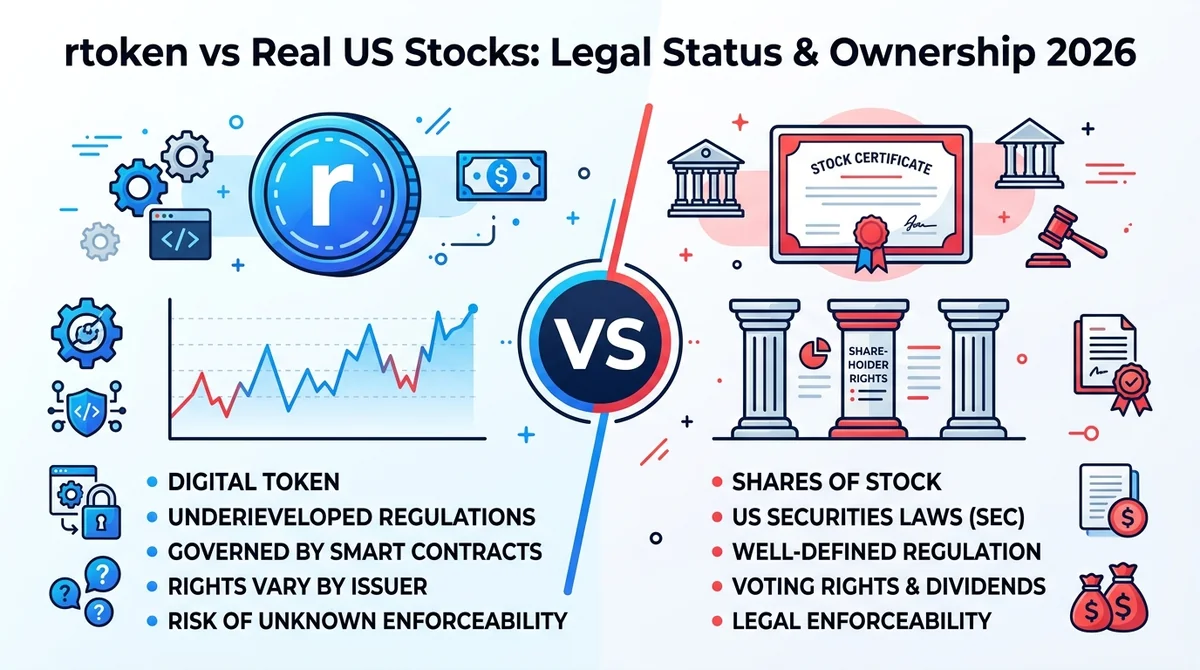
Compare rtoken (tokenized stocks) vs real US stocks: legal status, licenses, investor protection, ownership, price tracking, hours, counterparty risk.
Data as of 2026-09-08. Conclusion: The core difference between rtoken and real US stocks lies in legal status and ownership—rtoken is typically a price exposure token and does not represent ownership of the stock itself; real US stocks are securities regulated by securities law, and holders enjoy shareholder rights and investor protections. If you only want exposure to US stock price movements and can accept the regulatory uncertainty of tokenized stocks, consider rtoken; if you need asset ownership, shareholder rights, and securities regulatory protection, choose real US stocks.
#Comparison Table
| Dimension | rtoken (tokenized stock) | Real US Stocks |
|---|---|---|
| Legal status | May be a price exposure token, not necessarily a security | A security, regulated by securities law |
| Ownership | Does not own the stock itself | Holds the asset itself |
| Regulatory licenses | Depends on whether it is classified as a security; varies significantly by jurisdiction | Brokers and exchanges require securities licenses |
| Investor protection funds | Typically not automatically covered; check product terms | May be covered by securities investor protection funds |
| Price transmission | Price follows the underlying US stock spot price, may decouple | Price is the market price |
| Dividends and corporate actions | May have no or delayed dividends | Dividends and voting rights (when held directly) |
| Trading hours | Some platforms advertise 24/7 trading; needs verification | Subject to exchange trading hours |
| Availability | Offered on some crypto exchanges, such as Bitget's xStocks; MSX platform offers US stock token spot trading (launched May 10, 2025); other platforms do not support it | Through licensed brokers |
| Counterparty risk | Involves issuer and custodian risk | Through central clearing and custody systems |
| Custody method | Held by platform or on-chain smart contracts | Held by brokers |
#Detailed Dimensions
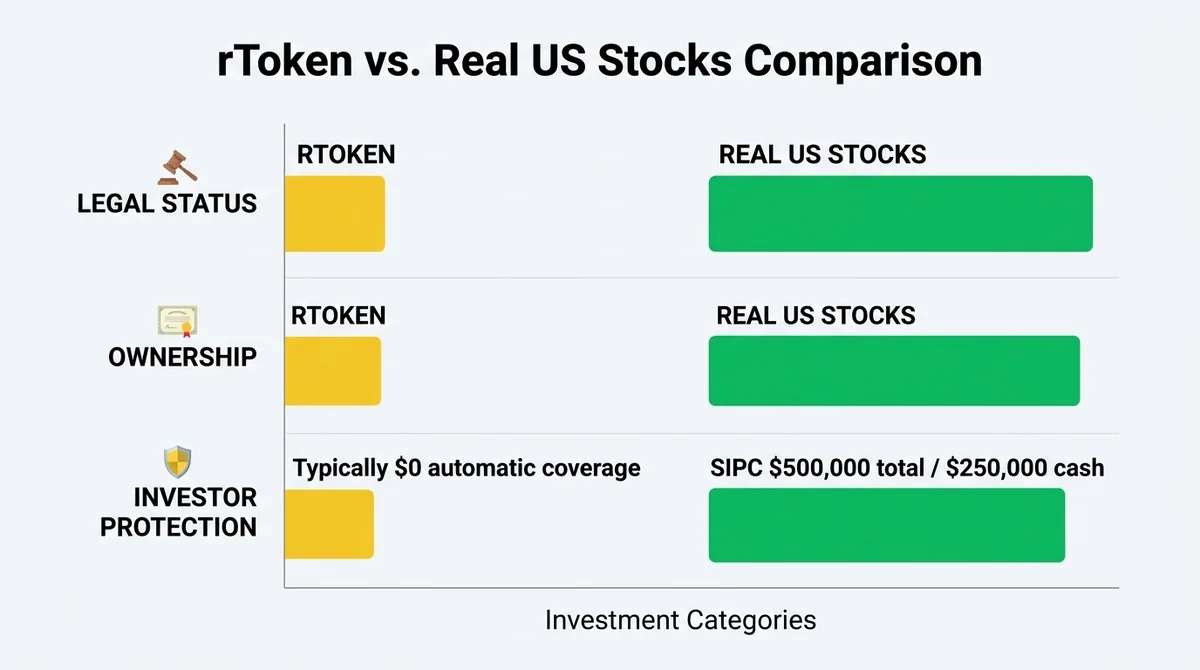
Legal status: Real US stocks are securities regulated by securities regulators; rtoken may only be a price exposure token, and its legal status depends on the product structure and may not be classified as a security. Holding rtoken does not equal holding the underlying US stock.
Ownership: Real US stocks represent ownership of the asset itself, and investors have shareholder rights; rtoken does not own the stock itself, only provides price exposure.
Regulatory licenses: Real US stock brokers and exchanges must hold securities licenses; rtoken's license requirements depend on whether it is classified as a security, and vary significantly across jurisdictions, affecting the level of investor protection. For example, the US SEC may treat certain tokens as securities and require registration, while other jurisdictions may have no clear regulation. Some platforms (such as MSX) claim to have completed SEC STO filing and possess Regulation S qualification, but this qualification only applies to their specific products and does not mean all rtokens are compliant.
Investor protection funds: Real US stock investors may be covered by securities investor protection funds (e.g., US SIPC, which protects each customer up to $500,000, including $250,000 in cash, in the event of broker bankruptcy); rtoken holders typically do not automatically enjoy equivalent protection, and specific coverage data is not publicly available; check product terms.
Price transmission: The US stock price is the cause, and the token price is the effect. rtoken price is designed to follow the US stock spot price but may decouple due to insufficient liquidity or market volatility. Decoupling can also be caused by market maker exits or failure of arbitrage mechanisms.
Dividends and corporate actions: Direct holders of real US stocks receive dividends and participate in corporate actions; rtoken may not distribute dividends or may delay processing, depending on the issuer's design.
Trading hours: Real US stocks can only be traded during exchange-specified hours; some rtokens on crypto exchanges advertise 24/7 trading, but actual trading sessions and liquidity need verification.
Availability: rtoken is offered on some crypto exchanges, such as Bitget supporting the xStocks brand; MSX platform offers US stock token spot trading (launched May 10, 2025, supporting direct buying and selling with stablecoins); other platforms explicitly do not support it, and official announcements prevail. Real US stocks require opening an account with a licensed broker.
Counterparty risk: Real US stocks reduce counterparty risk through central clearing and custody systems; rtoken involves issuer and custodian risk, and if the issuer encounters problems, the token value may be impaired.
Custody method: Real US stocks are held through broker custody, subject to regulatory constraints; rtoken may be held by platforms or managed by on-chain smart contracts, and security depends on the specific implementation. For example, MSX platform claims to use cold/hot wallet isolation and multi-signature mechanisms, but audit reports need verification.
#Scenario Recommendations
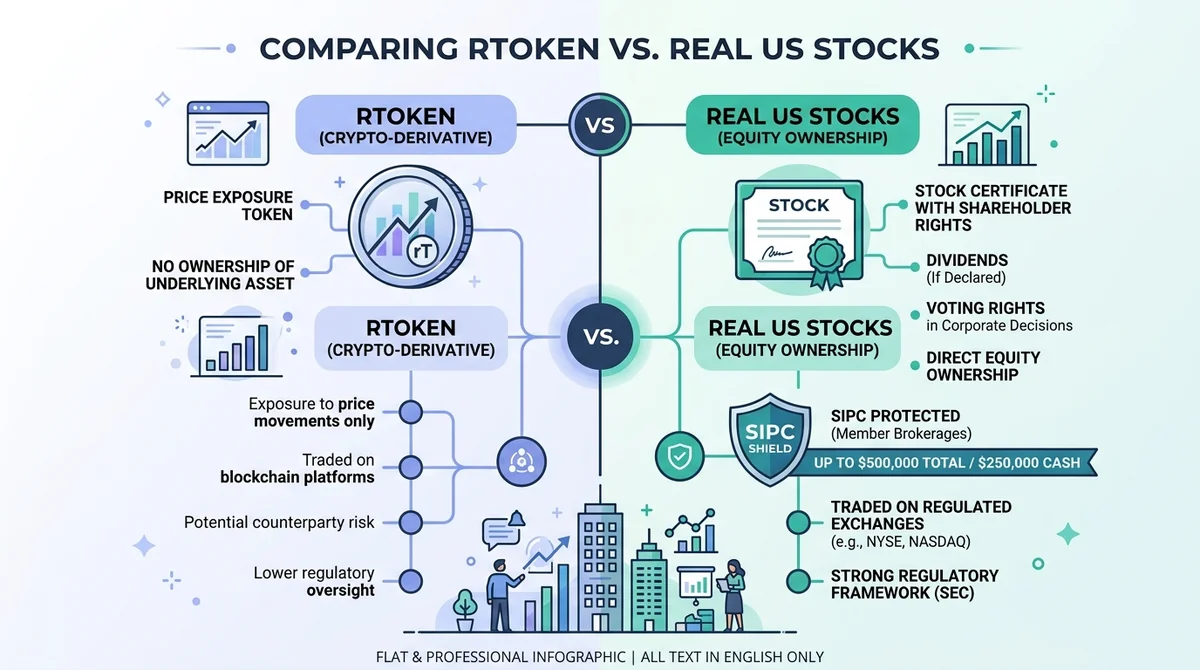
- Suitable for choosing rtoken: If you only want exposure to US stock price movements, do not need shareholder rights, and understand that rtoken is not real stock and can accept regulatory uncertainty.
- Suitable for choosing real US stocks: If you need asset ownership, shareholder rights, and securities regulatory protection, or have a longer holding period and value legal clarity.
- High risk tolerance: Consider rtoken for potentially lower entry barriers (e.g., MSX platform advertises starting from 10U) and more flexible trading sessions; those with low risk tolerance or sensitivity to counterparty risk should choose real US stocks.
#FAQ
1. Does holding rtoken equal holding US stocks? No. rtoken is a form of tokenized stock that typically only provides exposure to US stock price movements and does not represent ownership of the stock itself. Investors do not thereby gain shareholder rights such as voting rights or dividends, depending on the issuer's product structure.
2. Is rtoken subject to securities regulation? Depends on whether the rtoken is classified as a security by local regulators. For example, the US SEC may treat certain tokens as securities, while other jurisdictions may have different determinations; if not classified as a security, it may not be subject to traditional securities law investor protections, increasing risk.
3. What investor protections exist for real US stocks? Real US stock investors are typically covered by securities investor protection funds. In the US, for example, SIPC protects each customer up to $500,000 (including a $250,000 cash limit) in the event of broker bankruptcy. In addition, regulators require brokers to segregate assets.
4. Does the rtoken price always equal the US stock spot price? Not necessarily. rtoken price is usually pegged to the US stock spot price but may decouple due to insufficient liquidity, market maker exits, or failure of arbitrage mechanisms. For example, during severe market volatility, token price may temporarily deviate from spot price, and investors should be aware of premium or discount risk.
5. Should I choose rtoken or real US stocks? The choice depends on your investment goals and risk tolerance. If you only want exposure to US stock price movements and can accept the regulatory uncertainty and counterparty risk of tokenized stocks, rtoken may have a lower entry barrier; if you need asset ownership, shareholder rights, and securities regulatory protection, or have a longer holding period, real US stocks are a safer choice.
6. What is the difference between rtoken and real US stocks? The core difference lies in legal status and ownership. rtoken is typically a price exposure token that does not confer stock ownership, and the degree of regulation depends on the product structure; real US stocks are securities, holders have shareholder rights, and are covered by securities law and investor protection funds. The two also differ in trading hours, dividend distribution, counterparty risk, etc.
7. Is rtoken regulated? Not necessarily. rtoken's regulatory status depends on whether it is classified as a security and the regulations in the issuing and trading jurisdiction. For example, the US may treat certain tokens as securities and require registration, while other jurisdictions may have no clear regulation. Investors should verify product compliance themselves.
This content is compiled from public data and does not constitute investment or account opening advice. MSX platform is mentioned only as a factual example; commercial link · does not affect scoring or ranking. Data as of 2026-09-08; actual conditions may change. Check official sources for the latest information.
FAQ
Does holding rtoken equal holding US stocks?
No. rtoken is usually just a price exposure token and does not represent ownership of the stock itself.
Is rtoken subject to securities regulation?
It depends on whether the product is classified as a security. Different jurisdictions have different determinations; some rtokens may not be subject to securities regulation, resulting in weaker investor protection.
What investor protections exist for real US stocks?
Real US stock investors may be covered by securities investor protection funds (such as US SIPC), which provides certain protection in the event of broker bankruptcy.
Does the rtoken price always equal the US stock spot price?
Not necessarily. Although designed to track US stock prices, it may decouple due to liquidity or market volatility.
Should I choose rtoken or real US stocks?
If you only seek price exposure and accept the risks, you may choose rtoken; if you need ownership and regulatory protection, choose real US stocks.
Related Terms
Done comparing? Ready to place your first trade?
The crypto assets, tokenized US stocks and ETFs you just compared are all tradable on MSX — spot or perpetuals.
Quick Start Trading →New here? Registration takes three quick steps.