RToken vs. Real US Stocks: Trading Hours and Liquidity Differences 2026
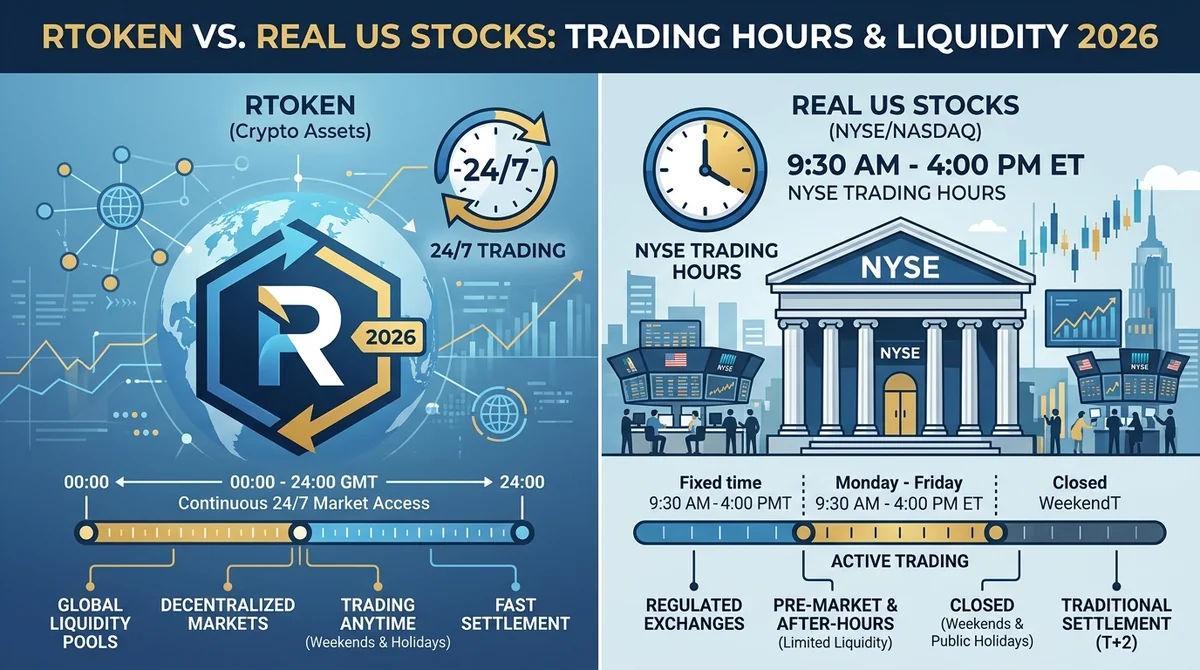
RToken offers 24/7 trading and price exposure, while real US stocks provide higher liquidity and ownership. Compare trading hours, liquidity, risks, and suitability.
Bottom Line: If you seek round-the-clock trading and only need gains from price movements, RToken may be a better fit; if you value shareholder status, market depth, and traditional trading rhythms, real US stocks remain the more prudent choice.
#What is the fundamental difference between RToken and real US stocks?
#Do you receive an asset certificate or a price-tracking tool?
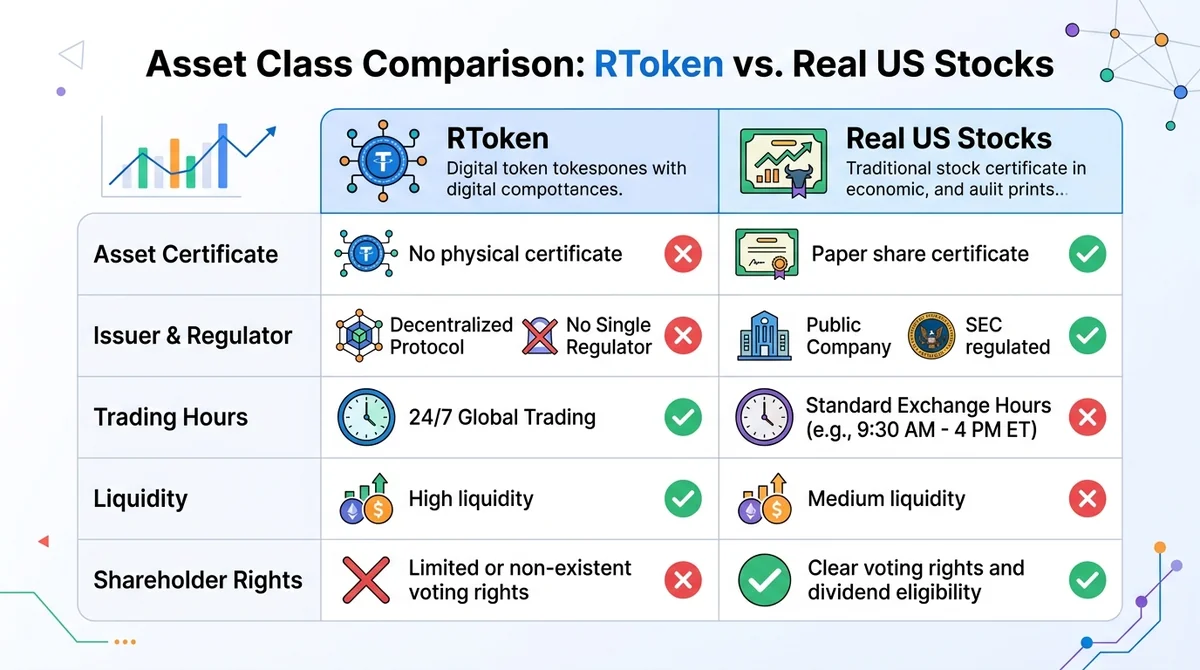
RToken is a tokenized stock, essentially anchored to the price performance of the underlying stock, and holders do not become shareholders of the listed company. In contrast, real US stocks are listed on traditional venues like NASDAQ and NYSE, and buying them means acquiring ownership of the corresponding shares, including voting rights and dividend entitlements.
#Who issues and who regulates?
RTokens are mostly minted by centralized or decentralized platforms, falling under the jurisdiction of various countries' digital asset-related regulations. Real US stocks are issued directly by listed companies and are covered by mature financial regulatory systems such as the U.S. Securities and Exchange Commission (SEC).
#How do RToken and real US stock trading hours differ?
#Can RToken really be bought and sold anytime?
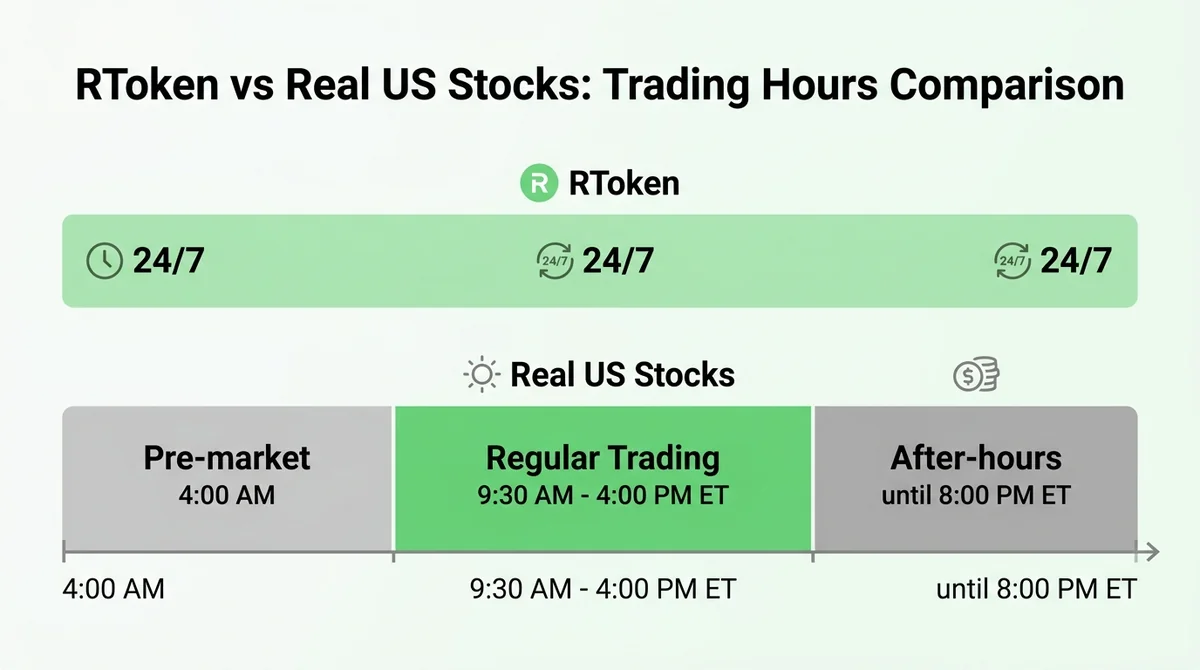
Yes, RTokens are generally not bound by traditional opening and closing times, supporting continuous trading 24 hours a day, 7 days a week, allowing users to enter and exit at any time according to their own time zone.
#How are real US stock trading windows divided?
Real US stocks follow fixed sessions: regular trading is from 9:30 AM to 4:00 PM Eastern Time (during daylight saving time), pre-market starts around 4:00 AM, and after-hours extends to around 8:00 PM. Note that during pre-market and after-hours sessions, participation is thinner, and bid-ask spreads tend to widen.
#How large is the liquidity difference between RToken and real US stocks?
#How does liquidity affect your transaction costs?
Real US stocks typically have thicker order books and higher turnover, with narrow spreads and low slippage. RToken liquidity depends on the platform and token; some assets lack depth, potentially incurring higher hidden costs when executing trades.
#How do both perform during extreme volatility?
Real US stocks have circuit breakers that may trigger temporary trading halts, but even in extreme market conditions, liquidity for major stocks remains relatively substantial. RTokens, on the other hand, may experience sudden liquidity evaporation during panic selling, making it difficult to execute orders or forcing exits at very poor prices.
#Who is better suited to trade RToken, and who to trade real US stocks?
#Is your trading rhythm around-the-clock or session-based?
Active traders operating across time zones or who prefer to monitor the market at any time may favor RToken's continuous trading feature. Users accustomed to focusing during fixed sessions and not needing overnight operations will find real US stocks' traditional rhythm sufficiently convenient.
#Do you want price movements or corporate shareholder status?
If you only want to capture gains from stock price fluctuations and are not interested in voting, dividends, or other rights, RToken can meet your needs. Conversely, if you wish to truly become a company shareholder and enjoy corresponding rights, real US stocks are the only choice.
#Where is your tolerance threshold for liquidity?
Users with high requirements for entry/exit speed and execution quality will find real US stocks' low spreads and deep liquidity more advantageous. If you are willing to accept thinner order books and higher friction costs, RToken can serve as an alternative tool.
#What risks should you be aware of when trading RToken?
#Will liquidity hinder you when you want to exit?
When RToken depth is insufficient, users may struggle to close positions at their desired price, especially during periods of high volatility, where slippage can widen dramatically and even lead to inability to execute trades in a timely manner.
#What does regulatory uncertainty bring?
RToken's compliance status is still evolving; policy tightening, platform investigations, or business adjustments can all affect asset safety and tradability. Real US stocks, while also subject to market volatility risks, operate within a clearer and more mature institutional framework.
#Where does counterparty risk hide?
RTokens often rely on issuers or custodians to maintain the peg and safeguard assets. If a platform faces solvency issues or technical failures, users may suffer asset losses. Real US stocks are settled uniformly through central depository systems, resulting in significantly lower counterparty risk.
#Comparison Table
| Dimension | RToken | Real US Stocks |
|---|---|---|
| Trading Hours | 24/7 continuous trading | Fixed sessions (9:30 AM–4:00 PM ET) |
| Ownership | Price exposure only, no shareholder rights | Real equity, including voting rights and dividends |
| Liquidity | Platform-dependent, may be weaker | Usually ample |
| Spread | May be wider | Usually narrower |
| Regulation | Digital asset rules, high uncertainty | SEC and other traditional regulators, mature system |
| Trading Costs | Potentially higher (spread + slippage) | Typically lower |
| Counterparty Risk | Issuer/platform level | Central depository, relatively low risk |
| Suitable For | 24/7 traders, price speculators | Long-term holders, rights seekers |
#Scenario Recommendations
Scenarios suitable for choosing RToken:
- Want to continue tracking and trading prices during US stock market closures.
- Only care about spread gains, not shareholder status.
- Can accept lower liquidity and higher transaction costs.
Scenarios suitable for choosing real US stocks:
- Want to truly hold shares and enjoy voting, dividend, and other rights.
- Prioritize liquidity and lower trading costs.
- Trading habits concentrated in traditional sessions, no need for overnight operations.
#FAQ
Q1: Can RToken be converted into real US stocks? A1: It depends on the platform; some service providers may offer conversion channels, but usually with conditions and fees.
Q2: Can real US stocks be traded 24 hours a day? A2: Outside regular hours, you can participate in pre-market and after-hours trading, but liquidity is weaker, and not all brokers offer these sessions.
Q3: Will RToken prices be perfectly synchronized with real US stocks? A3: Theoretically they should track closely, but due to liquidity, sentiment, and platform factors, premiums or discounts may occur.
Q4: Is KYC required to trade RToken? A4: It varies by platform; centralized platforms often require KYC, while some decentralized venues may not require identity verification.
Q5: Which is safer, real US stocks or RToken? A5: Real US stocks are bound by mature regulatory systems and have lower counterparty risk; RTokens face higher regulatory uncertainty and platform-level vulnerabilities.
This content is compiled from public data and does not constitute investment or account-opening advice. Data as of 2026-09-19; actual conditions may change. For the latest information, please refer to official sources.
FAQ
Can RToken be converted into real US stocks?
It depends on the specific platform; some platforms may offer conversion mechanisms, but typically require meeting certain conditions and may involve fees.
Can real US stocks be traded 24 hours a day?
Outside regular trading hours, pre-market and after-hours trading are available, but liquidity is lower, and not all brokers support these sessions.
Are RToken prices exactly the same as real US stocks?
In theory, RToken prices should track real US stocks, but premiums or discounts may occur due to liquidity, market sentiment, and other factors.
Is KYC required to trade RToken?
It depends on the platform; some platforms may require KYC, while some decentralized platforms may not require KYC.
Which is safer, real US stocks or RToken?
Real US stocks are protected by mature regulations and have lower counterparty risk; RTokens face higher regulatory uncertainty and platform risks.
Related Terms
Done comparing? Ready to place your first trade?
The crypto assets, tokenized US stocks and ETFs you just compared are all tradable on MSX — spot or perpetuals.
Quick Start Trading →New here? Registration takes three quick steps.