Real Estate RWA vs Japanese Stocks vs US Stocks: Entry Threshold Comparison
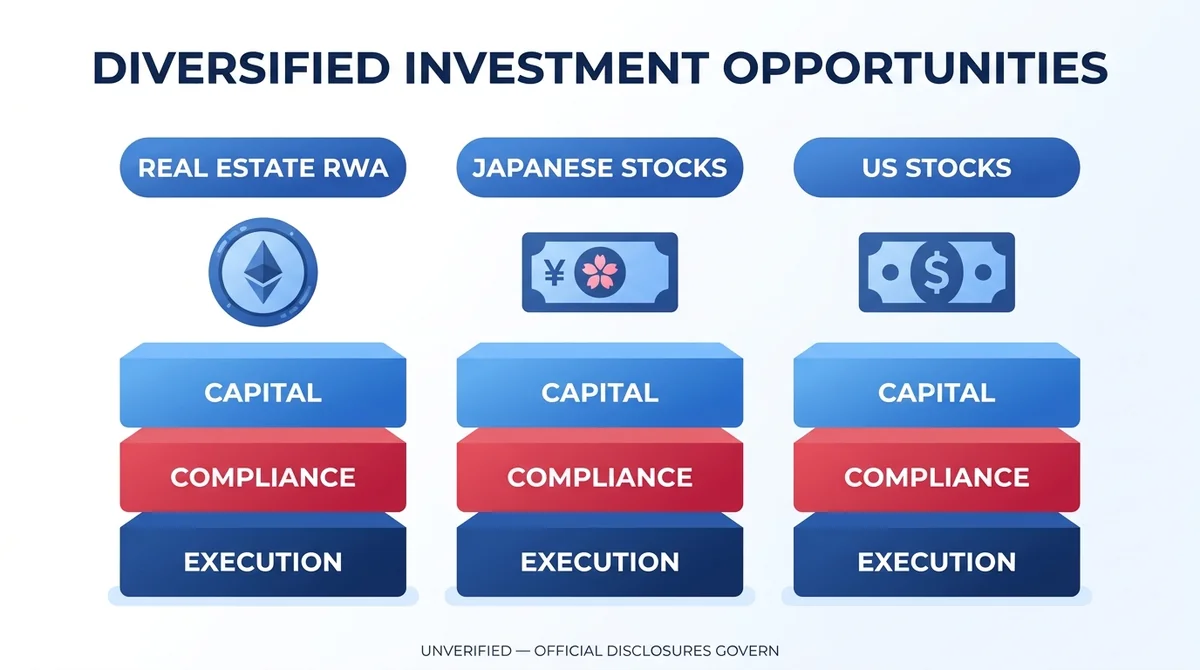
Breaking entry thresholds into capital, compliance and execution layers to compare real estate RWA, Japanese stocks and US stocks, plus RWA vs REITs barriers.
Conclusion: If you look only at minimum investment, real estate RWA tokens may have the lowest threshold. But once you factor in account-opening compliance, liquidity and exit, FX and taxes, the "total threshold" for Japanese and US stocks is more predictable, because both go through mature brokerage accounts and exchange systems, whereas the threshold for real estate RWA tokens depends heavily on the issuing platform and the regulation of the jurisdiction of issue. Note: the specific minimum amounts and fee rates discussed in this article are disclosed inconsistently across public sources, and most are unverified; the official disclosures of issuers or brokers should govern.
#What exactly differs between the entry thresholds of real estate RWA, Japanese stocks and US stocks?
Entry thresholds should be broken into three layers: capital threshold, compliance threshold and execution threshold. Looking only at minimum investment systematically underestimates the hidden costs of FX, taxes and liquidity.
#What does the "entry threshold" mean for each of the three asset types?
- Real estate RWA: real estate (including commercial real estate) equity certificates held as tokenized units. The threshold is set by the issuing platform and includes the minimum subscription unit, wallet and KYC requirements, and the compliance framework of the platform's location.
- Japanese stocks: actual shares listed on the Japanese market, traded in yen. The threshold is determined by the broker's open account channel, the trading unit (e.g., 100 shares per lot) and cross-border settlement arrangements.
- US stocks: actual shares listed on the US market, traded in US dollars. The threshold is determined by the broker's open account channel, whether fractional shares are supported, withholding tax and reporting obligations.
The essential difference: Japanese and US stocks are shareholder-status exposure, while real estate RWA tokens are unit-based exposure, and the latter does not necessarily carry equivalent shareholder rights.
#How do minimum capital, account-opening compliance and trading hours compare?
- Minimum capital: real estate RWA tokens are usually denominated in units, so the minimum investment may be lower than one lot of stock; Japanese stocks are constrained by trading units, making the per-trade capital threshold relatively rigid; some US brokers support fractional shares, which can lower the threshold. Minimum amounts across platforms and brokers are not uniformly disclosed, and this article does not infer specific figures; official disclosures should govern.
- Account-opening compliance: Japanese and US stocks require opening an account through a licensed broker, involving identity verification and cross-border investment eligibility; real estate RWA tokens require KYC on the issuing platform, and compliance requirements vary by jurisdiction of issue.
- Trading hours: Japanese stocks follow Japanese market hours and US stocks follow Eastern Time, creating time-zone execution costs for users in Asia; if RWA tokens are matched within the platform, trading hours depend on platform rules.
#Why can't the threshold be judged by minimum investment alone?
Because hidden thresholds keep generating costs throughout the holding period: FX fluctuations affect returns denominated in your local currency, tax reporting creates compliance obligations, and insufficient liquidity magnifies discounts on exit. Minimum investment is only the threshold for entering, not for exiting.
#Entry threshold comparison table for the three asset types: 8 dimensions item by item
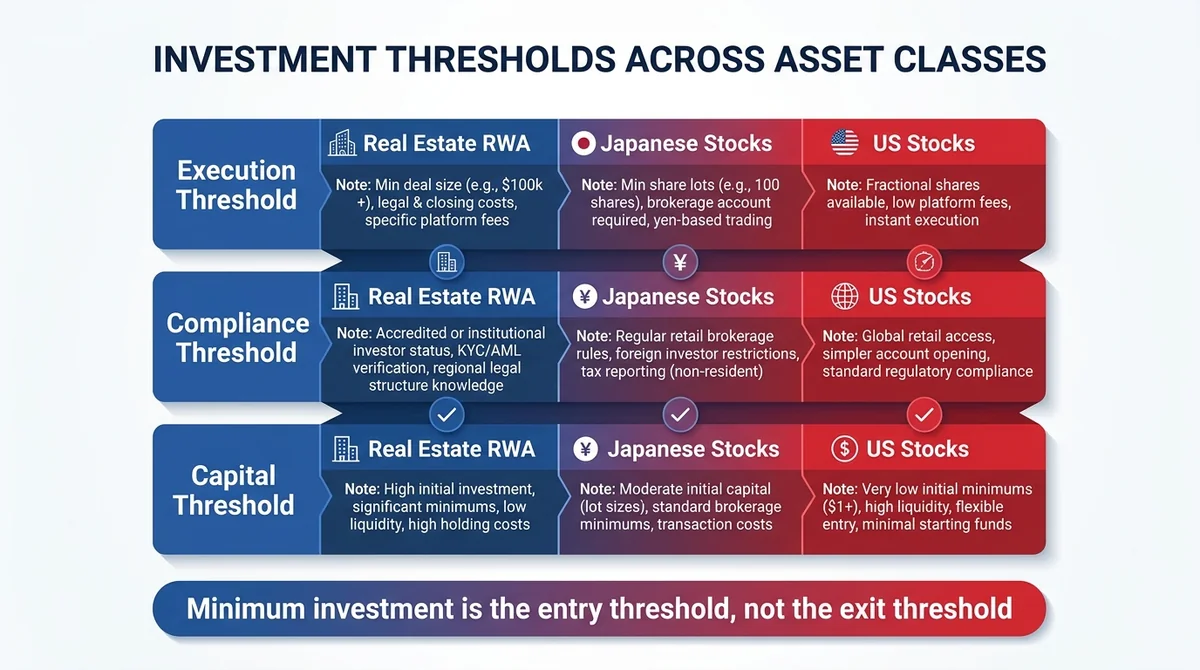
Core judgment: real estate RWA may have an edge on the capital threshold, while Japanese and US stocks have an edge on compliance transparency and liquidity; the choice depends on whether you fear "can't get in" or "can't get out" more.
| Dimension | Real estate RWA (tokenized units) | Japanese stocks | US stocks |
|---|---|---|---|
| Minimum capital | Unit-based, minimum investment may be lower, specific data unverified | Constrained by trading unit, per-trade threshold relatively rigid | Some brokers support fractional shares, threshold can be lowered |
| Unit size | Tokenized units, divisible | Mainly round lots | Whole or fractional shares, depending on broker |
| Account-opening compliance | Platform KYC, compliance varies by jurisdiction of issue | Open account with licensed broker, cross-border eligibility review | Open account with licensed broker, cross-border eligibility review |
| Trading hours | Depends on platform matching rules | Aligned with Japanese market hours | Aligned with Eastern Time, time difference for Asian time zones |
| Settlement currency | Depends on issuance arrangement, may be stablecoin or fiat | Japanese yen | US dollar |
| Liquidity | Relies on in-platform matching, depth usually limited | Exchange secondary market | Exchange secondary market, deeper |
| FX cost | Depends on conversion path between settlement currency and local currency | Yen vs local currency fluctuation | US dollar vs local currency fluctuation |
| Tax reporting | Depends on jurisdiction of issue and holding structure, rules vary widely | Cross-border investment reporting obligations | Withholding tax and reporting obligations |
#How do minimum capital and unit size compare?
The divisibility of tokenized units is the source of their capital-threshold advantage, but divisibility does not mean you can cash out at any time. The round-lot constraint on Japanese stocks makes it hard to diversify small amounts, while the fractional-share mechanism for US stocks is more flexible for diversification.
#How much do account-opening and compliance requirements differ?
The account-opening process for Japanese and US stocks is fairly standardized, brokers are subject to local regulation, and investor protection paths are relatively clear. The compliance framework for real estate RWA tokens depends on the issuer's place of registration and platform rules, and may vary greatly between issuers, so it needs to be checked item by item.
#How do trading hours and settlement currencies differ?
Time difference is an often-overlooked execution threshold: both Japanese and US stocks require users in Asian time zones to trade outside local hours. The settlement currency directly determines which FX risk you bear, and this affects long-term returns more than trading hours do.
#How should liquidity and exit difficulty be assessed?
Liquidity is the main structural weakness of real estate RWA tokens: in-platform matching depth is usually lower than that of exchange secondary markets, and exits may involve waiting or a discount. Exits from Japanese and US stocks rely on exchange liquidity, which varies widely between individual stocks but is transparent in mechanism.
#Commercial real estate RWA vs REITs: which has the lower threshold?
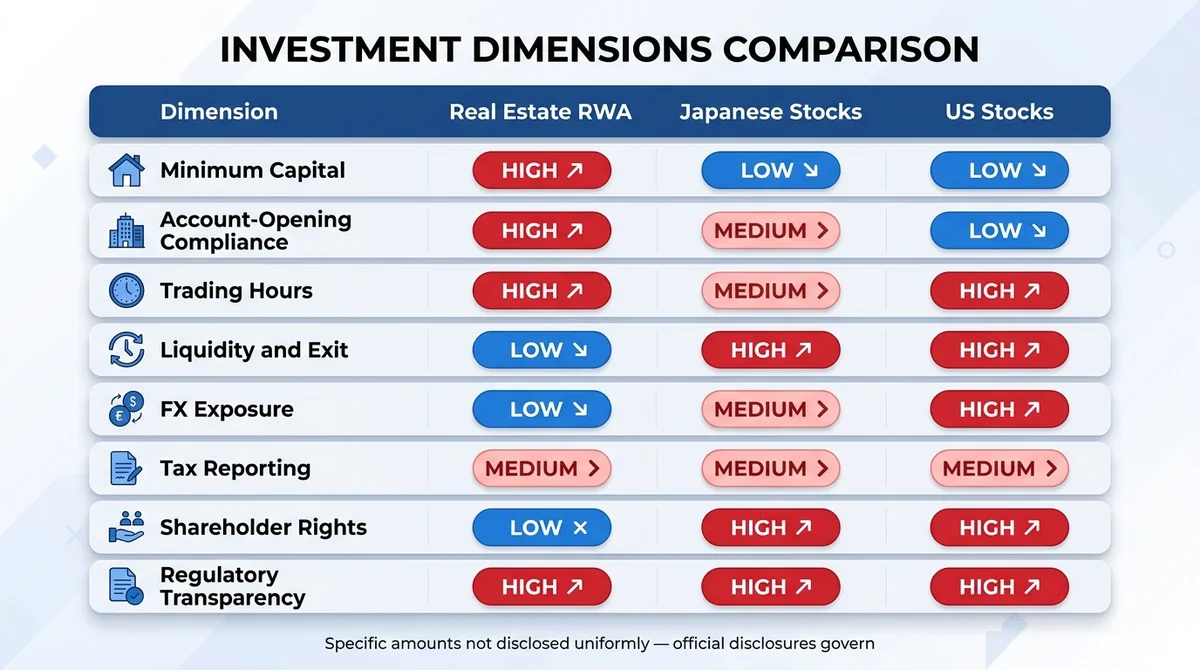
Conclusion: On the capital threshold alone, commercial real estate RWA tokens may be lower; on certainty of entry, REITs are lower — REITs go through regular securities accounts and liquidity comes from exchanges, while RWA tokens depend on the issuing platform.
#What are the entry method and threshold for REITs?
REITs are exchange-listed securities bought and sold through regular securities accounts; the threshold is determined by broker account-opening requirements and trading units, and liquidity comes from secondary-market matching.
#What are the entry method and threshold for real estate RWA tokens?
Real estate RWA tokens require KYC and wallet setup on the issuing platform, with subscription by unit; the threshold is set by platform rules, and liquidity comes from in-platform matching or issuer buyback arrangements.
#Where do the two differ on liquidity and regulation?
- Source of liquidity: REITs use the exchange secondary market; RWA tokens use in-platform matching, where depth is usually thinner.
- Regulatory framework: REITs are subject to securities regulation in the listing jurisdiction, with standardized disclosure; the regulatory path for RWA tokens varies by jurisdiction of issue, and investor protection mechanisms are not uniform.
- Nature of rights: REIT holders are securities holders; RWA token holders are unit holders, with rights defined by the issuance documents.
#How should investors with different capital and goals choose?
Core judgment: First determine your currency exposure and liquidity requirements, then decide the asset form, and only then compare minimum investment.
- If you have limited capital and can accept platform risk, you can start by learning about real estate RWA tokens, but first verify the issuer's custody fee arrangements and exit mechanism.
- If you value regulatory maturity and liquidity, you can prioritize Japanese or US stocks and enter through licensed broker channels.
- If you need yen exposure, look at Japanese stocks**; if you need US dollar exposure**, look at US stocks.
- If you cannot tolerate FX volatility, first assess the conversion cost between the settlement currency and your local currency before deciding whether to enter.
- If you need real estate exposure but do not want platform risk, prioritize exchange-listed instruments such as REITs.
#What risks and compliance issues must be noted before entry?
Core judgment: Platform risk of tokenized assets news and the FX and tax risks of cross-border investment are two types of risk that cannot be eliminated by comparing minimum investment.
#What are the platform and compliance risks of tokenized assets news?
Tokenized units depend on the issuing platform's custody fee arrangements and operational continuity, and there are differences in custody structures, redemption terms and compliance frameworks. Rule changes at the platform level may affect exit conditions.
#How should FX and tax risks of cross-border investment be assessed?
FX risk comes from relative fluctuations between the settlement currency and your local currency and is continuously exposed during the holding period; tax risk comes from reporting obligations and withholding arrangements for cross-border investment and must be confirmed under local rules.
#Which information is undisclosed and needs independent verification?
Minimum subscription amounts, fee structures, redemption arrangements and compliance qualifications of each platform are disclosed inconsistently across public sources; this article does not infer specific figures, and all must be governed by the official disclosures of issuers or brokers.
#FAQ
Q1: Is the entry threshold for real estate RWA always lower than for Japanese stocks? A: Not necessarily. The capital threshold may be lower, but the compliance and liquidity thresholds may be higher, depending on the issuing platform and the rules of the jurisdiction of issue.
Q2: Commercial real estate RWA vs REITs: which has the lower threshold? A: On the capital threshold, RWA tokens may be lower; on certainty of entry and liquidity, REITs are lower because they go through regular securities accounts and exchange secondary markets.
Q3: Where do the thresholds for Japanese and US stocks mainly differ? A: Mainly in settlement currency, trading sessions and tax reporting arrangements; the standardization of account-opening channels is relatively similar.
Q4: What is most easily overlooked in threshold comparisons? A: Exit difficulty. Minimum investment only reflects the cost of entry; liquidity and redemption terms determine actual exitability.
Q5: What are the data sources for this article? A: This article mainly compares publicly verifiable structural facts; where specific fee rates and minimum amounts are not uniformly disclosed, they are marked as unverified and must be confirmed with official sources.
This content is compiled from public information and does not constitute investment or account-opening advice. For specific threshold figures and fee rates, please refer to the official disclosures of each issuer and broker, as actual conditions may change.
FAQ
Is the entry threshold for real estate RWA always lower than for Japanese stocks?
Not necessarily. The capital threshold may be lower, but the compliance and liquidity thresholds may be higher, depending on the issuing platform and the rules of the jurisdiction of issue.
Commercial real estate RWA vs REITs: which has the lower threshold?
On the capital threshold, RWA tokens may be lower; on certainty of entry and liquidity, REITs are lower because they go through regular securities accounts and exchange secondary markets.
Where do the thresholds for Japanese and US stocks mainly differ?
Mainly in settlement currency, trading sessions and tax reporting arrangements; the standardization of account-opening channels is relatively similar.
What is most easily overlooked in threshold comparisons?
Exit difficulty. Minimum investment only reflects the cost of entry; liquidity and redemption terms determine actual exitability.
What are the data sources for this article?
This article mainly compares publicly verifiable structural facts; where specific fee rates and minimum amounts are not uniformly disclosed, they are marked as unverified and must be confirmed with official sources.
Related Terms
Done comparing? Ready to place your first trade?
The crypto assets, tokenized US stocks and ETFs you just compared are all tradable on MSX — spot or perpetuals.
Quick Start Trading →New here? Registration takes three quick steps.