Semiconductor vs AI Stocks: Key Differences, Growth, and Risks
Compare business models, growth drivers, and risks of semiconductor and AI stocks. Learn how to choose based on your risk tolerance in 2026.
Many investors hesitate between semiconductor and AI stocks, unsure how to allocate capital across hardware and software plays. This comparison breaks down business models, growth drivers, risks, and portfolio considerations to help you decide based on your risk tolerance and investment horizon.
#Key Takeaways
- Semiconductor stocks are hardware plays tied to chip demand cycles, while AI stocks are software and service plays with higher growth potential but less predictable earnings.
- Semiconductor revenue depends on electronic device demand and corporate capex cycles; AI revenue scales with software adoption and data usage.
- Both sectors benefit from the AI megatrend, but AI stocks may capture more direct value from software margins.
- Semiconductor stocks face boom-bust cycles and supply chain risks; AI stocks face valuation and competitive risks.
- Tokenized stock platforms allow fractional exposure to both sectors without traditional brokerage barriers.
#What Are the Key Differences Between Semiconductor and AI Stocks?
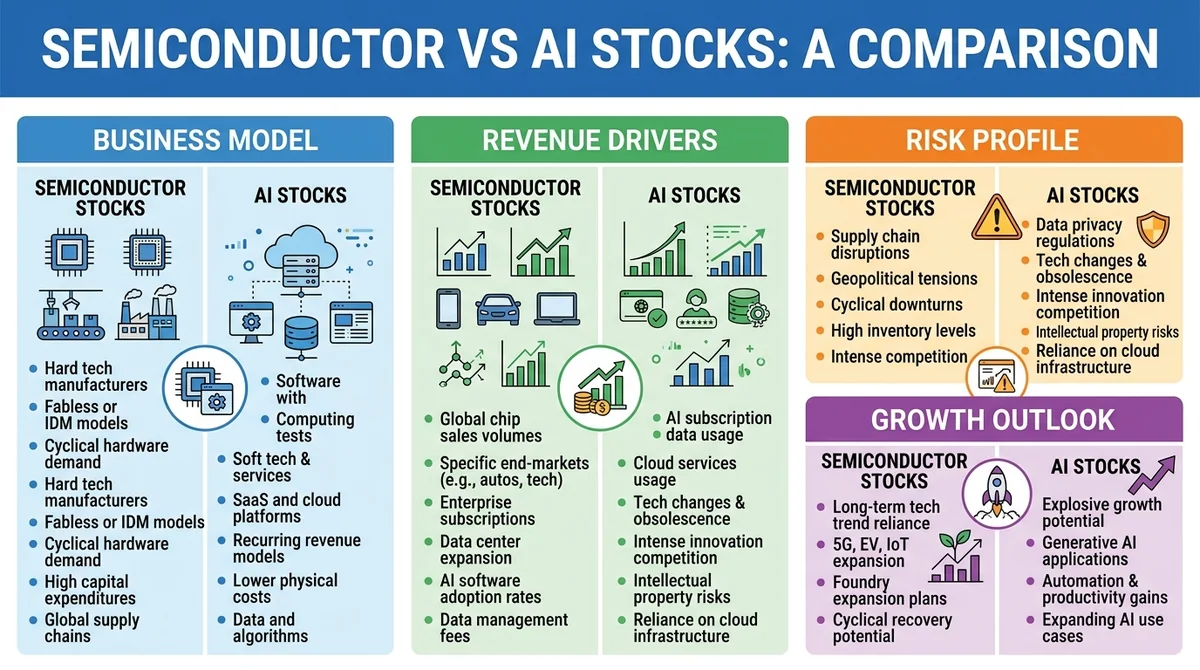
Semiconductor and AI stocks differ fundamentally in business models: semiconductor companies design and manufacture chips serving diverse industries, while AI companies focus on algorithms, platforms, and applications. This distinction drives different revenue drivers, customer bases, and competitive landscapes.
#Business models: hardware vs software
Semiconductor firms are hardware-centric, with revenue tied to chip sales and manufacturing. AI firms are software and service-centric, monetizing through subscriptions, APIs, and data usage. The hardware model requires heavy capital expenditure and long product cycles, whereas software scales rapidly with minimal marginal cost.
#Revenue drivers and customer base
Semiconductor revenue depends on electronic device demand and corporate capex cycles. AI revenue grows with enterprise digital transformation and AI tool adoption. Semiconductor customers include consumer electronics, automotive, and industrial sectors; AI customers span cloud providers, enterprises, and developers.
#Market maturity and competitive landscape
The semiconductor industry is established with clear leaders like TSMC and Nvidia in specific segments. AI is newer with faster evolution and higher disruption risk, with competition from both startups and tech giants. This maturity gap influences valuation and risk profiles.
#How Do Growth Prospects Compare for Semiconductor vs AI Stocks?
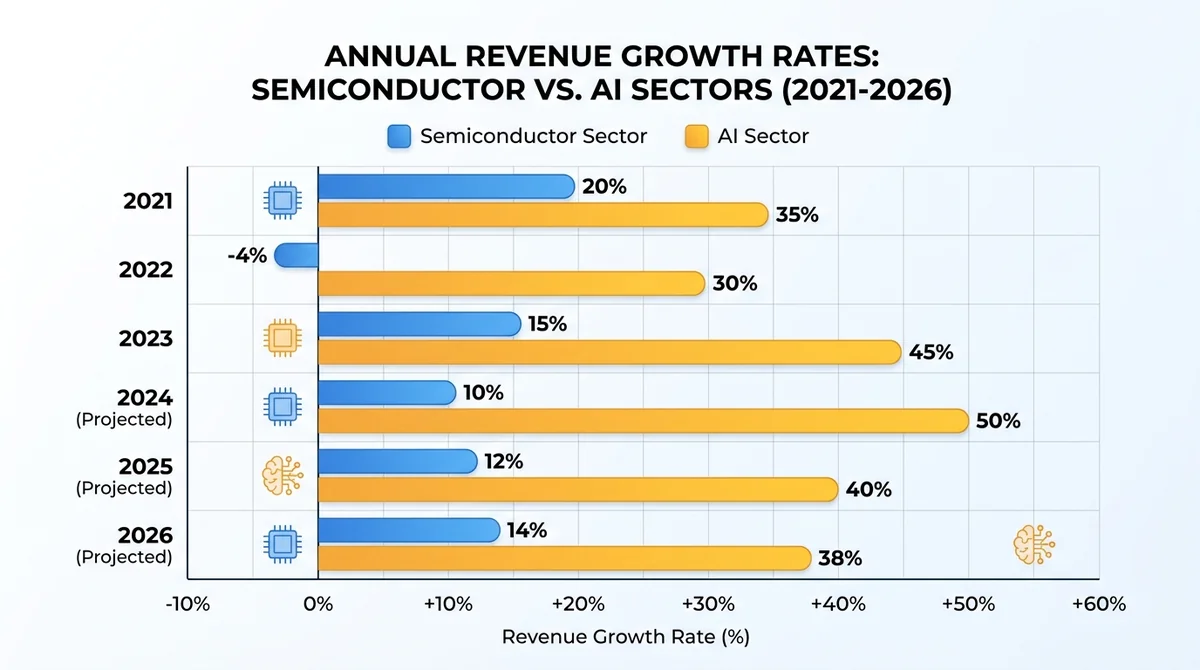
AI stocks generally have higher revenue growth potential, but semiconductor stocks also benefit from AI-driven demand for chips. The AI megatrend drives both sectors, though the value capture differs.
#Growth drivers for semiconductors (AI, IoT, automotive)
Semiconductor growth is fueled by increasing chip content in devices and new applications like AI accelerators, IoT sensors, and automotive electronics. AI accelerators, in particular, are a high-growth segment within semiconductors.
#Growth drivers for AI (cloud, automation, generative AI)
AI growth is driven by enterprise digital transformation and the proliferation of AI-powered tools. Cloud computing, process automation, and generative AI applications are expanding the addressable market rapidly.
#Risk comparison: cyclicality vs valuation
Semiconductor stocks face boom-bust cycles, inventory corrections, and supply chain disruptions, which can cause sharp earnings swings. AI stocks, while offering higher growth, carry the risk of overvaluation and intense competition, as rapid technological shifts can quickly erode a company's moat. Investors must weigh these distinct risk profiles when choosing between the two sectors.
#What Are the Risks of Investing in Semiconductor vs AI Stocks?
Semiconductor stocks carry cyclical and supply chain risks, while AI stocks carry valuation and competitive risks. Both sectors are exposed to global economic conditions and trade policies.
#Cyclicality and supply chain risks for semiconductors
Semiconductor stocks face boom-bust cycles, inventory corrections, and geopolitical tensions affecting supply chains. The industry's capital intensity amplifies downturns when demand softens.
#Valuation and competition risks for AI
AI stocks may be overvalued and subject to rapid technological shifts and regulatory scrutiny. Competition is intense, and today's leader can be disrupted by new architectures or open-source alternatives.
#Regulatory and geopolitical factors
Both sectors face export controls, data privacy regulations, and antitrust scrutiny. Geopolitical tensions can disrupt semiconductor supply chains and restrict AI technology transfers.
#How Do Valuations Compare Between Semiconductor and AI Stocks?
AI stocks often have higher valuations relative to earnings, reflecting higher growth expectations, while semiconductor stocks may be more reasonably valued. Investors should consider PEG ratios and sector medians when available.
#Typical valuation metrics for each sector
Semiconductor stocks often trade at lower P/E ratios due to cyclicality; AI stocks may command premium multiples for growth. However, valuation data is not public; use qualitative comparison.
#Historical valuation trends
Historically, semiconductor valuations have been cyclical, expanding during upcycles and compressing during downturns. AI valuations have been elevated since the generative AI boom, with some stocks trading at high price-to-sales multiples.
#Impact of growth expectations on multiples
Higher growth expectations justify higher multiples for AI stocks, but also increase downside risk if growth disappoints. Semiconductor multiples are more anchored to earnings cycles.
#How to Choose Between Semiconductor and AI Stocks for Your Portfolio?
Choose based on your risk profile: semiconductors for cyclical value, AI for growth, or a blend for balanced exposure. Consider your investment horizon and diversification needs.
#Assess your risk tolerance and investment horizon
Conservative investors may prefer diversified semiconductor ETFs; aggressive investors may accept AI volatility for higher growth. A longer horizon can absorb cyclical downturns in semiconductors.
#Consider diversification and correlation
Combining both sectors can balance cyclical stability with growth potential. Semiconductors and AI stocks may have moderate correlation, but their risk drivers differ.
#Evaluate access options: individual stocks, ETFs, tokenized stocks
Tokenized stock platforms allow fractional exposure to both sectors without traditional brokerage barriers. ETFs provide diversified exposure, while individual stocks require more research.
Disclaimer: This content is for informational purposes only and does not constitute investment advice. All investments involve risk, including possible loss of principal. Past performance is not indicative of future results.
FAQ
What are the main differences between semiconductor and AI stocks?
Semiconductor stocks are hardware plays with cyclical demand, while AI stocks are software and service plays with high growth potential but less predictable earnings.
Which sector has higher growth potential, semiconductor or AI?
AI stocks generally have higher revenue growth potential, but semiconductor stocks also benefit from AI-driven demand for chips.
Are semiconductor stocks riskier than AI stocks?
Semiconductor stocks carry cyclical and supply chain risks, while AI stocks carry valuation and competitive risks. Risk depends on the specific company and market conditions.
How should I decide between investing in semiconductor or AI stocks?
Choose based on your risk profile: semiconductors for cyclical value, AI for growth, or a blend for balanced exposure.
Can I invest in both semiconductor and AI stocks through tokenized platforms?
Yes, tokenized stock platforms allow fractional exposure to both sectors without traditional brokerage barriers.
Done comparing? Ready to place your first trade?
The crypto assets, tokenized US stocks and ETFs you just compared are all tradable on MSX — spot or perpetuals.
Quick Start Trading →New here? Registration takes three quick steps.