Singapore stocks vs China A-shares valuation gap
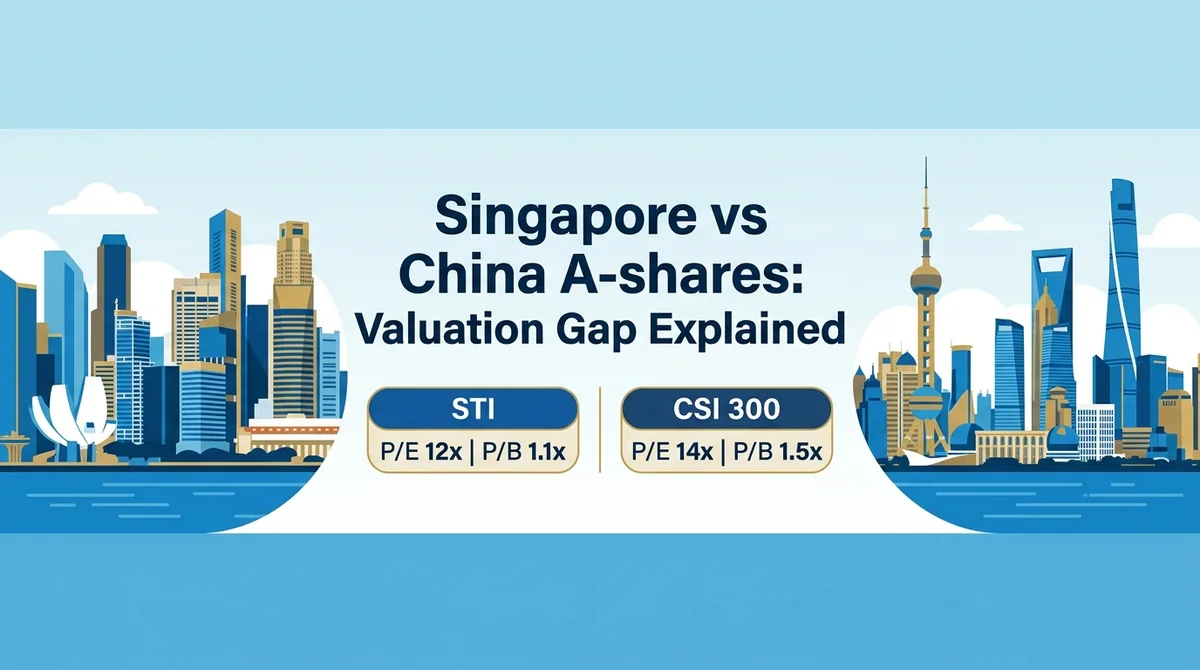
Singapore stocks trade at lower valuations than China A-shares, driven by sector mix and investor base. Explore the gap and what it means for investors.
Conclusion: Singapore stocks are generally valued lower than China A-shares, but this gap is mainly driven by differences in industry structure and investor composition, and cannot be simply interpreted as Singapore stocks being more attractive.
Data as of: 2026-06-22
#How large is the valuation gap between Singapore stocks and China A-shares?
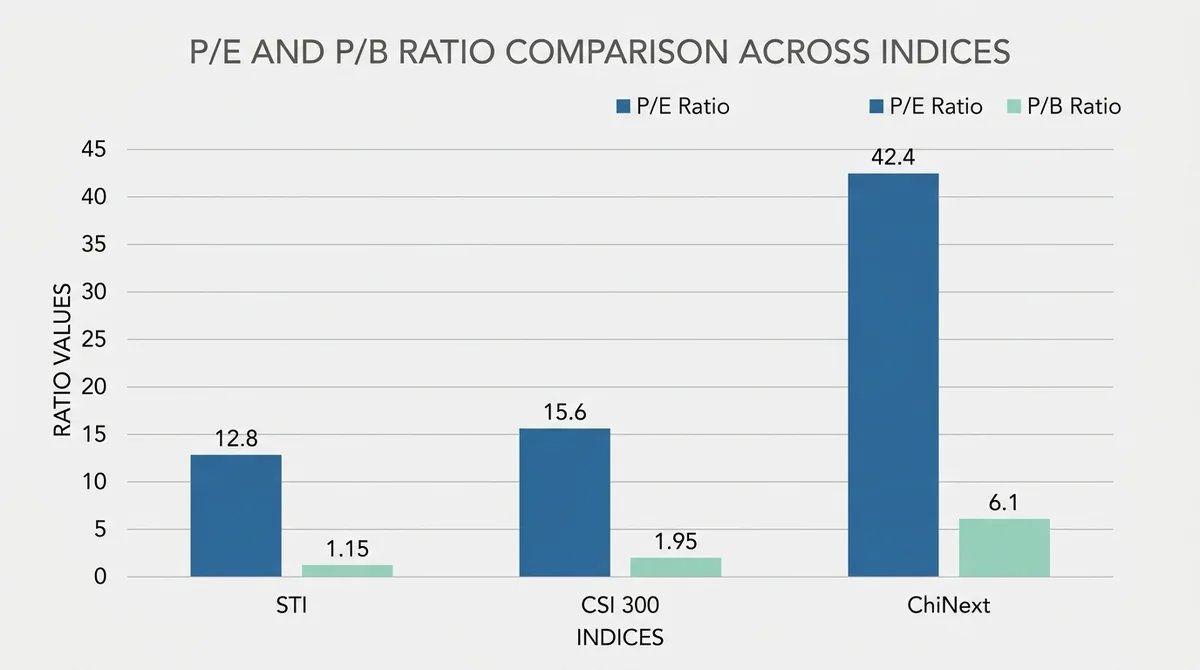
As of June 2026, the Singapore Straits Times Index (STI) trades at a P/E of about 12x and a P/B of about 1.1x; the CSI 300 trades at a P/E of about 14x and a P/B of about 1.5x. A-shares overall carry a clear valuation premium.
#How do the P/E and P/B ratios of the major indices differ?
- STI: P/E about 12x, P/B about 1.1x.
- CSI 300: P/E about 14x, P/B about 1.5x.
- ChiNext: P/E about 45x, P/B about 4.5x, reflecting higher valuations in A-share growth sectors.
#Which sectors show the most obvious valuation gaps?
Singapore financials, property, and REITs generally trade at P/E ratios of 8-12x and P/B below 1x; A-share consumer, technology, and manufacturing sectors often trade at P/E ratios of 20-40x, with some niches even higher. The cross-sector valuation gap is significant.
#Has this valuation gap been persistent or recent?
This gap has existed for a long time. Over the past decade, the STI's P/E has mostly stayed in the 10-15x range, while A-share major indices have shown wider P/E fluctuations and a higher central tendency. The gap is structural rather than a recent phenomenon.
#Why are Singapore stocks generally valued lower than China A-shares?
Singapore's market has a high weight in low-valuation sectors such as financials, property, and REITs, while A-shares have a high weight in high-growth sectors such as consumer, technology, and manufacturing. Industry structure differences are the primary reason for the valuation gap.
#How does industry structure affect overall valuation?
In the STI, financials and property together account for more than 50% of the index weight, and these sectors typically carry lower valuations; in the CSI 300, financials account for about 20%, with consumer, technology, and industrial sectors taking larger shares, pushing up the overall valuation.
#How does investor structure lead to valuation discounts or premiums?
Singapore's market is dominated by institutional investors and long-term capital, leading to more rational pricing; A-shares have a high proportion of retail investors with active trading, which tends to push valuations higher. Retail-driven markets often assign higher premiums to growth stocks.
#How much do liquidity and market depth affect valuation?
Singapore's average daily turnover is far lower than that of A-shares, resulting in a clear liquidity discount. Insufficient liquidity depresses valuations because investors demand higher liquidity compensation.
#What does the valuation gap mean for investors?

Low valuations do not necessarily represent better investment opportunities, and high valuations do not necessarily mean greater risk. The valuation gap itself does not constitute a buy or sell signal.
#Do low valuations represent better investment opportunities?
Low valuations may provide a margin of safety, but earnings quality and growth prospects must be considered. Some low-valuation Singapore stocks have stable earnings but limited growth, and may not deliver high returns.
#Do high valuations mean greater risk?
High valuations may reflect growth expectations, but the risk of correction is also greater. If earnings in high-valuation A-share sectors fall short of expectations, significant adjustments may occur.
#How should investors view the valuation gap based on their risk appetite?
Investors should choose markets based on their risk tolerance and investment horizon. Those who prefer stable cash flows and low volatility may focus on Singapore high-dividend assets; those seeking growth and able to withstand volatility may consider A-share growth sectors.
#How do trading mechanisms and access differ between Singapore stocks and China A-shares?
Singapore's stock market has more international trading mechanisms, no price limits, and convenient foreign participation; A-shares have price limits and T+1 settlement, and foreign investors must use specific channels.
#What are the differences in trading hours and rules?
Singapore's trading hours differ from A-shares, and there are no price limits; A-shares have a 10% daily price limit (20% for ChiNext and STAR Market) and T+1 settlement.
#How do foreign investor access channels differ?
A-shares are accessed through QFII, Stock Connect, and other channels with certain quota restrictions; Singapore's market is more open, and foreign investors can participate directly.
#What are the differences in dividend tax and capital gains tax policies?
Singapore has no capital gains tax, and its dividend tax policy differs from A-shares; A-share dividend tax rates vary based on holding period, and capital gains are temporarily exempt from individual income tax.
#Risk Warning and Disclaimer
Disclaimer: Valuation comparisons are based solely on public data, which may have lags and definitional differences. Investors should pay attention to market volatility, policy changes, and currency risk. This content is compiled from public data and does not constitute investment or account opening advice. Data as of 2026-06-22, actual conditions may change. For more information, please refer to official sources.
Commercial link · Does not affect scoring or ranking: To learn how the MSX platform can help you trade global stocks and cryptocurrencies, visit MSX Trading Platform.
FAQ
How large is the valuation gap between Singapore stocks and China A-shares?
The Singapore Straits Times Index trades at a P/E of about 12x and a P/B of about 1.1x; the CSI 300 trades at a P/E of about 14x and a P/B of about 1.5x. A-shares overall carry a clear valuation premium.
Why are Singapore stocks generally valued lower than China A-shares?
Mainly because Singapore's market has a high weight in low-valuation sectors such as financials, property, and REITs, is dominated by institutional investors, and has relatively insufficient liquidity; while A-shares have a high weight in high-growth sectors and high retail participation, pushing up overall valuations.
Do low valuations represent better investment opportunities?
Not necessarily. Low valuations may provide a margin of safety, but earnings quality and growth prospects must be considered. Some low-valuation Singapore stocks have limited growth and may not deliver high returns.
How do foreign investor access channels differ between A-shares and Singapore stocks?
A-shares are accessed through QFII, Stock Connect, and other channels with certain quota restrictions; Singapore's market is more open, and foreign investors can participate directly.
How do trading mechanisms differ between Singapore stocks and China A-shares?
Singapore has no price limits and different trading hours; A-shares have a 10% daily price limit (20% for ChiNext and STAR Market) and T+1 settlement.
Related Terms
Done comparing? Ready to place your first trade?
The crypto assets, tokenized US stocks and ETFs you just compared are all tradable on MSX — spot or perpetuals.
Quick Start Trading →New here? Registration takes three quick steps.