SK Hynix vs Micron vs Samsung: Which Memory Stock Fits Your Portfolio?
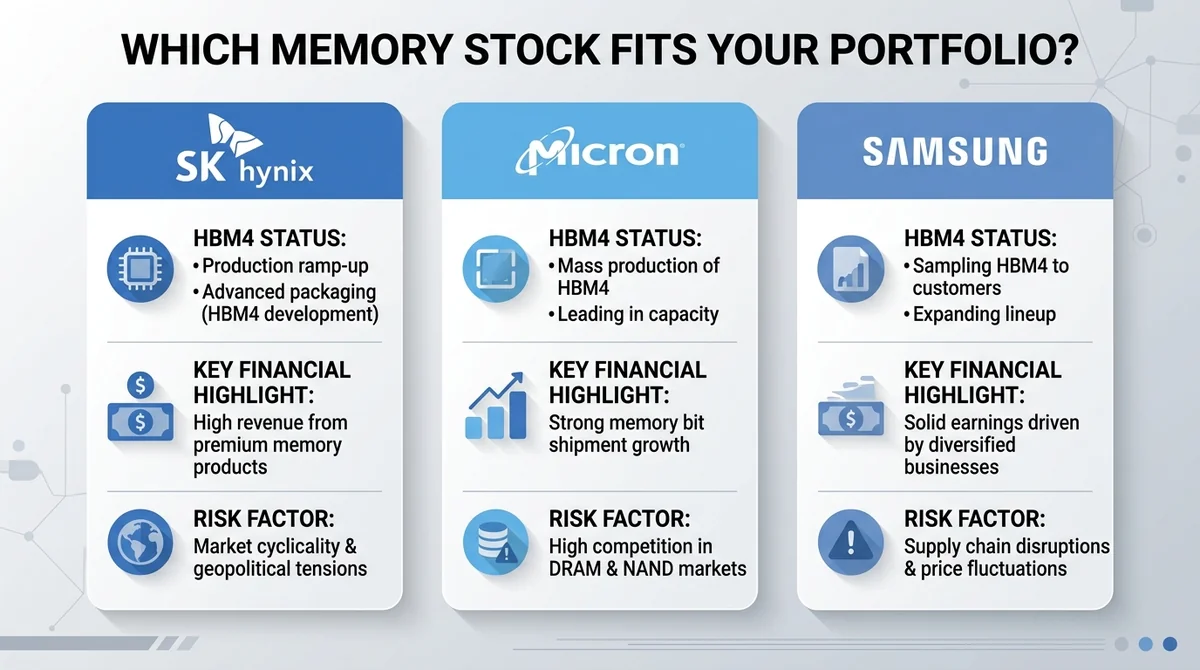
See how SK Hynix, Micron, and Samsung compare on HBM roadmaps, financials, and risk to find the memory stock for your AI exposure goals.
#SK Hynix vs Micron vs Samsung: Which Memory Stock Fits Your Portfolio?
SK Hynix, Micron, and Samsung are the three dominant memory manufacturers, but they differ sharply in HBM leadership, financial profiles, and risk exposure. This comparison breaks down HBM and AI memory, financials, risk-adjusted exposure, server memory reliability, and investor fit to help you choose.
Key Takeaways:
- SK Hynix and Micron lead in high-volume HBM4 supply for Nvidia platforms, while Samsung scales HBM4 rapidly and offers the broadest AI portfolio.
- Micron's fiscal 2026 guidance shows exceptional revenue and margin growth; SK Hynix and Samsung present trade-offs between memory focus and diversification.
- Micron is the only major DRAM maker with U.S. fabs, relevant for policy support; SK Hynix carries high Nvidia dependency and Korean market risk; Samsung has conglomerate complexity.
- All three produce server DRAM with comparable reliability, with FIT rates generally 100–350 failures per billion device-hours.
#How Do SK Hynix, Micron, and Samsung Compare on HBM and AI Memory?
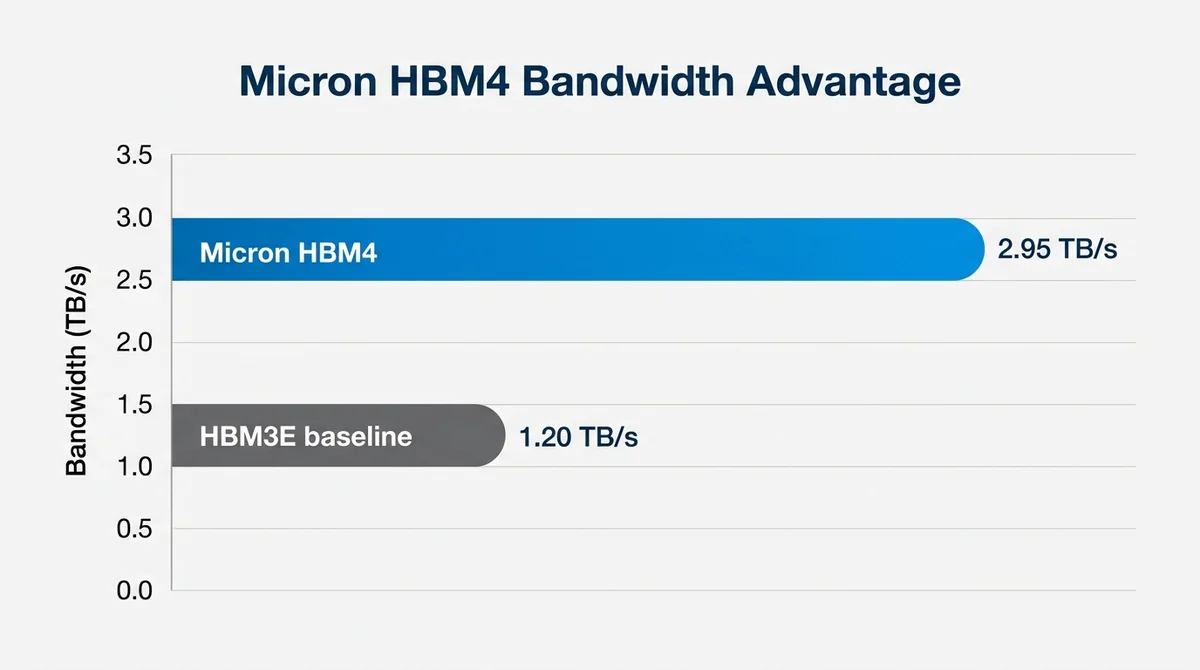
All three companies are advancing HBM4, but their roadmaps and AI portfolios differ. SK Hynix has established HBM production, an HBM4/HBM4E roadmap, and a multiyear Nvidia partnership. Micron reported HBM4 high-volume production for Nvidia Vera Rubin with over 2.8TB/s bandwidth and 20% better power efficiency than HBM3E. Samsung began commercial HBM4 shipments in February 2026 and expects 2026 HBM sales to more than triple from 2025; it shipped HBM4E samples in May 2026. Samsung has the broadest AI portfolio due to memory, foundry, logic, and packaging integration.
#What is each company's HBM roadmap for 2026?
- SK Hynix: Established HBM production and HBM4/HBM4E roadmap, with multiyear Nvidia partnership.
- Micron: HBM4 high-volume production for Nvidia Vera Rubin, over 2.8TB/s bandwidth, 20% better power efficiency than HBM3E.
- Samsung: Commercial HBM4 shipments began February 2026; 2026 HBM sales expected to more than triple from 2025; HBM4E samples shipped May 2026.
#Which company has the strongest AI memory portfolio?
Samsung has the broadest AI portfolio because it combines memory, foundry, logic, and packaging. SK Hynix is more concentrated on memory and storage, offering more direct AI-memory exposure. Micron provides relatively focused memory exposure through a U.S.-listed company. Company announcements use different testing methods and configurations, so specifications should not be compared without context.
#What Are the Key Financial and Valuation Differences?
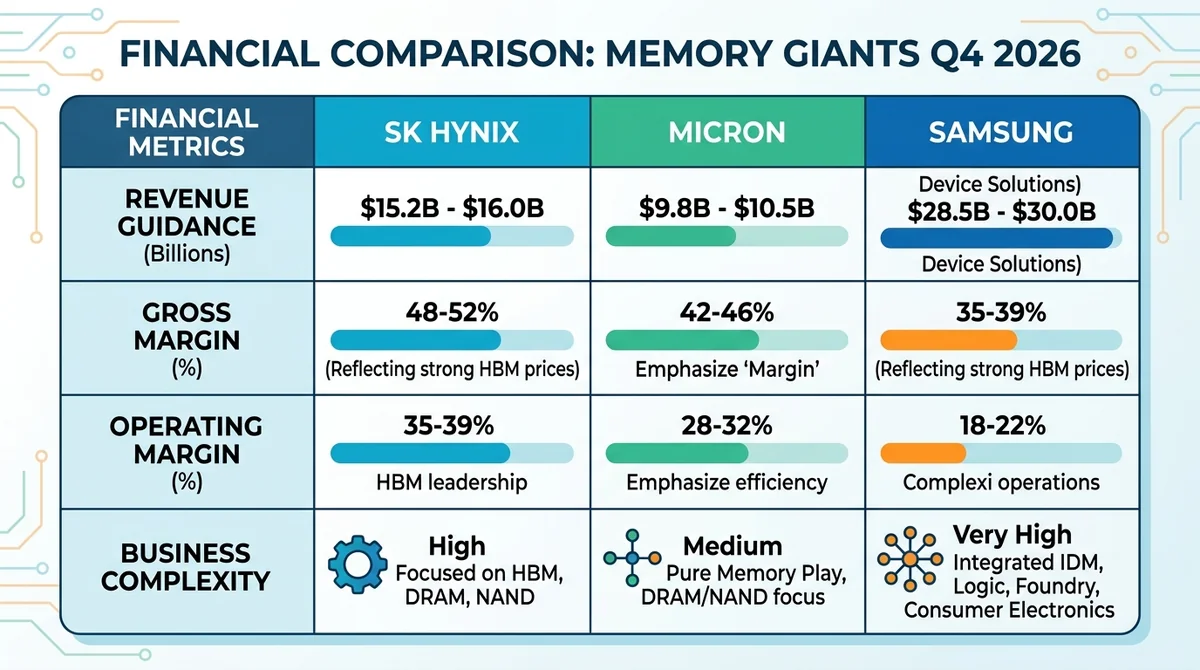
Micron's Q3 fiscal 2026 results showed record performance and Q4 revenue guidance of approximately $50 billion with gross margin near 86%. SK Hynix benefits from strong operating margins and enterprise SSD exposure but faces customer concentration and FX risks. Samsung's valuation reflects conglomerate complexity and execution across multiple businesses. Data on SK Hynix and Samsung specific financials beyond the above is not publicly available in the provided sources.
#How do recent earnings and guidance compare?
- Micron: Q3 fiscal 2026 record performance; Q4 revenue guidance ~$50 billion, gross margin near 86%.
- SK Hynix: Strong operating margins and enterprise SSD exposure; customer concentration and FX risks.
- Samsung: Valuation reflects conglomerate complexity and execution across multiple businesses.
#Which stock is more expensive relative to growth?
Micron's fiscal 2026 guidance indicates exceptional revenue and margin growth, while SK Hynix and Samsung present trade-offs between memory focus and broader business diversification. Direct valuation metrics are not provided in the sources.
#Which Company Offers the Best Risk-Adjusted Exposure for Investors?
Risk profiles differ significantly. SK Hynix risks include customer concentration, Korean market and FX exposure. Micron risks include valuation, memory cyclicality, and competition. Samsung risks include complex conglomerate exposure and execution across multiple businesses. Micron is the only major DRAM manufacturer with U.S. fabs, relevant for government contracts and supply chain considerations.
#What are the main risks for each stock?
| Company | Key Risks |
|---|---|
| SK Hynix | Customer concentration, Korean market and FX exposure |
| Micron | Valuation, memory cyclicality, competition |
| Samsung | Complex conglomerate exposure, execution across multiple businesses |
#How does geographic and customer concentration affect each company?
Investors seeking direct U.S. exposure and policy support may favor Micron, while those accepting Korean market risks and high Nvidia dependency may consider SK Hynix; Samsung offers diversified semiconductor exposure but with conglomerate complexity.
#How Does Server Memory Reliability Compare Across the Three Manufacturers?
Published studies from hyperscale operators show comparable reliability across all three manufacturers. Samsung FIT rates range 100–300; SK Hynix 120–350 (varies by process node). Micron's FIT data is not explicitly listed in the provided excerpt but is implied comparable. Compatibility considerations for HPE ProLiant and Dell PowerEdge are relevant for server buyers.
#What do FIT rate studies show?
- Samsung: 100–300 FIT
- SK Hynix: 120–350 FIT
- Micron: Not explicitly listed but implied comparable
All three manufacturers produce server DRAM with comparable reliability, with FIT rates generally between 100–350 failures per billion device-hours depending on generation.
#Does compatibility vary by server platform?
Compatibility considerations for HPE ProLiant and Dell PowerEdge are relevant for server buyers. The sources note that every server memory module comes from one of these three fabs, so compatibility is generally manageable across platforms.
#Which Memory Stock Should You Choose for Your Portfolio?
The optimal choice depends on whether you prioritize pure AI memory exposure (SK Hynix), U.S. policy support and diversification (Micron), or broad semiconductor integration (Samsung).
#What investor profile fits each company?
- SK Hynix: Suits investors seeking high AI-memory purity and Nvidia ecosystem exposure.
- Micron: Suits investors wanting U.S. listing, policy tailwinds, and diversified DRAM/NAND exposure.
- Samsung: Suits investors preferring broad semiconductor integration and lower memory-specific volatility.
#How to decide based on AI exposure vs diversification?
No company is automatically the best investment; choose based on technology, valuation, geographic, and execution preferences. Consider your risk tolerance for customer concentration, geographic exposure, and cyclicality.
#Sources
- Samsung vs Hynix vs Micron Server RAM 2026 — Reliability, Pricing & ProLiant/PowerEdge Compatibility
- SK hynix vs Micron vs Samsung: Which AI Memory Company Is Different?
Disclaimer: This content is for informational purposes only and does not constitute investment advice. Data may be incomplete or outdated; verify independently before making decisions.
FAQ
Which company leads in HBM4 supply for Nvidia platforms?
SK Hynix and Micron currently lead in high-volume HBM4 supply for Nvidia platforms, while Samsung is scaling HBM4 shipments rapidly.
Does Micron have U.S. manufacturing advantages?
Yes, Micron is the only major DRAM manufacturer with fabs in the United States, which matters for government contracts and supply chain considerations.
Are there significant differences in server memory reliability among the three?
No, published studies show comparable reliability; FIT rates generally range from 100 to 350 failures per billion device-hours.
Which company has the broadest AI semiconductor portfolio?
Samsung has the broadest AI portfolio because it combines memory, foundry, logic, and packaging.
What are the main risks of investing in SK Hynix?
SK Hynix faces customer concentration risk, Korean market risk, and foreign exchange exposure.
Is any company automatically the best investment?
No, the optimal choice depends on your preference for AI memory purity, U.S. policy support, or broad semiconductor integration.
Related Terms
Done comparing? Ready to place your first trade?
The crypto assets, tokenized US stocks and ETFs you just compared are all tradable on MSX — spot or perpetuals.
Quick Start Trading →New here? Registration takes three quick steps.