Spot vs Perpetual Fees 2026: Real Fee Rates, Rebates, and Funding Rates Across 5 Major Exchanges
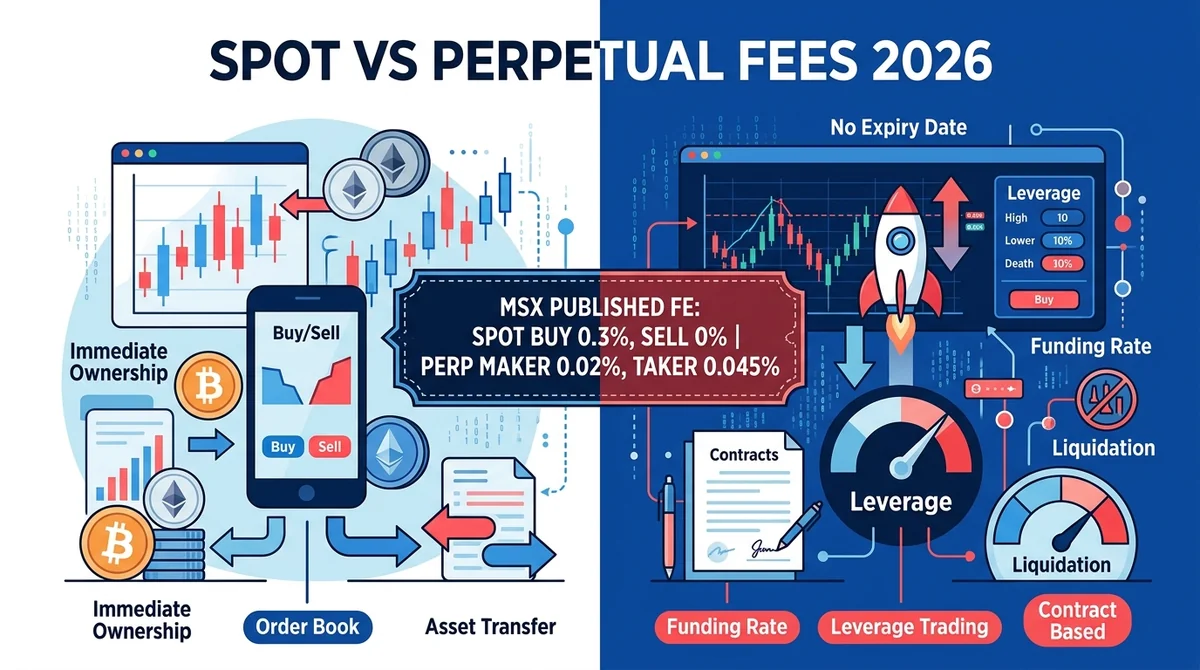
Spot vs perpetual: spot one-time fee; perpetual adds maker/taker + funding rate. Short-term: trading fee; long-term: funding rate. MSX example; not advice.
#Answer
There is no absolute answer as to whether spot or perpetual fees are lower. In terms of short-term trading cost, spot is usually lower because it only involves a one-time trading fee. In terms of long-term holding cost, the funding rate on perpetuals can significantly affect total cost, even exceeding the trading fee. Specific rates vary by exchange, VIP level, and platform token discounts. This article only uses MSX's published rates as a verifiable example. Since complete comparable data for the 5 major exchanges was not obtained, no false cross-exchange ranking is provided.
#Verifiable Example: MSX Published Fees
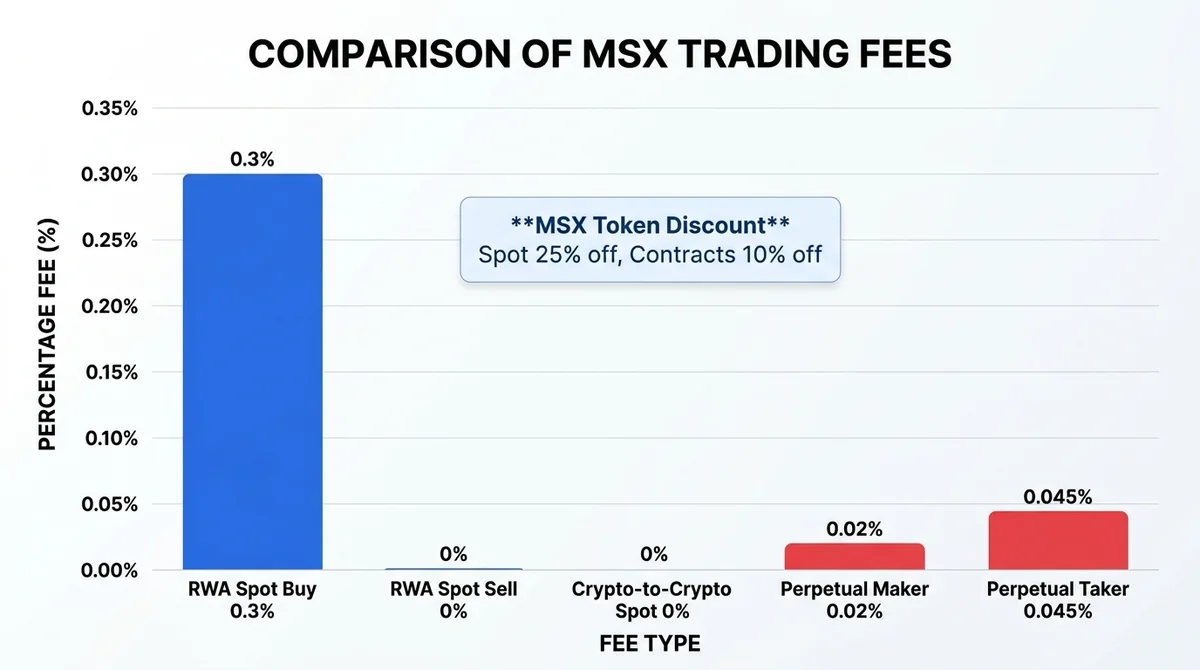
According to platform disclosure (local fact base), MSX's current fees are as follows:
- RWA spot: buy 0.3%, sell 0%
- Crypto-to-crypto spot: 0%
- Perpetual contracts: Maker 0.02%, Taker 0.045%
- Using $MSX as deduction: spot 25% off, contracts 10% off
Note: This is a single-platform example and does not represent the 5 major exchanges; funding rates are not listed in the example and should be based on each platform's real-time disclosure.
#How Do the Cost Structures of Spot and Perpetual Fees Differ?
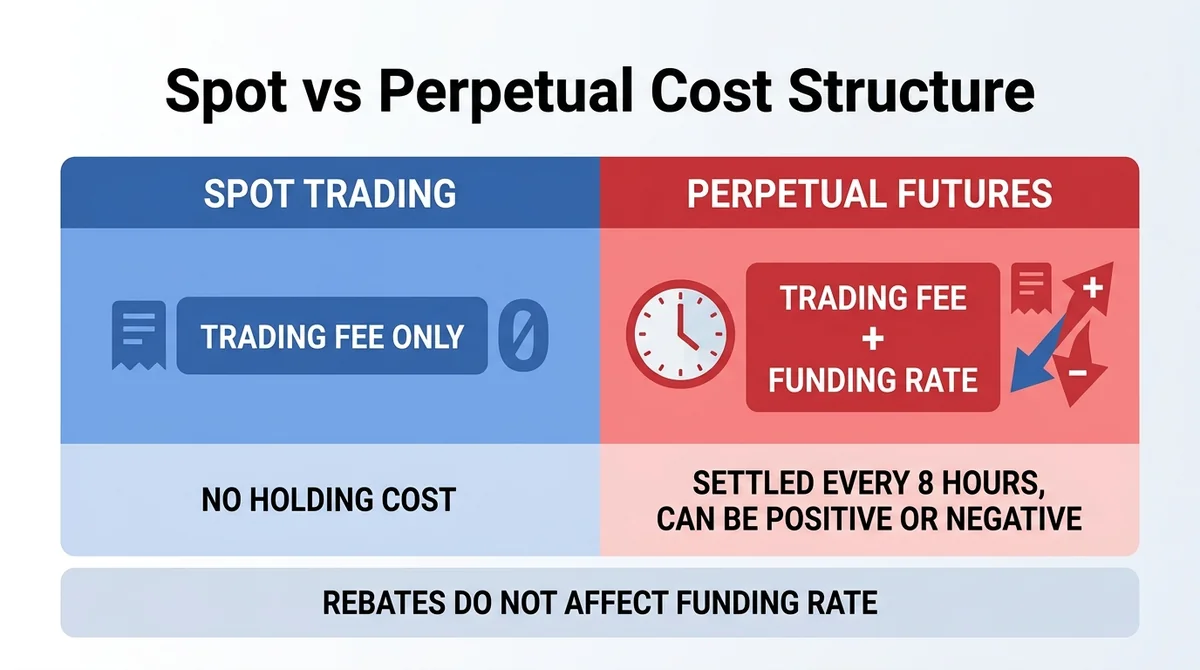
Fee structure: Spot trading fees are charged once as a percentage of notional value, usually distinguishing maker/taker. Perpetual contracts also have a funding rate, which is a periodic payment between traders on opposite sides, not paid to the exchange, but constituting a real holding cost.
Main costs: Spot costs only consist of the trading fee (excluding withdrawals, etc.); perpetual costs are the sum of the trading fee and the funding rate. The funding rate is settled every 8 hours or according to platform rules, and can be positive or negative.
Funding rate: Spot has no funding rate. The perpetual funding rate is determined by supply and demand between longs and shorts. When long demand is strong, the rate is positive, and longs pay shorts; conversely, when the opposite occurs, the rate is negative and shorts pay longs. The funding rate is not fixed and needs continuous monitoring for long-term positions.
#What Are the Spot and Perpetual Fee Rates of Major Exchanges in 2026?
This article did not obtain complete comparable 2026 fee data for the 5 major exchanges (such as Binance, OKX, etc.). Each platform typically publishes a fee schedule, but factors such as VIP level, platform token deductions, and promotional rebates cause significant differences in actual rates. Therefore, we cannot provide a 'cross-exchange comparison of real fee rates for the 5 major exchanges'; we can only offer a single-platform example from MSX (see above). Users are advised to directly check the latest official disclosures on each exchange's website.
#How Do Rebates and Funding Rates Affect Final Trading Costs?
Rebate mechanism: Trading fees for both spot and perpetual may be reduced through rebates or platform token deductions, but funding rates are usually not affected by rebates, so rebates have limited impact on total perpetual costs.
Funding rate: The funding rate fluctuates with market supply and demand, and long-term holders need to evaluate it carefully. The longer the position is held, the larger the cumulative funding rate becomes, potentially far exceeding the initial trading fee.
#How to Comprehensively Assess the Actual Trading Costs of Spot vs Perpetual?
- Short-term trading: Focus on comparing maker/taker fees and rebate ratios; high-frequency trading total fees increase linearly.
- Long-term holding: Spot has no additional holding cost; for perpetual, estimated cumulative funding rate should be considered. Historical funding rate ranges can be referenced but future fluctuations need attention.
- Unified basis: Include spot fees, perpetual trading fees, funding rate, rebates, platform token discounts, withdrawal fees, spread, etc., in calculations.
- Example with MSX deduction: Spot 25% off can reduce 0.3% to about 0.225%; contracts 10% off can reduce 0.045% to about 0.0405%. This is a single-platform calculation for MSX; other platforms have different discounts.
#What Are the Common Risks to Note in Spot and Perpetual Trading?
- High leverage in perpetual amplifies losses; unfavorable price movements may lead to liquidation, causing additional losses.
- Sharp fluctuations in funding rates increase holding costs, especially in extreme market conditions where rates may rise rapidly.
- Platform token deductions require holding platform tokens, and their price fluctuations may erode deduction benefits.
- This article does not constitute investment advice. Before trading, fully understand product risks and manage position sizes.
#Comparison Table
| Dimension | Spot | Perpetual |
|---|---|---|
| Fee structure | Charged once as a percentage of notional value | Maker/taker fee + periodic funding rate |
| Main cost | Trading fee | Trading fee + funding rate |
| Funding rate | None | Yes, positive/negative fluctuating with market supply/demand |
| Rebate impact | Some platforms offer, can offset fees | Some platforms offer, can offset trading fees, funding rate usually not offset |
| Trading frequency impact | High-frequency total fees increase linearly | High-frequency trading fees increase, funding rate impact smaller |
| Holding period impact | No additional holding cost | Longer holding, larger cumulative funding rate |
| Leverage and risk | No/low leverage, lower risk | Supports high leverage, amplifies profit/loss risk |
| Suitable scenarios | Long-term holding, low-frequency trading | Short-term trading, hedging, arbitrage |
| Fee transparency | Fee disclosure varies | Fee disclosure varies, funding rate changes in real time |
#Scenario Recommendations
Suitable for spot: Long-term holders, low-frequency traders, or those who do not want to bear funding rate uncertainty; spot is more appropriate.
Suitable for perpetual: Short-term traders, arbitrageurs, or users who need to hedge spot positions, who can manage funding rate and liquidation risks; perpetual may be more appropriate, but the impact of funding rate on total cost should be carefully evaluated.
#FAQ
Which has lower fees: spot or perpetual? In short-term trading, if funding rate is not considered, spot is usually lower; for long-term holding, cumulative funding rate on perpetual may make total cost exceed spot. It depends on platform fee rates and funding rate levels. Using MSX as an example, spot buy is 0.3%, contract taker is 0.045%, but funding rate is not provided, so a direct comparison cannot be made.
What is the biggest factor affecting perpetual holding costs? The funding rate. The longer the position is held, the larger the cumulative funding rate becomes. Even if the trading fee is very low, the funding rate may become the main cost.
How much can platform token deductions save? Deduction ratios vary by platform. Using MSX's disclosed example, spot gets 25% off and contracts get 10% off, but funding rates are generally not affected by deductions.
How to comprehensively assess actual trading costs of spot vs perpetual? It is necessary to include spot fees, perpetual trading fees, funding rate, rebates, platform token discounts, withdrawal fees, etc., in the same basis, and calculate based on your trading frequency and holding period. This article did not obtain unified fee data for the 5 major exchanges; it is recommended to refer to each exchange's real-time disclosure.
What are the risks of high leverage in perpetual contracts? High leverage magnifies profits and losses; unfavorable price movements may lead to liquidation, causing additional losses. Sharp fluctuations in funding rates also increase holding costs. Understand fully before trading.
#Disclaimer
This content is compiled based on public data and a local trusted fact base, and does not constitute investment or account opening advice. Data is as of 2026-08-31, and actual conditions may change. For more official fee information, please check each exchange's official website.
FAQ
Which has lower fees: spot or perpetual?
In short-term trading, if funding rate is not considered, spot is usually lower; for long-term holding, cumulative funding rate on perpetual may make total cost exceed spot. It depends on platform fee rates and funding rate levels. Using MSX as an example, spot buy is 0.3%, contract taker is 0.045%, but funding rate is not provided, so a direct comparison cannot be made.
What is the biggest factor affecting perpetual holding costs?
The funding rate. The longer the position is held, the larger the cumulative funding rate becomes. Even if the trading fee is very low, the funding rate may become the main cost.
How much can platform token deductions save?
Deduction ratios vary by platform. Using MSX's disclosed example, spot gets 25% off and contracts get 10% off, but funding rates are generally not affected by deductions.
How to comprehensively assess actual trading costs of spot vs perpetual?
It is necessary to include spot fees, perpetual trading fees, funding rate, rebates, platform token discounts, withdrawal fees, etc., in the same basis, and calculate based on your trading frequency and holding period. This article did not obtain unified fee data for the 5 major exchanges; it is recommended to refer to each exchange's real-time disclosure.
What are the risks of high leverage in perpetual contracts?
High leverage magnifies profits and losses; unfavorable price movements may lead to liquidation, causing additional losses. Sharp fluctuations in funding rates also increase holding costs. Understand fully before trading.
Related Terms
Done comparing? Ready to place your first trade?
The crypto assets, tokenized US stocks and ETFs you just compared are all tradable on MSX — spot or perpetuals.
Quick Start Trading →New here? Registration takes three quick steps.