Subnet Tokens vs App Chains: Ecosystem Comparison
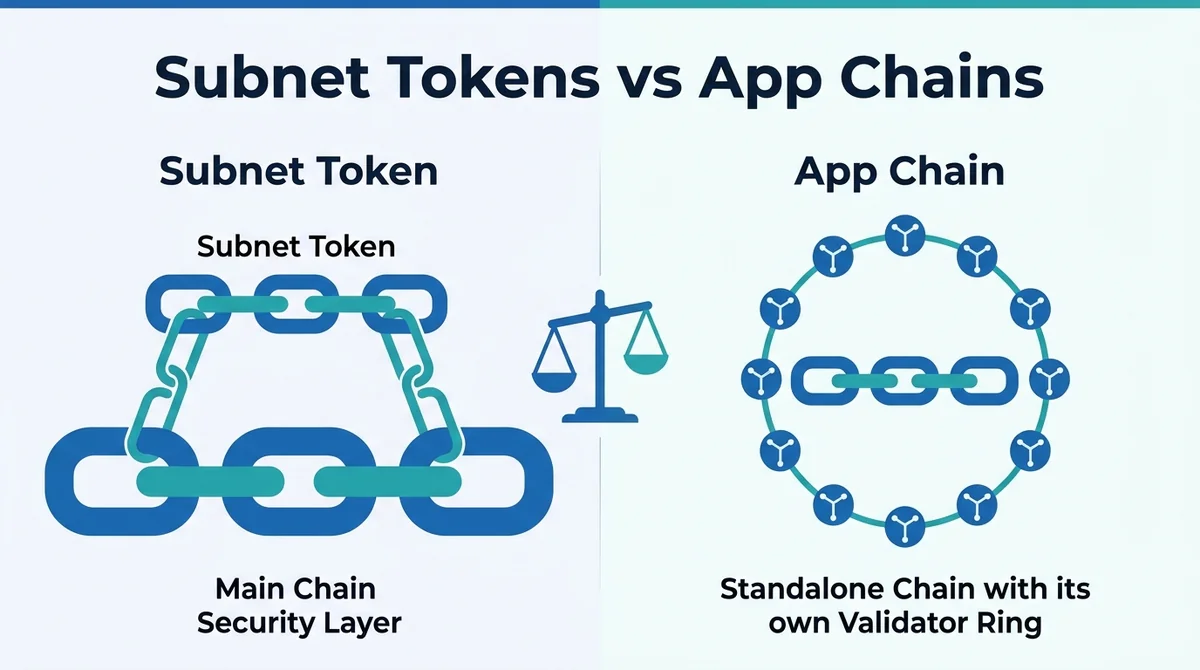
Compare Subnet Tokens and App Chains across security source, token role, scalability, cost and sovereignty, with scenario fit and an action checklist.
Bottom line: If you want fast launch and want to borrow the main chain's security and liquidity, evaluate a Subnet first; if you need fully custom rules, fees and governance sovereignty, evaluate an App Chain. This is not a contest of raw performance, but a structural trade-off between where security comes from and how much sovereignty you hold.
#What exactly is the difference between Subnet Tokens and App Chains?
One-line distinction: Subnet Tokens run on top of an existing main chain's security and settlement, while App Chains build their own validator set and governance. The two differ fundamentally in security source, token role and degree of sovereignty.
#Where does security come from: shared main chain or self-built validators?
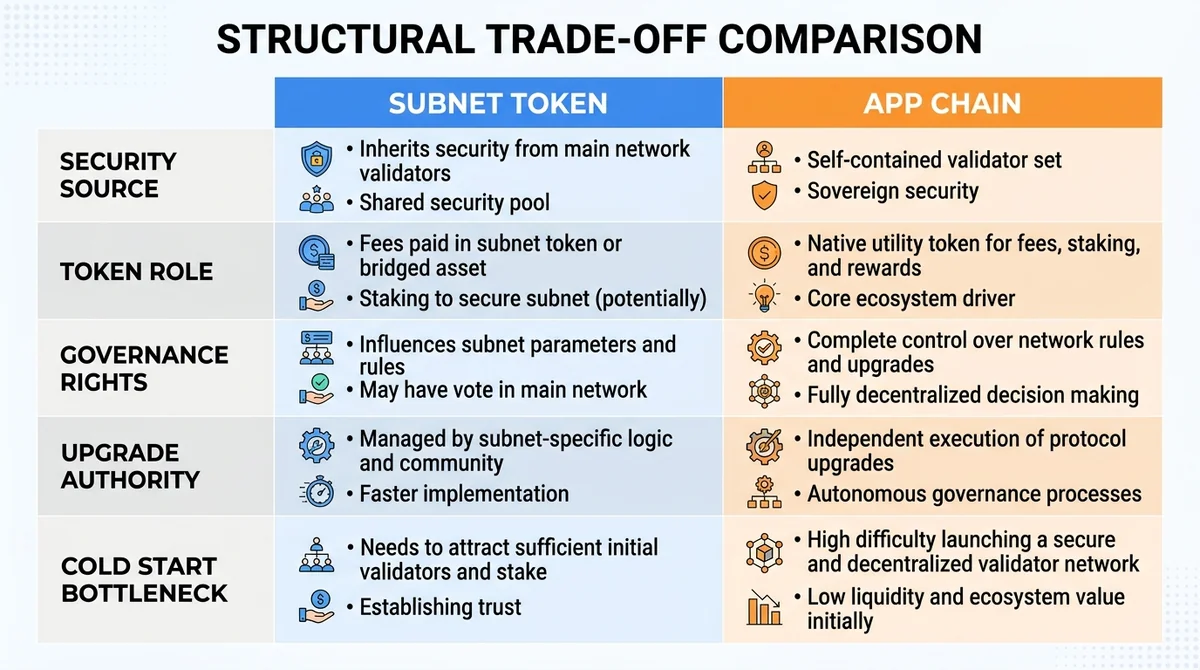
A Subnet's security is provided by the main chain and its validator set, so the subnet does not need to build a consensus security budget from scratch. An App Chain must recruit its own validators, set staking thresholds and continuously pay incentives, so its security budget fluctuates with the token price.
The specific size and entry thresholds of the two validator sets are not backed by verifiable public data in this article and should be based on each chain's official documentation.
#What role does the token play in the ecosystem?
- Subnet Token: mainly handles Gas, staking and ecosystem incentives within the subnet, with value capture coupled to the main chain's fee mechanism.
- App Chain Token: closer to a sovereign asset, handling Gas, staking security, governance voting and fee capture at once — its roles are more concentrated and more dependent on its own economic design.
#Who holds governance and upgrade rights?
A Subnet's underlying protocol upgrades are usually decided by main chain governance; the subnet has autonomy at the parameter level but its boundaries are constrained by the main chain. An App Chain's upgrades and governance are entirely decided by its own governance mechanism — higher sovereignty, but governance mistakes have no external backstop.
#Scalability comparison: which handles growth better, Subnet Tokens or App Chains?
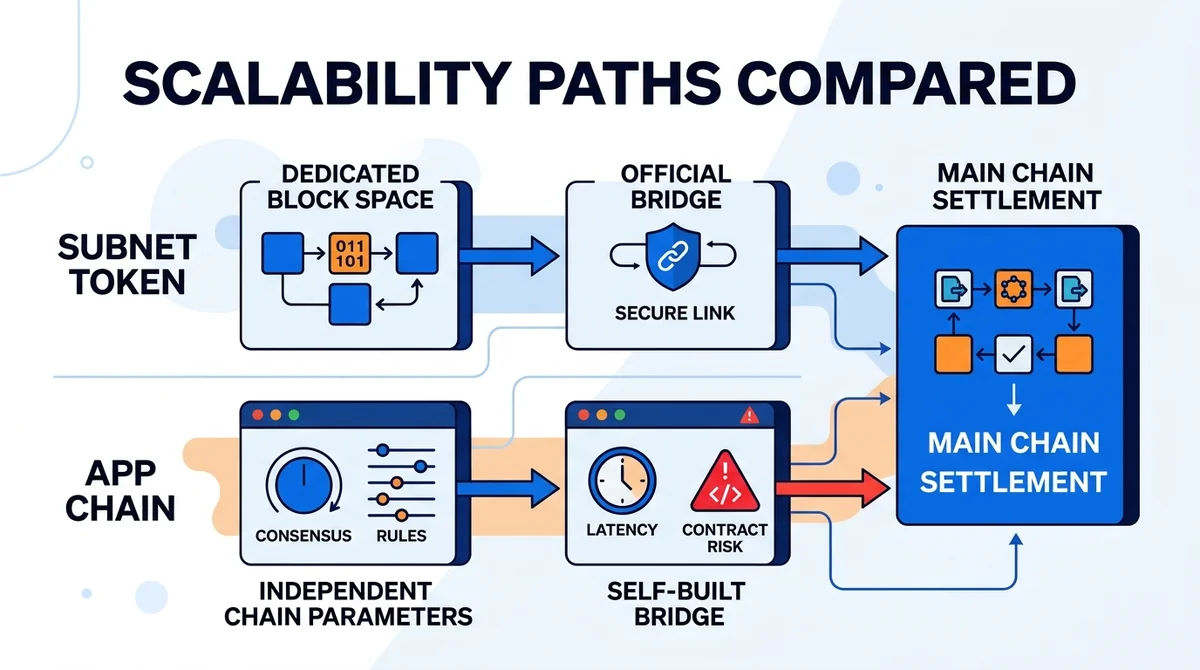
Bottom line: Subnets scale horizontally through dedicated block space and main chain settlement, while App Chains trade throughput for independent chain parameter tuning but must bear cross-chain and cold-start costs themselves.
#How do throughput and resource isolation mechanisms differ?
A Subnet's core advantage is resource isolation — a single application gets dedicated block space and does not compete with other high-frequency applications for main chain capacity. An App Chain has full control over whole-chain parameters: block time, block size and Gas limits can all be set independently, but its throughput ceiling depends on its own validator hardware and network conditions.
Scalability is not a single TPS number; you must also look at resource isolation, settlement guarantees and failure recovery capability.
#Which has lower cross-chain and interoperability costs?
Asset and message passing between a Subnet and its main chain usually has an official bridging path, but cross-chain transfers still carry latency and contract risk. An App Chain must build its own bridge or integrate a third-party cross-chain bridge, bearing interoperability costs and security assumptions itself. Specific bridging fees are not backed by verifiable data in this article, so no numeric comparison is made here.
#Where are the bottlenecks during ecosystem cold start?
- Subnet: the bottleneck is differentiation and traffic acquisition within the main chain ecosystem; a low validator threshold is an advantage.
- App Chain: the bottleneck is validator recruitment and initial liquidity; the cold-start period requires continuous subsidies for the security budget.
#Decentralization and security trade-offs: is shared security really safer?
Bottom line: Shared security lowers the threshold for subnets to build their own validators, but introduces dependence on the main chain; App Chains have higher sovereignty but must bear the attack surface of consensus and cross-chain bridges alone.
#How do validator set size and thresholds differ?
A Subnet reuses main chain validators and in theory inherits the main chain's security budget scale, with entry thresholds set by main chain rules. An App Chain's validator set is usually smaller, with entry thresholds set by the chain itself; specific numbers are not backed by verifiable data in this article.
#How is a subnet affected when the main chain fails?
Shared security means the dependency is two-way: when the main chain experiences consensus stalls or governance disputes, the subnet's settlement and cross-chain paths may be affected at the same time. This is a structural cost of shared security, not an occasional event.
#Which attack surfaces does an App Chain bear alone?
- Consensus-layer attacks and validator collusion
- Contract risk of self-built or third-party cross-chain bridges
- Governance attacks and concentrated upgrade permissions
#Cost structure differences: what does running and maintaining each require?
Bottom line: Subnets have low launch costs, but fees and value partly flow to the main chain; App Chains require high upfront investment and self-funded validator incentives, but fees and value capture stay on their own chain.
#What makes up launch and ongoing operating costs?
A Subnet's launch costs mainly come from subnet deployment and main chain interaction fees, with a lighter operational burden. An App Chain requires building its own validator node clusters, monitoring and upgrade processes, with significantly higher staffing and infrastructure investment. Specific amounts are not backed by verifiable data in this article.
#Where is the pressure of token incentive spending greater?
An App Chain must independently pay validators and ecosystem incentives, concentrating inflation pressure on its own token. A Subnet's incentive spending can be coordinated with the main chain ecosystem, but its token value capture path is relatively indirect.
#Does value capture flow to the main chain or stay on the chain?
Part of a Subnet's fees and settlement value flows to the main chain; an App Chain's fees and MEV revenue stay on its own chain but must be offset by security spending. This is the trade-off most easily overlooked when choosing a solution.
#Should your project choose a Subnet or an App Chain?
Bottom line: Choose a Subnet for fast launch and main chain liquidity, choose an App Chain for full sovereignty and custom rules, and teams with limited operational capacity should lean toward shared security solutions.
#Scenario routing
- If you prioritize fast launch and borrowing main chain liquidity and user base: evaluate a Subnet first and treat the main chain ecosystem entry as a distribution channel.
- If you require fully custom rules, compliance boundaries or fee models: evaluate an App Chain and accept the cost of self-built validators and governance.
- If your team is small and cannot run nodes long-term: lean toward shared security solutions and externalize operational complexity.
- If token economic design is part of your core product: an App Chain's sovereign asset model fits better, but you must design the security budget yourself.
- If the goal is to validate a product hypothesis short-term: prioritize the low-cost option and defer sovereignty decisions until scale is validated.
#Action checklist
- Clarify whether the security budget reuses the main chain or is self-built, and estimate long-term incentive spending.
- Verify the target chain's validator entry thresholds and set size (based on official disclosures).
- Assess cross-chain bridging paths, latency and contract risk.
- Calculate where fees and MEV accrue, and judge whether value capture stays on the chain.
- Confirm who holds governance and upgrade permissions, and assess the degree of centralization.
- Evaluate the team's ability to operate nodes and upgrades long-term.
- Write the above conclusions and main chain dependency risks into the decision document.
#Risk warnings and disclaimer
Technical and governance risks: Subnets carry main chain dependency and governance centralization risks; App Chains carry risks of small validator sets, concentrated governance permissions and cross-chain bridge contract risk. Both approaches involve smart contract implementation risk.
Data note: Specific figures such as validator counts, fees and incentive amounts are not fully disclosed in public data and are subject to each project's official documentation.
This content is compiled from public information and does not constitute investment advice or a recommendation to open account. Crypto asset prices are highly volatile; base your solution decision on the latest official documentation and block explorer disclosures.
FAQ
What is the core difference between a Subnet Token and an App Chain Token?
A Subnet Token's security is provided by the main chain, and the token mainly handles Gas, staking and incentives; an App Chain Token is closer to a sovereign asset, handling Gas, staking security, governance and fee capture at once, with its security budget maintained independently.
Is shared security always safer than self-built validators?
Not necessarily. Shared security inherits the main chain's security budget scale but introduces dependence on the main chain — a main chain consensus stall affects the subnet too; App Chains have higher sovereignty but usually smaller validator sets and must bear the attack surface of consensus and bridges alone.
Should scalability be judged by TPS numbers?
You should not look at a single TPS figure alone. Assess resource isolation mechanisms, settlement guarantees, cross-chain latency and failure recovery capability together. A Subnet's advantage is dedicated block space; an App Chain's advantage is full control over whole-chain parameters.
Which should a small team choose?
Teams with limited operational capacity should lean toward shared security solutions and externalize validator operations complexity; an App Chain requires long-term investment in node clusters, monitoring and upgrade processes.
Where do fees and value ultimately stay?
Part of a Subnet's fees and settlement value flows to the main chain; an App Chain's fees and MEV revenue stay on its own chain but must be offset by ongoing validator incentive spending — the two should be compared in the same table.
Related Terms
Done comparing? Ready to place your first trade?
The crypto assets, tokenized US stocks and ETFs you just compared are all tradable on MSX — spot or perpetuals.
Quick Start Trading →New here? Registration takes three quick steps.