Tokenized Gold vs Physical Gold: Holding Costs, Liquidity, and Redemption Differences 2026
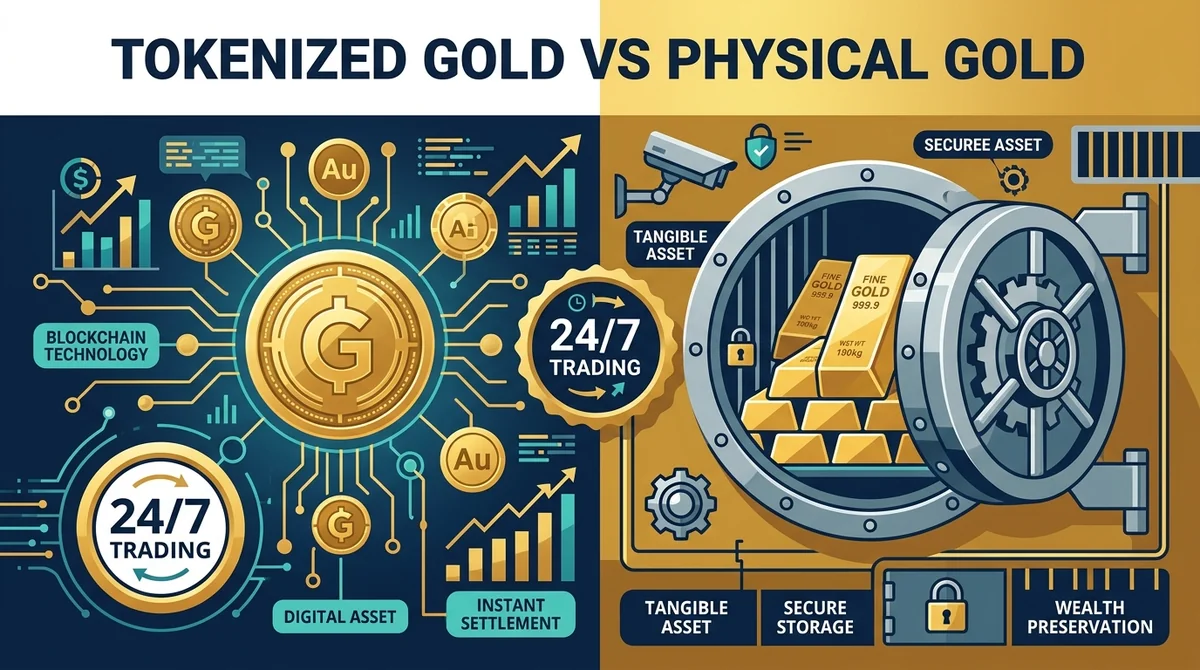
Objective comparison of tokenized and physical gold: holding costs, liquidity, redemption differences, and use cases to help investors choose.
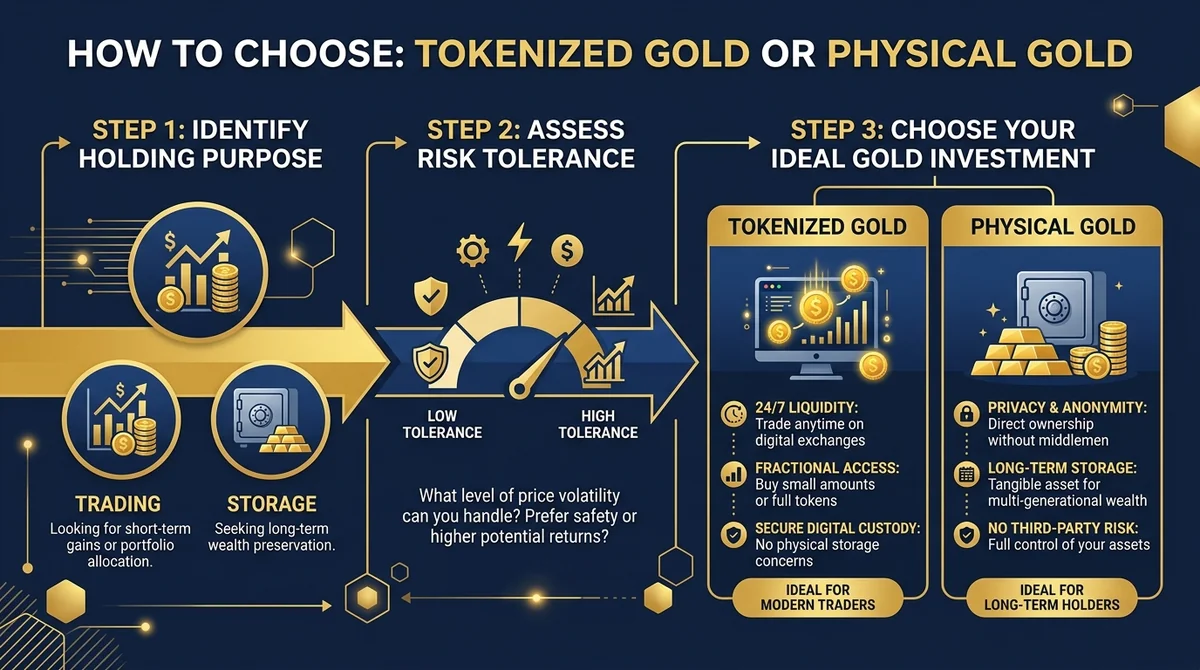
Conclusion: Generally speaking, tokenized gold is more suitable for traders seeking 24/7 liquidity, fractionalized holding, and low entry barriers; physical gold is more suitable for holders who value physical delivery, privacy, and long-term large-value storage. Before choosing, first clarify whether your holding purpose is trading or storage, and assess your own risk tolerance.
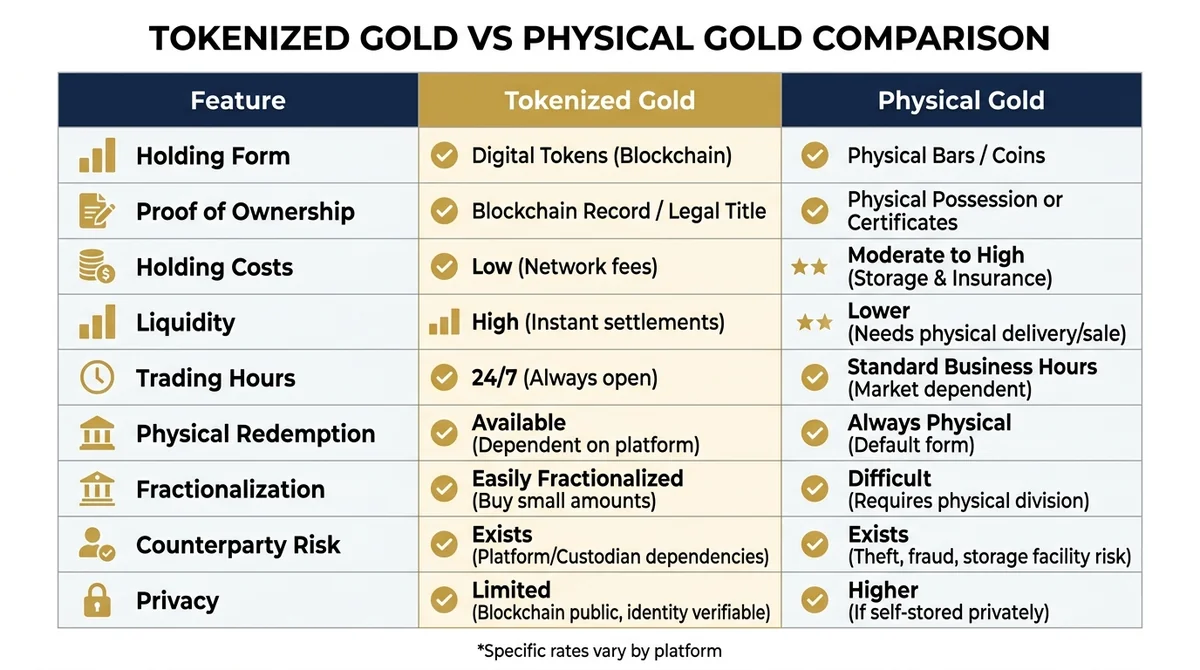
Comparison Table:
| Dimension | Tokenized Gold | Physical Gold |
|---|---|---|
| Holding form | Blockchain digital certificate | Physical bars/coins |
| Proof of ownership | On-chain certificate + issuer custody | Physical possession + purchase receipt |
| Holding costs | On-chain gas, platform management fees, minting/redemption fees (specific rates vary by platform and product) | Storage, insurance, and delivery fees (specific rates vary by custody method and institution) |
| Liquidity | Usually tradable 24/7 on-chain/on exchanges, supports fractionalization | Limited by business hours and physical delivery, slower to liquidate |
| Trading hours | Usually 24/7 | Exchange business hours |
| Redemption for physical | Via issuer-designated process, may have minimum amounts and fees | Directly holds physical, no redemption issue |
| Fractionalization | Supports small fractional holdings | Typically whole bars/coins, hard to fractionalize |
| Counterparty risk | Issuer default, smart contract, custody risk | Theft, damage, storage cost risk |
| Privacy | On-chain records may be public | Physical holding can be anonymous |
| Use cases | Short-term trading, small allocation | Long-term storage, large holdings, physical demand |
Detailed Comparison:
Holding form: Tokenized gold is a digital certificate on the blockchain representing fractional ownership of the underlying physical gold, but users typically do not directly hold gold bars; physical gold means directly holding bars or coins, with ownership determined by the physical item itself and how it is stored.
Proof of ownership: Tokenized gold relies on on-chain certificates and issuer custody audits; physical gold relies on physical possession and purchase receipts, requiring self-custody or professional storage.
Holding costs: Physical gold typically incurs storage, insurance, and physical delivery fees, while tokenized gold incurs blockchain gas fees, platform management fees, and possible minting/redemption fees. Specific rates vary by platform, custody method, and product; no uniform standard is provided here, so please verify them yourself.
Liquidity: Tokenized gold can usually be traded 24/7 on-chain or on exchanges, supports fractionalization, and liquidity depends on platform trading depth; physical gold liquidation is limited by trading venue business hours and physical delivery, making it slower, but liquidity can be improved through alternatives such as gold ETFs.
Trading hours: Tokenized gold is not restricted by traditional market trading hours; physical gold must be bought and sold during the business hours of the trading venue.
Redemption for physical: Redeeming tokenized gold for physical usually requires going through an issuer-designated process, which may have minimum redemption amounts and fees; specific conditions are subject to the issuance terms. Physical gold has no redemption issue, but you need to arrange storage or delivery yourself.
Fractionalization: Tokenized gold supports small fractional holdings, lowering the barrier; physical gold is usually traded as whole bars or coins, making it hard to divide, but small bars and coins can provide smaller units.
Counterparty risk: Tokenized gold carries issuer default, smart contract, and custody risks; physical gold carries risks of theft, damage, and storage costs.
Privacy: On-chain records of tokenized gold may be public, and privacy depends on platform design (such as privacy chains or mixers); physical gold can remain anonymous under private custody, but large purchases usually require identity verification.
Use cases: Tokenized gold is more suitable for trading and fractional allocation, while physical gold is more suitable for long-term storage and physical delivery needs. However, products such as gold ETFs can provide a middle option and should be included in the comparison.
Scenario Recommendations:
- Generally speaking, if you are a short-term trader who needs a 24/7 market and high liquidity, tokenized gold is more suitable.
- Generally speaking, if you are a long-term holder who values physical delivery and privacy, physical gold is safer.
- If you are a small investor who wants fractional gold holdings, tokenized gold has a lower barrier.
- If you are a high-net-worth user who requires large physical storage and anonymity, physical gold fits your needs better, but you need to consider custody costs.
- If you are concerned about counterparty risk, evaluate the issuer and custody arrangements of the tokenized platform; if you cannot accept them, choose physical gold or a gold ETF.
FAQ:
Does tokenized gold mean holding gold itself?: Tokenized gold is a digital certificate on the blockchain representing fractional ownership of the underlying physical gold, but users typically do not directly hold gold bars; what you actually hold is the certificate, not the gold itself.
What are the storage and insurance costs for physical gold?: Physical gold typically incurs storage, insurance, and physical delivery fees. Specific rates depend on the custody method (such as bank safe deposit boxes or professional vaults) and institution; no uniform standard is provided here.
Can tokenized gold be traded 24/7?: It can usually be traded 24/7 on-chain or on exchanges, supports fractionalization, but liquidity depends on platform trading depth, and not all platforms provide the same liquidity.
How can tokenized gold be redeemed for physical gold?: Redemption usually requires going through an issuer-designated process, which may have minimum redemption amounts and fees; specific conditions are subject to the issuance terms. Redemption policies vary significantly across platforms.
Who is more suitable for tokenized gold?: It suits users who want small, high-frequency, or fractional gold holdings, but they must accept platform counterparty risk and the operational threshold of on-chain operations.
Disclaimer: This content is compiled based on public information and general knowledge and does not constitute investment or account opening advice. Specific rates and terms are subject to the latest announcements of the issuer; readers should verify them independently.
FAQ
Does tokenized gold mean holding gold itself?
Tokenized gold is a digital certificate on the blockchain representing fractional ownership of the underlying physical gold, but users typically do not directly hold gold bars; what you actually hold is the certificate, not the gold itself.
What are the storage and insurance costs for physical gold?
Physical gold typically incurs storage, insurance, and physical delivery fees. Specific rates depend on the custody method (such as bank safe deposit boxes or professional vaults) and institution; no uniform standard is provided here.
Can tokenized gold be traded 24/7?
It can usually be traded 24/7 on-chain or on exchanges, supports fractionalization, but liquidity depends on platform trading depth, and not all platforms provide the same liquidity.
How can tokenized gold be redeemed for physical gold?
Redemption usually requires going through an issuer-designated process, which may have minimum redemption amounts and fees; specific conditions are subject to the issuance terms. Redemption policies vary significantly across platforms.
Who is more suitable for tokenized gold?
It suits users who want small, high-frequency, or fractional gold holdings, but they must accept platform counterparty risk and the operational threshold of on-chain operations.
Related Terms
Done comparing? Ready to place your first trade?
The crypto assets, tokenized US stocks and ETFs you just compared are all tradable on MSX — spot or perpetuals.
Quick Start Trading →New here? Registration takes three quick steps.