Tokenized Gold vs. Tokenized Treasuries 2026: Liquidity Risk and Redemption Mechanism Comparison
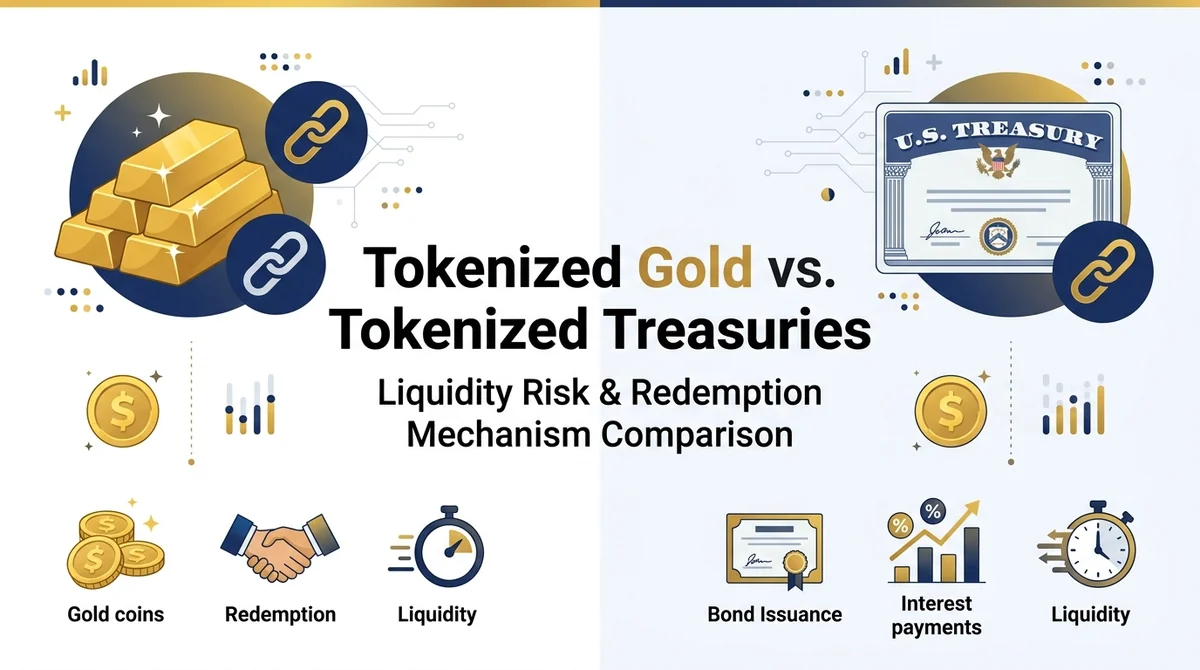
Tokenized gold anchors to spot gold prices for inflation hedging; tokenized Treasuries anchor to U.S. Treasury cash flows for stable coupons. Compare underlying assets, liquidity risk, redemption, and use cases. Not investment advice.
#Answer Summary
Conclusion: The core difference between tokenized gold and tokenized Treasuries lies in the underlying assets and return logic: the former anchors to spot gold prices, focusing on inflation hedging; the latter anchors to U.S. Treasury cash flows, offering relatively stable coupon income. In terms of liquidity risk, tokenized gold depends more on on-chain trading depth and the spot gold market, while tokenized Treasuries are more constrained by Treasury market liquidity and redemption policies. There is no absolute superiority, only matching needs. Different product structures vary significantly; the following is a general comparison, subject to product documentation.
#Comparison Table
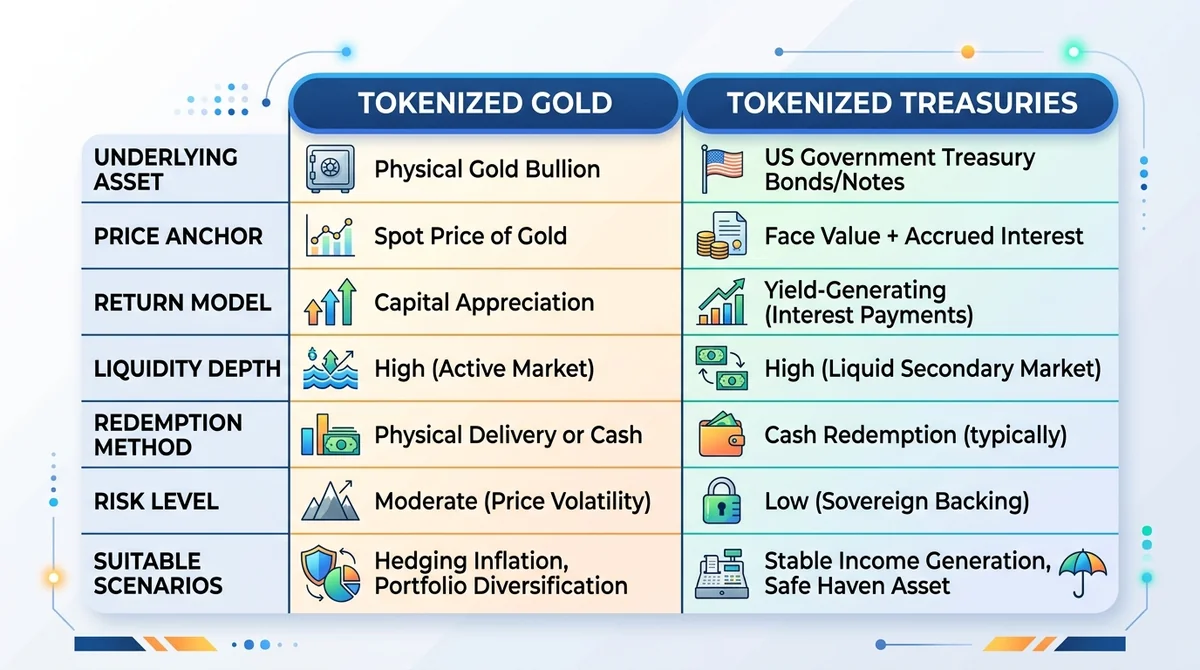
| Dimension | Tokenized Gold | Tokenized Treasuries |
|---|---|---|
| Underlying Asset | Gold spot | U.S. Treasury securities |
| Price Anchor | Spot gold price | U.S. Treasury cash flow |
| Return Model | Inflation hedge, price appreciation potential (historical correlation, not guaranteed) | Fixed coupon income (may vary after fees) |
| Liquidity Depth | Varies by product; depends on on-chain trading depth and spot gold market, specific data requires order book | Varies by product; depends on Treasury market liquidity and redemption policy, specific data requires order book |
| Redemption Method | Physical redemption or cash settlement; physical redemption has higher threshold and costs; mostly cash settlement | Primarily cash settlement, may be subject to lock-up period or underlying asset liquidity constraints |
| Redemption Time | Varies by product, refer to product documentation | Varies by product, refer to product documentation |
| Fee Structure | Varies by product, refer to product documentation | Varies by product, refer to product documentation |
| Regulatory Jurisdiction | Varies by product, refer to issuer | Varies by product, refer to issuer |
| Risk Level | Primarily price volatility risk, non-sovereign asset, plus custody/contract risk | Primarily issuer credit risk and interest rate risk, plus redemption run risk |
| Suitable Scenarios | Inflation hedge, long-term holding, non-sovereign asset allocation | Short-term liquidity management, stable cash flow, conservative allocation |
#Dimension Details
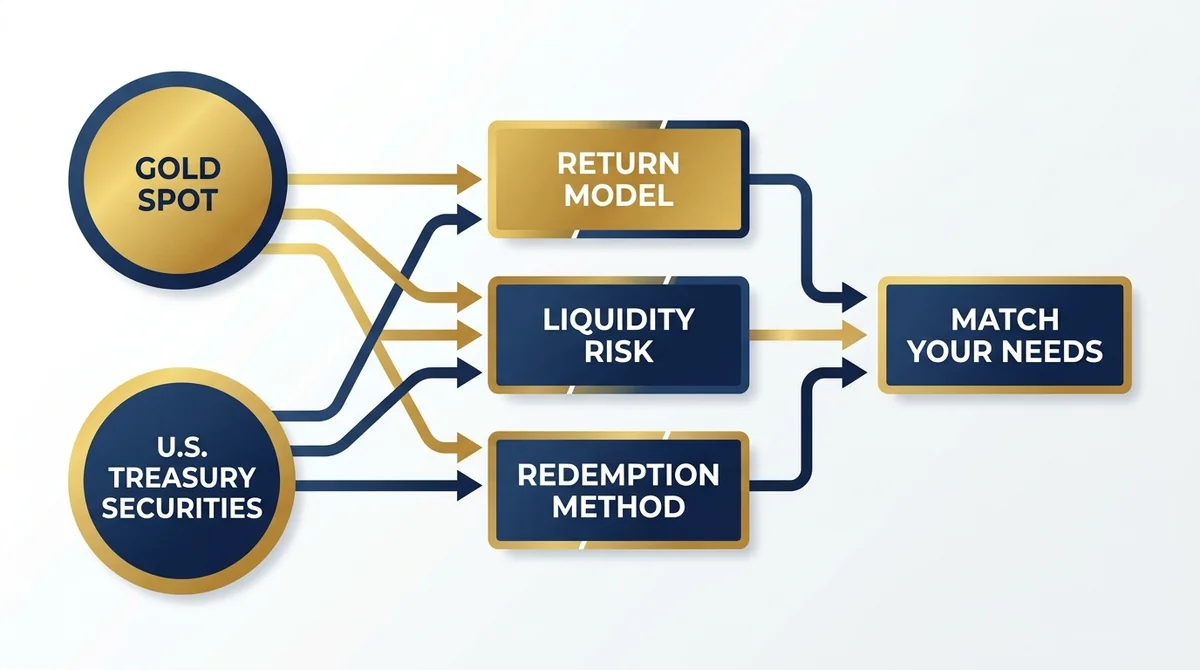
Underlying Asset: The underlying asset of tokenized gold is spot gold; the underlying asset of tokenized Treasuries is U.S. Treasury securities. Neither is the physical asset itself, but an on-chain price exposure or cash flow exposure. Whether the underlying asset is directly held or synthetic exposure requires checking the product structure.
Price Anchor: Tokenized gold anchors to spot gold prices; tokenized Treasuries anchor to the future cash flows of U.S. Treasury securities. The former's price fluctuates with gold prices, while the latter's returns come from coupon payments and principal repayment.
Return Model: Tokenized gold's returns come from price movements; historically gold has sometimes been viewed as an inflation hedge, but this is not guaranteed. Tokenized Treasuries offer relatively fixed coupon income, but management fees, on-chain costs, and early redemption penalties may affect net returns.
Liquidity Depth: Tokenized gold liquidity depends on market-making depth for on-chain trading pairs and the spot gold market; tokenized Treasuries liquidity is affected by both secondary-market Treasury liquidity and product redemption policy. For specific depth data, check each platform's order book and market maker commitments; this article does not provide specific platform data.
Redemption Method: Tokenized gold generally supports cash settlement, and some products offer physical redemption but with higher thresholds and costs. Tokenized Treasuries primarily use cash settlement, but may have lock-up periods or be constrained by underlying asset liquidity. Redemption time and fees vary by product and should be based on product documentation.
Fee Structure: The fee structures (management fees, redemption fees, on-chain gas, etc.) of both product types vary by product and should be based on specific product documentation.
Regulatory Jurisdiction: The issuer and applicable regulatory jurisdiction vary by product; review the issuer's registration location and compliance licenses.
Risk Level: Tokenized gold mainly carries gold price volatility risk and on-chain/custody risk; tokenized Treasuries mainly carry issuer credit risk, interest rate risk, and redemption run risk. Neither is principal-protected.
#Scenario Recommendations
When to Choose Tokenized Gold: If you are primarily concerned about fiat currency purchasing power erosion, want to hold assets unrelated to sovereign credit, and can tolerate price volatility, you should prioritize verifying physical redemption terms, on-chain liquidity, and custodian qualifications of tokenized gold products.
When to Choose Tokenized Treasuries: If you need relatively predictable cash flows, have a lower risk appetite, and primarily use funds for short-term liquidity management, you should prioritize verifying the underlying Treasury composition, lock-up periods, redemption fees, and issuer credit history of tokenized Treasuries.
#FAQ
Q: Does tokenized gold support physical delivery? A: Some products support physical redemption, but with higher thresholds and costs; most scenarios use cash settlement. Specific terms are subject to product documentation.
Q: What are the restrictions on redeeming tokenized Treasuries before maturity? A: Typically cash settlement is primary, may have lock-up periods or be constrained by underlying asset liquidity. Redemption time and fees need to be confirmed per product.
Q: Where does the liquidity risk of the two mainly come from? A: Liquidity risk of tokenized gold comes from on-chain trading depth and the spot gold market; liquidity risk of tokenized Treasuries comes from Treasury market liquidity and redemption policy. Market maker mechanisms and trading pair depth are key variables.
Q: Which metric should ordinary people look at first? A: First look at underlying assets, redemption method, and fee structure, then liquidity depth and issuer credit. Do not assume risk is controllable when data is missing.
Q: Are these products principal-protected? A: No. Both face price volatility, issuer credit, custody, and smart contract risks.
#Disclaimer
This content is compiled from public data and does not constitute investment or account opening advice. Data as of 2026-09-08, actual conditions may change. It is recommended to verify official product documentation and regulatory information.
FAQ
Does tokenized gold support physical delivery?
Some products support physical redemption, but with higher thresholds and costs; most scenarios use cash settlement. Specific terms are subject to product documentation.
What are the restrictions on redeeming tokenized Treasuries before maturity?
Typically cash settlement is primary, may have lock-up periods or be constrained by underlying asset liquidity. Redemption time and fees need to be confirmed per product.
Where does the liquidity risk of the two mainly come from?
Liquidity risk of tokenized gold comes from on-chain trading depth and the spot gold market; liquidity risk of tokenized Treasuries comes from Treasury market liquidity and redemption policy. Market maker mechanisms and trading pair depth are key variables.
Which metric should ordinary people look at first?
First look at underlying assets, redemption method, and fee structure, then liquidity depth and issuer credit. Do not assume risk is controllable when data is missing.
Are these products principal-protected?
No. Both face price volatility, issuer credit, custody, and smart contract risks.
Done comparing? Ready to place your first trade?
The crypto assets, tokenized US stocks and ETFs you just compared are all tradable on MSX — spot or perpetuals.
Quick Start Trading →New here? Registration takes three quick steps.