Tokenized Gold vs Tokenized U.S. Treasuries 2026: Yield, Liquidity, and Hedging Cost Comparison
Compare tokenized gold and tokenized U.S. Treasuries: underlying assets, income, liquidity, hedging, and holding costs to match risk preferences.
#Tokenized Gold vs Tokenized U.S. Treasuries 2026: Yield, Liquidity, and Hedging Cost Comparison
Conclusion: In most market environments, investors seeking stable cash flow may be better suited to tokenized U.S. Treasuries, while those prioritizing hedging against systemic risk and inflation may be better suited to tokenized gold. The two are not mutually exclusive; the specific choice should be combined with personal risk tolerance and portfolio objectives.
#Comparison Table
| Dimension | Tokenized Gold | Tokenized U.S. Treasuries |
|---|---|---|
| Underlying asset | Usually backed by physical gold, depending on the issuer | Usually backed by U.S. Treasury bonds, depending on the issuer |
| Yield source | Mainly from gold price fluctuations; some products may offer staking yield | Mainly from fixed interest on U.S. Treasury bonds |
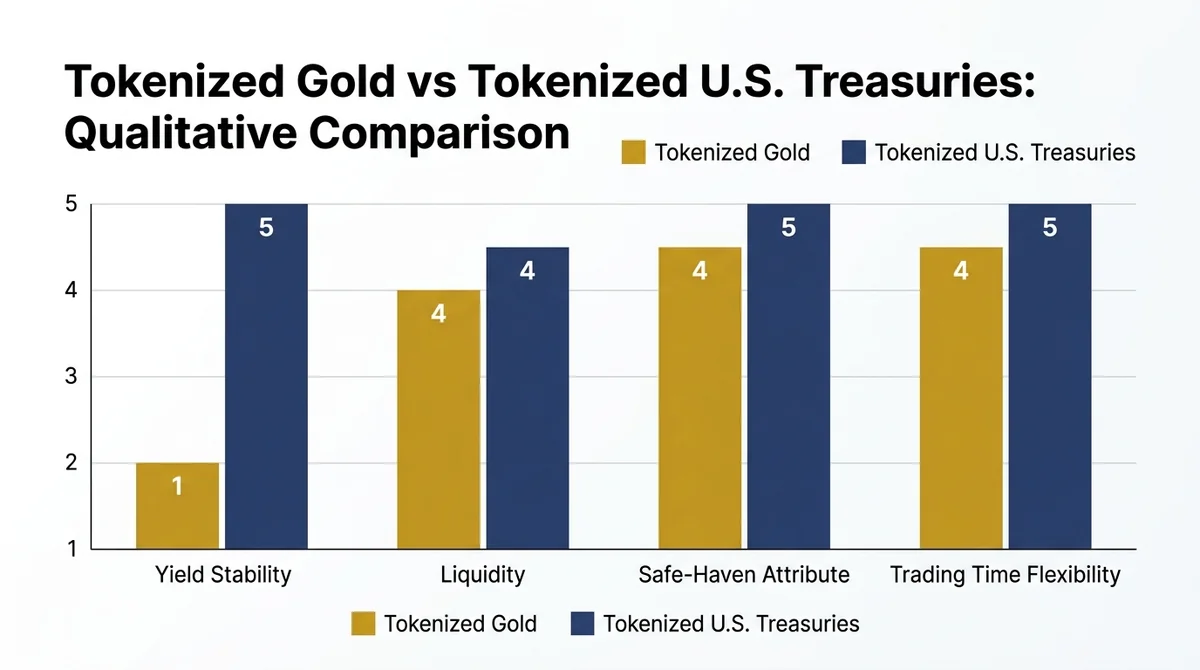
| Yield stability | Lower, heavily affected by market conditions | Higher, but affected by interest rate environment |
| Liquidity | Varies depending on listing platforms and on-chain pool depth; generally tradable on multiple crypto platforms | May be affected by bond market trading hours, accredited investor restrictions, and compliance requirements |
| Trading time restrictions | Fewer restrictions for on-chain trading | May be affected by underlying bond market trading hours |
| On-chain liquidity pools | Varies by product; no unified public data | Varies by product; no unified public data |
| Safe-haven attribute | Gold traditionally has safe-haven attributes, but tokenized form may be affected by crypto market volatility | Low-risk fixed income; performance under extreme risk depends on interest rate and credit environment |
| Holding cost | Varies by issuer and custody method; no unified public data | Varies by issuer and custody method; no unified public data |
| Redemption mechanism | Usually backed by physical gold, but specific terms (physical delivery/cash settlement/minimum redemption amount) vary by issuer | Usually backed by U.S. Treasury bonds; specific terms vary by issuer |
#Detailed Dimensions
Underlying asset: Generally, tokenized gold is backed by physical gold, and tokenized U.S. Treasuries are backed by U.S. Treasury bonds. However, the pegging mechanisms of specific products may differ; investors should verify the issuer's proof of reserves and custody arrangements.
Yield source: In typical cases, the yield from tokenized U.S. Treasuries mainly comes from fixed interest on U.S. Treasury bonds, and the yield from tokenized gold mainly comes from gold price fluctuations. Some tokenized gold products may provide additional yield through staking, but this is not a universal feature.
Yield stability: The fixed interest of tokenized U.S. Treasuries makes their yield stability relatively high, but they still face interest rate risk; the gold price fluctuations of tokenized gold lead to relatively low yield stability, and long-term holding may result in capital gains or losses.
Liquidity: The liquidity of tokenized gold depends on the exchanges it is listed on and on-chain pool depth, with significant differences among products; the liquidity of tokenized U.S. Treasuries may be affected by underlying bond market trading hours, accredited investor restrictions, and compliance requirements, and some products may have inactive secondary market trading.
Trading time restrictions: Because of their on-chain trading characteristics, tokenized gold can usually be traded 24/7 with fewer restrictions; tokenized U.S. Treasuries may be affected by underlying bond market trading hours and have certain restrictions.
On-chain liquidity pools: The on-chain liquidity pool depth of both asset classes varies by product and platform, and there is no unified public data for direct comparison.
Safe-haven attribute: Traditionally, gold is considered a safe-haven asset; tokenized gold may inherit some safe-haven attributes, but its on-chain price may be affected by overall crypto market volatility and deviate from physical gold. Tokenized U.S. Treasuries are more of a low-risk fixed income; in extreme risk-averse environments, their performance depends on interest rate movements and credit conditions, and they are not absolutely safe.
Holding cost: Holding costs include custody fees, on-chain transaction fees, redemption fees, etc. They vary specifically by issuer and custody method, and there is no unified public data for comparison.
Redemption mechanism: Redemption mechanisms are usually linked to the underlying asset, but specific terms (such as physical delivery, cash settlement, minimum redemption amount, redemption time) differ significantly by issuer; investors should carefully read the product terms.
#Scenario Recommendations
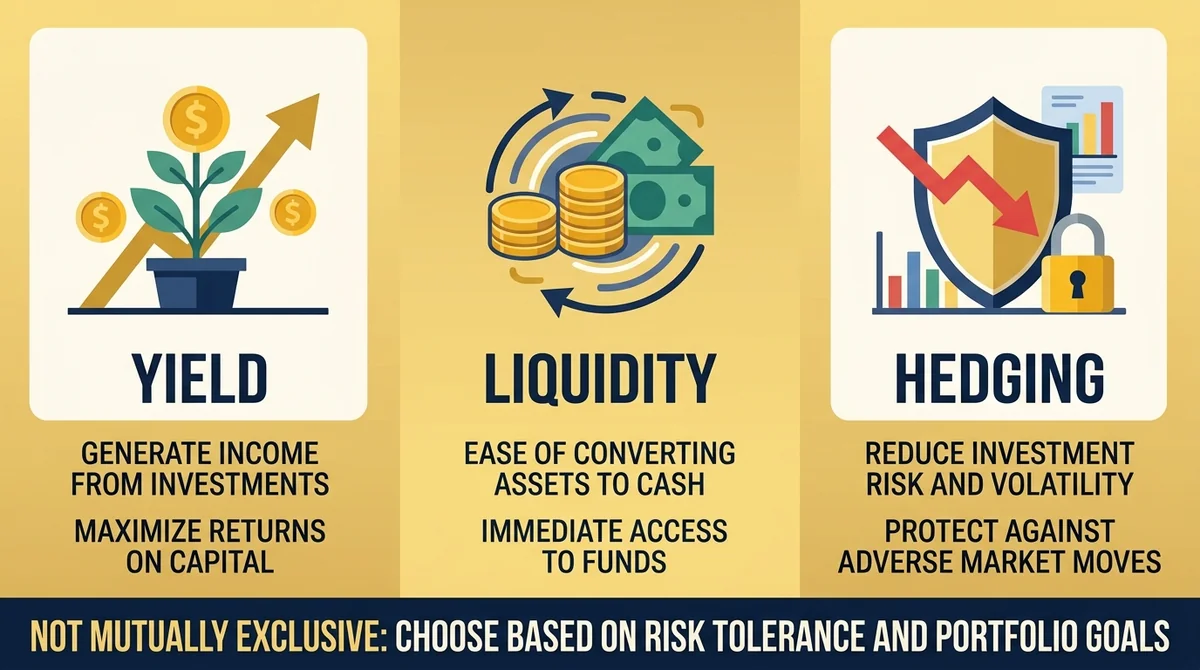
May be suitable for tokenized gold: Investors who want to hedge against inflation or systemic market risk; investors who can tolerate price fluctuations; investors who want to trade flexibly on multiple platforms and pay attention to underlying asset reserves.
May be suitable for tokenized U.S. Treasuries: Conservative investors seeking stable cash flow; investors who want to reduce portfolio volatility and allocate to fixed income; investors who can accept bond market trading hours and compliance restrictions and have verified the product's legal structure.
#FAQ
Which offers higher yield, tokenized gold or tokenized U.S. Treasuries?
It cannot be directly compared. Yield from tokenized U.S. Treasuries comes from fixed interest and is relatively stable; yield from tokenized gold comes from gold price fluctuations and may be higher or lower, depending on market conditions and product fees.
Is tokenized gold always more liquid than tokenized U.S. Treasuries?
Not necessarily. Tokenized gold is usually tradable on multiple platforms, but specific liquidity depends on each platform's depth; tokenized U.S. Treasuries are affected by bond market hours and compliance restrictions, and liquidity performance varies by platform and product.
Which should I prioritize for hedging?
If you are concerned about systemic risk, tokenized gold's safe-haven attributes may be stronger, but be aware of on-chain volatility risk; if you are only seeking low-risk fixed income, tokenized U.S. Treasuries may be more appropriate.
Can the two be allocated together?
Yes. Based on risk preference, conservative investors can overweight tokenized U.S. Treasuries, and hedging-oriented investors can overweight tokenized gold; combined allocation helps diversify risk.
Which has lower holding costs?
It varies by platform and product; no unified public data is available. Check the fee terms of specific issuers and custodians, including custody fees, transaction fees, redemption fees, etc.
#Disclaimer
This content is compiled from public information and does not constitute investment or account opening advice. Tokenized asset investments involve market risk, smart contract risk, custody risk, and regulatory risk. Investors should exercise independent judgment and assume their own risks. Data is as of the time of writing and may change; please refer to official sources for the latest information.
Related reading:
FAQ
Which offers higher yield, tokenized gold or tokenized U.S. Treasuries?
It cannot be directly compared. Yield from tokenized U.S. Treasuries comes from fixed interest and is relatively stable; yield from tokenized gold comes from gold price fluctuations and may be higher or lower, depending on market conditions and product fees.
Is tokenized gold always more liquid than tokenized U.S. Treasuries?
Not necessarily. Tokenized gold is usually tradable on multiple platforms, but specific liquidity depends on each platform's depth; tokenized U.S. Treasuries are affected by bond market hours and compliance restrictions, and liquidity performance varies by platform and product.
Which should I prioritize for hedging?
If you are concerned about systemic risk, tokenized gold's safe-haven attributes may be stronger, but be aware of on-chain volatility risk; if you are only seeking low-risk fixed income, tokenized U.S. Treasuries may be more appropriate.
Can the two be allocated together?
Yes. Based on risk preference, conservative investors can overweight tokenized U.S. Treasuries, and hedging-oriented investors can overweight tokenized gold; combined allocation helps diversify risk.
Which has lower holding costs?
It varies by platform and product; no unified public data is available. Check the fee terms of specific issuers and custodians, including custody fees, transaction fees, redemption fees, etc.
Related Terms
Done comparing? Ready to place your first trade?
The crypto assets, tokenized US stocks and ETFs you just compared are all tradable on MSX — spot or perpetuals.
Quick Start Trading →New here? Registration takes three quick steps.