Tokenized U.S. Stocks vs Real U.S. Stocks 2026: Spread, Slippage, and Settlement Time Comparison
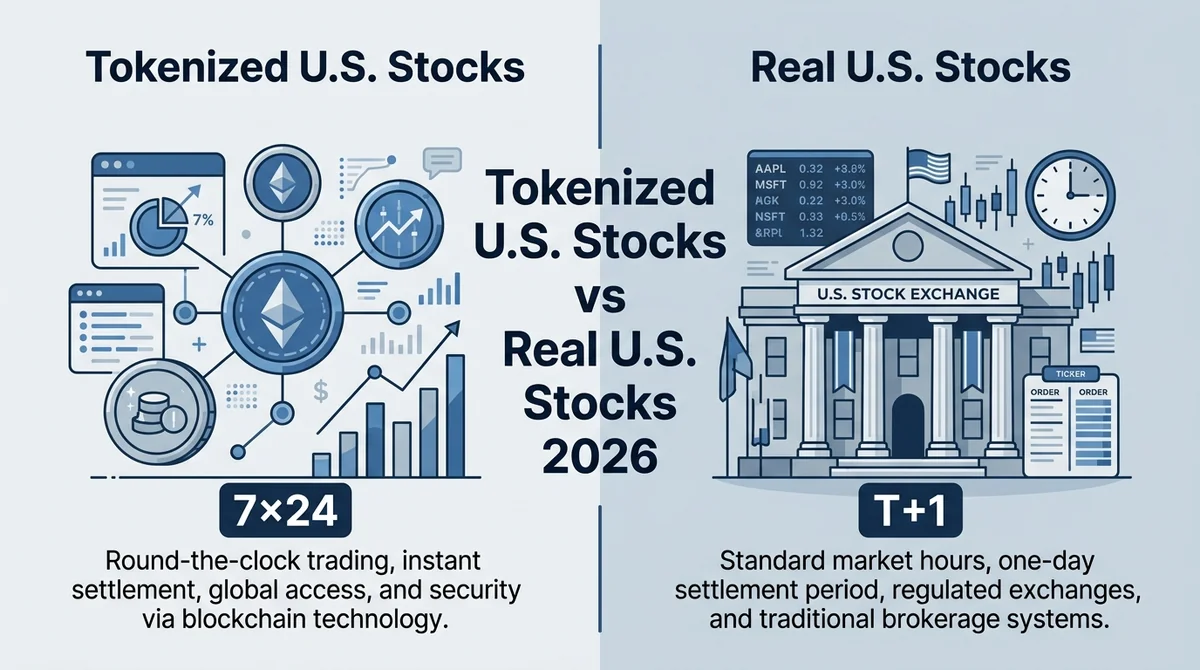
Tokenized vs real US stocks: spread, slippage, and settlement time compared. Asset form, trading hours, liquidity, settlement risk.
#Tokenized U.S. Stocks vs Real U.S. Stocks 2026: Spread, Slippage, and Settlement Time Comparison
Conclusion: The core difference between tokenized U.S. stocks and real U.S. stocks lies not in price, but in trading and settlement infrastructure. Tokenized stocks typically offer near-real-time on-chain settlement and longer trading hours, but spread, slippage, and settlement risk are highly dependent on the issuing platform. Real U.S. stocks are generally superior in liquidity and execution quality, but settlement involves multiple levels of clearing. If you pursue settlement speed and can tolerate platform risk, tokenized stocks are worth studying. If you care more about execution costs and regulatory protection, real U.S. stocks are a safer choice. This article is compiled from public information; please refer to official announcements for specific platform rules and data.
#Comparison Table
| Dimension | Tokenized U.S. Stocks | Real U.S. Stocks |
|---|---|---|
| Asset form | On-chain mapping representing the underlying asset but not necessarily granting shareholder rights | Traditional securities, typically with voting rights and dividends |
| Trading hours | Usually 7×24, but some platforms may differ | Limited by exchange hours, with limited after-hours trading |
| Spread | Affected by on-chain liquidity; data not publicly disclosed | Mainstream stocks usually have narrow spreads, but specific values vary by underlying |
| Slippage | Can be larger when liquidity is thin | Mainstream stocks have deeper order books, so slippage is usually smaller |
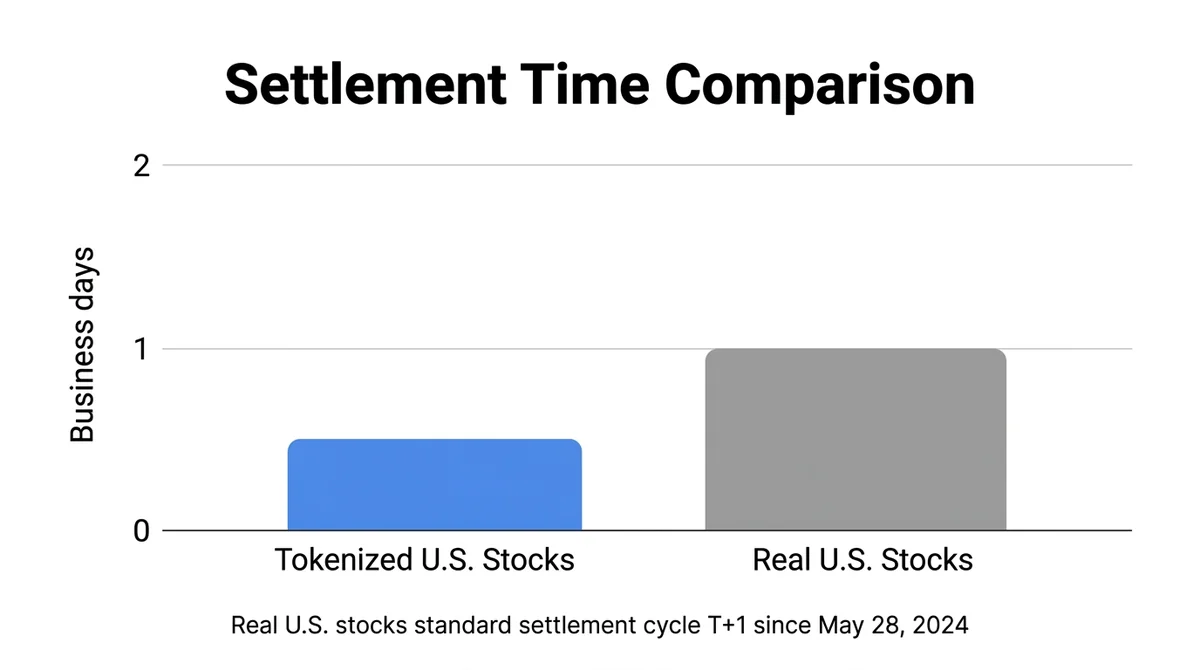
| Settlement time | Based on on-chain settlement, usually near real-time (specific speed depends on network confirmation requirements) | Requires clearing and custody; current standard settlement cycle is T+1 (since May 28, 2024) |
| Settlement risk | Smart contract vulnerabilities, opaque reserves, platform risk | Central counterparties and clearinghouses; lower risk but failure possible |
| Liquidity source | Depends on issuing platform and on-chain liquidity pools | Global exchanges, market makers, and institutional investors |
| Market infrastructure | Smart contracts, oracles, wallets | Exchanges, clearinghouses, custodians, regulators |
| Regulatory protection | Most platforms are in a regulatory gray area; some have sought compliance paths | Protected by securities regulation, with investor compensation mechanisms |
| Accessibility | Requires specific platforms and wallets; restricted in some regions | Widely accessible through brokers |
#Detailed Analysis
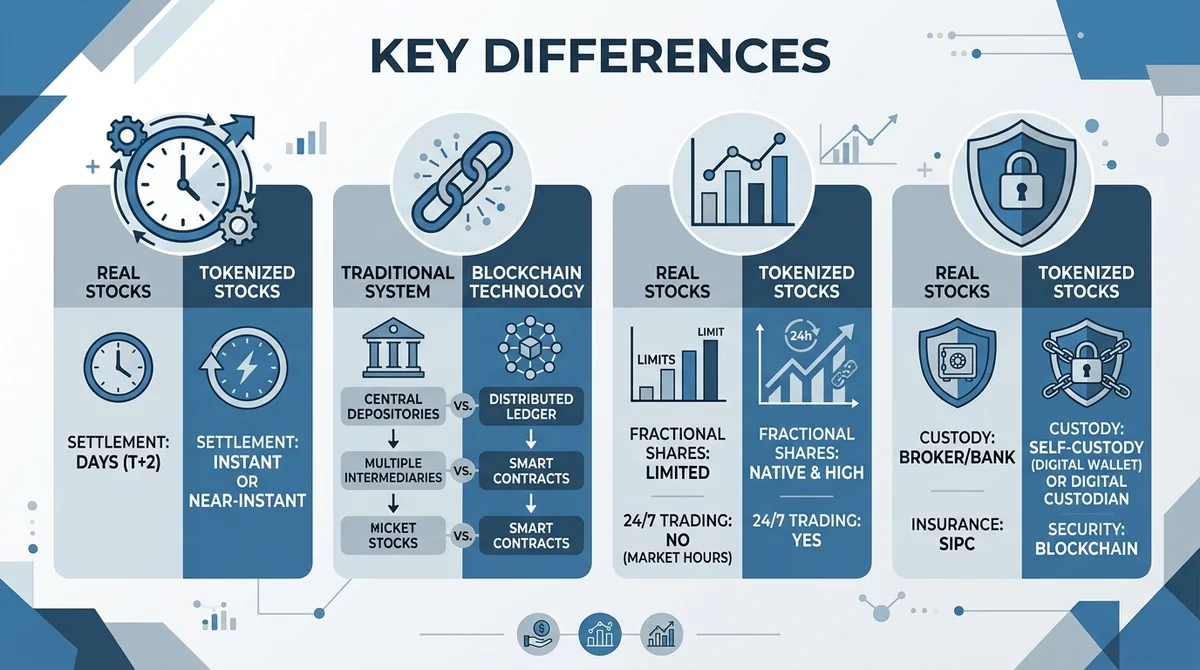
Asset form: Tokenized stocks map the underlying asset via blockchain, but holding the token does not necessarily equate to holding the real stock; shareholder rights may be held by the issuer. Real U.S. stocks provide direct securities ownership with clear shareholder identity.
Trading hours: Tokenized stocks typically trade 7×24, but note that different platforms may set maintenance or pause periods. Real U.S. stocks trade mainly during exchange opening hours, with limited pre-market and after-hours liquidity.
Spread: The spread of tokenized stocks is affected by the depth of on-chain liquidity pools; active underlyings may have narrower spreads, while less popular underlyings may widen significantly. For real U.S. stocks, mainstream stocks have multiple market makers, and spreads are usually measured in basis points, but there is no unified public data; specific values should be checked on exchanges or market data sources.
Slippage: Tokenized stocks may see significant slippage on large orders due to limited on-chain liquidity. Real U.S. large-cap stocks have deep order books, so slippage is relatively controllable. However, the specific slippage level depends on order size, underlying liquidity, and market conditions, and varies greatly across platforms.
Settlement time: Tokenized stocks complete transfer after on-chain confirmation, usually near real-time (actual speed depends on the blockchain network and confirmation requirements). Real U.S. stock settlement involves clearing, custody, and settlement institutions; the current standard settlement cycle is T+1 (since May 28, 2024), and usually takes longer.
Settlement risk: Tokenized stocks face smart contract vulnerabilities, opaque reserve assets, and platform operational risks. Real U.S. stock settlement is safeguarded by central counterparties and custodians, but there is still a technical possibility of settlement failure.
Liquidity source: Tokenized stocks rely on platform-specific liquidity pools and market-making bots. Real U.S. stock liquidity comes from global investors and market makers. Real U.S. stocks usually have higher liquidity, but some popular tokenized underlyings may have comparable liquidity on specific platforms.
Market infrastructure: Tokenized stocks rely on blockchain, oracles, and smart contracts. Real U.S. stocks rely on exchanges, clearinghouses, and custody networks.
Regulatory protection: Most tokenized stock issuance platforms may not be subject to strict securities regulation, with limited investor protection, though some have sought compliance paths and hold relevant licenses. Real U.S. stocks are regulated by the SEC and other bodies, with protections such as broker insurance.
Accessibility: Tokenized stocks require purchase through crypto platforms that support the asset and require an on-chain wallet. Real U.S. stocks can be traded by opening an account with a traditional broker.
#Scenario Recommendations
Suitable for tokenized stocks: You want to trade U.S. stocks at any time globally and need faster settlement; you accept self-custody wallet and smart contract risks; you mainly trade index-level liquid underlyings and act as your own market maker on small platforms.
Suitable for real U.S. stocks: You need full shareholder rights and regulatory protection; you trade large amounts and are sensitive to slippage; you prefer traditional broker processes and do not want to take on on-chain risk.
#FAQ
Are tokenized stock prices exactly the same as real U.S. stocks? In theory, tokenized stock prices are pegged to real U.S. stocks, but they may deviate due to liquidity, cross-chain premiums, or platform fees; actual price difference data is not publicly disclosed.
What are the settlement risks of tokenized stocks? They mainly include smart contract vulnerabilities, opaque reserve assets, platform exit scams, or compliance changes that make redemption impossible.
Is trading tokenized stocks protected by U.S. securities regulation? Most tokenized stock issuance platforms are outside the U.S. securities regulatory framework, so investor protection is limited. Check the platform's legal statement for its specific compliance status.
How large is the slippage difference for large orders between tokenized stocks and real U.S. stocks? Because on-chain liquidity is usually thinner for tokenized stocks, large orders may have significantly higher slippage than for mainstream real U.S. stocks, but specific values vary by platform and are not publicly disclosed.
For specific platform rules and official data, please refer to the issuer's or exchange's official announcements.
This content is compiled from public data and does not constitute investment or account opening advice. Data as of 2026-08-30; actual conditions may change.
FAQ
Are tokenized stock prices exactly the same as real U.S. stocks?
In theory, tokenized stock prices are pegged to real U.S. stocks, but they may deviate due to liquidity, cross-chain premiums, or platform fees; actual price difference data is not publicly disclosed.
What are the settlement risks of tokenized stocks?
They mainly include smart contract vulnerabilities, opaque reserve assets, platform exit scams, or compliance changes that make redemption impossible.
Is trading tokenized stocks protected by U.S. securities regulation?
Most tokenized stock issuance platforms are outside the U.S. securities regulatory framework, so investor protection is limited. Check the platform's legal statement for its specific compliance status.
How large is the slippage difference for large orders between tokenized stocks and real U.S. stocks?
Because on-chain liquidity is usually thinner for tokenized stocks, large orders may have significantly higher slippage than for mainstream real U.S. stocks, but specific values vary by platform and are not publicly disclosed.
Related Terms
Done comparing? Ready to place your first trade?
The crypto assets, tokenized US stocks and ETFs you just compared are all tradable on MSX — spot or perpetuals.
Quick Start Trading →New here? Registration takes three quick steps.