Tokenized US Stocks vs. Direct US Stocks: Dividend Withholding Tax (WHT) and On-Chain Settlement Compared (2026)
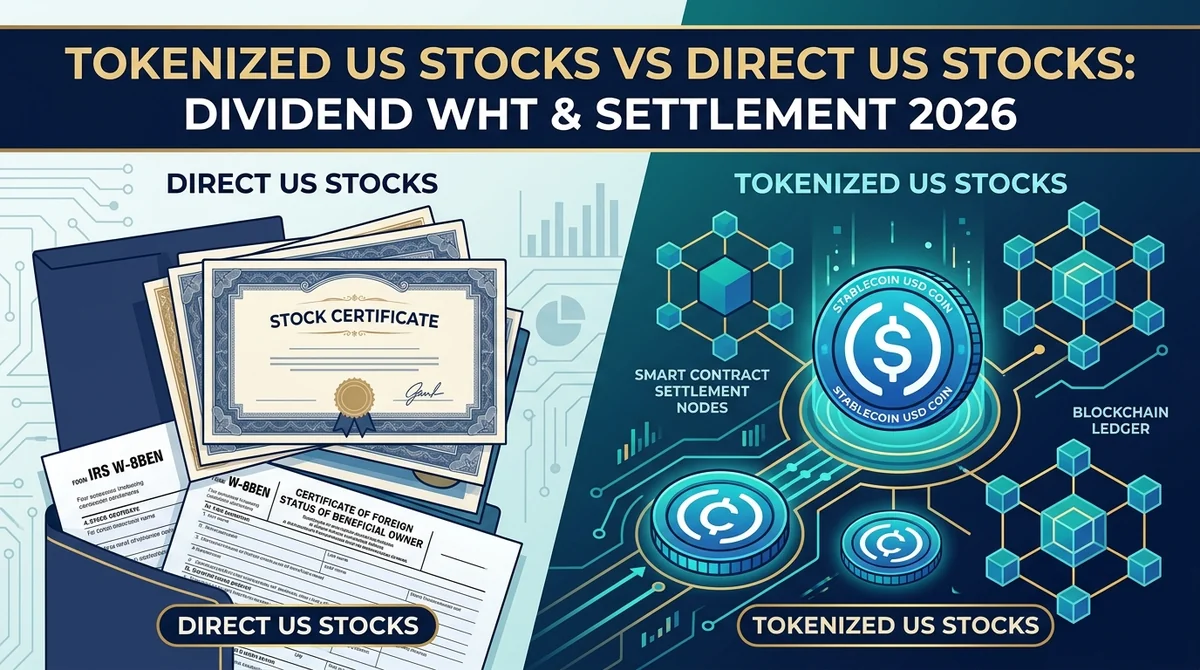
Compare direct US stock ownership and tokenized stocks on dividend withholding tax (WHT), on-chain settlement, asset rights, and tax certificates.
In dividend distribution scenarios, buying direct US stocks is ideal for traditional investors seeking legal ownership, compliant tax deduction certificates, and statutory investor protections; tokenized US stocks cater to Web3 investors holding on-chain stablecoins who prioritize 24/7 liquidity and automated settlement. For a systematic evaluation of access routes, refer to Tokenized US Stocks vs Real US Stocks: Shortest Entry Route in 2026 (MSX Compare Screening Method).
#What Is the Core Difference in Dividend Mechanisms Between Direct US Stocks and Tokenized Stocks?
Directly holding US stocks grants statutory dividend rights from publicly traded companies. In contrast, tokenized US stocks provide price exposure where the dividend distribution mechanism is an on-chain cash flow mapping agreed upon by the token issuer—not a statutory shareholder dividend regulated by the SEC. For more details on handling corporate actions, see Direct Stock Ownership vs Tokenized Stocks: Corporate Actions & Dividend Reinvestment 2026.
#Are the Legal Characteristics of Real Stock Dividends and Tokenized Asset Dividends the Same?
Legal Status: Completely different. When purchasing US stocks directly, investors are registered on the broker's ledger or a central depository (such as DTC), possessing legal shareholder status and entitled to profit distributions under corporate bylaws approved by the board of directors. Tokenized US stocks fall under Real World Asset (RWA) tokenization or derivative contracts; investors hold on-chain receipts issued by the token issuer. Their "dividends" represent contractual rights between the issuer and holder—essentially passing through economic benefits based on underlying stock prices and payouts.
#Are Tokenized Stock Payouts Real Dividends or Price Compensations?
Nature of Distribution: Spot US stock dividends are the "cause," while tokenized payout settlement is the "effect." In tokenized asset structures, payouts generally take two forms:
- Cash Flow Mapping Distribution: After the underlying custodian receives the US stock dividend, it deducts relevant taxes and routing fees, distributing the equivalent net amount in stablecoins (e.g., USDC/USDT) to holding addresses pro rata.
- NAV Adjustment / Price Compensation: Some protocols use smart contracts to accumulate the ex-dividend net amount directly into the token's Net Asset Value (NAV), or adjust the index benchmark price in derivative contracts. To understand structural differences between spot and derivative exposures, read Direct Stock Ownership vs Tokenized Stocks: Ownership, Taxation & Platform Risk 2026.
#How Is US Dividend Withholding Tax (WHT) Handled in Both Models?
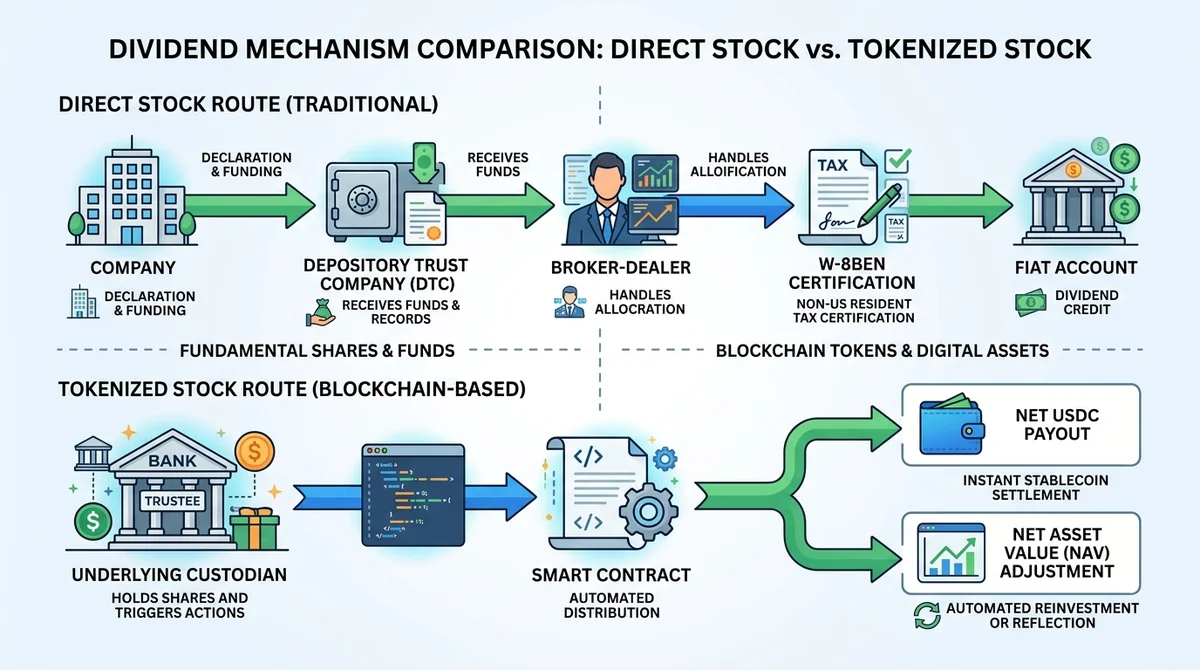
Traditional US brokerages withhold Dividend Withholding Tax (WHT) directly upon distribution based on Form W-8BEN, whereas tokenized US stocks are typically taxed at the underlying custodian level before distributing the net amount in stablecoins or settling on-chain via net NAV adjustments.
#What Is the Standard W-8BEN Dividend Withholding Tax Process at Traditional Brokers?
WHT Process: Non-US tax residents trading US stocks via compliant brokers must complete Form W-8BEN in advance. The Internal Revenue Service (IRS) imposes a standard 30% Withholding Tax (WHT) on dividends paid to non-resident aliens. If the investor's home country/region maintains a bilateral tax treaty with the US (qualifying for reduced treaty rates such as 10% or 15%), the broker automatically withholds tax at the treaty rate on the payable date. The net amount is credited to the fiat account, and official tax documents (like Form 1042-S) are provided at year-end for local tax reporting and credits.
#How Do On-Chain Tokenized US Stocks Handle the 30% WHT or Tax Pass-Through?
On-Chain Tax Pass-Through: Tokenized US stock issuers establish offshore Special Purpose Vehicles (SPVs) or trusts to hold spot US shares off-chain. Because the trust or issuing entity receives dividends directly off-chain, US custodians generally withhold the standard 30% WHT upfront. The issuer then converts the remaining 70% net proceeds into stablecoins to distribute to token holders.
Absence of Tax Certificates: Under this model, individual on-chain holders generally cannot look through the underlying entity to claim bilateral tax treaty benefits, nor can they obtain official IRS tax certificates issued in their own names. This creates compliance friction for high-net-worth investors requiring formal tax offsets.
#Core Comparison: Direct US Stocks vs. Tokenized US Stocks
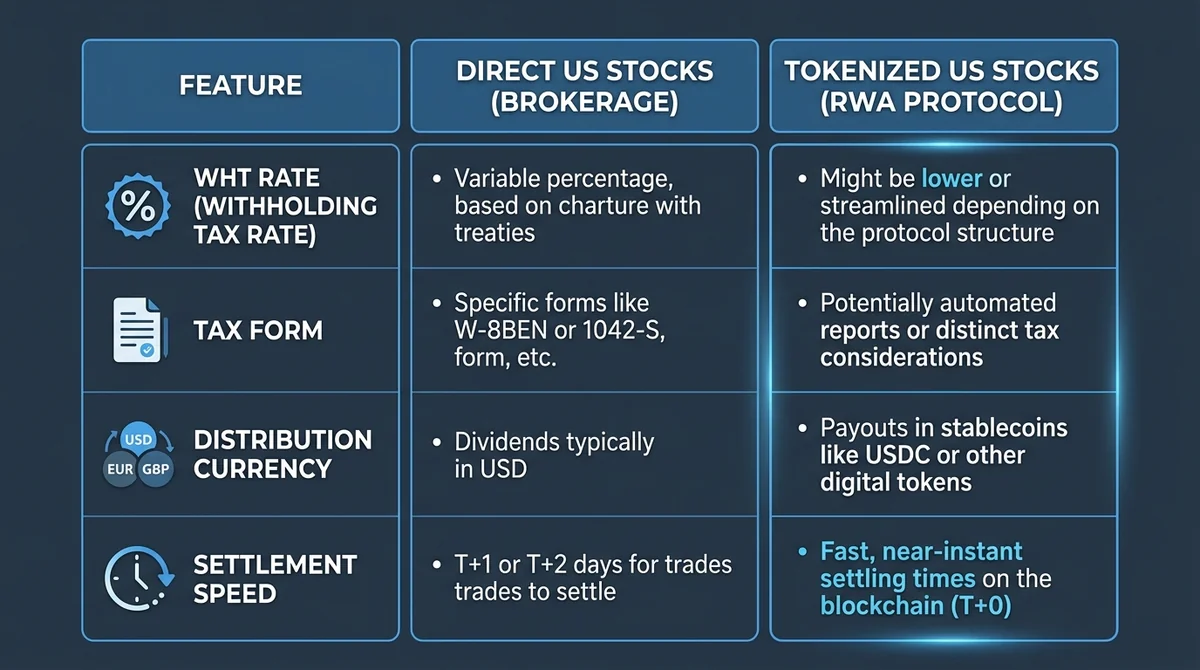
| Comparison Dimension | Direct US Stocks (Traditional Broker) | Tokenized US Stocks (On-Chain Assets) |
|---|---|---|
| Asset Legal Nature | Registered statutory shareholder ownership | Issuer contractual claim / price exposure |
| Dividend Form | Direct fiat deposit (USD, etc.) | Stablecoins (USDC/USDT) or token NAV adjustment |
| WHT Withholding | Broker automatically withholds via W-8BEN (10%–30%) | Underlying entity deducts standard 30% before net distribution |
| Tax Documentation | Official forms provided (1042-S / 1099) | On-chain transaction records and tx hashes only |
| Settlement Cycle | T+1 to T+3 bank/brokerage clearing | Smart contract triggered, instant or daily batch settlement |
| Custody & Counterparty | Regulated clearinghouse (DTC) & licensed brokers | Smart contract + Issuer offshore trust/SPV |
| Entry Barrier | Full fiat KYC, bank wire review | Web3 wallet connection, light KYC on some platforms |
| Investor Protection | SIPC protection (up to $500,000 coverage) | Smart contract code & issuer credit backing |
#Settlement Timing, Asset Custody, and Smart Contract Risks
- Settlement & Timing: Traditional brokerage dividends pass through Ex-Dividend Date, Record Date, and Payable Date. Cross-border withdrawals after cash credits are often subject to banking clearing delays. Tokenized stocks, once settled off-chain, can automate micro-distributions on-chain via oracles and smart contracts, allowing funds to be reinvested immediately within DeFi ecosystems.
- Custody Systems: Traditional US stocks rely on strictly regulated central securities depository and clearing systems, where broker insolvency is covered by statutory investor protection schemes (e.g., SIPC). Tokenized stocks rely on Proof of Reserves (PoR) from issuers and the security of smart contract code.
#How Should Different Investors Choose in Dividend Scenarios?
- If you are a long-term dividend growth investor or large-capital allocator: Prioritize direct US stocks. Building positions via licensed brokers like IBKR or major compliant platforms allows you to benefit from reduced WHT rates under applicable tax treaties and provides valid tax receipts for domestic filing. For an in-depth review of trading barriers, refer to MSX Exchange vs. Traditional US Stock Brokers (IBKR) In-Depth Comparison 2026: Tokenized Stock Trading Thresholds, Deposits/Withdrawals, and Settlement Timelines.
- If you are a crypto-native holder or high-frequency cross-asset trader: Consider tokenized US stocks. When holding stablecoins and aiming to bypass cumbersome fiat wire procedures, tokenized equities provide convenient 24/7 position adjustments. When selecting a tokenized platform, evaluate its Proof of Reserves (PoR) and compliance background. For liquidity comparisons, see MSX vs Binance vs Gate Tokenized Stock Trading Comparison 2026: Fees, Liquidity & Compliance Differences.
- If you trade derivatives with high leverage: Clarify the differences between tokenized spot equities and contracts. For detailed cost breakdowns, see Tokenized Stock Contract vs Tokenized Stock Perpetual: Settlement, Dividend & Leverage Funding Cost Differences.
#What Are the Key Risks and Compliance Disclaimers for Tokenized Stock Dividends?
- Issuer Credit & Underlying De-pegging Risk: Token value relies on whether the issuer holds full collateral in real US spot shares. If the off-chain custodian faces bankruptcy, liquidation, frozen assets, or opaque disclosures, on-chain dividend payouts may halt or token prices may de-peg.
- Smart Contract & Oracle Vulnerabilities: On-chain dividend allocation is usually executed by smart contracts, while pricing and ex-dividend metrics depend on oracle feeds. Contract logic bugs or oracle price manipulation can lead to inaccurate payouts or protocol exploits.
- Cross-Border Tax & Legal Uncertainty: Tax authorities across jurisdictions have not unified the classification of crypto-based "mapped dividends." Investors may face double taxation or compliance risks where payouts are reclassified as capital gains or miscellaneous income.
This content is compiled from public data and does not constitute investment or account-opening advice. Data is current as of 2026-09-09; actual market conditions may vary.
FAQ
Can holders of tokenized US stocks enjoy reduced WHT rates under bilateral tax treaties?
Generally no. Tokenized US stocks are held collectively off-chain by the issuing entity, and US custodians typically withhold the standard 30% WHT upfront. Individual investors cannot look through the underlying entity to apply for treaty rates directly with the IRS.
Are dividends from tokenized US stocks distributed in USD fiat or cryptocurrency?
Most tokenized US stock platforms automatically distribute post-tax net proceeds in stablecoins (such as USDC or USDT) directly to holding wallet addresses, or accrue them into the token's Net Asset Value (NAV) via smart contracts.
Do tokenized US stock holders possess voting rights as shareholders of the public company?
No. Tokenized stock investors only hold price exposure and cash flow allocation rights as defined by smart contracts and issuance terms. Statutory shareholder voting rights remain with the off-chain custodian holding the underlying shares.
Related Terms
Done comparing? Ready to place your first trade?
The crypto assets, tokenized US stocks and ETFs you just compared are all tradable on MSX — spot or perpetuals.
Quick Start Trading →New here? Registration takes three quick steps.