Uniswap V3 LP Token vs Holding ETH: Which Yields More?
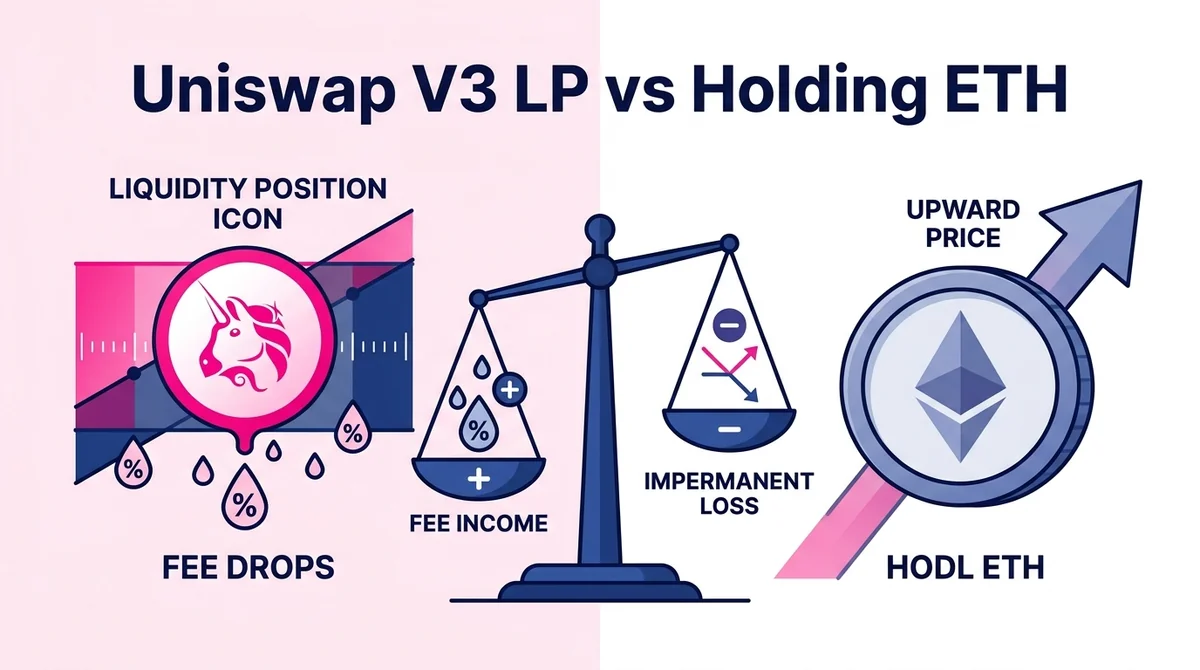
Compare Uniswap V3 LP tokens with holding ETH: fee income, impermanent loss, and range management costs, plus scenario-based choices and a checklist.
Conclusion: Neither option is absolutely higher-yielding. The upside of a Uniswap V3 LP position depends on pool trading volume, your share of liquidity, and your range management skill, while the return from simply holding ETH is determined entirely by ETH's price. If you cannot tolerate impermanent loss or are unwilling to adjust your price range regularly, holding ETH directly is the simpler path.
#What are Uniswap V3 LP tokens and holding ETH, respectively?
LP token: Represents your share of a Uniswap V3 liquidity pool and your right to claim that pool's trading fees pro rata. In V3, you must also set a price range for this capital, which is concentrated and locked within that range.
Holding ETH: Simply holding the asset itself. There is a single source of return, namely ETH price movements; there is no fee income and no impermanent loss.
Capital lock-up differences: LP capital is locked in the pool and tied to a price range, and exiting requires removing liquidity; ETH held directly can be transferred or used for other purposes at any time.
#How do the sources of return differ between Uniswap V3 LP and holding ETH?
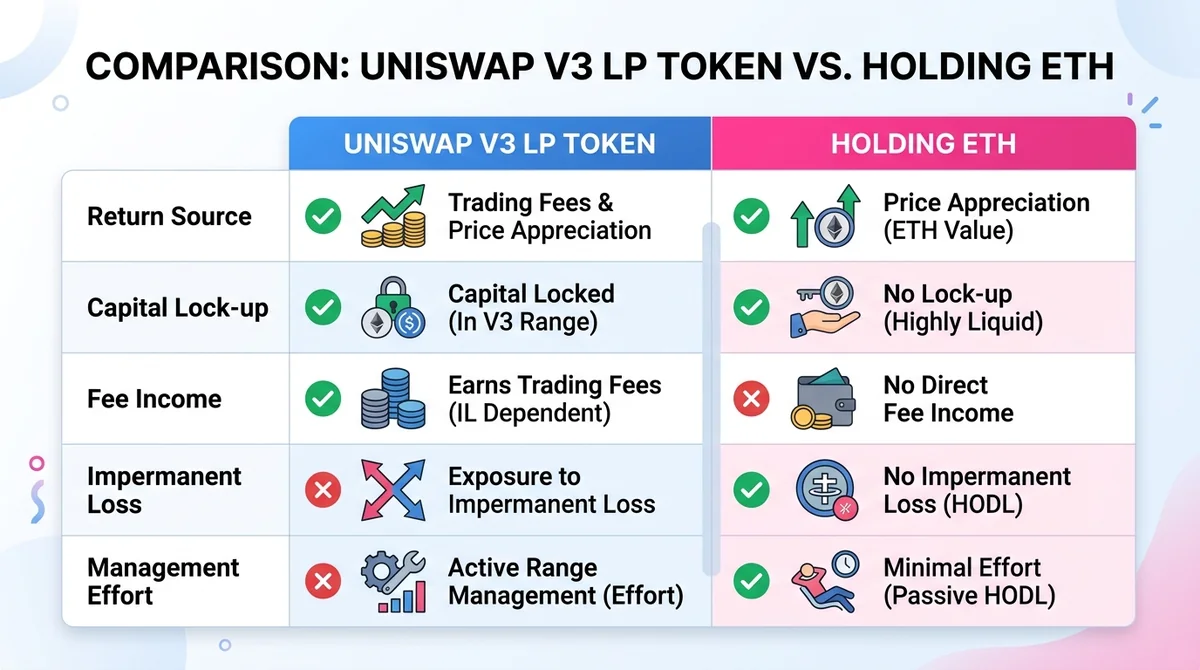
LP fee income: Comes from a proportional cut of every trade in the pool, and your share depends on your portion of the pool's effective liquidity. The larger the trading volume and the higher your share, the more fees accumulate.
The double-edged nature of concentrated liquidity: V3 lets you concentrate capital in a narrow range, improving capital efficiency within that range so the same capital can occupy a higher share of liquidity; but once the price breaks out of the range, that capital may stop earning fees and the position composition shifts toward a single asset.
Return characteristics of holding ETH: There is no fee cash flow; gains and losses come only from ETH's price itself, with no structural deviation caused by providing liquidity.
#How does impermanent loss affect the comparison between LP and holding ETH?
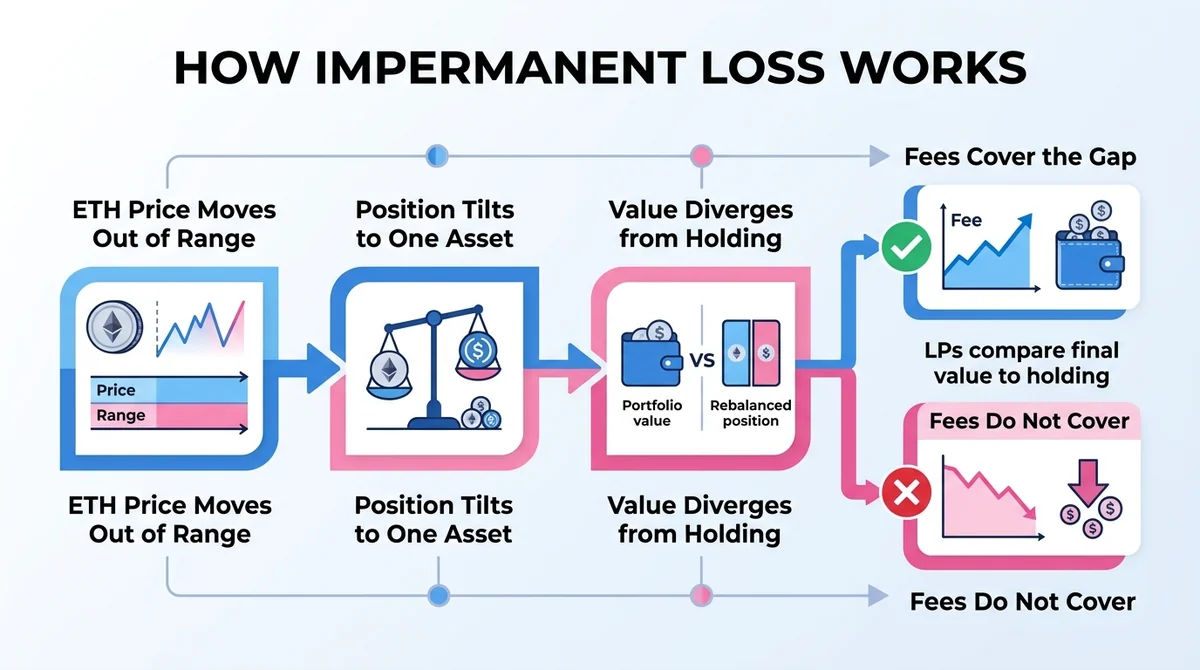
Definition: Impermanent loss is the difference between the value of an LP position and the value of simply holding the two assets as they were from the start. It is not a separate fee item but a deviation from a benchmark.
Trigger conditions: Impermanent loss widens when ETH's price moves sharply and one-directionally relative to the other asset. The farther the price deviates from your set range, the more the LP's asset composition tilts toward the worse-performing side.
Coverage conditions: Whether fees can cover impermanent loss depends on the combination of volatility and pool trading volume. High volatility plus low volume is the most unfavorable combination; high volume plus oscillation within the range is relatively favorable. Specific figures must be measured from the historical data of the specific pool, and this article does not provide unverified numbers.
#When might LP returns exceed holding ETH?
- Price oscillates repeatedly within the range: Trades keep occurring inside your range, fees accumulate continuously, and the position composition deviates only modestly.
- Active trading in the pool: Fee income per unit of liquidity rises, giving stronger cash flow for the same capital commitment.
- Range setting matches volatility: A narrow range offers high capital efficiency but is easily broken, while a wide range offers more tolerance but dilutes per-unit returns; you need to weigh these against the actual rhythm of volatility.
- Active management in place: Regularly assess whether the range still covers the price and whether reconfiguration is needed.
Conversely, if ETH enters a one-directional trend and your range is broken, the LP may both stop earning fees and bear a value deviation relative to holding.
#Who is better suited to Uniswap V3 LP, and who is better suited to holding ETH?
Better suited to LP: Users who can tolerate impermanent loss, are willing to continuously track and adjust the price range, and seek fee cash flow rather than pure price exposure.
Better suited to holding ETH: Users who need the asset to remain liquid, are unwilling to bear the time cost of range management, or want the simplest possible return structure.
Not suited to LP: People who cannot check their positions regularly, are sensitive to smart contract risk, or treat this capital as short-term reserve funds.
#What risks should be noted for LP versus holding ETH?
LP-side risks: Smart contract and protocol-layer risk, impermanent loss, interruption of returns after the range is broken, and the uncertainty of fee income fluctuating with trading volume.
Holding ETH-side risks: Mainly exposure to ETH price volatility; there is no fee income and no impermanent loss.
Common ground: Neither guarantees returns, and historical fee data does not represent future performance.
#Action checklist
- Determine whether this capital may need to be used at any time; if so, prioritize holding directly.
- If you choose LP, first select the specific pool and trading pair, and verify the pool's fee tier and recent trading volume.
- Backtest your range setting against historical price ranges to estimate the relative relationship between accumulated fees and impermanent loss.
- Assess whether you can track the range weekly or daily, and set trigger conditions for adjustments.
- Verify the protocol contract address and approval scope, and limit the approval amount per transaction.
- Record the asset composition at entry as the benchmark for later impermanent loss calculations.
#FAQ
Q1: Are Uniswap V3 LP returns always higher than holding ETH? A: Not necessarily. LP returns come from fees but must be reduced by impermanent loss and range management costs; the net result depends on trading volume and the price path and cannot be guaranteed in advance.
Q2: Is impermanent loss a real loss? A: It is a value deviation relative to holding the two assets as they were. It only becomes a definite relative loss when you exit and realize it.
Q3: What happens after the price breaks out of the range? A: The position may stop earning fees and its asset composition tilts in a single direction; you need to reassess whether to adjust the range.
Q4: Does holding ETH have any extra yield? A: Under the scope discussed in this article, the return from holding ETH comes only from price movements, with no fee income.
Q5: Can LP tokens be exited at any time? A: You can remove liquidity, but you bear the asset composition and price at that moment, along with on-chain transaction costs and contract interaction risk.
This content is compiled from public information and does not constitute investment or open account advice. It does not include verified real-time pool data; for actual parameters, refer to Uniswap's official documentation and on-chain data.
FAQ
Are Uniswap V3 LP returns always higher than holding ETH?
Not necessarily. LP returns come from fees but must be reduced by impermanent loss and range management costs, and the net result depends on trading volume and the price path.
Is impermanent loss a real loss?
It is a value deviation relative to holding the two assets as they were, and it only becomes a definite relative loss when you exit and realize it.
What happens after the price breaks out of the range?
The position may stop earning fees and its asset composition tilts in a single direction, so you need to reassess whether to adjust the range.
Does holding ETH have any extra yield?
Under the scope of this article, the return from holding ETH comes only from price movements, with no fee income; other yield paths such as staking are outside this comparison.
Can LP tokens be exited at any time?
You can remove liquidity, but you bear the asset composition and price at that moment, along with on-chain transaction costs and contract interaction risk.
Done comparing? Ready to place your first trade?
The crypto assets, tokenized US stocks and ETFs you just compared are all tradable on MSX — spot or perpetuals.
Quick Start Trading →New here? Registration takes three quick steps.