EquityZen vs Tokenized Pre-IPO and the Third Path: Exit Certainty Ranking of Secondary Share Transfers, SPVs, and Tokenized Channels in 2026
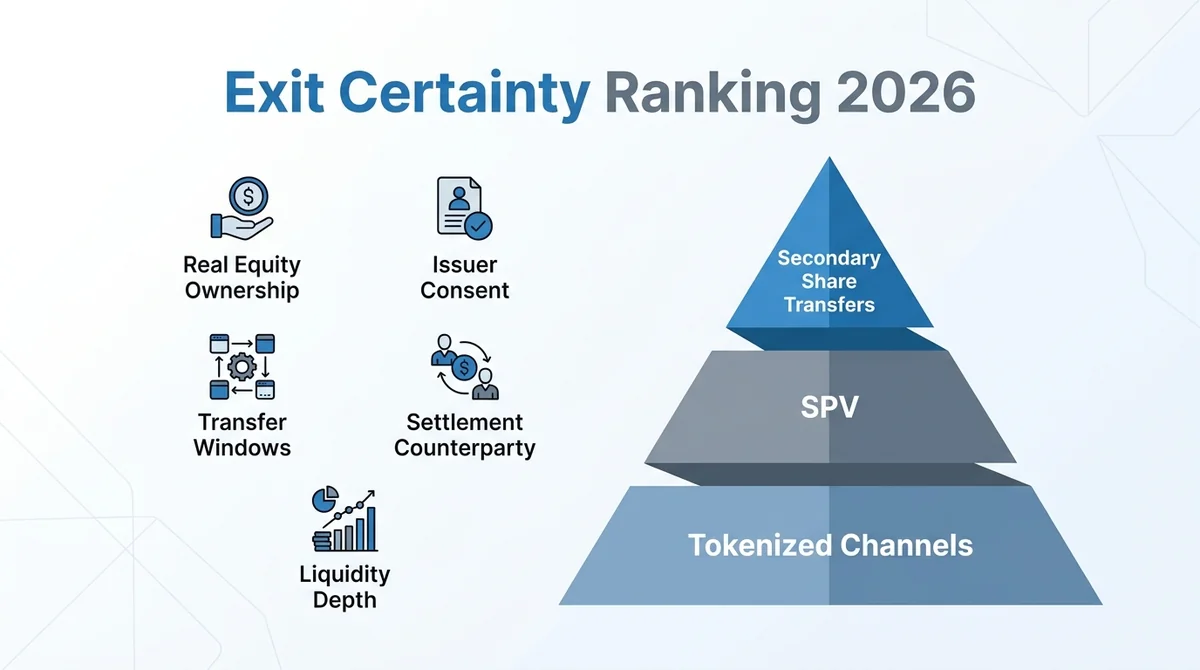
2026 Pre-IPO exit certainty ranking: secondary share transfers beat SPVs, SPVs beat tokenized channels. Compare real equity chains, transfer windows, and token liquidity.
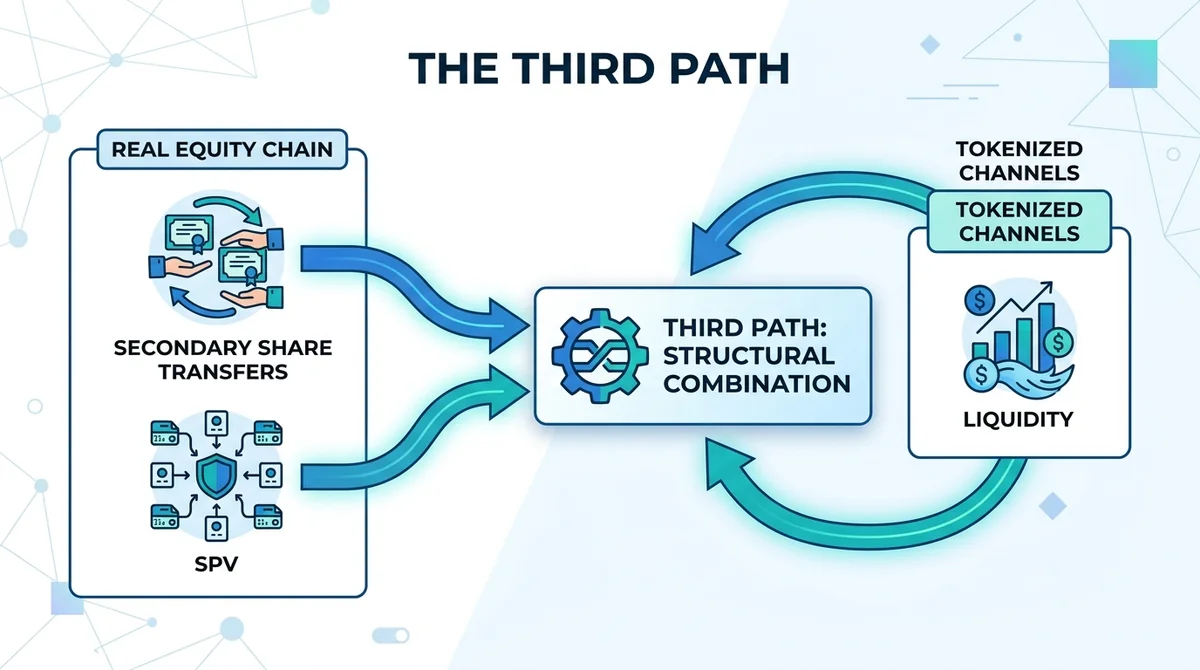
Conclusion: If exit certainty is the primary goal, the ranking in this article is secondary share transfers > SPV > tokenized channels. The third path is not about finding another platform; it is about structurally combining the real equity chain (locked-in shares) with tokenized channels (supplementary liquidity). This ranking is a judgment based on structural reasoning in this article, not an industry standard. Specific terms must be governed by the formal documents of each channel.
#Why look for a third path beyond EquityZen and tokenized Pre-IPO?
EquityZen-type platforms and tokenized Pre-IPO channels each solve half the problem: the former gives real shares but is subject to transfer restrictions, while the latter gives liquidity but only price exposure. The third path is a structural combination of the two, not a binary choice between them.
#What are the boundaries of EquityZen-type platforms?
EquityZen-type platforms focus on secondary share transfers and are constrained by issuer transfer restrictions and accredited investor thresholds. This means two things: first, whether you can buy depends on whether existing shareholders are willing to sell; second, whether you can exit depends on whether the issuer approves the transfer and when the transfer window opens. The boundary of the platform is not "whether it can be listed" but "whether the transfer chain is recognized by the issuer."
#What are the boundaries of tokenized Pre-IPO channels?
Tokenized Pre-IPO provides price exposure, not real equity. It typically offers no shareholder status and no participation rights in corporate actions, and exit depends on token market liquidity. The token price is the effect, and the underlying valuation is the cause; the two may move in the same direction, but their magnitude and timing can decouple.
#What problem does the third path solve?
The third path solves the problem that the "real equity chain" and "liquidity supplementation" cannot be satisfied simultaneously. The approach is: use secondary share transfers or SPVs to lock in the real equity chain, then use tokenized channels to manage liquidity for the existing exposure, rather than replacing the equity chain with tokenized channels. Note that specific fee rates, minimum thresholds, and lock-up period data for each channel are not publicly disclosed and are subject to platform disclosures and offering documents.
#How should exit certainty be ranked among secondary share transfers, SPVs, and tokenized channels?
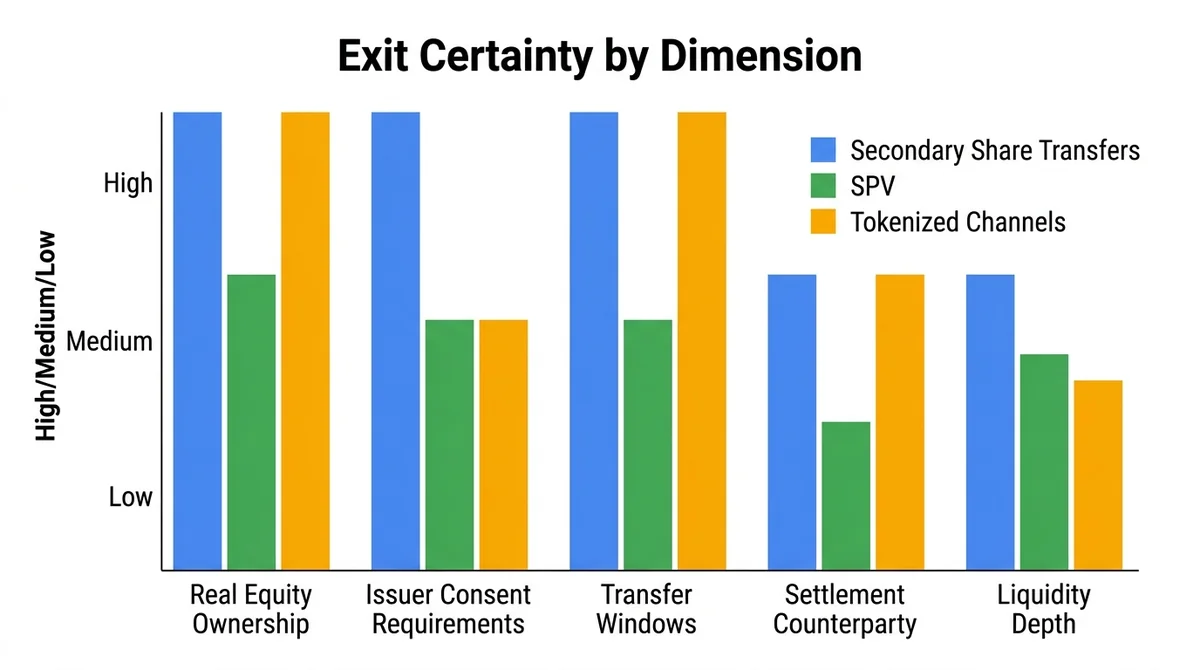
For exit certainty alone, the ranking in this article is secondary share transfers > SPV > tokenized channels. The ranking is based on five dimensions: real equity ownership, issuer consent requirements, transfer windows, settlement counterparties, and liquidity depth. Note: this is a structural judgment, not an empirical conclusion about any specific platform or underlying asset; differences in terms across platforms may change the local ranking.
#What dimensions determine exit certainty?
- Real equity ownership: Whether it directly or indirectly corresponds to the underlying company's equity, determining whether you hold rights or exposure.
- Issuer consent requirements: Whether the transfer requires issuer consent, determining whether exit is subject to unilateral will.
- Transfer window: Whether there is a clear transfer window period, determining whether the exit timing is predictable.
- Settlement counterparty: Whether the delivery counterparty is an issuer-recognized registry chain or a platform/market maker, determining settlement certainty.
- Liquidity depth: Secondary matching depth or token market depth, determining whether the exit size is limited by market capacity.
#What is the exit chain for secondary share transfers?
Directly acquiring existing shareholder shares, with exit dependent on the issuer and the transfer window. The chain is the shortest and the equity attribute is the most direct, but the exit timing is constrained by issuer consent and the window period, and it is not available at any time.
#What is the exit chain for an SPV structure?
The SPV indirectly holds the underlying asset, and investors hold SPV interests. Exit depends on the SPV manager's performance and distribution terms, including distribution timing, distribution order, and management fee structure. The chain has one more layer than direct shares, and transparency depends on the degree of disclosure in the SPV documents.
#What is the exit chain for tokenized channels?
Settlement is based on the token market, and exit certainty depends on the liquidity depth and market-making arrangements of that market. The advantages are fast settlement and potentially lower thresholds; the disadvantage is that it only corresponds to price exposure, and exit size is limited when depth is insufficient.
#How to read the key differences comparison table of the three channels?
When reading the comparison table, look at two columns first: asset nature and liquidity source. For the real equity chain, look at the transfer window; for tokenized channels, look at token market depth; the remaining dimensions are used to verify thresholds and costs.
| Dimension | Secondary share transfer | SPV | Tokenized channel |
|---|---|---|---|
| Asset nature | Real equity (direct shares) | Real equity (indirect interest) | Price exposure |
| Is it real equity | Yes | Indirectly yes | No |
| Issuer consent | Usually required | Subject to SPV terms | Not applicable |
| Lock-up period | Data not disclosed; subject to offering documents | Data not disclosed; subject to SPV terms | Data not disclosed; subject to platform rules |
| Liquidity source | Secondary matching + transfer window | SPV manager distribution | Token market depth |
| Settlement counterparty | Registry chain/platform | SPV manager | Token market maker |
| Accredited investor requirement | Usually yes | Usually yes | Depends on region and platform |
| Exit path | Transfer to new buyer | Distribution or share transfer | Sell tokens on secondary market |
Data not disclosed: Specific fee rates, minimum investment amounts, and lock-up period lengths for each channel are subject to offering documents and platform disclosures; this article does not estimate them.
#Which path should you choose? Scenario-based routing
- If the primary goal is exit certainty, prioritize secondary share transfers, followed by SPVs; accept that exit timing is constrained by the transfer window.
- If you already hold equity shares and need liquidity supplementation, use tokenized channels as a supplement rather than a replacement, and make clear that they only provide price exposure.
- If you cannot meet accredited investor or issuer consent requirements, tokenized channels are a more accessible option, but you must accept the price exposure attribute and token market liquidity risk.
- If the capital size is small, the thresholds for SPVs and tokenized channels are usually more friendly; specific data is not disclosed and must be verified item by item in the offering documents.
- If you need risk hedging during the holding period, tokenized channels can be used for exposure management, but they do not change the exit arrangements of the underlying equity chain.
#What risks does taking the third path entail?
#Transfer restrictions and issuer consent risk
The issuer may refuse or delay share transfers, making exit timing uncertain. This is the main non-market risk of secondary share transfers and is beyond investor control.
#SPV counterparty and manager risk
SPVs rely on the manager's performance and distribution terms, with limited information transparency. Distribution timing, fee deduction order, and default handling clauses need to be checked item by item before signing.
#Liquidity and pricing basis risk of tokenized channels
The token price is the effect, and the US stock price is the cause; tokenized stocks are not equal to real US stocks. When depth is insufficient, exit size will be limited by market capacity; pricing basis differences may cause the token price to deviate from the underlying valuation.
#Compliance risk
Accredited investor determinations and regional restrictions vary by channel, and cross-regional participation may face additional compliance requirements.
#Action checklist
- Confirm whether the target asset has a real equity chain (share transfer or SPV) and whether the issuer permits transfer.
- Request and read the offering documents or SPV terms, and verify the lock-up period, distribution order, and fee structure.
- Confirm whether you meet the accredited investor determination and regional restrictions.
- Assess the market depth of the tokenized channel to determine whether it can absorb your planned exit size.
- Clarify that the role of the tokenized channel in the portfolio is supplementary liquidity, not equity replacement.
- Record the exit trigger conditions and time expectations for each channel to form a written checklist.
#FAQ
Q1: Can tokenized Pre-IPO replace share transfers on EquityZen-type platforms? No. The former provides price exposure, while the latter corresponds to the real equity chain; a replacement relationship does not hold, but a combination relationship does.
Q2: Why is the exit certainty ranking secondary share transfers > SPV > tokenized channels? Because the former corresponds to real equity and a clear transfer chain, SPVs have an additional layer of manager dependence, and tokenized channels only correspond to price exposure and token market liquidity. This ranking is only about exit certainty, does not involve return judgment, and is a structural judgment rather than an empirical conclusion.
Q3: Why is the exit certainty of SPVs lower than direct share transfers? SPVs are indirect holdings, and exit depends on the manager's performance and distribution terms; the chain has one more layer, and information transparency depends on the degree of document disclosure.
Q4: Is the liquidity of tokenized channels always better? Not necessarily. Settlement is faster and thresholds may be lower, but exit size is limited when depth is insufficient; liquidity pros and cons need to be judged by specific market depth.
Q5: What are the fee rates and lock-up periods for each channel? Data is not disclosed and is subject to platform disclosures and offering documents; this article does not estimate them.
This content is compiled based on public information and structural reasoning and does not constitute investment or account opening advice. The fee rates, thresholds, and lock-up periods mentioned in this article have not been verified and actual terms may change. To verify the latest terms, please refer to the official sources of each channel.
FAQ
Can tokenized Pre-IPO replace share transfers on EquityZen-type platforms?
No. The former provides price exposure, while the latter corresponds to the real equity chain; a replacement relationship does not hold, but a combination relationship does.
Why is the exit certainty ranking secondary share transfers > SPV > tokenized channels?
Because the former corresponds to real equity and a clear transfer chain, SPVs have an additional layer of manager dependence, and tokenized channels only correspond to price exposure and token market liquidity. This ranking is only about exit certainty, does not involve return judgment, and is a structural judgment rather than an empirical conclusion.
Why is the exit certainty of SPVs lower than direct share transfers?
SPVs are indirect holdings, and exit depends on the manager's performance and distribution terms; the chain has one more layer, and information transparency depends on the degree of document disclosure.
Is the liquidity of tokenized channels always better?
Not necessarily. Settlement is faster and thresholds may be lower, but exit size is limited when depth is insufficient; liquidity pros and cons need to be judged by specific market depth.
What are the fee rates and lock-up periods for each channel?
Data is not disclosed and is subject to platform disclosures and offering documents; this article does not estimate them.
Related Terms
Found your pick? Ready to buy in?
Your chosen asset — crypto spot, tokenized US stocks/ETFs or perpetuals — you can trade it on MSX.
Quick Start Trading →New here? Registration takes three quick steps.