2026 AI Chip Stocks Compared: Nvidia, TSMC, Broadcom, Marvell, Micron
Compare 2026 top AI chip stocks—Nvidia, TSMC, Broadcom, Marvell, Micron—by moat, growth, and risk to see which fits your portfolio.
AI chip stocks split in 2025: Nvidia's valuation debate and TSMC's capacity edge coexist. Investors must weigh moat, growth, and valuation. The table below compares five key players.
Key Takeaways
- Nvidia leads AI GPUs and CUDA, with a strong competitive barrier but Very High uncertainty.
- TSMC manufactures most advanced AI chips, also with a wide moat.
- Broadcom and Marvell provide custom AI silicon; Micron supplies HBM.
- Nvidia's valuation is debated—some analysts see a discount to fair value, but uncertainty is extreme.
- AI data center capex is projected to jump 40–50% YoY to ~$1.5 trillion by 2027.
| Company | Role | Moat | Key Risk |
|---|---|---|---|
| Nvidia | AI GPUs, CUDA, networking | Wide | Very High uncertainty |
| TSMC | Advanced foundry | Wide | Geopolitical, capex cycles |
| Broadcom | Custom AI silicon, networking | Moderate | Customer concentration |
| Marvell | Custom AI silicon | Moderate | Growth dependency on few clients |
| Micron | HBM memory | Narrow | Memory price volatility |
#Which AI Chip Stocks Are the Top Contenders in 2026?
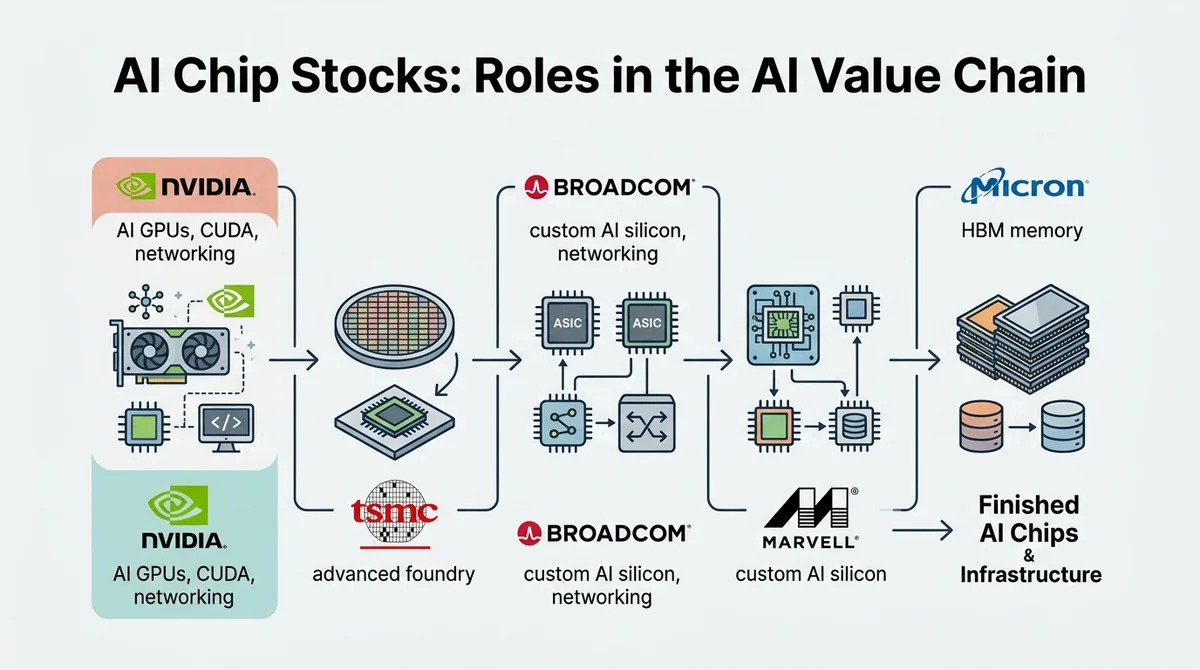
The top AI chip stocks in 2026 are Nvidia, TSMC, Broadcom, Marvell, and Micron, each playing a distinct role in the AI infrastructure value chain. Nvidia leads in AI GPUs and the CUDA software platform, creating a technical ecosystem advantage. TSMC manufactures most advanced AI chips, including Nvidia's, thanks to its leading-edge manufacturing capabilities and scale. Broadcom and Marvell provide custom AI silicon and networking chips. Micron supplies high-bandwidth memory (HBM) used in AI accelerators.
#Who are the leaders in AI GPUs and accelerators?
Nvidia is the clear leader in AI GPUs, with its CUDA platform providing a technical ecosystem advantage for AI model training. Broadcom and Marvell are key providers of custom AI accelerators and networking chips for hyperscalers. These companies benefit from the rapid buildout of AI infrastructure, but all face Very High uncertainty due to the fast pace of technology shifts.
#Which foundries and memory makers are essential to AI infrastructure?
TSMC is the dominant foundry for advanced AI chips, including Nvidia's GPUs, thanks to its leading-edge manufacturing capabilities and scale. Micron supplies high-bandwidth memory (HBM), which is critical for AI accelerators. Both are essential links in the AI supply chain, though their fortunes are tied to overall AI capital expenditure cycles.
#How Do Nvidia, TSMC, and Broadcom Compare on Moat and Growth?
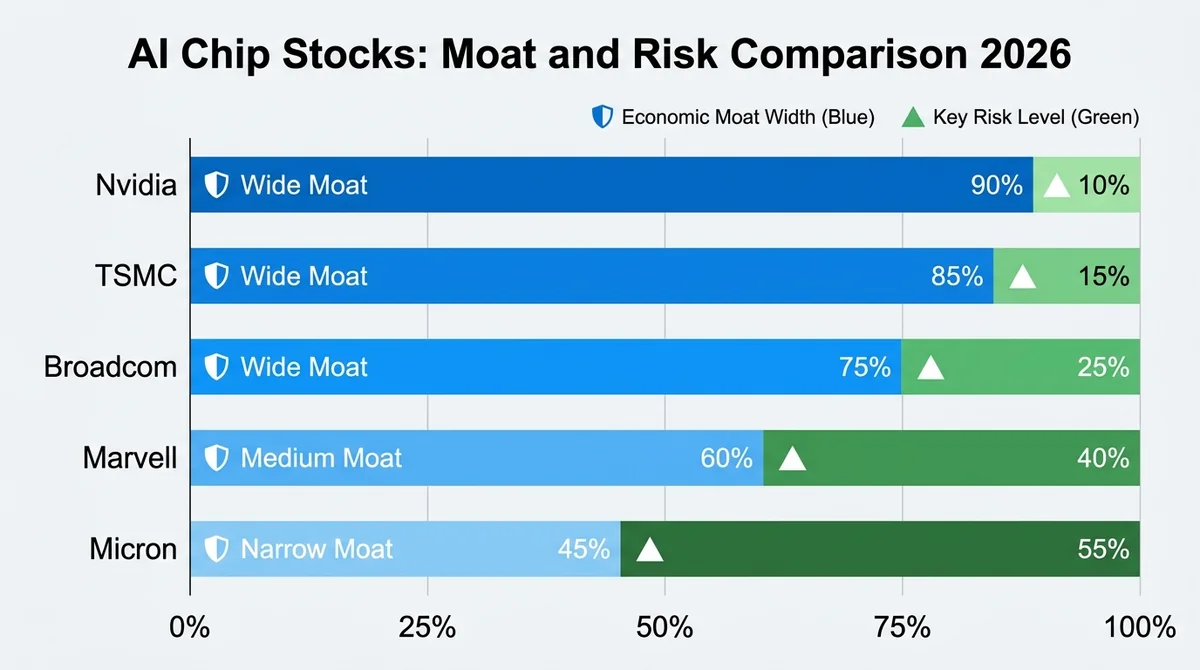
Nvidia and TSMC both have wide economic moats but very high uncertainty, while Broadcom offers strong AI networking exposure with a different risk profile. Nvidia's moat comes from its GPU hardware, CUDA software, and networking portfolio. TSMC's moat is based on its leading-edge manufacturing capabilities and scale. Broadcom's growth is tied to custom AI accelerators and networking chips for hyperscalers.
#What gives Nvidia its strong competitive barrier?
Nvidia's strong competitive barrier stems from its market leadership in graphics processing units, hardware, software, and networking tools needed to enable the exponentially growing AI market. In the long run, tech titans are expected to seek second-sources or in-house solutions, but these efforts will, at best, only chip away at Nvidia's AI dominance, according to Morningstar.
#Why is TSMC considered a critical AI chip supplier?
TSMC manufactures most of the world's advanced AI chips, including those designed by Nvidia and others. Its moat is based on leading-edge manufacturing capabilities and enormous scale, which are difficult for competitors to replicate. This makes TSMC a critical supplier for nearly all major AI chip designers.
#How does Broadcom benefit from custom AI silicon?
Broadcom's growth is increasingly tied to custom AI accelerators and networking chips for hyperscalers. As large tech companies build out AI data centers, they often turn to Broadcom for custom silicon solutions, providing a different risk profile compared to Nvidia's merchant GPU model.
#Which AI Chip Stock Offers the Best Valuation Today?
Valuation data is limited in the provided sources, but Nvidia was noted as approximately 20% undervalued relative to a $280 fair value estimate as of August 2025. Valuation varies widely across AI chip stocks, and some may be more reasonably priced after recent sell-offs. No forward price targets or earnings multiples are provided in the source data. Investors should compare valuation against growth rates and moat durability.
#Are AI chip valuations stretched after the recent rally?
AI stocks still require even greater growth to support the very high valuations we see in AI, according to Morningstar's chief US market strategist. After a strong second quarter, indexes driven by aspects of the AI trade had some of their best quarters on record. The Morningstar Global Next Generation Artificial Intelligence Index was up about 45% this spring and more than 33% for the year to date, owing to the AI infrastructure buildout.
#Which AI chip stocks appear undervalued relative to fair value estimates?
Based on the provided sources, only Nvidia has a specific fair value estimate: it looked 20% undervalued relative to a $280 fair value estimate as of August 2025. For other AI chip stocks, no fair value estimates or valuation metrics are available in the source data. Investors should treat valuation as one factor among moat durability, growth runway, and risk tolerance.
#How Should You Choose the Right AI Chip Stock for Your Portfolio?
Choose an AI chip stock by weighing moat durability, growth potential, valuation, and your own risk tolerance, or consider an AI ETF for broader exposure. Consider your risk tolerance: AI chip stocks can be volatile and are rated Very High uncertainty. Evaluate each company's moat, growth runway, and current valuation. Diversification through AI-focused ETFs can reduce single-stock risk. No single stock is universally best—the right choice depends on individual goals.
#What factors matter most: moat, growth, or valuation?
All three factors matter, but their relative importance depends on your investment horizon and risk tolerance. A wide moat can protect against competition, but high growth often comes with high valuation and uncertainty. For long-term investors, moat durability may be more important; for shorter-term traders, growth momentum and valuation may dominate.
#How does risk tolerance affect AI chip stock selection?
AI chip stocks are rated Very High uncertainty, meaning they can experience sharp price swings. If you have a low risk tolerance, you may prefer more diversified exposure through an AI ETF rather than a concentrated single-stock position. If you can tolerate volatility, you might allocate a small portion to a high-conviction name like Nvidia or TSMC.
#What role do AI chip ETFs play for diversified exposure?
AI-focused ETFs can provide broad exposure to the AI chip theme while reducing single-stock risk. Instead of picking one winner, an ETF holds a basket of AI chip and infrastructure companies. This can be a sensible choice for investors who want AI exposure but are uncomfortable with the volatility of individual semiconductor stocks.
#What Are the Key Risks of Investing in AI Chip Stocks?
Key risks include potential slowdowns in AI capex, competition from in-house chips, and high valuation volatility, though current spending projections remain strong. AI infrastructure spending is projected to grow, with cloud and AI data center capex expected to jump 40-50% YoY to ~$1.5 trillion by 2027. Tech titans may develop second-source or in-house AI chips, potentially eroding Nvidia's dominance. AI stocks carry Very High uncertainty ratings due to rapid technology shifts. Recent sell-offs highlight the sector's volatility.
#Could AI infrastructure spending slow down?
While hyperscalers have largely indicated that their capital expenditures will only increase next year, any unexpected slowdown could hurt AI chip stocks. Bank of America recently projected that worldwide cloud and AI data center capex will jump by 40% to 50% year over year to around $1.5 trillion in 2027. However, if economic conditions worsen or AI adoption disappoints, spending could be cut.
#How does competition affect AI chip leaders?
Competition is intensifying as tech titans strive to find second-sources or in-house solutions to diversify away from Nvidia in AI. These efforts will, at best, only chip away at Nvidia's AI dominance, according to Morningstar. For TSMC, competition from other foundries is limited by its technology lead, but geopolitical risks remain.
#Are AI chip stocks in a bubble?
AI stocks still require even greater growth to support the very high valuations we see in AI, according to Morningstar. While the sector has seen massive gains, the long-term demand for AI infrastructure is real. However, valuations could compress if growth slows or if AI monetization disappoints. Recent sell-offs are a reminder of the sector's volatility.
Disclaimer: This content is for informational purposes only and does not constitute investment advice. All data is as of the source dates and may change.
FAQ
What is the best AI chip stock to buy in 2026?
There is no single best AI chip stock; the right choice depends on your risk tolerance and goals. Nvidia, TSMC, Broadcom, Marvell, and Micron each play a distinct role in the AI value chain.
Is Nvidia still a good AI chip stock to buy?
Nvidia has a wide economic moat from its GPUs, CUDA software, and networking portfolio, and was estimated about 20% undervalued relative to a $280 fair value as of August 2025. However, it carries Very High uncertainty.
Which AI chip stock has the widest moat?
Both Nvidia and TSMC have wide economic moats. Nvidia's moat comes from its GPU and CUDA ecosystem; TSMC's moat comes from its leading-edge manufacturing capabilities and scale.
Are AI chip stocks overvalued?
AI stocks still require greater growth to support very high valuations, according to Morningstar. Some names may be more reasonably priced after sell-offs, but the sector is volatile.
Should I buy individual AI chip stocks or an AI ETF?
If you prefer lower single-stock risk, an AI-focused ETF offers diversified exposure. If you can tolerate volatility and want concentrated exposure, individual stocks like Nvidia or TSMC may be suitable.
What are the biggest risks for AI chip stocks?
Key risks include a potential slowdown in AI infrastructure spending, competition from in-house or second-source chips, and high valuation volatility. Current capex projections remain strong, but uncertainty is Very High.
Found your pick? Ready to buy in?
Your chosen asset — crypto spot, tokenized US stocks/ETFs or perpetuals — you can trade it on MSX.
Quick Start Trading →New here? Registration takes three quick steps.