AMD
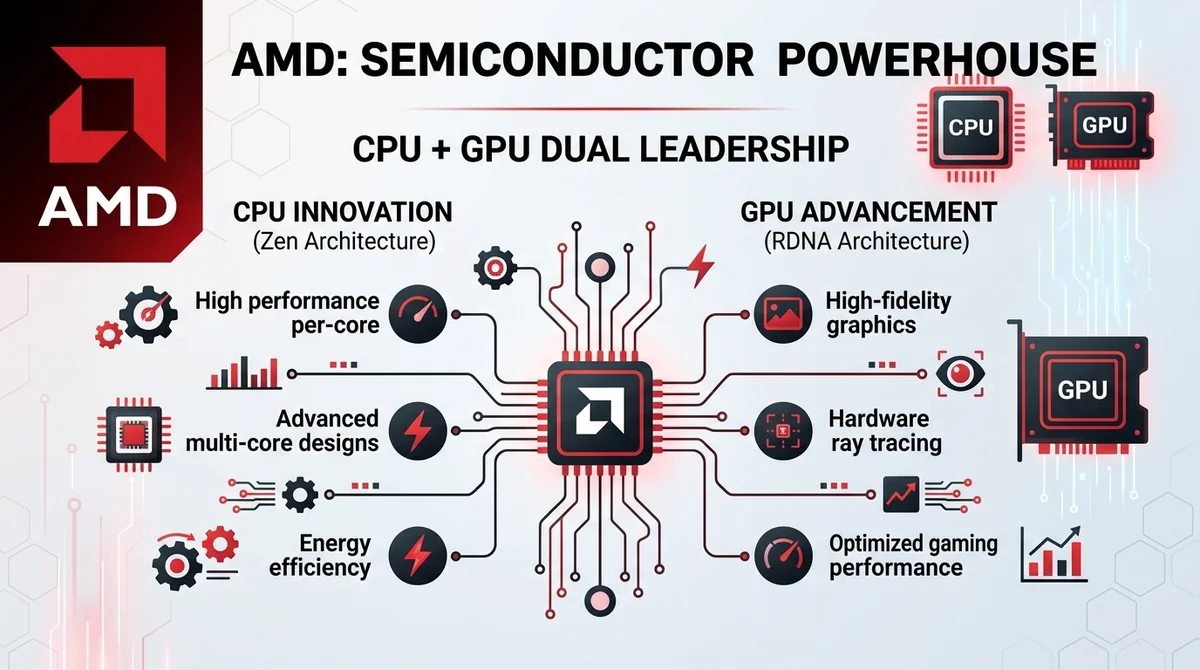
What kind of company is AMD? From CPU/GPU business, financial performance, competitive advantages and risks, to how Chinese A-share investors can participate compliantly, this article provides a data-driven objective analysis.
Conclusion: AMD is a global semiconductor company with competitiveness in both CPU and GPU markets, suitable for investors with higher risk tolerance who are optimistic about the long-term development of the semiconductor industry; Chinese A-share investors cannot directly buy AMD US stocks, but can obtain indirect exposure through compliant channels such as QDII funds.
#What kind of company is AMD?
#What is AMD's core business?
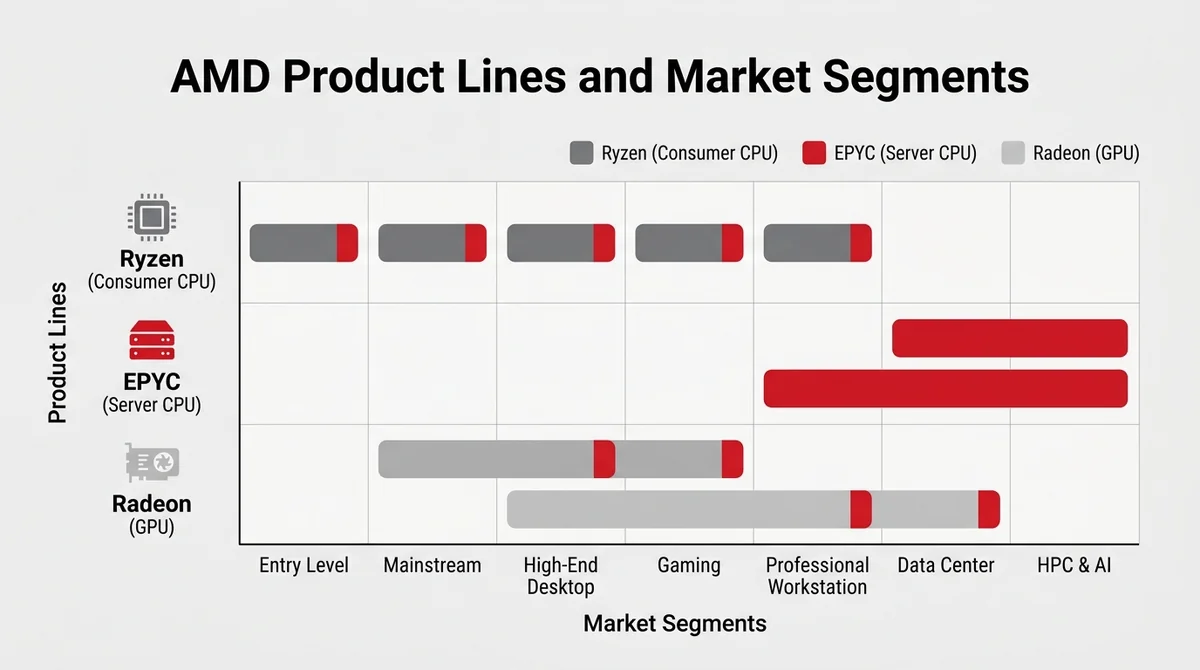
AMD (Advanced Micro Devices) covers two major product lines: central processing units (CPU) and graphics processing units (GPU). In the CPU field, AMD's Ryzen and EPYC series target consumer and enterprise markets respectively; in the GPU field, the Radeon series competes with NVIDIA. This dual-line layout makes AMD one of the few semiconductor companies with both high-performance CPU and GPU design capabilities.
#What is AMD's position in the semiconductor industry?
AMD is an important player in the global semiconductor industry, forming major competition with Intel in the x86 architecture CPU market and directly competing with NVIDIA in the discrete GPU market. According to public data, AMD's share in the server CPU market has increased in recent years, but specific market share data is not disclosed. Its technology roadmap and product iteration speed have a significant impact on the industry landscape.
#How is AMD's financial performance?
#What are the trends in AMD's revenue and profit?
AMD's financial performance has been stable in recent years, with revenue and net profit generally showing an upward trend, but specific figures should be based on the latest financial reports. This article does not provide real-time financial data; investors should refer to the company's official financial reports for accurate information.
#Is AMD's balance sheet structure healthy?
AMD's balance sheet structure needs to be analyzed in conjunction with the latest financial reports. From public information, the company's cash flow and debt levels have not shown major anomalies, but there is a lack of verifiable detailed data, so no quantitative judgment is made here.
#What are AMD's competitive advantages and risks in the industry?
#What are AMD's technical advantages?
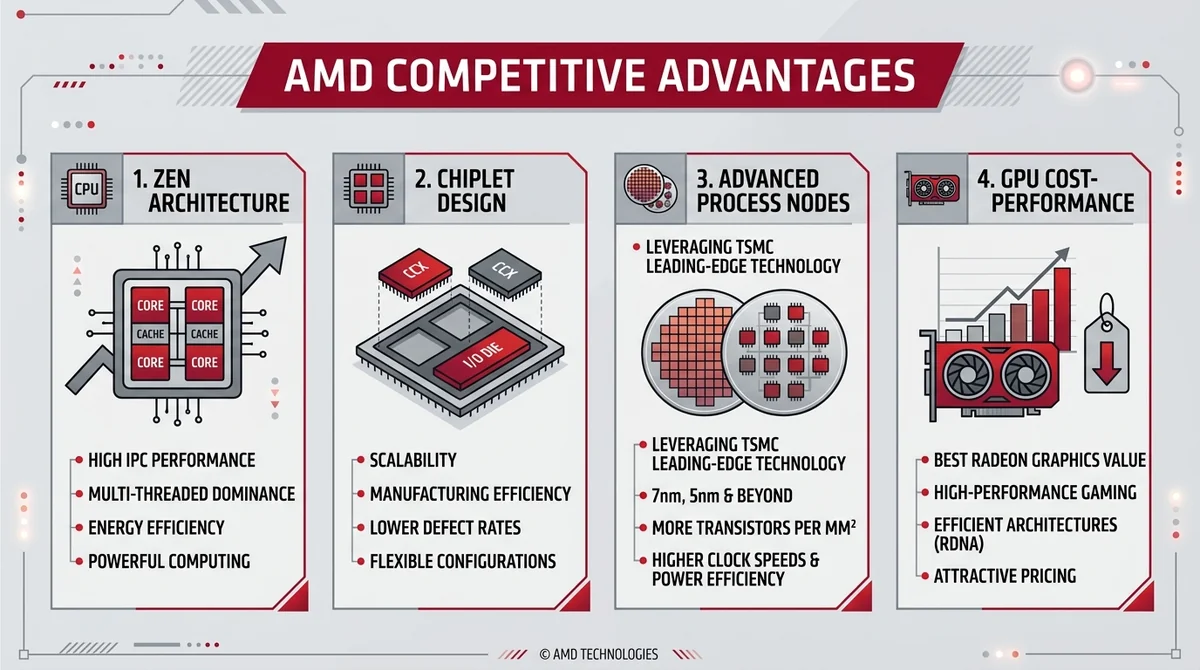
AMD has certain technical advantages, mainly reflected in:
- Zen architecture-based CPUs are competitive in energy efficiency and multi-core performance;
- Active adoption of chiplet design and advanced process nodes;
- GPU architecture continues to iterate, offering cost-performance advantages in some computing workloads.
#What are the main risks AMD faces?
The main risks AMD faces include:
- Market competition risk: Intel and NVIDIA have strong R&D investment and ecosystem building, leading to intense competition;
- Industry cyclicality risk: The semiconductor industry has obvious cyclicality, and demand fluctuations may affect company performance;
- Supply chain risk: Advanced process nodes rely on foundries such as TSMC, with uncertainty in capacity and yield.
#How can Chinese A-share market investors invest in AMD?
#Can they directly buy AMD stock?
Chinese A-share market investors cannot directly buy AMD US stocks. AMD is listed on NASDAQ, and A-share accounts cannot directly trade US stocks; compliant cross-border investment channels are required.
#What are the indirect ways to invest in AMD?
Compliant indirect investment channels for AMD mainly include:
- QDII funds: Indirectly hold AMD exposure through Qualified Domestic Institutional Investor (QDII) funds that invest in the US stock market;
- Cross-border ETFs: Some cross-border ETFs listed on A-share or Hong Kong stock markets may include AMD as a constituent stock, but specific holdings should be checked in fund announcements;
- Other compliant channels: Such as through brokers or banks with overseas investment qualifications, subject to foreign exchange management regulations.
Investors should verify the investment scope and fees of the product when choosing a channel, and pay attention to exchange rate risk.
#What type of investor is AMD suitable for?
#What is the required risk tolerance?
AMD stock has high volatility and is suitable for investors with higher risk tolerance. The semiconductor industry is greatly affected by technology iteration, competitive landscape, and macroeconomic factors, and stock prices may experience significant fluctuations.
#Is it suitable for long-term holding or short-term trading?
From a long-term perspective, AMD is suitable for investors optimistic about the long-term development of the semiconductor industry. Short-term trading requires attention to market sentiment and technicals, but this article does not provide trading advice. Conservative investors or those seeking stable returns may not be suitable for investing in AMD.
#5-Dimension Score
- Liquidity: 8/10 (US stock market liquidity is sufficient, but specific trading data is not disclosed)
- Cost: 7/10 (As a US stock, trading costs depend on the broker, with no special fee advantage)
- Risk: 6/10 (High industry competition and cyclicality risk)
- Return characteristics: 8/10 (Long-term growth potential coexists with high volatility)
- Accessibility: 5/10 (Chinese A-share investors need indirect channels such as QDII, with higher barriers)
#Pros and Cons
#Pros
- Dual-line business layout: Both CPU and GPU product lines are competitive, reducing dependence on a single market.
- Active technology iteration: Fast follow-up in advanced process nodes and architecture innovation, with some products offering outstanding cost-performance.
- Improved industry position: Effective competition with Intel in the server CPU market, with a growing market share trend.
#Cons
- High competitive pressure: Intel and NVIDIA have obvious advantages in R&D and ecosystem, requiring AMD to sustain high investment.
- Industry cyclicality: Semiconductor industry fluctuations may affect the stability of company performance.
- High barrier for Chinese investors: A-share investors can only participate through indirect channels such as QDII, with insufficient convenience.
#Core Attributes Explained
- Fees: Data not disclosed (depends on the specific trading channel).
- Valuation: Data not disclosed (refer to the latest market data).
- Liquidity: The US stock market has good overall liquidity, but AMD's individual stock liquidity data is not disclosed.
- Equity attributes: Directly holding AMD stock entitles shareholders to rights, including voting rights and dividends (if any); indirect holding through QDII funds means rights are exercised by the fund manager.
#Risk History
AMD has historically experienced multiple performance fluctuations and significant stock price drawdowns, such as financial difficulties in the early 2010s, followed by a turnaround through the Zen architecture. The semiconductor industry's cyclicality has also led to noticeable ups and downs in performance across different years. Investors should pay attention to the company's latest financial reports and industry dynamics.
#Suitable for / Not suitable for
Suitable for:
- Investors optimistic about the long-term growth of the semiconductor industry;
- Growth-oriented investors who can tolerate high volatility;
- A-share investors who wish to allocate US tech assets through channels such as QDII.
Not suitable for:
- Conservative investors with low risk tolerance;
- Investors seeking stable dividend income;
- Investors who cannot accept the complexity of cross-border investment and exchange rate risk.
#Frequently Asked Questions (FAQ)
Which is better, AMD or NVIDIA? The two have different business focuses: NVIDIA leads in GPU and AI computing, while AMD has a dual-line layout in CPU and GPU. The choice depends on the investor's judgment of specific sub-sectors; this article does not make recommendations.
Can Chinese investors directly buy AMD stock? No. A-share accounts cannot directly trade US stocks; indirect investment through compliant channels such as QDII funds is required.
Does AMD pay dividends? AMD has not publicly announced a stable dividend policy; refer to company announcements for specifics.
What are the main risks of AMD? Main risks include intense industry competition, semiconductor cycle fluctuations, and supply chain dependence.
What indicators should be monitored when investing in AMD? Revenue growth rate, gross margin, R&D investment, market share changes, and industry prosperity indicators.
This content is compiled from public data and does not constitute investment or account opening advice. Data as of 2026-10-05, actual conditions may change. For the latest information, please refer to AMD's official investor relations page and compliant channels.
FAQ
Which is better, AMD or NVIDIA?
The two have different business focuses: NVIDIA leads in GPU and AI computing, while AMD has a dual-line layout in CPU and GPU. The choice depends on the investor's judgment of specific sub-sectors; this article does not make recommendations.
Can Chinese investors directly buy AMD stock?
No. A-share accounts cannot directly trade US stocks; indirect investment through compliant channels such as QDII funds is required.
Does AMD pay dividends?
AMD has not publicly announced a stable dividend policy; refer to company announcements for specifics.
What are the main risks of AMD?
Main risks include intense industry competition, semiconductor cycle fluctuations, and supply chain dependence.
What indicators should be monitored when investing in AMD?
Revenue growth rate, gross margin, R&D investment, market share changes, and industry prosperity indicators.
Related Terms
Read the review? Ready to try a small position?
The crypto assets and tokenized US stocks/ETFs covered here are available on MSX — spot and perpetuals.
Quick Start Trading →New here? Registration takes three quick steps.