Asia Pacific stocks by market cap 2026
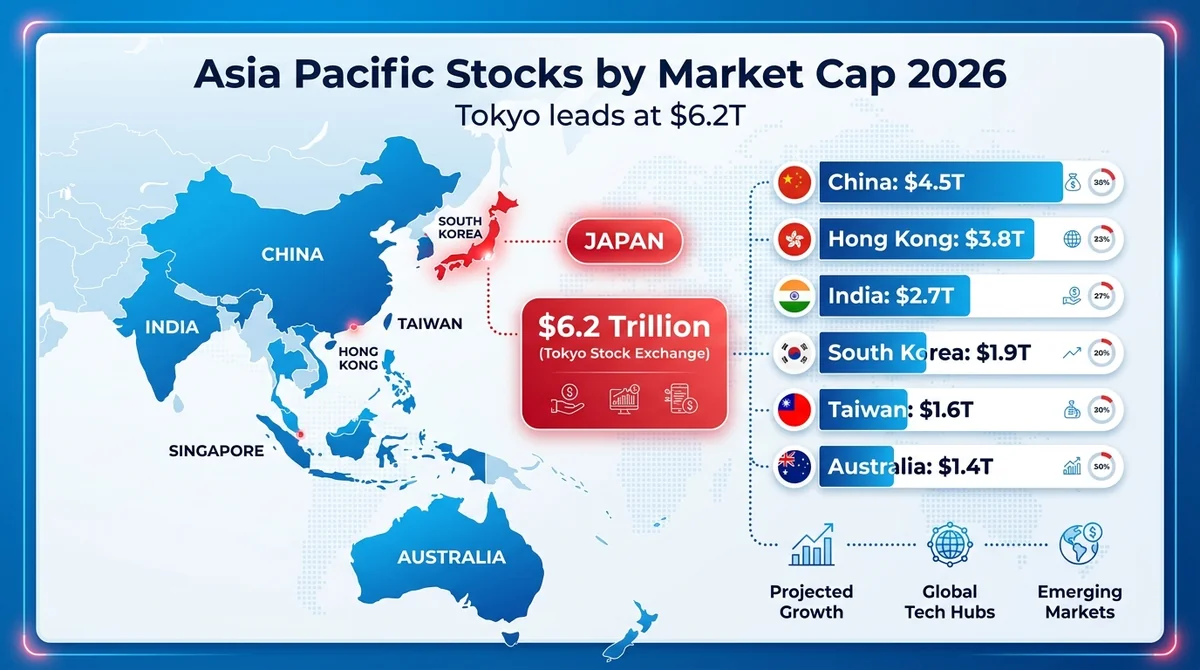
2026 Asia Pacific major exchange market cap rankings: Tokyo leads, Shanghai & Shenzhen close behind, Hong Kong bridges China and the world. Compare listing requirements, foreign access, taxes, and liquidity.
The Tokyo Stock Exchange is the largest stock exchange in the Asia Pacific region by market capitalization, but the combined market cap of Shanghai and Shenzhen is equally massive, and Hong Kong serves as a key gateway for international capital into mainland China. Investors should prioritize market liquidity depth and foreign access rules over a single market cap ranking.
#Overview of Major Asia Pacific Exchange Market Caps
The Tokyo Stock Exchange is the largest exchange in Asia Pacific by market cap. As of September 2026, its total market capitalization is approximately $6.2 trillion, with about 3,800 listed companies, including global names like Toyota and Sony.
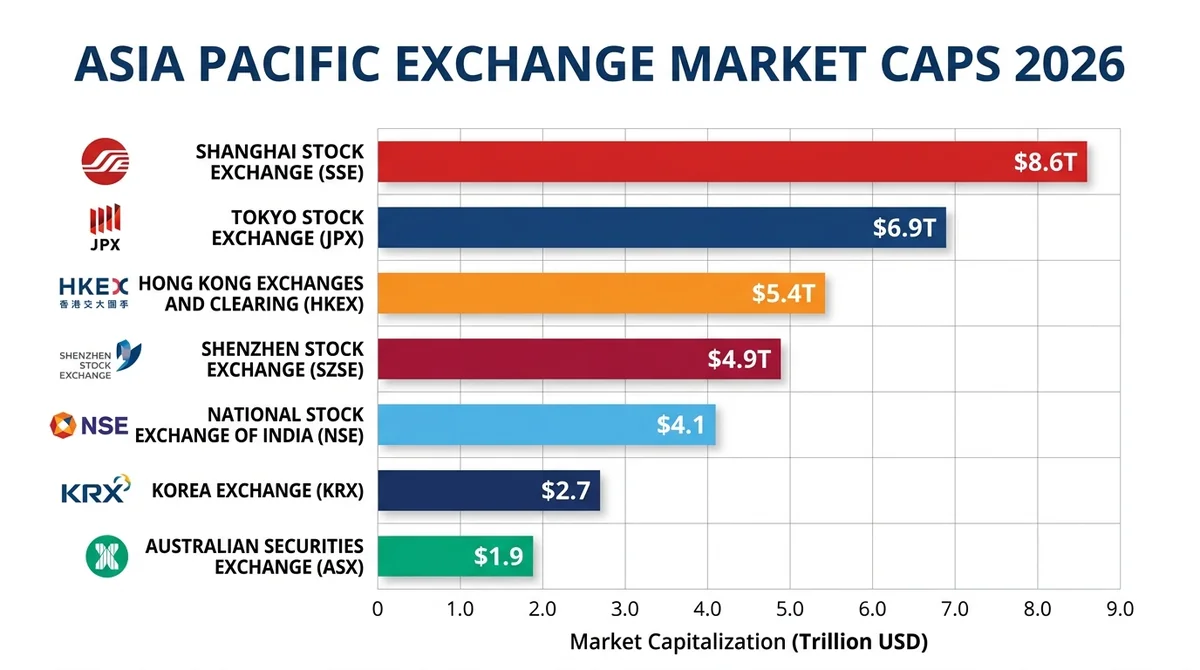
Shanghai and Shenzhen exchanges: Their combined market cap is comparable to Tokyo's; individually, they rank second and third respectively. Shanghai focuses on large state-owned enterprises and the STAR Market, while Shenzhen hosts more technology and growth-oriented companies.
Hong Kong Exchange: Ranks third in Asia Pacific by market cap, but has the highest foreign participation, acting as a bridge between mainland China and global markets.
#Key Differences
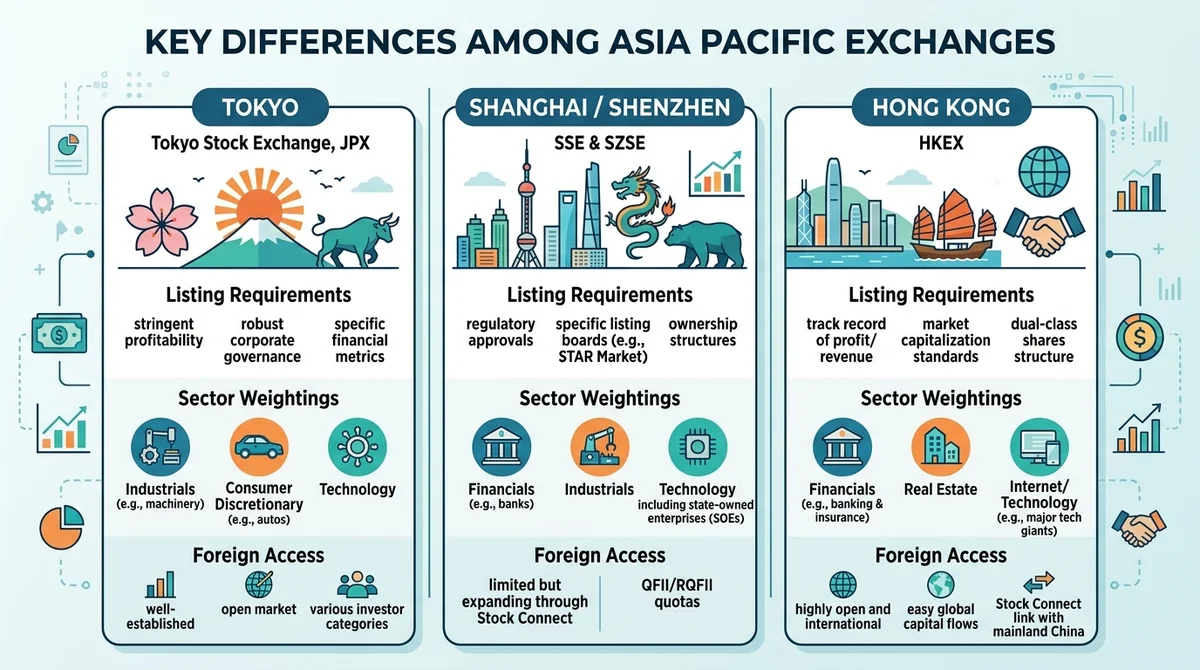
Listing requirements: Japan and Hong Kong adopt international accounting standards with transparent review processes; mainland China exchanges have additional requirements on profitability and shareholding structure, and registration-based IPO reform is still ongoing.
Sector weightings: The Japanese market is dominated by industrials, consumer, and financials; mainland China markets have higher weights in industrials and technology; the Australian market is centered on resources and banks.
Foreign access: Japan and Hong Kong are largely open to foreign investors; mainland China has limited openness through mechanisms like QFII and Stock Connect, with capital controls still in place.
#Market Depth Assessment
Beyond market cap, turnover rate reflects trading activity: Japan's turnover rate is about 100%, Hong Kong's around 60%, and mainland China markets show higher volatility due to a large retail investor base. In terms of average daily turnover, both Tokyo and Shanghai exceed tens of billions of US dollars, while Hong Kong is significantly influenced by international capital flows.
Number of listed companies: Tokyo about 3,800, Shanghai about 2,000, Shenzhen about 2,500, Hong Kong about 2,600. More listings do not necessarily mean better liquidity; some small-cap stocks have very thin trading.
#Factors to Consider Before Investing
Currency risk: Investing in Asia Pacific stocks entails exchange rate fluctuations between your home currency and the investment currency. For example, prolonged yen weakness can erode USD-denominated returns.
Regulatory differences: Securities laws and disclosure requirements vary by country. Mainland China has stricter regulations on data security and antitrust, which may affect specific sectors.
Tax implications: Dividend withholding taxes differ significantly: Japan levies 15% on non-residents, mainland China 10%, and Hong Kong has no dividend tax, while capital gains tax rules vary by country.
#Who It's For / Not For
Suitable for: Long-term investors seeking geographic diversification and bullish on Asia Pacific economic growth; those who can tolerate currency fluctuations and regulatory changes.
Not suitable for: Short-term traders who need high liquidity and instant exit; individual investors unfamiliar with local laws and tax rules.
#FAQ
Q: Which Asia Pacific exchange has the largest market cap? A: The Tokyo Stock Exchange has the largest market cap, approximately $6.2 trillion as of September 2026, but Shanghai and Shenzhen combined can match it.
Q: Can foreign investors directly invest in China A-shares? A: Yes, through Stock Connect (Shanghai-Hong Kong and Shenzhen-Hong Kong) or QFII mechanisms with limited participation, subject to quota limits and eligibility requirements.
Q: What taxes apply to investing in Asia Pacific stocks? A: Dividend withholding taxes vary by country: Japan 15%, mainland China 10%, Hong Kong 0%. Capital gains tax should be discussed with a local tax advisor.
Q: How do you measure market liquidity? A: Look at average daily turnover and turnover rate; the higher both are, the better the liquidity. Specific figures can be found in official exchange statistics.
Q: How correlated are Asia Pacific markets with European and US markets? A: Correlation is moderate, but mainland China markets are heavily influenced by policy and may move independently.
This content is compiled from public data and does not constitute investment or account opening advice. Data as of 2026-09-14; actual conditions may change. For more official data, please refer to exchange websites.
FAQ
Which Asia Pacific exchange has the largest market cap?
The Tokyo Stock Exchange typically has the largest market cap, but Shanghai and Shenzhen combined can match it.
Can foreign investors directly invest in China A-shares?
Yes, through Stock Connect (Shanghai-Hong Kong and Shenzhen-Hong Kong) or QFII mechanisms with limited participation, subject to quota limits and eligibility requirements.
What taxes apply to investing in Asia Pacific stocks?
Dividend withholding taxes vary by country: Japan 15%, mainland China 10%, Hong Kong 0%. Capital gains tax should be discussed with a local tax advisor.
How do you measure market liquidity?
Look at average daily turnover and turnover rate; the higher both are, the better the liquidity.
How correlated are Asia Pacific markets with European and US markets?
Correlation is moderate, but mainland China markets are heavily influenced by policy and may move independently.
Related Terms
Read the review? Ready to try a small position?
The crypto assets and tokenized US stocks/ETFs covered here are available on MSX — spot and perpetuals.
Quick Start Trading →New here? Registration takes three quick steps.