Bitcoin
Comprehensive Bitcoin (BTC) review: decentralization, 21M supply cap, high volatility, regulatory risks. For long-term, high-risk investors with custody fee tips.
Bitcoin is a decentralized digital asset based on blockchain, with a total supply capped at 21 million, featuring censorship resistance and scarcity. For investors evaluating Bitcoin, the primary criterion is their own risk tolerance and investment horizon; the next step is to verify asset storage methods and compliant trading channels.
#What Are the Core Features of Bitcoin?
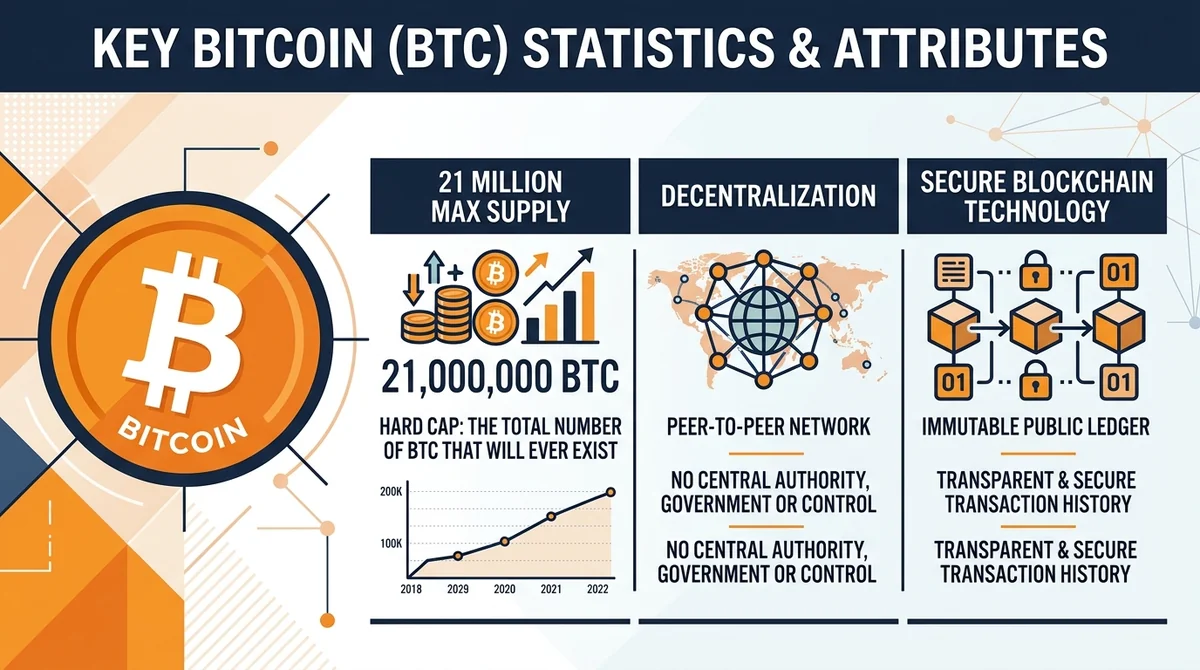
Decentralized network: Bitcoin maintains its ledger through globally distributed nodes, without reliance on a single central authority.
21 million supply cap: The supply is fixed by code and cannot be increased; this scarcity design is central to its value proposition.
Blockchain technology foundation: Transactions are recorded on a public, immutable blockchain, ensuring transparency and verifiability.
#How Does Bitcoin Achieve Decentralization?
The Bitcoin network is operated by thousands of independent nodes, and no single entity can control transaction confirmation or rule changes. The consensus mechanism (proof of work) requires participants to commit computational power, thereby ensuring network neutrality.
#Why Is Bitcoin's Supply Limited?
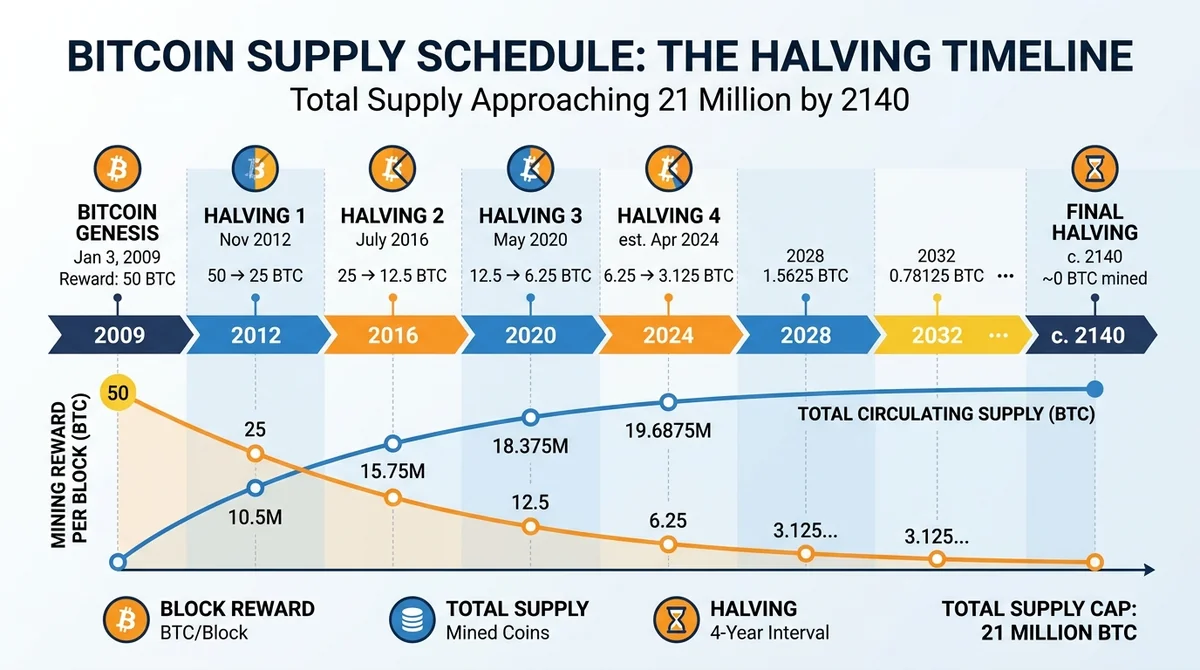
The Bitcoin protocol fixes the total supply at 21 million, released gradually through block rewards that halve every four years, with all coins in circulation by around 2140. This hard cap distinguishes it from fiat currencies that can be infinitely inflated.
#What Are the Main Risks of Bitcoin?
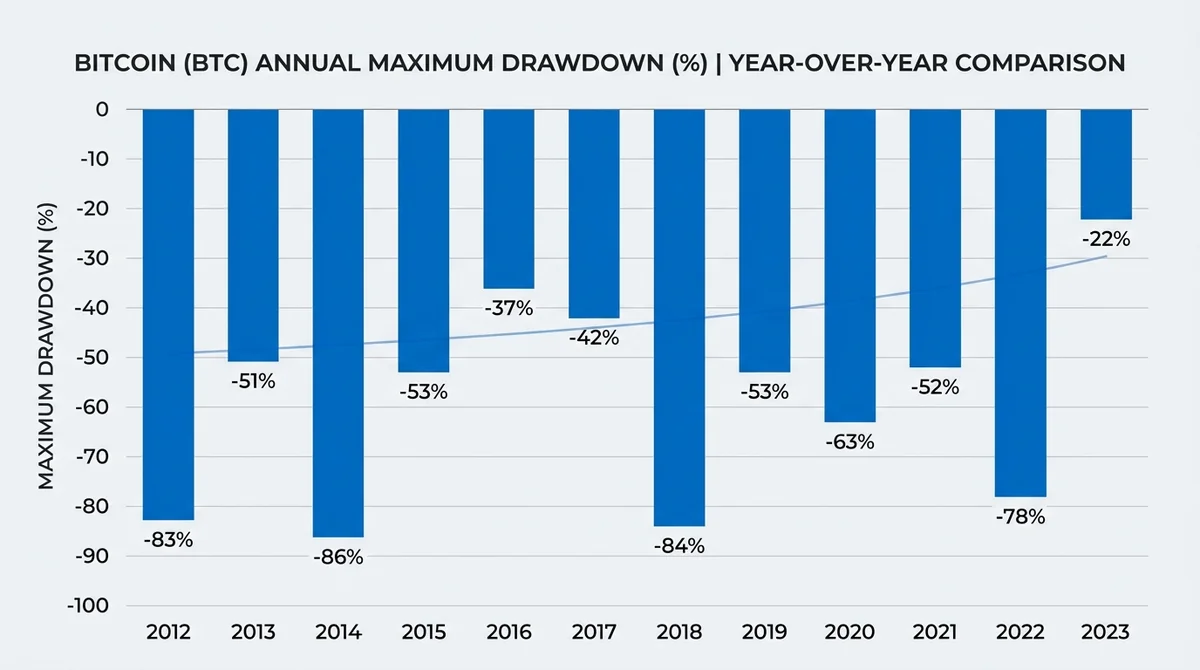
High price volatility: Bitcoin prices can fluctuate sharply in short periods, and historical drawdowns exceeding 50% are not uncommon.
Global regulatory uncertainty: Countries differ widely in their regulatory attitudes toward crypto assets, and policy changes may affect trading channels and asset valuation.
Security risks (exchanges, wallets): Centralized exchanges may suffer attacks or bankruptcy, and personal wallets can lead to permanent loss of assets if private keys are mishandled.
#How Volatile Is Bitcoin's Price?
Measured by annual maximum drawdown, Bitcoin has experienced declines of over 70% multiple times in history. Volatility is far higher than traditional stocks and bonds, requiring investors to tolerate substantial unrealized losses.
#What Regulatory Risks Does Bitcoin Face?
Some jurisdictions prohibit or restrict cryptocurrency trading, and tax reporting requirements may change. Regulatory actions can lead to exchange service suspensions or asset freezes.
#Who Is Bitcoin Suitable For?
Long-term store of value: Bitcoin is often seen as digital gold, suitable for investors who hold for years and ignore short-term fluctuations.
High risk appetite: Only those who can accept the risk of significant principal loss should allocate to Bitcoin.
Asset allocation ratio: Most professional advice suggests keeping Bitcoin at 1%-5% of the total portfolio to avoid over-concentration.
#Long-Term Holding or Short-Term Trading?
Bitcoin's short-term price is heavily influenced by sentiment and perpetual futures leverage, requiring professional knowledge and time for short-term trading. Long-term holding aligns better with its scarcity narrative, but still requires enduring cyclical volatility.
#How to Assess Risk Tolerance?
Ask yourself: if the portfolio drops 60%, would you panic sell? If the answer is yes, Bitcoin is not suitable as a core holding.
#How to Safely Hold Bitcoin?
Cold wallets are safer: Hardware wallets or How to create a paper wallet safely store private keys offline, avoiding network attacks.
Diversified storage: Do not keep all assets on a single exchange or wallet; diversification reduces single-point failure risk.
Choose compliant exchanges: Prioritize platforms that are regulated, have clear proof of reserves, and a long operating history.
#What Is the Difference Between Hot Wallets and Cold Wallets?
Hot wallets are connected to the internet, convenient for transactions but vulnerable to attacks; cold wallets are completely offline, more secure but less convenient. For large long-term holdings, cold wallets are recommended.
#How to Mitigate Exchange Risks?
Check the exchange's proof of reserves, security history, and regulatory licenses; avoid storing assets on unknown platforms; regularly transfer assets to a cold wallet you control.
#Overall Rating and Target Audience
Overall rating: 7.2/10. Suitable for investors with high risk tolerance and a long-term store-of-value goal; not suitable for short-term speculators or those unable to withstand large fluctuations.
#5-Dimension Ratings
- Liquidity: 9 — Bitcoin has huge 24-hour trading volume on major exchanges with minimal bid-ask spreads.
- Cost: 7 — On-chain transfer fees fluctuate with network congestion, but mainstream exchange trading fees are low.
- Risk: 6 — Volatility and regulatory uncertainty are significant, and security risks must be self-managed.
- Return profile: 8 — Historical long-term returns are outstanding, but future performance is unpredictable.
- Accessibility: 7 — Available in most regions globally, but restricted in some areas, with varying fiat on-ramp channels.
#Pros
- Decentralized with a limited supply, providing inflation-resistant properties.
- Excellent global liquidity, tradable 24/7.
- Significant historical long-term returns with relatively low correlation to traditional assets.
#Cons
- Extreme price volatility can cause major principal losses.
- Uncertain regulatory environment; some countries ban or restrict use.
- Self-custody requirements are high; lost or stolen private keys cannot be recovered.
#Risk History
Bitcoin has experienced multiple drawdowns of over 70% in history, such as after the bull markets of 2013, 2017, and 2021. Exchange failures and hacks have also occurred, such as the Mt. Gox incident, which caused massive user asset losses.
#Who Should / Shouldn't Use Bitcoin
Suitable for: Long-term investors, individuals seeking asset diversification who can tolerate high volatility, users who align with decentralization ideals.
Not suitable for: Short-term traders, retirement fund managers, those unable to withstand large principal fluctuations, users unfamiliar with private key management.
#Frequently Asked Questions
Is Bitcoin a legal asset? Legal in most countries, but legal status varies by region; some countries prohibit or restrict it.
Can Bitcoin be purchased in fractions? Yes, the smallest unit is one hundred millionth (1 satoshi); you don't need to buy a whole coin.
Do Bitcoin transactions require taxes? Most jurisdictions treat Bitcoin as property, and trading profits must be reported as capital gains tax.
Can Bitcoin be hacked? The Bitcoin network itself is extremely secure, but exchanges and wallets can be targets of attacks.
How to choose a Bitcoin wallet? For large long-term holdings, use a hardware wallet; for small frequent transactions, use a reputable hot wallet.
This content is compiled from public data and does not constitute investment or open account advice. Data as of 2026-09-26; actual conditions may change. Please refer to the Bitcoin whitepaper and official exchange announcements for the latest information.
FAQ
Is Bitcoin a legal asset?
Legal in most countries, but legal status varies by region; some countries prohibit or restrict it.
Can Bitcoin be purchased in fractions?
Yes, the smallest unit is one hundred millionth (1 satoshi); you don't need to buy a whole coin.
Do Bitcoin transactions require taxes?
Most jurisdictions treat Bitcoin as property, and trading profits must be reported as capital gains tax.
Can Bitcoin be hacked?
The Bitcoin network itself is extremely secure, but exchanges and wallets can be targets of attacks.
How to choose a Bitcoin wallet?
For large long-term holdings, use a hardware wallet; for small frequent transactions, use a reputable hot wallet.
Related Terms
Read the review? Ready to try a small position?
The crypto assets and tokenized US stocks/ETFs covered here are available on MSX — spot and perpetuals.
Quick Start Trading →New here? Registration takes three quick steps.