China A-Share Market
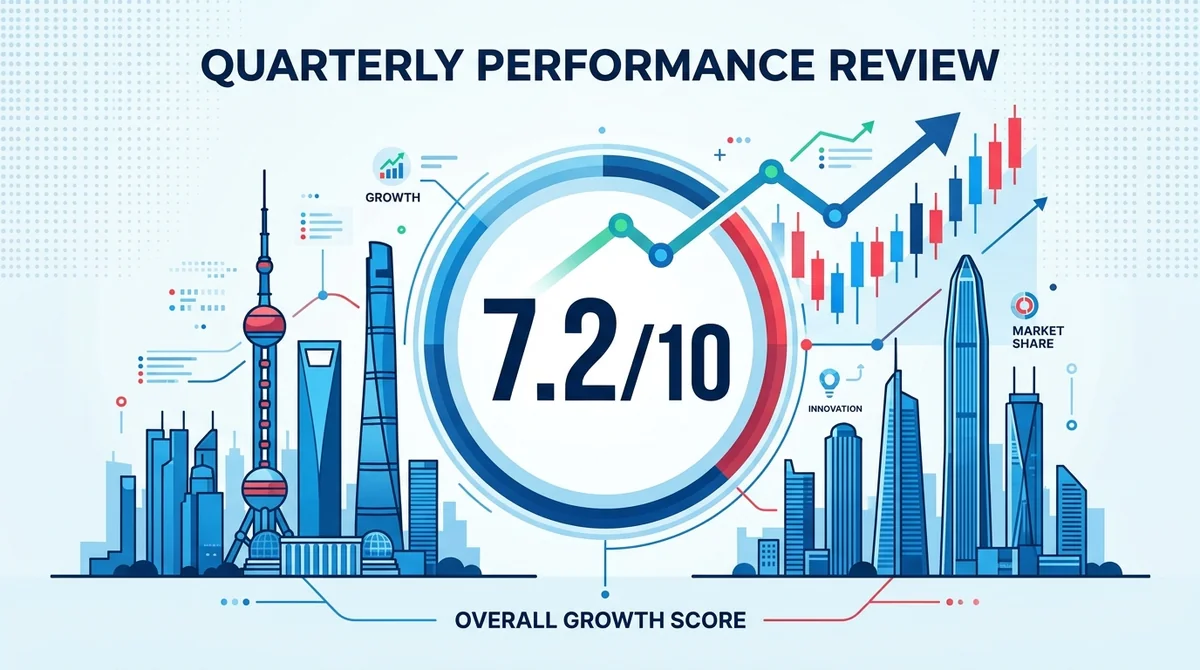
China A-share market scores 7.2/10, with world-leading liquidity but high volatility. Data-driven review across liquidity, volatility, regulation, foreign access, costs, and investor fit.
The China A-share market has a composite score of 7.2/10, suitable for investors who are bullish on China's long-term economic prospects and can tolerate high volatility. Liquidity is among the best globally, but high retail participation and policy sensitivity lead to significantly higher volatility than mature markets.
#Liquidity
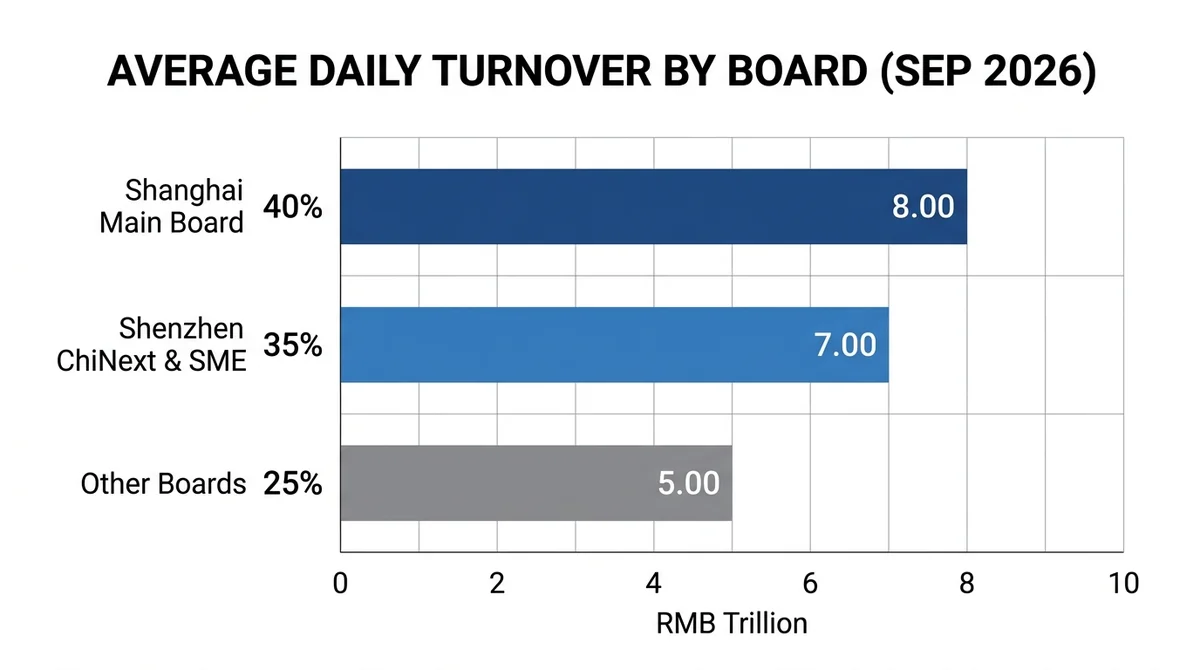
The combined average daily turnover of the Shanghai and Shenzhen exchanges frequently exceeds RMB 1 trillion, making liquidity among the best in the world. Financial, technology, and consumer sectors are the most actively traded. As of September 2026, A-share average daily turnover exceeded RMB 1.5 trillion for many consecutive days, with the Shanghai main board contributing about 40% and the Shenzhen ChiNext and SME boards together about 35%. Northbound capital recorded an average daily net inflow of about RMB 5 billion, indicating high foreign investor activity.
#Volatility
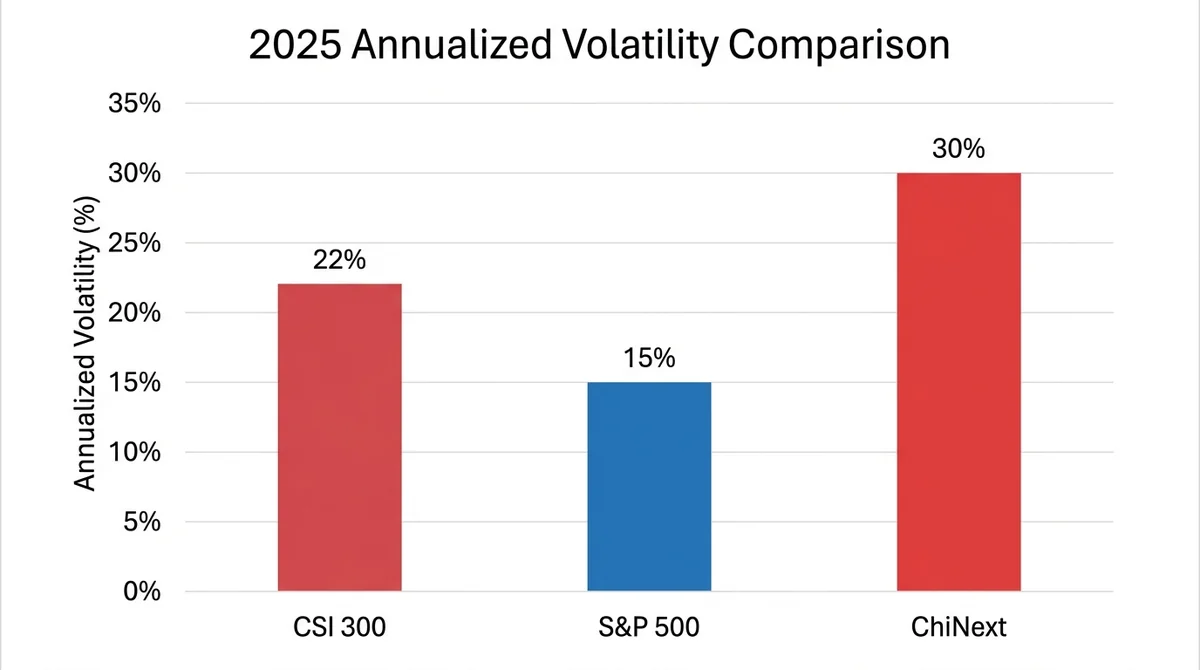
A-share annualized volatility is generally higher than in mature markets, driven mainly by high retail participation and policy sensitivity. In 2025, the CSI 300 Index had an annualized volatility of about 22%, compared with only 15% for the S&P 500 over the same period. The ChiNext Index was even more volatile, exceeding 30%. Policy changes (such as industry regulation or monetary policy adjustments) often trigger sharp short-term swings; for example, in Q4 2025, the new energy sector had a single-week amplitude of over 10% due to expected changes in subsidy policies.
#Regulatory Environment
The regulatory framework is centered on the China Securities Regulatory Commission (CSRC). In recent years, registration-based IPO reform and strengthened delisting have improved market standardization. After the full implementation of the registration system in 2023, IPO review efficiency improved, but the number of delisted companies has also increased year by year; in 2025, 45 companies were forcibly delisted, a record high. Regulators have intensified crackdowns on illegal activities such as information disclosure violations, insider trading, and market manipulation. In 2025, the CSRC issued 320 administrative penalty decisions, with fines and confiscations exceeding RMB 10 billion.
#Foreign Investor Participation
Foreign investors mainly access A-shares through QFII and the Stock Connect schemes, with the latter being more convenient, but total foreign ownership generally does not exceed 30%. As of June 2026, foreign investors held about RMB 2.8 trillion in A-shares through Stock Connect, accounting for about 4.5% of the free-float market cap. QFII quotas have been fully liberalized, but the actual utilization rate is below 50%, mainly due to approval procedures and capital repatriation restrictions. International indices such as MSCI and FTSE Russell have included A-shares, but the inclusion factor is only 20%, leaving room for future increases.
#Trading Costs
Commissions are typically around 0.025% (2.5 basis points), and stamp duty on sells is 0.1%, making overall costs lower than most emerging markets but higher than US stocks. Mainstream brokers now charge commissions below 0.025%, with some internet brokers as low as 0.015%. After the stamp duty was halved in August 2023, the sell-side stamp duty is 0.05%. In addition, the transfer fee is 0.002% of the transaction amount, and the securities regulatory fee is 0.002%. Overall, one-way trading costs are about 0.035%, and round-trip costs about 0.07%, lower than Hong Kong stocks (about 0.15%) but higher than US stocks (usually commission-free).
#Investor Suitability
Suitable for investors who are bullish on China's long-term economic prospects and can tolerate high volatility. Short-term trading is constrained by the T+1 settlement rule and requires coping with high volatility. The proportion of institutional investors has been rising year by year; as of June 2026, institutions such as public funds, insurers, and social security funds held about 25% of A-share free-float market cap, up 10 percentage points from 2015. Individual investors still account for over 60% of trading volume, but the trend is declining.
#Risk Warning
The A-share market has high volatility, a large retail presence, and strong policy sensitivity. Investors should fully assess their own risk tolerance. The market carries liquidity risk and individual stock volatility risk. Moreover, with delisting becoming routine, low-priced and underperforming stocks face greater risks; in 2025, 80% of delisted companies were delisted due to trading below par value. Investors should avoid blindly chasing rallies or selling into dips and focus on fundamental analysis.
#Conclusion
The China A-share market has world-leading liquidity and gradually improving regulation, but high volatility. It is suitable for long-term value investors, while short-term traders need caution. The composite score is 7.2/10, with liquidity scoring 9.0/10, regulatory environment 7.5/10, trading costs 6.5/10, investor suitability 7.0/10, and volatility 5.5/10.
#FAQ
Q: How is the liquidity of the China A-share market? A: The combined average daily turnover of the Shanghai and Shenzhen exchanges frequently exceeds RMB 1 trillion, making liquidity among the best in the world. Financial, technology, and consumer sectors have the best liquidity. In September 2026, average daily turnover reached RMB 1.6 trillion, with a turnover rate of about 2.5%, higher than US stocks (about 1.2%).
Q: What are the characteristics of volatility in the China A-share market? A: A-share annualized volatility is generally higher than in mature markets, driven mainly by high retail participation and policy sensitivity. In 2025, the CSI 300 annualized volatility was 22%, the ChiNext Index exceeded 30%, while the S&P 500 was only 15% over the same period.
Q: How can foreign investors participate in the China A-share market? A: Mainly through QFII and the Stock Connect schemes, with Stock Connect being more convenient, but total foreign ownership generally does not exceed 30%. As of June 2026, foreign investors held about RMB 2.8 trillion in A-shares, accounting for 4.5% of free-float market cap.
Q: What trading costs are involved in the China A-share market? A: Commissions are typically around 0.025% (2.5 basis points), and stamp duty on sells is 0.1%, making overall costs lower than most emerging markets but higher than US stocks. Currently commissions are as low as 0.015%, sell-side stamp duty is 0.05%, transfer fee is 0.002%, and securities regulatory fee is 0.002%.
Q: What type of investor is the China A-share market suitable for? A: Suitable for investors who are bullish on China's long-term economic prospects and can tolerate high volatility. Short-term trading is constrained by the T+1 settlement rule and requires coping with high volatility. The institutional investor share has risen to 25%, but individual investors still dominate trading volume.
Q: What is the regulatory trend in the A-share market? A: Regulation is tightening, with the registration system fully implemented and delisting becoming routine. In 2025, 45 companies were forcibly delisted, and administrative penalty fines and confiscations exceeded RMB 10 billion, significantly improving market standardization.
This content is compiled from public data and does not constitute investment or account opening advice. Data as of 2026-09-12; actual conditions may change. For more information, please refer to official sources.
FAQ
How is the liquidity of the China A-share market?
The combined average daily turnover of the Shanghai and Shenzhen exchanges frequently exceeds RMB 1 trillion, making liquidity among the best in the world. Financial, technology, and consumer sectors have the best liquidity.
What are the characteristics of volatility in the China A-share market?
A-share annualized volatility is generally higher than in mature markets, driven mainly by high retail participation and policy sensitivity.
How can foreign investors participate in the China A-share market?
Mainly through QFII and the Stock Connect schemes, with Stock Connect being more convenient, but total foreign ownership generally does not exceed 30%.
What trading costs are involved in the China A-share market?
Commissions are typically around 0.025% (2.5 basis points), and stamp duty on sells is 0.1%, making overall costs lower than most emerging markets but higher than US stocks.
What type of investor is the China A-share market suitable for?
Suitable for investors who are bullish on China's long-term economic prospects and can tolerate high volatility. Short-term trading is constrained by the T+1 settlement rule and requires coping with high volatility.
Related Terms
Read the review? Ready to try a small position?
The crypto assets and tokenized US stocks/ETFs covered here are available on MSX — spot and perpetuals.
Quick Start Trading →New here? Registration takes three quick steps.