Delivery Futures
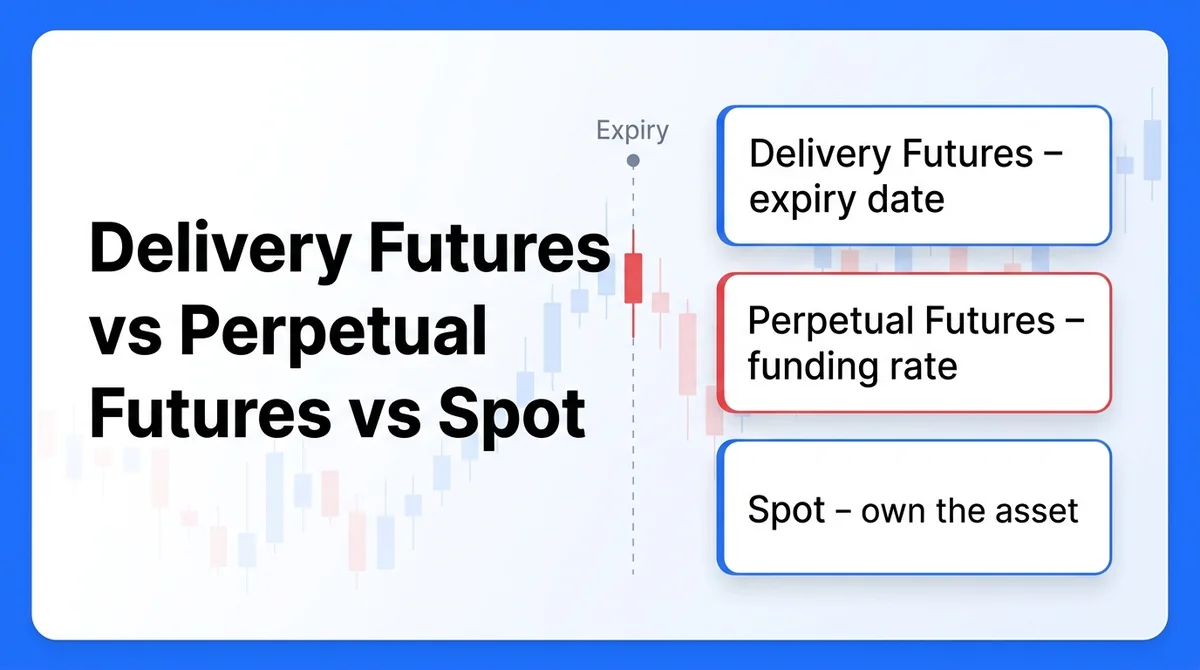
Delivery futures settle on a fixed expiry date; perpetuals have no expiry and rely on funding. Compare mechanics, 5 evaluation dimensions, pros, cons, and a pre-expiry checklist.
Delivery futures are derivative contracts with a defined expiry date that settle according to agreed rules at maturity. Their mechanics differ from perpetual futures, which have no expiry and are anchored by how does perpetual futures funding rate work; if you need a defined time window rather than an indefinite position, the structure of delivery futures may fit better—otherwise you should evaluate other tools first.
One-line conclusion: users with a defined time window who can actively manage expiry and settlement should choose delivery futures; those who want to hold the asset itself long term should choose spot; those who want continuous price exposure without handling expiry should choose perpetual futures, but must bear the funding rate cost.
Data cutoff date: 2026-01-01. The specific platform parameters referenced in this article (settlement price algorithm, perpetual futures leverage tiers, fee rates, order book depth) are all marked as "data not disclosed"; before use, refer to the real-time data in the platform's official contract rules documentation.
This article does not constitute investment advice or advice to open account. Leveraged expiring contracts carry liquidation risk, and losses may reach the entire margin.
#What are delivery futures, and how do they differ from perpetual futures?
Delivery futures are futures-type contracts that undergo physical or cash settlement on a specific expiry date. Their core feature is the expiry date: the contract terminates on the agreed date and is settled according to pre-published rules. Perpetual futures have no expiry date; they anchor the contract price near the spot price through periodic receipt or payment of funding rates.
One conceptual point needs to be clear first: contracts only trade price movements and do not hold the asset itself. Buying a delivery futures contract is not the same as holding the underlying asset; you gain price exposure, not asset ownership, voting rights, or dividend rights. This is fundamentally different from holding-type instruments such as spot and tokenized stocks.
#Delivery futures, perpetual futures, or spot: how to choose? Key differences
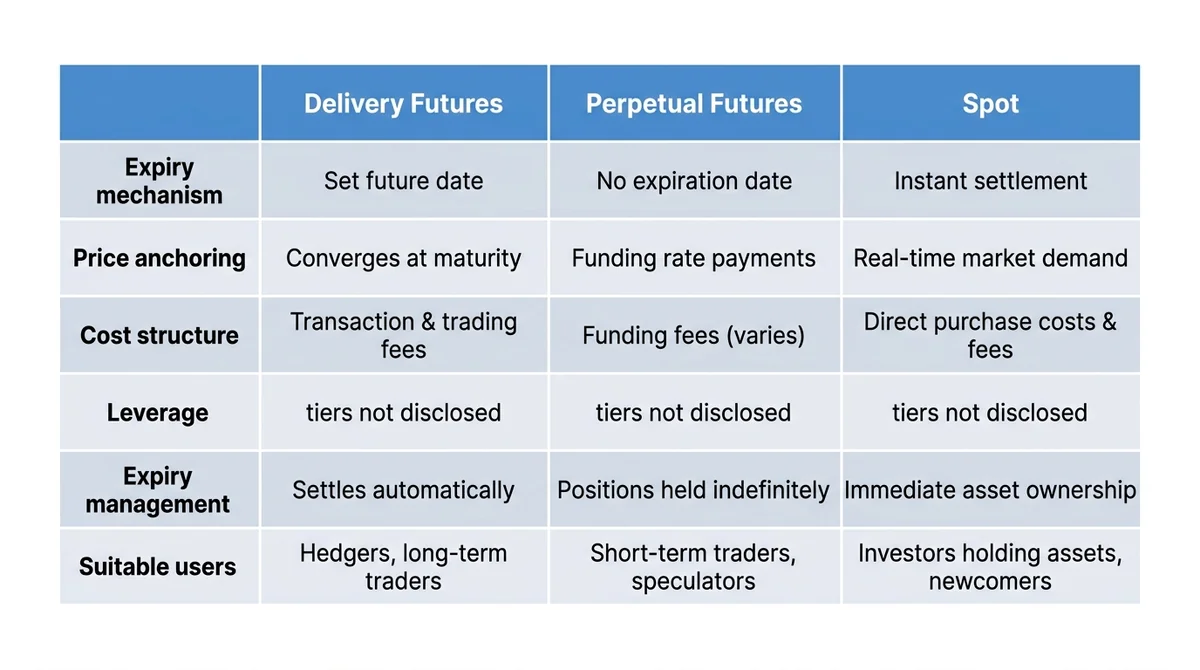
Conclusion first: it depends on whether you want "expiry." Choose delivery futures for an expiry structure, perpetuals for indefinite price exposure, and spot for the asset itself.
| Comparison dimension | Delivery futures | Perpetual futures | Spot |
|---|---|---|---|
| Expiry mechanism | Defined expiry date; settled by rules at maturity | No expiry; can be held long term | No expiry concept |
| Price anchoring | Converges toward spot/index price at expiry | Anchored by periodic funding rates | Immediate market price |
| Cost structure | Mainly open/close spread and fees | Continuous funding rate receipts/payments + fees | Mainly trading fees |
| Leverage | Usually supported; specific tiers not disclosed | Usually supported; specific tiers not disclosed | Generally no leverage |
| Expiry management cost | Requires active closing or preparation for settlement | No expiry management needed | No expiry management needed |
| Suitable users | Users with a defined time window who can actively manage expiry | Users wanting continuous exposure who can bear funding rates | Users wanting to hold the asset itself |
#How does expiry settlement of delivery futures work?
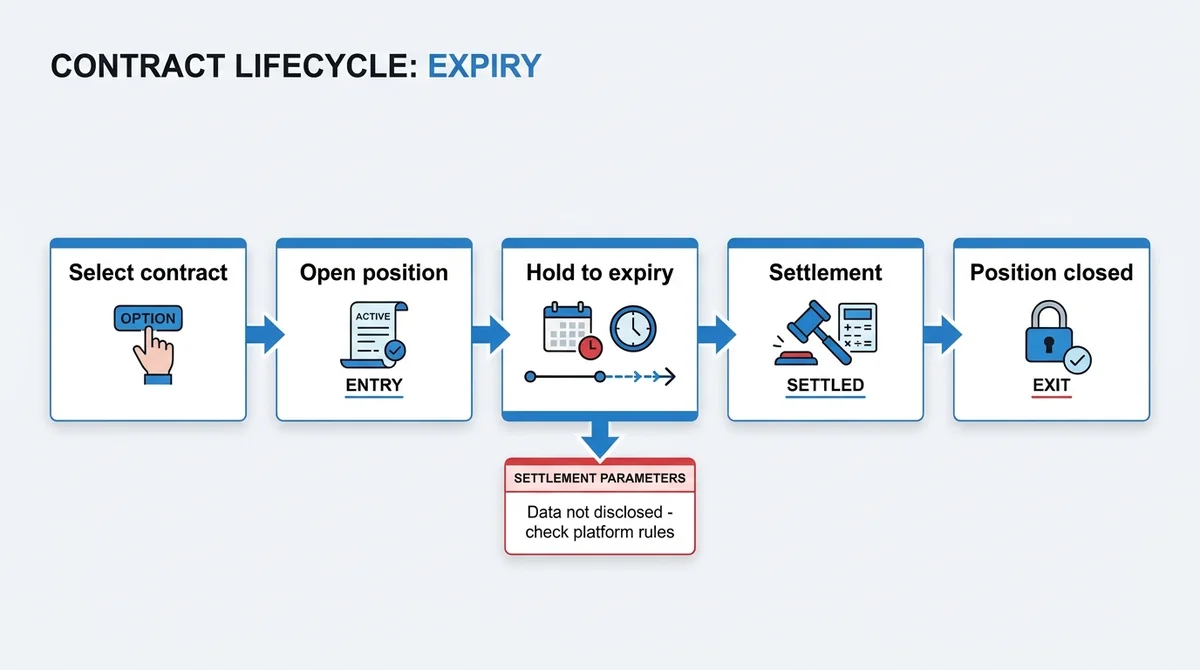
Expiry settlement is usually executed according to the settlement price and rules agreed in the contract, and the settlement price generally references the underlying spot price or index price during the expiry period. The specific calculation method, settlement timing, and fee handling differ by platform. This article does not cite the settlement parameters of any specific platform; relevant values are marked as data not disclosed, and you should consult that platform's contract rules documentation before use.
#What is the difference between having an expiry date and not having one?
The difference shows up in three places: first, time management cost—delivery futures require you to actively close or prepare for expiry settlement, while perpetual futures do not; second, the price anchoring mechanism—delivery futures rely on convergence at expiry, while perpetual futures rely on funding rates; third, the position cost structure—perpetual futures involve continuous funding rate receipts and payments, while the cost of delivery futures is more reflected in the open/close spread and fees.
#How should the five evaluation dimensions of delivery futures be scored?
Delivery futures can be evaluated across five dimensions: expiry and settlement rule transparency, perpetual futures leverage and liquidation mechanism, liquidity cost, underlying coverage, and risk controllability; missing data is marked as "data not disclosed." Below are the judgment points and scoring table for each dimension.
| Evaluation dimension | What to look at | Scoring points | Data status |
|---|---|---|---|
| Transparency of expiry and settlement rules | Settlement price source, settlement timing, rule change announcements | Deduct points if the settlement price algorithm is not disclosed | Data not disclosed |
| Perpetual futures leverage and liquidation mechanism | Leverage tiers, how does cross margin work in perpetual futures trading, liquidation and deleveraging sequence | The higher the leverage, the greater the probability that adverse price moves trigger liquidation | Data not disclosed |
| Liquidity and trading costs | Order book depth, bid-ask spread, fee rates, liquidity decay before expiry | Deduct points if depth declines and slippage widens near expiry | Data not disclosed |
| Available underlyings and contract cycles | Types of underlyings, weekly/monthly/quarterly expiry cycles | Richer cycles make it easier to match your time window | Data not disclosed |
| Risk controllability and user fit | Whether risk characteristics match holding period and risk tolerance | Deduct points if you cannot monitor the market continuously | Qualitative judgment |
#Transparency of expiry and settlement rules
Check whether the settlement price source is verifiable, whether the settlement timing is clear, and whether rule changes have an announcement mechanism. The more transparent the rules, the lower the uncertainty before expiry. If a platform does not disclose its settlement price algorithm, this dimension should be scored down.
#Perpetual futures leverage and liquidation mechanism
Look at available perpetual futures leverage tiers, margin mode (how does cross margin work in perpetual futures trading or isolated), and the liquidation trigger and deleveraging sequence. The higher the leverage multiple, the greater the probability that adverse price moves trigger liquidation. Specific tiers and liquidation parameters are platform-level data, and this article does not speculate on them.
#Liquidity and trading costs
Look at order book depth, bid-ask spread, fee rates, and whether there is liquidity decay before expiry. Near expiry, open interest and depth of some contracts may decline, and slippage may widen. Specific fee rates and depth values are marked as data not disclosed and are subject to the platform's real-time data.
#Available underlyings and contract cycles
Look at which underlyings are supported and which expiry cycles exist (such as weekly, monthly, quarterly). The richer the cycles, the easier it is to match your time window; the more concentrated the underlyings, the less room for diversification.
#Risk controllability and user fit
Check whether the tool's own risk characteristics match your holding period and risk tolerance. Leveraged expiring contracts are not suitable for users who cannot monitor the market continuously or cannot bear liquidation losses.
#What are the pros and cons of delivery futures?
#Pros: what certainty does the expiry structure bring?
First, the expiry date is clear and the settlement rules are predictable, making it easier to plan around a fixed point in time. Second, the structure is clear: there is no continuous funding rate receipt or payment like perpetual futures, so the cost composition is relatively simple. Third, it suits strategies with a defined event window or time constraint.
#Cons: where does expiry risk show up?
First, you must actively manage expiry; if you do not close before expiry, you enter the settlement process, and the outcome is determined by the rules rather than your judgment. Second, volatility and liquidity changes near expiry require extra attention. Third, leverage amplifies gains and losses; adverse price moves may trigger liquidation, and losses may exceed initial expectations.
#Who are delivery futures suitable for, and who are they not suitable for?
Conclusion: suitable for users with a defined time window who can actively manage expiry and settlement; not suitable for users who want to hold the asset itself long term or do not want to handle expiry.
- Suitable: users with a defined expiry expectation, who treat the expiry date as part of their strategy, and who can actively close or are prepared to enter the settlement process.
- Not suitable: users who want to hold the asset itself long term (they should look at spot-type tools), users who want continuous price exposure but do not want to manage expiry (they should look at perpetual futures and bear the funding rate cost), and users who cannot monitor the market continuously or cannot bear liquidation losses.
#How should traders with a defined time window use them?
They are suitable for users with a defined expiry expectation who can actively close or are prepared to enter the settlement process. These users treat the expiry date as part of their strategy rather than a nuisance to avoid.
#Why do long-term holding needs not match?
Users who want to hold long term and do not want to handle expiry and settlement are not suited to delivery futures. If the goal is to hold the asset itself long term, they should focus on spot-type tools; if the goal is continuous price exposure without managing expiry, the mechanics of perpetual futures are closer to the need, but they must bear the funding rate cost.
Risk tolerance is a prerequisite for judgment. Leveraged expiring contracts may quickly trigger liquidation in extreme market conditions, and before use you should confirm that you can bear the loss of the entire margin.
#What risks should you watch for when using delivery futures?
#How do perpetual futures leverage and liquidation amplify losses?
Perpetual futures leverage amplifies gains and losses by a multiple. When the price moves in an unfavorable direction and the margin is insufficient to maintain the position, liquidation is triggered, the position is forcibly closed, and the loss is realized as a realized loss. The higher the leverage, the smaller the price move needed to trigger liquidation.
#What should you watch for near expiry?
Before expiry, confirm the settlement rules, settlement price source, and settlement timing, and pay attention to changes in open interest and order book depth. If you plan to close, leave enough time and avoid concentrating operations during periods when liquidity declines.
#Action checklist: what to verify before opening an account and before expiry
Conclusion: before opening an account, verify rule transparency first; before expiry, verify settlement parameters and liquidity first.
Before opening an account/using:
- Whether the platform discloses the calculation source of the settlement price and the settlement timing (if not disclosed, score down this dimension).
- Whether available perpetual futures leverage tiers, margin mode (how does cross margin work in perpetual futures trading/isolated), and liquidation rules can be checked.
- Whether fee rates, bid-ask spreads, and order book depth can be viewed in real time.
- Whether the supported underlyings and expiry cycles (weekly/monthly/quarterly) cover your time window.
Before expiry:
- Confirm whether the settlement rules, settlement price source, and settlement timing have been announced.
- Assess changes in open interest and order book depth, leave time for closing, and avoid concentrating operations during periods when liquidity declines.
- Review margin levels and confirm you can bear adverse price moves and potential liquidation losses.
- Clarify whether you will actively close or enter the settlement process; the two outcomes are determined by different mechanisms.
This article does not constitute investment advice.
This content is compiled from public information and does not constitute investment or open account advice. No specific platform parameters are cited in this article, and actual conditions may change. To verify specific rules, you can check the relevant platform's official contract documentation (such as the platform's official rules documentation or a regulator's public risk warning page).
#FAQ
Q1: What is the core difference between delivery futures and perpetual futures? A: Delivery futures have a defined expiry date and settle at maturity; perpetual futures have no expiry date and anchor the spot price through funding rates.
Q2: Do delivery futures close automatically at expiry? A: After expiry, they are handled according to the platform's agreed settlement rules. Whether settlement is automatic or requires active action depends on that platform's rules; this article does not have the specific parameters, which fall under data not disclosed.
Q3: Do delivery futures require constant market monitoring? A: Leveraged expiring contracts carry rising risk near expiry and during violent swings, and usually require continuous attention to margin and the expiry timing; users who cannot monitor the market continuously should be cautious.
Q4: How is the settlement price of delivery futures determined? A: It generally references the underlying spot price or index price during the expiry period; the specific algorithm and parameters are determined by platform rules, and this article does not speculate.
Q5: If I don't want to manage the expiry date, what alternatives are there? A: You can consider perpetual futures with no expiry (bearing the funding rate cost), or use spot-type tools to gain asset exposure.
Q6: Which is more suitable for long-term holding, delivery futures or perpetual futures? A: Neither is fully suitable for holding the asset itself long term. If the goal is to hold the asset long term, choose spot-type tools; if you only want long-term price exposure and can bear funding rates, perpetual futures are closer to the need than delivery futures, because there is no need to repeatedly handle expiry.
Q7: What happens if delivery futures are not closed at expiry? A: Positions not closed before expiry enter the platform's agreed settlement process and are settled according to the settlement price and rules; the outcome is determined by the rules rather than your judgment. Whether settlement is automatic or requires active action depends on platform rules and falls under data not disclosed.
Q8: Are delivery futures suitable for beginners? A: Generally not. Delivery futures involve leverage, expiry management, and liquidation risk, and require understanding settlement rules and continuously monitoring margin; beginners should first learn about spot and non-leveraged tools before evaluating whether to use expiring contracts.
Q9: What is the cost structure of delivery futures? A: The cost of delivery futures is mainly reflected in the open/close spread and fees; there is no continuous funding rate receipt or payment like perpetual futures. However, liquidity may decline near expiry, and slippage costs may rise. Specific fee rates are subject to the platform's real-time data and fall under data not disclosed.
FAQ
What is the core difference between delivery futures and perpetual futures?
Delivery futures have a defined expiry date and settle at maturity; perpetual futures have no expiry date and anchor the spot price through funding rates.
Do delivery futures close automatically at expiry?
After expiry, they are handled according to the platform's agreed settlement rules. Whether settlement is automatic or requires active action depends on that platform's rules; this article does not have the specific parameters, which fall under data not disclosed.
Do delivery futures require constant market monitoring?
Leveraged expiring contracts carry rising risk near expiry and during violent swings, and usually require continuous attention to margin and the expiry timing; users who cannot monitor the market continuously should be cautious.
How is the settlement price of delivery futures determined?
It generally references the underlying spot price or index price during the expiry period; the specific algorithm and parameters are determined by platform rules, and this article does not speculate.
If I don't want to manage the expiry date, what alternatives are there?
You can consider perpetual futures with no expiry (bearing the funding rate cost), or use spot-type tools to gain asset exposure.
Read the review? Ready to try a small position?
The crypto assets and tokenized US stocks/ETFs covered here are available on MSX — spot and perpetuals.
Quick Start Trading →New here? Registration takes three quick steps.