Choosing the Right Form
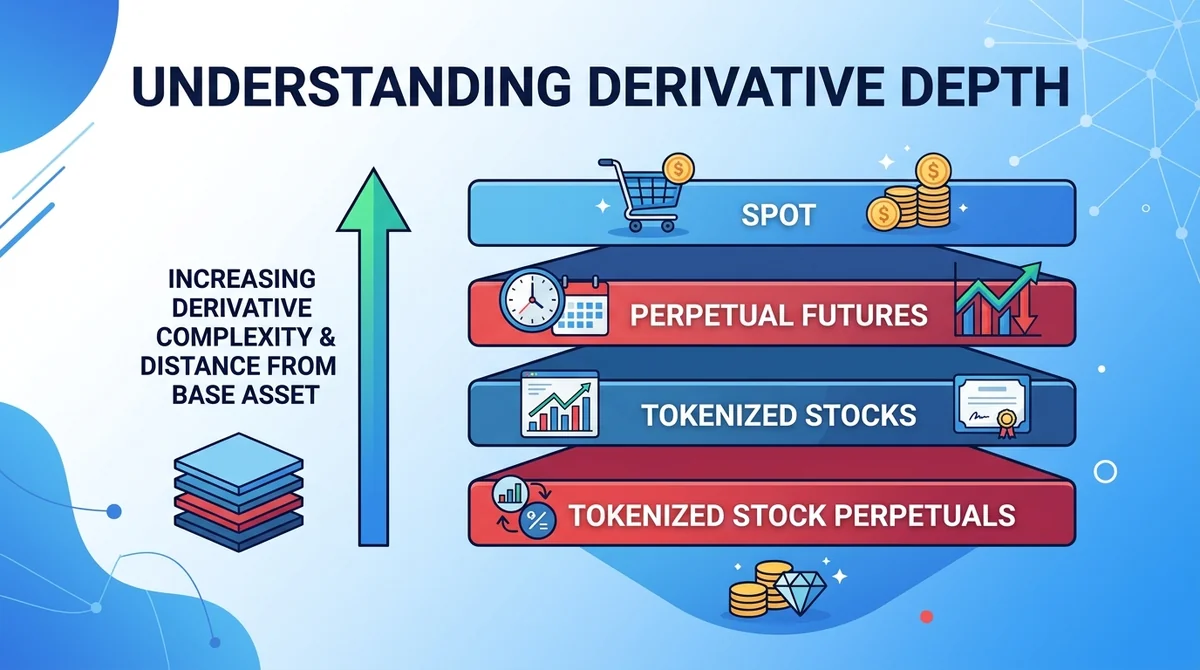
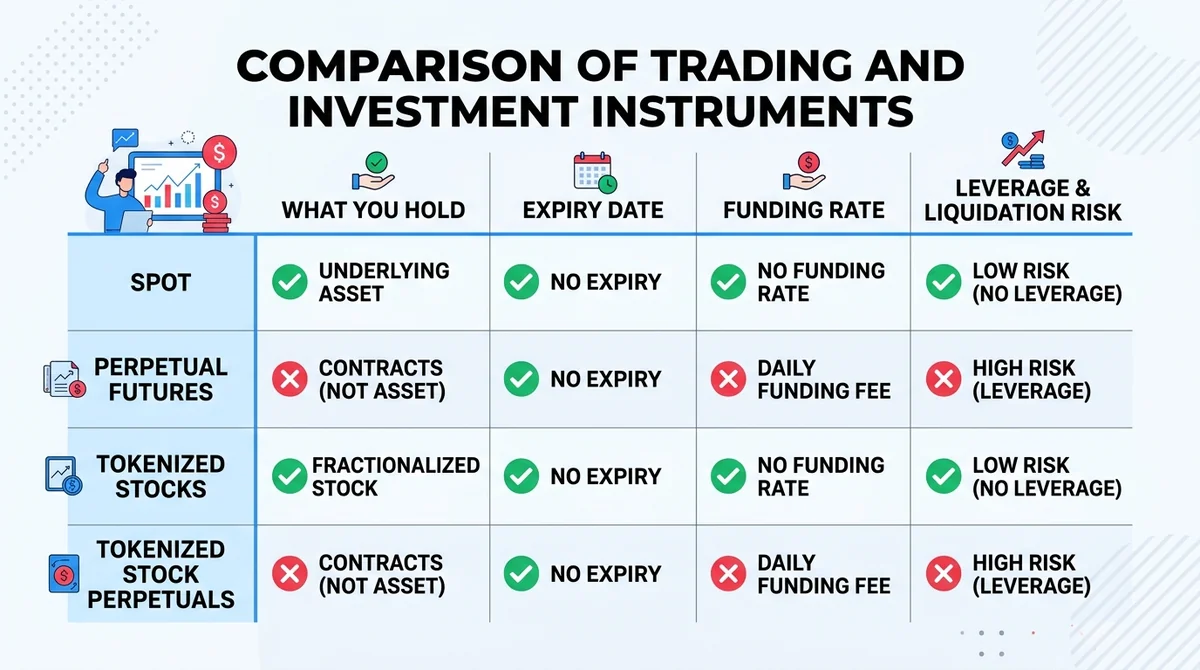
Spot, perpetuals, tokenized stocks and tokenized stock perpetuals compared by holding purpose, price exposure, shareholder rights, leverage and funding costs.
Start with your holding purpose: if you want to actually hold the asset itself, choose spot; only if you want to trade price movements and accept leverage and liquidation risk should you look at perpetual futures; if you only need US stock price exposure without shareholder rights, consider tokenized stocks; tokenized stock perpetuals are a further derivative layer and only enter the picture when you are explicitly pursuing derivative efficiency.
#What exactly is the difference between spot, perpetual futures, tokenized stocks and tokenized stock perpetuals?
The core difference among the four forms lies in what you hold: the asset itself, a price contract, or a layer of price exposure.
#What does each of the four forms hold?
Spot: real buying and selling, holding the asset itself. You own the underlying asset, price movements are reflected directly in the position value, there is no expiry date, and there is no funding rate.
Perpetual futures: no expiry date, anchored to the spot price through the perpetual futures funding rate settlement schedule. What you hold is a contract position; you trade price movements, not the asset itself. It carries perpetual futures leverage and involves forced liquidation and blow-up mechanisms.
Tokenized stocks: map US stock price performance in token form, providing price exposure rather than genuine US stock shareholder status.
Tokenized stock perpetuals: add another derivative structure on top of tokenized stock price exposure, with leverage and funding rates, further removed from real stocks.
#Are tokenized stocks the same thing as real US stocks?
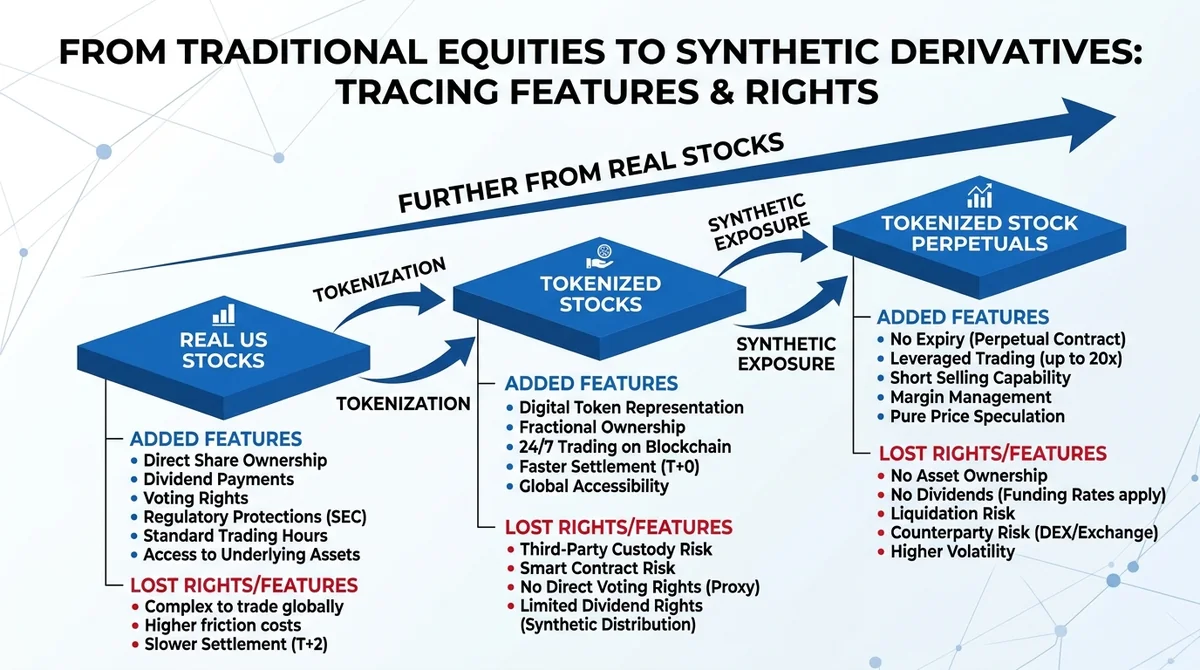
No. Tokenized stocks provide US stock price exposure without real shareholder rights. Real US stock shareholders typically have shareholder-level rights involving corporate actions, voting rights and dividend arrangements, while tokenized stocks handle these aspects differently, and specific terms are subject to issuer disclosure. If this difference matters to you, see the site's two comparisons: "Direct Ownership vs Tokenized Stocks: Corporate Actions and Dividend Reinvestment Differences 2026" and "Direct Ownership vs Tokenized Stocks: Ownership, Tax and Platform Risk 2026".
#Why are tokenized stock perpetuals further from real stocks?
Tokenized stock perpetuals are derivatives: they do not hold the tokenized stock itself but trade contracts on its price direction. With leverage and funding rates layered on, their return structure, cost structure and risk boundaries all differ from real shareholding, making them a price tool one layer further out.
#Is your holding purpose to hold the asset or to trade price movements?
Holding purpose determines the form: this sentence is the first-principles criterion for choosing among the four forms.
#Which form should I choose for long-term holding?
If the purpose is to hold the asset itself long term, choose spot. Spot involves no ongoing cost of how does perpetual futures funding rate work, and there is no leveraged forced liquidation mechanism; position value corresponds directly to the asset price.
#Which form should I choose if I only want to profit from price swings?
Only if the purpose is trading price movements should you consider perpetual futures. Perpetual futures have no expiry date and allow both long and short positions, but they carry perpetual futures leverage; adverse price moves may trigger forced liquidation or blow-up, and you must keep paying funding rates.
#What if I need US stock exposure but not shareholder rights?
When you only need US stock price exposure and do not require shareholder rights, consider tokenized stocks. They provide price exposure rather than shareholder status, suitable for scenarios where US stock price performance is used as an allocation or hedging variable without shareholder-level rights claims.
#How do leverage and liquidation risk affect form selection?
#What risks does leverage amplify?
Leverage amplifies both gains and losses. Perpetual futures and tokenized stock perpetuals both carry perpetual futures leverage; when prices move adversely, the speed and magnitude of losses are amplified.
#Under what circumstances do forced liquidation and blow-up occur?
When margin is insufficient to maintain a position, forced liquidation is triggered; in extreme market conditions a blow-up may occur, with losses potentially extending to the entire principal. The higher the leverage, the closer the price at which forced liquidation is triggered. Specific liquidation rules, maintenance margin ratios and TRUMPUSDT perpetual futures margin requirements explained vary by platform and are subject to platform rules (not individually verified in this article).
#Is the funding rate an ongoing cost?
Yes. Perpetual futures and tokenized stock perpetuals both require continuous funding rate payments; the longer the holding period, the less negligible the cumulative cost. Specific funding rate values change with the market, and this article does not cite unverified figures.
#If... then...: scenario routing for the four forms
- If you only want to hold the asset itself long term, choose spot and avoid leverage and funding rates.
- If you want to go long or short and accept blow-up risk, choose perpetual futures, but first confirm you can bear the loss of your entire principal.
- If you only want US stock price exposure and no shareholder rights, consider tokenized stocks.
- If you pursue derivative efficiency and understand leverage and funding rate costs, only then look at tokenized stock perpetuals.
- If you are unsure of your purpose, go back to the question "hold the asset or trade price movements" — the answer will directly eliminate half the options.
#What risks and disclaimers should I understand before choosing a form?
#What are the rights differences between tokenized stocks and real stocks?
Tokenized stocks are not the same as real US stocks and do not carry real shareholder rights. Shareholder-level matters such as corporate actions, dividend arrangements and voting rights are handled differently from direct shareholding, subject to issuer terms.
#Where is the loss boundary for leveraged products?
Leveraged derivatives may lose the entire principal. Both perpetual futures and tokenized stock perpetuals may trigger a blow-up in extreme market conditions, and the loss boundary is not limited to the initial margin.
This content is compiled from public data and does not constitute investment or open account advice. Data is as of 2026-06-30 and actual conditions may change. To verify specific terms, check the official sources of the relevant platforms.
FAQ
What is the most essential difference between spot and perpetual futures?
Spot holds the asset itself, while perpetual futures only trade price movements. Perpetual futures have no expiry date, are anchored to the spot price through funding rates, carry leverage and involve forced liquidation and blow-up mechanisms.
Do tokenized stocks equal holding real US stocks?
No. Tokenized stocks provide US stock price exposure without real shareholder rights; shareholder-level matters such as corporate actions and dividends are handled differently from direct shareholding.
What is the difference between tokenized stock perpetuals and tokenized stocks?
Tokenized stocks are price exposure itself; tokenized stock perpetuals add another derivative structure on top, with leverage and funding rates, further removed from real stocks.
Do only perpetual futures have funding rates?
The funding rate is a mechanism of perpetual futures-type products, used to anchor the spot price. Spot holding involves no ongoing cost of how does perpetual futures funding rate work.
What should I do if I am unsure which form to choose?
First answer the question "hold the asset or trade price movements": hold the asset means spot, trade price movements means considering perpetual-type products; if US stock price exposure alone suffices, look at tokenized stocks.
Read the review? Ready to try a small position?
The crypto assets and tokenized US stocks/ETFs covered here are available on MSX — spot and perpetuals.
Quick Start Trading →New here? Registration takes three quick steps.