How to Pick a Crypto Asset
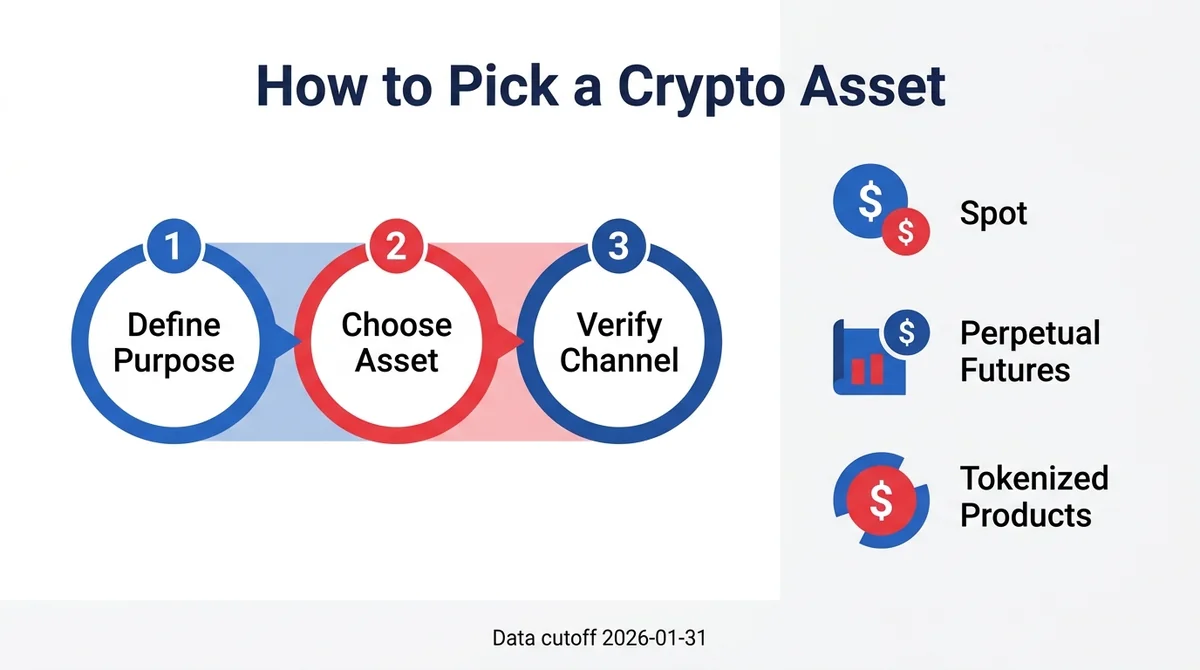
Beginners should define the purpose first, then the asset: spot vs perpetual futures vs tokenized products compared on ownership, leverage and rights, plus checklists.
How beginners pick a crypto asset starts not with the gainers list, but with defining your purpose: long-term holding, trading volatility, or simply gaining exposure to a certain price. Purpose determines the universe of assets, and that universe then determines which trading channels are available.
Data cutoff: 2026-01-31. This article is an information summary and does not include specific platform fee rates, yields, volume, or reserve sizes. Any specific figures and rules must defer to the platform's official public disclosures, and where data is not public it is marked as "data not disclosed."
#Where should beginners start when picking a crypto asset?
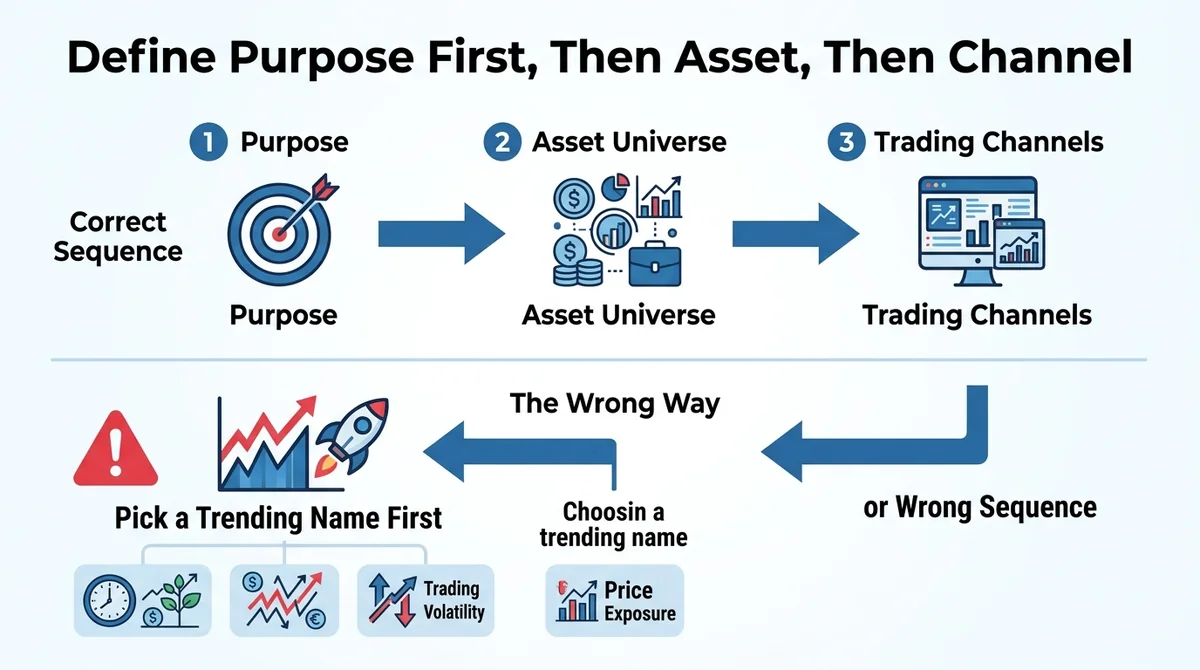
Conclusion: Define the purpose first, then the asset, and finally verify the channel. Reverse the order and you will be led around by trending names.
#Why is defining the purpose more important than picking the coin first?
You define the purpose first because it determines what you actually need. Holding the asset itself, trading price volatility, and taking only a slice of price exposure correspond to completely different asset forms, cost structures, and risks. Picking a name first and then thinking about the purpose often mismatches "trading volatility" into a "long-term holding" position, or mistakes "price exposure" for "holding the asset."
#How should you self-check holding period, risk tolerance, and available trading channels?
- Holding period: How long do you plan to hold? The shorter the period, the more you rely on liquidity and trading costs; the longer the period, the more you rely on disclosure and the asset's own ability to persist.
- Risk tolerance: How large a drawdown can you accept? Crypto asset prices are highly volatile, and perpetual futures leverage further amplifies losses.
- Trading channels: Which platforms can you legally access in your region, and which asset types do they support? The channel determines the available scope; compliance regions and asset lists that a platform does not disclose should not be treated as default options.
#Which verifiable dimensions should you look at when choosing a coin?
Conclusion: Prioritize liquidity, disclosure, and asset type. These three reflect actual tradability and risk better than short-term price performance.
#What do liquidity and volume tell you?
Liquidity determines whether you can enter and exit near the quoted price, and volume reflects market participation. When liquidity is thin, bid-ask spreads widen, the impact cost of large trades rises, and paper gains may not be realizable at the exit price. Specific data such as order book depth and volume must defer to the platform's public data; when data is not disclosed, it should be marked as "data not disclosed" rather than assuming "if there is volume, you can trade."
#Which items should you check in a project's disclosure?
Check at least four: asset type and issuance structure, custody fee arrangements, fee structure, and whether there is verifiable reserve or audit documentation. If any item is missing, treat it as incomplete information rather than as safe by default. "Having an audit report" does not by itself mean the risk is eliminated; you also need to look at the audit scope, timing, and issuer.
#What is the difference between spot, futures, and tokenized products?
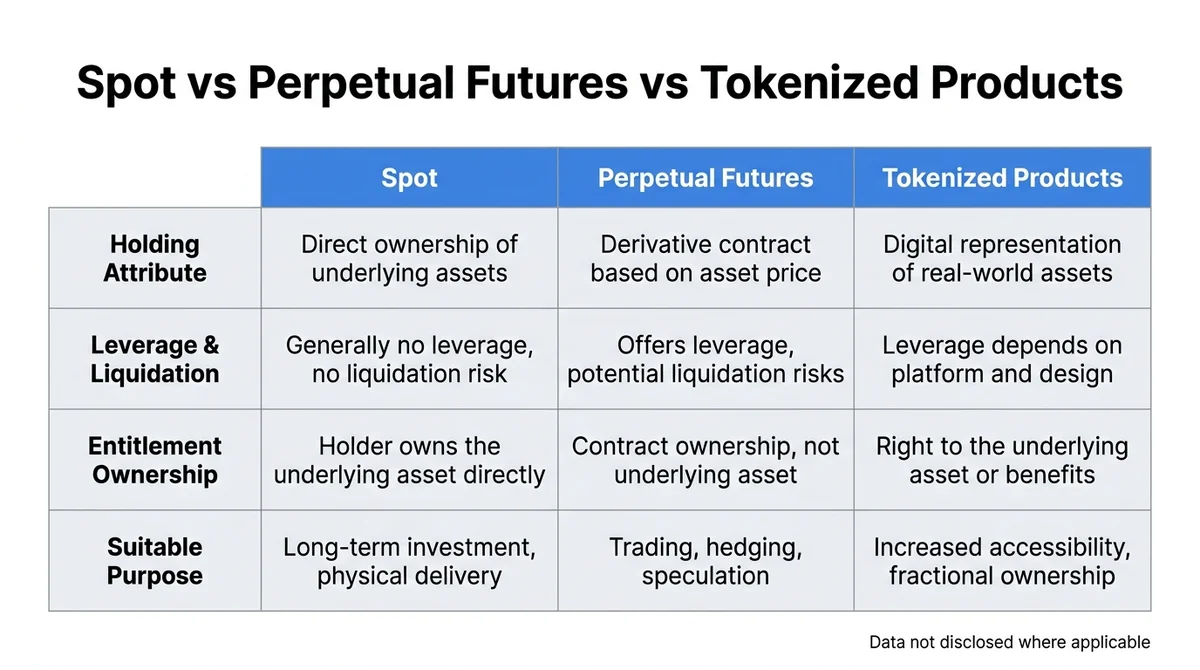
Conclusion: Spot holds the asset itself; perpetual futures only trade direction and carry a liquidation mechanism; tokenized products give price exposure rather than shareholder status. The differences in holding attributes, perpetual futures leverage risk, and entitlement ownership mean they suit completely different purposes.
| Dimension | Spot | Perpetual futures | Tokenized products |
|---|---|---|---|
| Holding attribute | Holds the asset itself; price exposure and ownership are relatively direct | Does not hold the asset; trades direction | Provides price exposure, usually not equivalent to true ownership of the underlying |
| Leverage and liquidation | Generally no forced liquidation (unless borrowing) | Involves funding rates and liquidation mechanics; perpetual futures leverage amplifies losses | Leverage arrangements depend on product structure and must be checked item by item |
| Entitlement ownership | Belongs to the holder; specific rights depend on issuance and custody arrangements | No underlying entitlements, only a contract position | Usually excludes shareholder status, voting rights, or dividend entitlements |
| Main costs | Trading fees and bid-ask spread | Fees, funding rates, liquidation losses | Management fees, structural costs, and spreads (data not disclosed) |
| Suitable for | People who hold long term and value ownership attributes | People who understand leverage and liquidation and trade short- to mid-term volatility | People who only need a certain price exposure and do not need shareholder rights |
For the mechanics difference between spot and perpetual, see the on-site "perpetual futures vs spot trading pros and cons: 2026 trader strategy and platform selection decision guide"; for the ownership difference between tokenized stocks and real stocks, see "Direct shareholding vs tokenized stocks: ownership, tax, and platform risk 2026." (On-site references are commercial links · do not affect scoring or ranking)
#How should you route your choice in different scenarios?
Conclusion: Route by goal—long-term holders look at spot liquidity and transparency, volatility traders first understand leverage and liquidation, and those who only want price exposure must be clear that tokenized products are not the real underlying.
- If you are a long-term holder: Prioritize spot assets with good liquidity and complete disclosure, and limit the share of any single asset.
- If you trade volatility: First understand how does perpetual futures funding rate work, liquidation mechanics, and perpetual futures leverage costs before deciding whether to use perpetual futures; see the on-site "BTC spot vs BTC perpetual 2026: funding rate, liquidation mechanics, and trading cost differences." (Commercial link · does not affect scoring or ranking)
- If you only want a certain price exposure: You can learn about tokenized products, but you must be clear that they provide price exposure, not shareholder status; see "Tokenized US stocks vs real US stocks: the shortest path to entry selection in 2026." (Commercial link · does not affect scoring or ranking)
- If you care about the external environment: Macro events affect multi-asset moves; see the on-site "FOMC rate decision preview: bitcoin and ethereum market impact analysis." (Commercial link · does not affect scoring or ranking)
- If you care about regional availability: Differences in compliant channels in regions such as the Middle East affect the available scope; defer to the platform's public compliance-region disclosures.
#What are the most common pitfalls for beginners choosing coins?
Conclusion: Looking only at short-term gains, over-concentrating positions, and using leverage are the three common mistakes that amplify the probability of losses.
#Why shouldn't you only look at the gainers list?
The gainers list reflects price changes over a past period; it does not reflect liquidity, disclosure, or asset type. Using the gainers list as the basis for choosing a coin substitutes short-term results for verifiable dimensions; the gain itself may also be driven by a small number of trades under low liquidity and does not mean you can exit at that price.
#What are the consequences of concentrated positions and leverage?
A concentrated position turns single-asset risk into portfolio risk; leverage triggers liquidation when prices move against you, pushing losses beyond what your principal can absorb. When the two combine, drawdowns accelerate markedly. In addition, the explicit fees and implicit slippage of frequent trading continuously erode returns, and short-term strategies especially need to calculate these costs first.
#FAQ
#DFDV spot vs perpetual futures trading on crypto exchange: what is the difference?
Spot means holding the asset itself, with price exposure and ownership attributes that are relatively direct; perpetual futures trade direction without holding the asset, involve funding rates and liquidation mechanics, and perpetual futures leverage amplifies losses. Before choosing, confirm whether you want holding or volatility.
#Are tokenized stocks the same as real US stocks?
No. Tokenized products provide price exposure and are usually not equivalent to shareholder status or entitlements in the real underlying, and generally exclude voting rights and dividend entitlements; specific rights depend on issuance and custody arrangements.
#What problems does insufficient liquidity cause?
Insufficient liquidity widens bid-ask spreads, raises the impact cost of large trades, and paper gains may not be realizable near the quoted price. Order book depth and volume must defer to the platform's public data; when data is not disclosed, it should be treated as unverifiable.
#Risk warning and disclaimer
Crypto asset prices are highly volatile. This article only provides screening dimensions and decision paths and does not constitute any investment advice. To verify specific platform rules, see the relevant platform's official source disclosures and regulator public pages, and defer to the platform's official public disclosures. This article contains no quantifiable data (fee rates, volume, reserve sizes, etc.); any specific figures must defer to the platform's official public disclosures.
FAQ
What should be the first step for beginners choosing a crypto asset?
Define the purpose first: long-term holding, trading volatility, or simply gaining exposure to a certain price. Purpose determines the asset universe, and you then verify tradable channels accordingly, rather than working backward from trending names.
Which dimensions matter most when choosing a coin?
Liquidity, disclosure, and asset type. These three reflect actual tradability and risk better than short-term price performance; when data is missing, mark it as data not disclosed rather than assuming safety.
What are the essential differences between spot, perpetual futures, and tokenized products?
Spot means holding the asset itself; perpetual futures trade direction and involve funding rates and liquidation mechanics; tokenized products provide price exposure and usually are not equivalent to shareholder status or entitlements in the real underlying.
Why shouldn't you choose coins based only on the gainers list?
The gainers list only reflects price changes over a past period and does not reflect liquidity, disclosure, or asset type, and gains may be driven by a small number of trades under low liquidity. Using it in place of verifiable dimensions easily leads to wrong decisions.
What are the consequences of leverage for beginners?
Leverage triggers liquidation when prices move against you, pushing losses beyond what your principal can absorb; combined with concentrated positions, drawdowns accelerate markedly, and fees and slippage also continuously erode returns.
Related Terms
Read the review? Ready to try a small position?
The crypto assets and tokenized US stocks/ETFs covered here are available on MSX — spot and perpetuals.
Quick Start Trading →New here? Registration takes three quick steps.